Japanese White Oak (Quercus myrsinaefolia): Identification, Care & Uses
Japanese White Oak (Quercus myrsinifolia), known in Japanese as Shirakashi (シラカシ), is an evergreen oak native to Japan, Korea, and parts of China and mainland Southeast Asia. In Japan, it is especially familiar in the Kanto region, where it has long been planted around homes, shrines, temples, parks, and farmhouses as a hedge, windbreak, and landscape tree.
This guide covers how to identify Japanese White Oak, its flowers and acorns, bark and timber, natural distribution, traditional uses, pruning, and cultivation.
What Is Japanese White Oak?
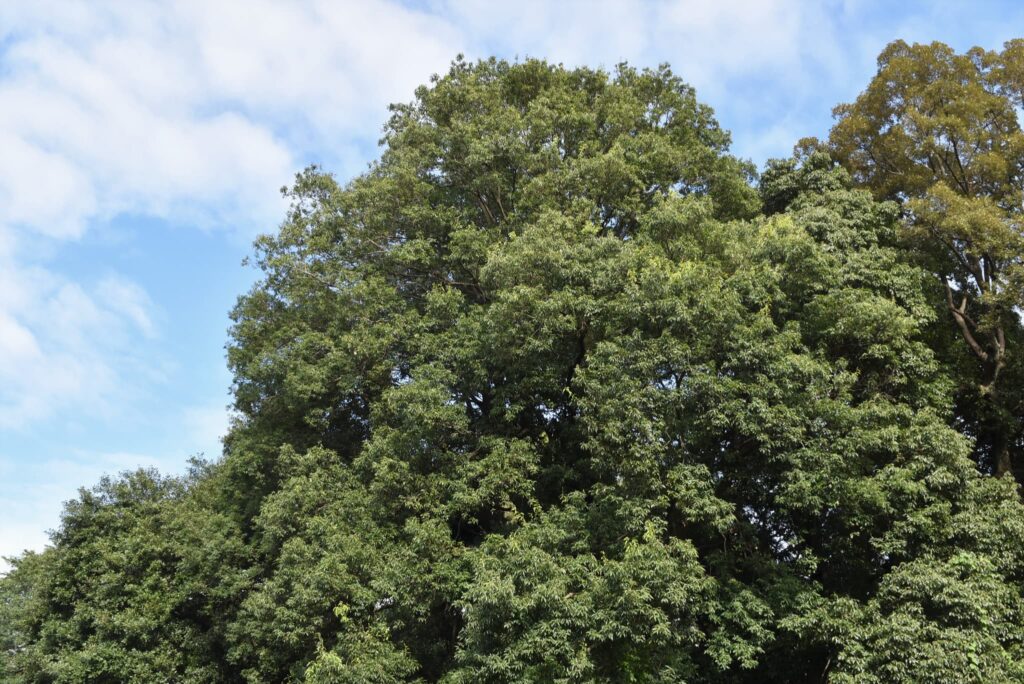
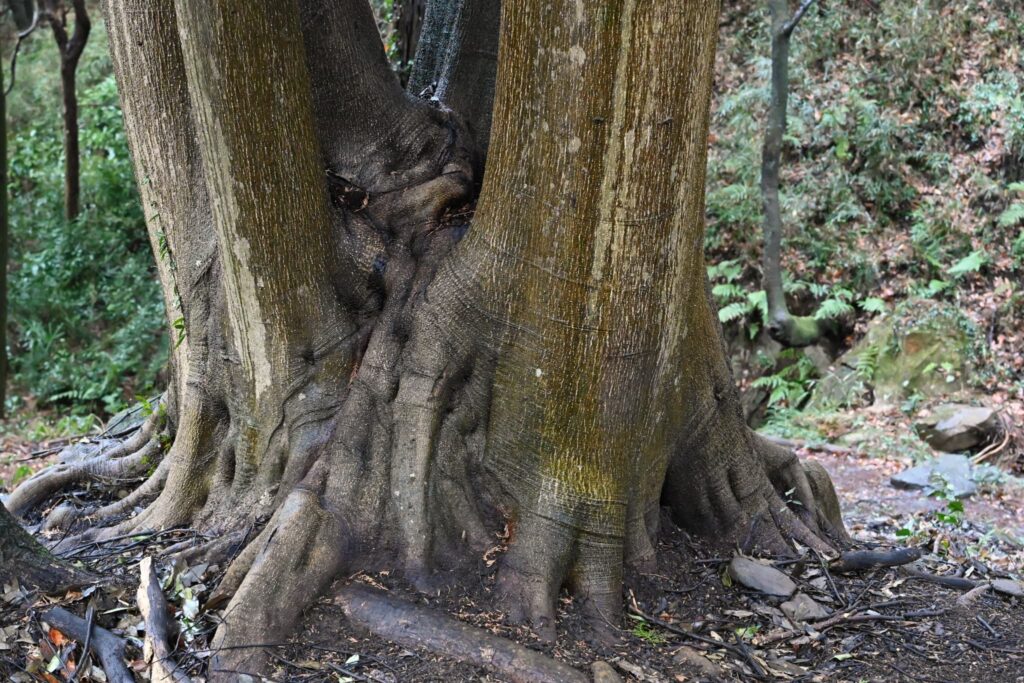
Japanese White Oak is a medium to large evergreen tree in the oak family, Fagaceae. In Japan, its natural range extends from Fukushima and Niigata Prefectures southward through Honshu, Shikoku, and Kyushu. It also occurs in Korea and China, with its wider native range extending into parts of mainland Southeast Asia.
In Japan, Japanese White Oak is particularly characteristic of warm-temperate lowland and foothill vegetation. It is also one of the most familiar evergreen oaks in the Kanto region, where it has traditionally been used for hedges, windbreaks, and garden planting.
The species is currently accepted as Quercus myrsinifolia Blume. Older literature may place it under the name Cyclobalanopsis myrsinifolia, reflecting an alternative treatment in which the ring-cupped evergreen oaks were separated into the genus Cyclobalanopsis.
Overview
| Item | Description |
|---|---|
| Scientific Name | Quercus myrsinifolia Blume |
| Common Names | Japanese White Oak; Bamboo-leaf Oak; Chinese Evergreen Oak |
| Japanese Name | Shirakashi (シラカシ); Kurogashi (クロガシ) |
| Family | Fagaceae |
| Genus | Quercus |
| Native Range | Japan, Korea, China, and parts of mainland Southeast Asia |
| Plant Type | Evergreen broadleaf tree |
| Height | Commonly 10–20 m; larger specimens can occur |
| Flowering Season | April–May |
| Fruit Type | Acorn, ripening in the same year |
| Hardiness | Approximately USDA Zone 7; hardiness varies with climate and provenance |
| Sun Exposure | Full sun to partial shade |
Characteristics
| Feature | Description |
|---|---|
| Growth Habit | Evergreen tree with a dense, rounded to broadly oval crown |
| Leaf Arrangement | Alternate |
| Leaf Shape | Narrow lanceolate to narrowly elliptical |
| Leaf Size | Approximately 5–15 cm long, usually 2–4 cm wide |
| Leaf Margin | Small, sharp teeth concentrated toward the upper part of the leaf |
| Leaf Color | Glossy dark green above; pale green to whitish-green beneath |
| New Growth | Often reddish-brown to deep maroon when emerging in spring |
| Acorn | Ovoid to narrowly ovoid; matures in the first year |
| Bark | Dark gray to blackish, relatively smooth when young and becoming rougher with age |
Foliage
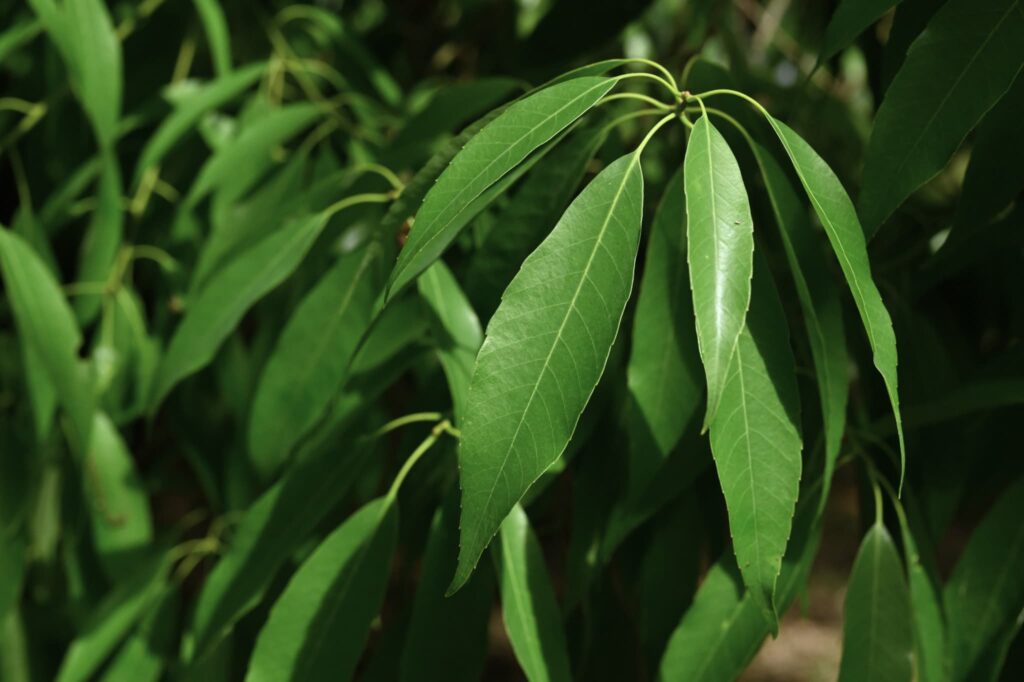
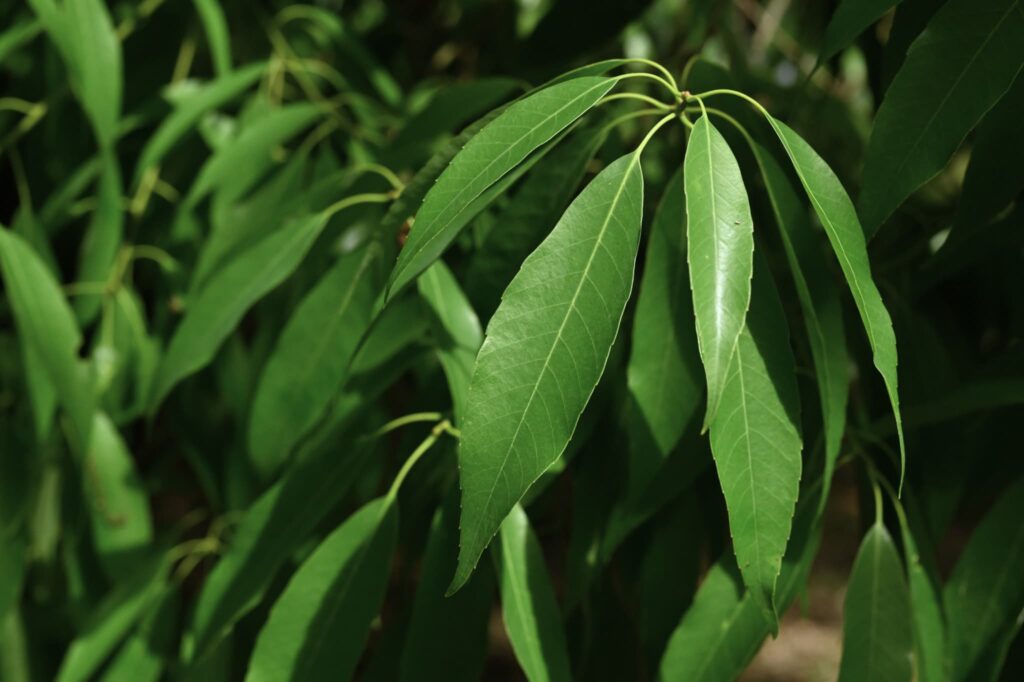
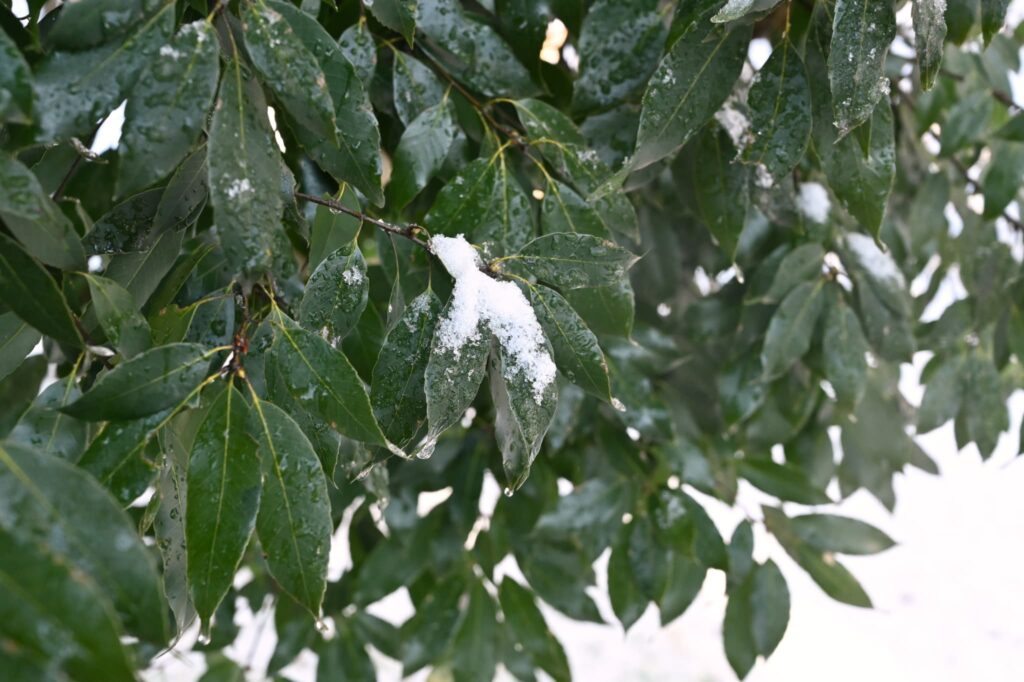
The leaves are alternately arranged and are typically narrow, lanceolate to narrowly elliptical, with a long pointed tip. Small teeth are concentrated toward the upper part of the leaf margin.
The upper surface is glossy dark green, while the underside is usually pale green or whitish-green rather than the striking powdery white seen on Ura-shiro Oak (Quercus salicina).
New growth in spring can be reddish-brown to deep maroon before gradually turning green. This flush of colored new foliage can be particularly attractive in cultivated trees.
Leaf shape varies somewhat between individual trees, but the combination of narrow leaves, a pointed tip, and relatively shallow serrations is characteristic.
Flowers
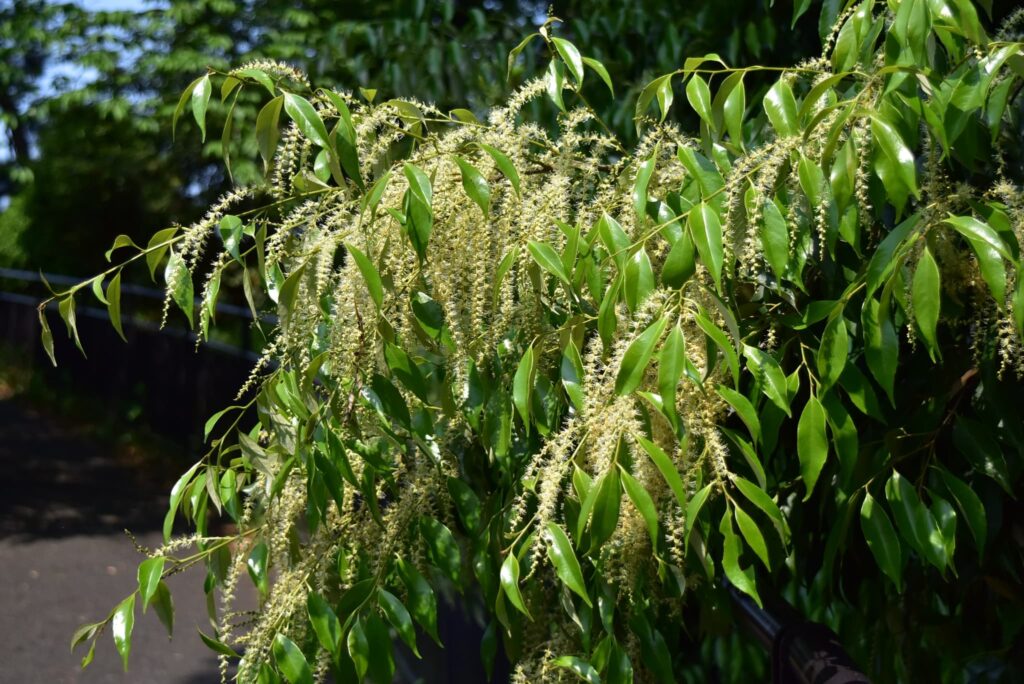
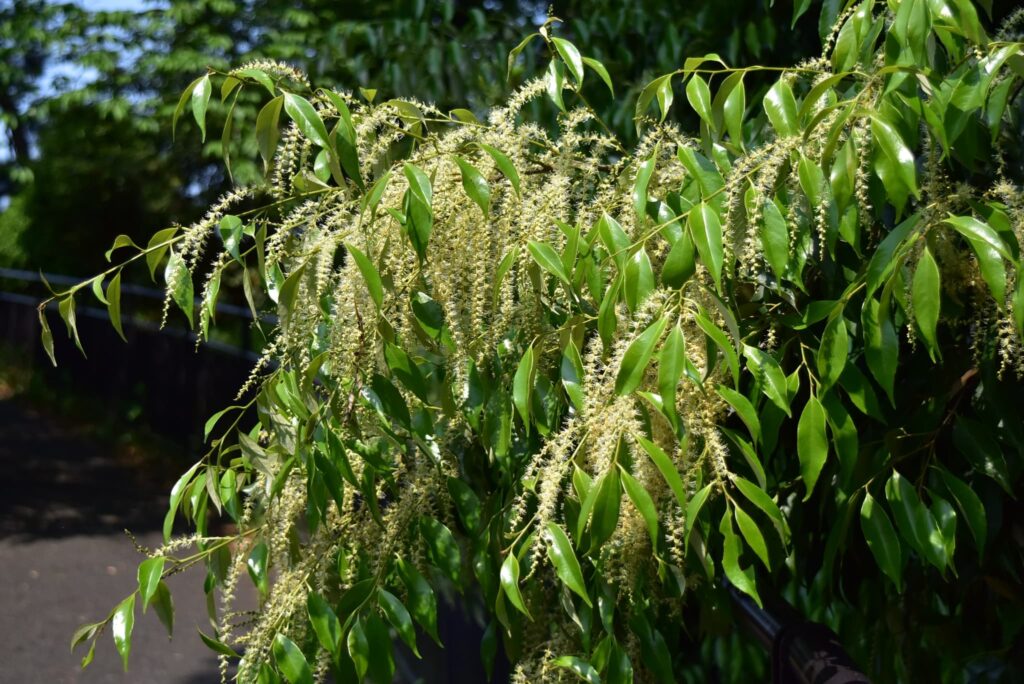
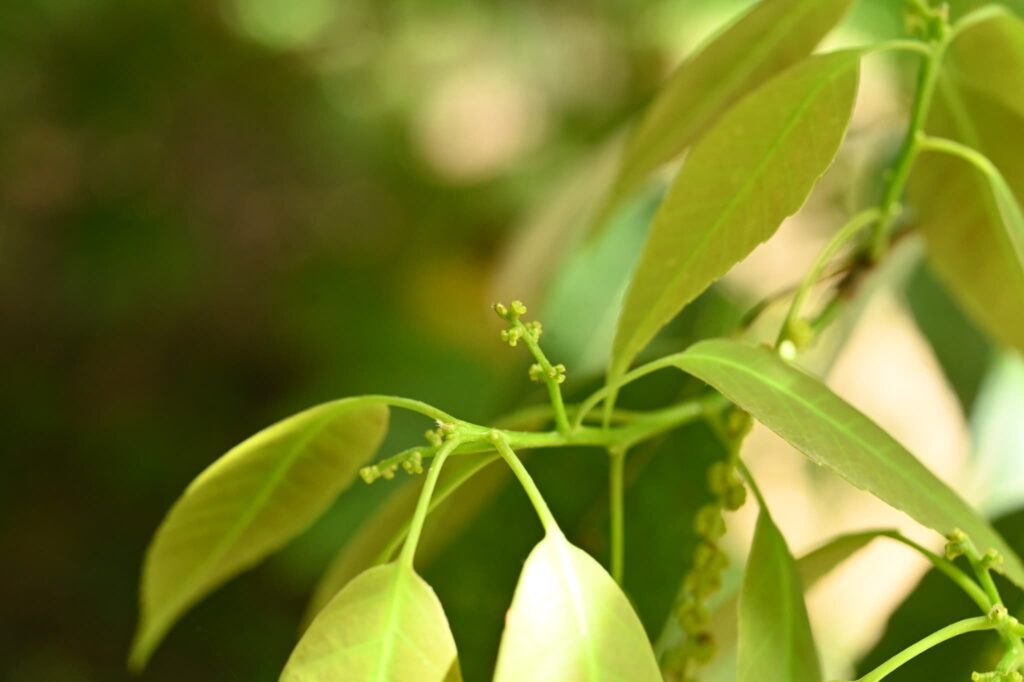
Japanese White Oak is monoecious, meaning that male and female flowers occur on the same tree.
Flowering generally takes place from April to May in Japan. Male flowers are produced in slender, pendulous catkins, while the much smaller female flowers occur on new growth and are easily overlooked.
Like other oaks, Japanese White Oak is wind-pollinated. Trees that are frequently clipped as hedges may produce few noticeable flowers because pruning removes much of the flowering growth.
Fruits
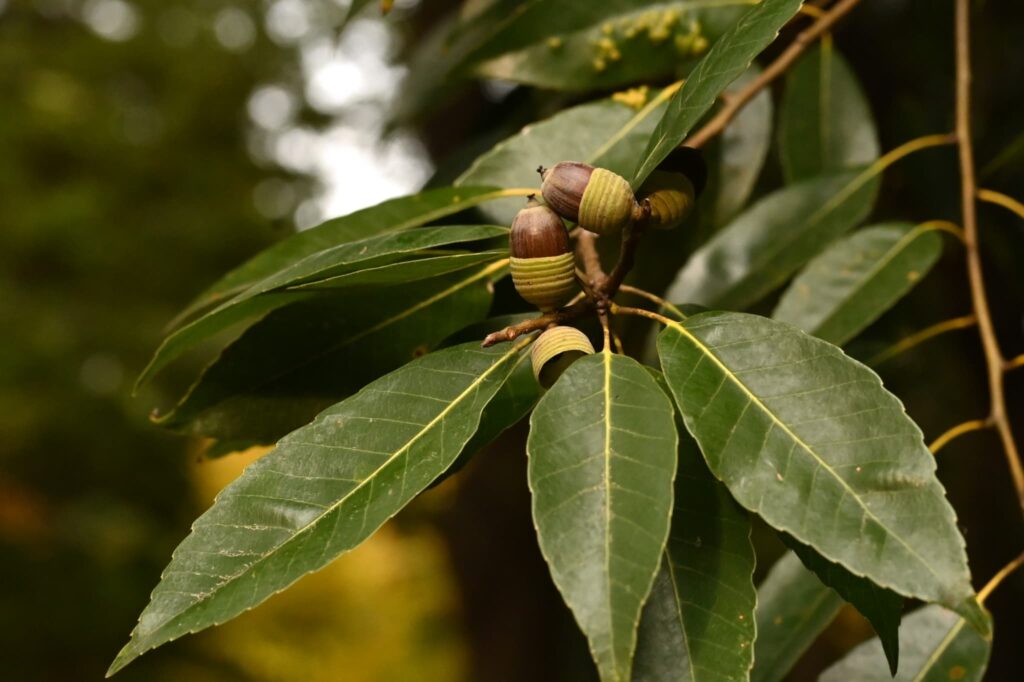
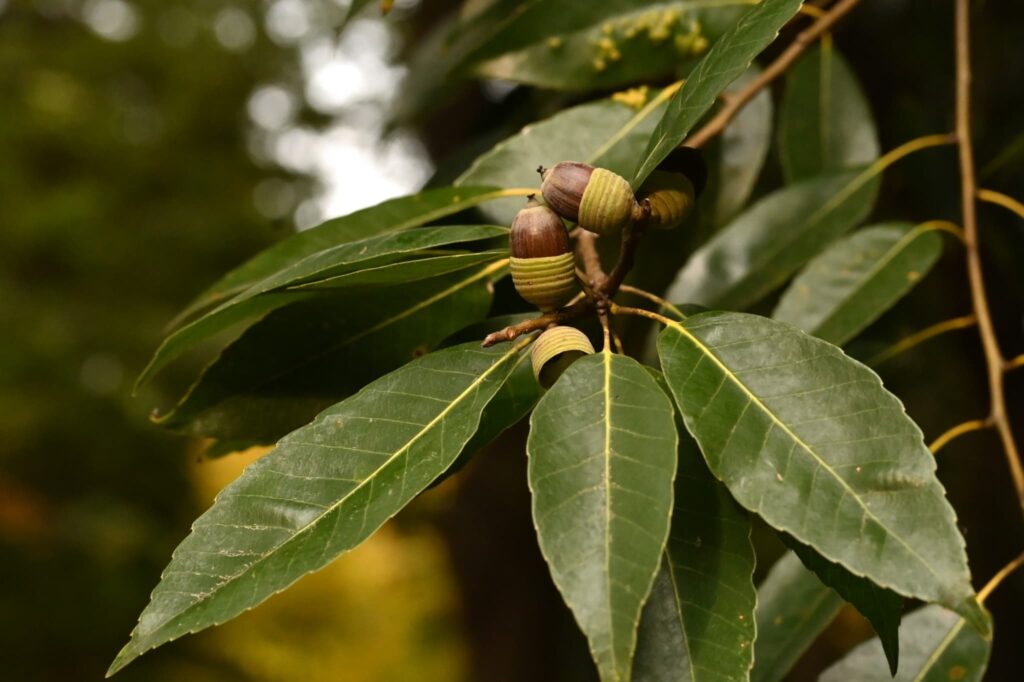
The fruit is an acorn that generally matures during the same year as flowering, usually in autumn.
Acorns are ovoid to narrowly ovoid and are relatively small compared with those of some other Japanese oaks. The cupule has concentric rings, a characteristic feature of the ring-cupped evergreen oaks traditionally placed in Cyclobalanopsis.
Japanese White Oak acorns contain substantial tannins and are strongly astringent when raw. Acorns were historically processed by leaching tannins before being eaten, but they are not considered a normal food today.
Acorns are also an important food resource for wildlife, including birds and mammals, and contribute to natural regeneration and seed dispersal.
Bark & Timber
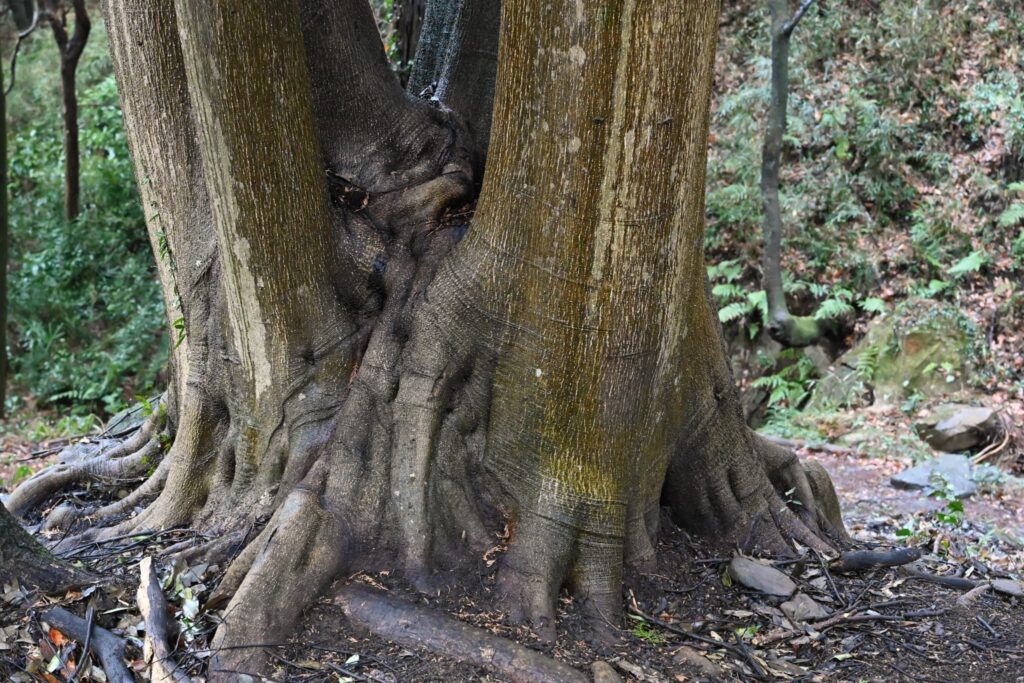
The bark of Japanese White Oak is dark gray to blackish, giving rise to the alternative Japanese name Kurogashi (“black oak”). Young bark is relatively smooth, while older trunks become rougher.
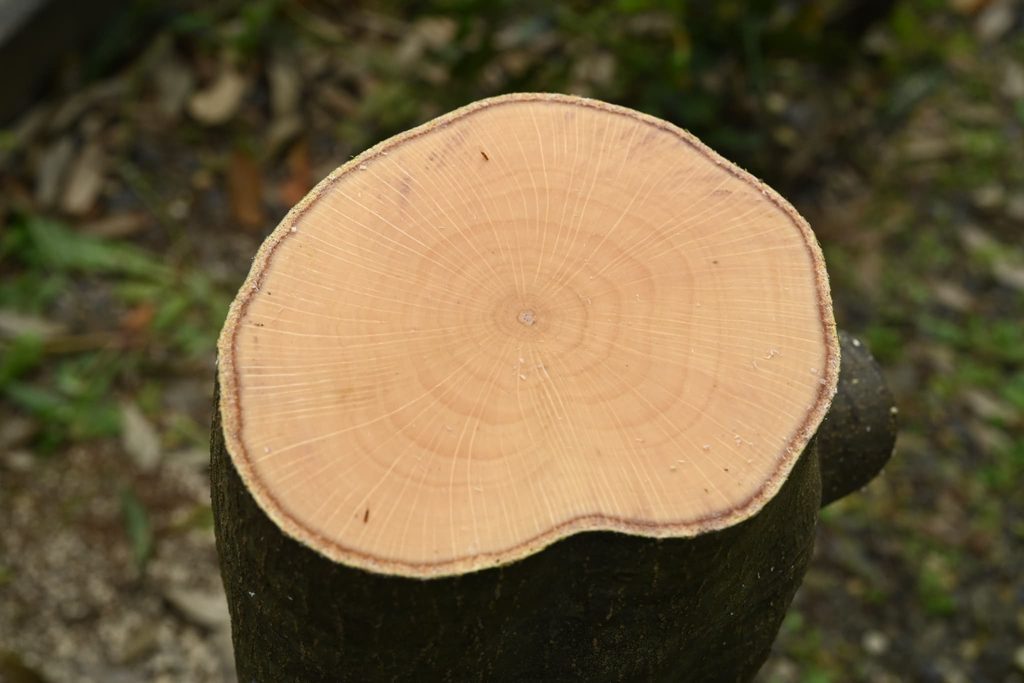
The timber is pale compared with the reddish wood of Japanese Red Oak (Quercus acuta), which is the principal reason for the name Shirakashi (“white oak”).
The wood is hard, heavy, strong, and elastic. Traditional uses include tool handles, agricultural implements, ship and boat components, oars, plane bodies, wooden swords, and other applications requiring durable, resilient wood.
The timber is not particularly easy to dry or work, and its natural durability is better described as moderate rather than exceptionally high.
Size & Growth
Japanese White Oak can become a substantial tree, commonly reaching around 20 m in height under favorable conditions. It generally develops a dense, rounded or broadly oval crown when allowed to grow naturally.
In cultivation, however, it is frequently maintained at much smaller dimensions through regular pruning. Its ability to tolerate clipping is one of the main reasons it has been widely planted as a hedge and garden tree in Japan.
Uses & Cultural Significance
The name Shirakashi is generally explained by the pale color of its timber, particularly in comparison with the more reddish timber of Akagashi (Japanese Red Oak, Quercus acuta). The alternative name Kurogashi refers to the dark bark.
Japanese White Oak has a long history of practical use in rural landscapes. It was commonly planted around farmhouses as a windbreak and boundary hedge, especially in regions such as the Kanto Plain.
Today it remains an important landscape tree. It is used for:
- Evergreen hedges
- Windbreaks and screens
- Park and street planting
- Shrine and temple landscapes
- Japanese-style gardens
- Niwaki and clipped specimens
- Urban greening
Its dense evergreen foliage provides year-round screening, while its tolerance of repeated pruning makes it particularly useful where a controlled form is required.
Growing Guide
| Factor | Notes |
|---|---|
| Light | Full sun is best for mature trees; young trees tolerate partial shade |
| Soil | Adaptable to a range of well-drained garden soils |
| Water | Water regularly while newly planted; established trees usually need little supplemental irrigation except during prolonged drought |
| Wind & Snow | Generally tolerant of wind and snow once established |
| Cold Hardiness | One of the more cold-hardy evergreen oaks native to Japan; suitability varies by site |
| Pruning | Highly tolerant of clipping, but severe crown reduction should be avoided where possible |
| Pests & Disease | Generally robust, although insects and fungal problems can occur under unfavorable conditions |
Light & Soil
Japanese White Oak grows well in full sun and can tolerate partial shade, particularly when young. Mature trees generally perform best with sufficient light.
It is adaptable to a range of soils, provided that drainage is reasonable. Avoid persistently waterlogged sites.
Watering
Newly planted trees should be watered regularly while they establish their root systems. Once established, Japanese White Oak is relatively resilient and normally relies on rainfall.
During prolonged periods of summer drought, especially in urban sites surrounded by pavement or compacted soil, supplemental watering can improve tree health.
Deep watering is preferable to frequent shallow watering.
Wind & Snow Tolerance
Japanese White Oak is well suited to exposed rural and urban landscapes and has traditionally been used as a windbreak tree.
Its evergreen foliage can, however, suffer winter damage in colder regions. Trees growing near the northern limit of their range are more likely to experience leaf browning or bleaching during severe cold or drying winter winds.
Cold Hardiness
Japanese White Oak is among the hardier evergreen oaks cultivated in Japan. Its natural range extends farther north than that of several other evergreen oaks, reaching into southern Tohoku.
The northern limit of its natural distribution has been reported around Rikuzentakata in Iwate Prefecture. This does not mean that every site farther north is unsuitable, because local climate, exposure, snow cover, and provenance all affect winter survival.
For garden planting, winter exposure is often more important than a simple prefectural boundary. In colder regions, a sheltered site protected from strong winter winds is preferable.
Pruning
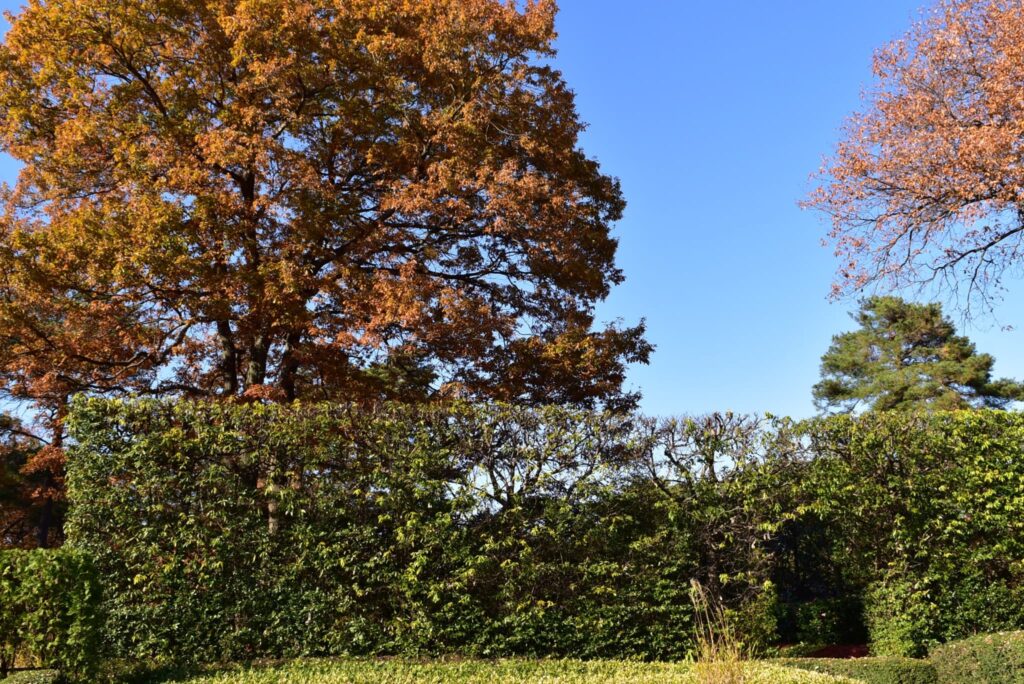
Japanese White Oak is highly tolerant of pruning and can be maintained as a hedge, screen, or formal garden tree.
However, tolerance of pruning does not mean that severe reduction is always the best practice. Research on Japanese White Oak has found that crown-reduction pruning can have a greater negative effect on tree vigor than pruning methods that retain the upper crown.
For established trees, it is therefore preferable to maintain a structurally sound crown rather than repeatedly cutting the entire crown back to a predetermined height.
For hedges and niwaki, regular light to moderate pruning is generally preferable to infrequent, severe cutting.
Heavy pruning also reduces flowering and acorn production because flowering shoots and developing reproductive structures are removed.
Suitability for Home Gardens
Japanese White Oak is an excellent choice for gardeners who need an evergreen tree that can be clipped and maintained at a controlled size.
It is particularly useful for:
- Tall evergreen hedges
- Privacy screens
- Boundary planting
- Windbreaks
- Japanese-style gardens
- Niwaki
The main consideration is its eventual size. Although it tolerates pruning extremely well, an unpruned tree can become large, so adequate space should be provided when planting a specimen tree.
Pests & Diseases
Japanese White Oak is generally a robust landscape tree, but it is not completely free of pests and diseases.
Insects such as caterpillars can occasionally cause significant defoliation, particularly when trees are stressed or heavily pruned. Fungal problems can also occur under humid or poorly ventilated conditions.
Good site selection, appropriate watering, and structurally sound pruning are preferable to relying on repeated corrective treatment.
Cultivars
Japanese White Oak is usually grown and sold as the straight species rather than as a large collection of named cultivars.
Its natural variation in leaf size and shape provides some visual diversity, and individual trees can differ noticeably in their growth habit and foliage.
Older botanical and horticultural literature may also use the name Cyclobalanopsis myrsinifolia. This is a taxonomic synonym rather than a separate species; modern treatments such as Plants of the World Online accept Quercus myrsinifolia.
Similar Species
Japanese White Oak can be confused with several other evergreen oaks, especially where their ranges overlap.
- Japanese Blue Oak (Quercus glauca, Arakashi)
- Japanese Red Oak (Quercus acuta, Akagashi)
- Ubame Oak (Quercus phillyraeoides, Ubamegashi)
- Ura-shiro Oak (Quercus salicina, Urajiro-gashi)
- Tsukunanegashi (Quercus sessilifolia)
- Ichii Oak (Quercus gilva, Ichiigashi)
How to Tell Japanese White Oak from Japanese Blue Oak (Arakashi)
| Feature | Japanese White Oak (Q. myrsinifolia) | Japanese Blue Oak (Q. glauca) |
|---|---|---|
| Leaf shape | Narrow and elongated | Generally broader |
| Leaf tip | Long and sharply pointed | Pointed but usually less slender overall |
| Leaf texture | Relatively thin to moderately leathery | Often thicker and more substantial |
| Leaf underside | Pale green to whitish-green, generally without a dense white coating | Often more distinctly grayish beneath |
| Serration | Small teeth concentrated toward the upper part | Usually more conspicuous toward the upper part |
| Overall appearance | Slender, bamboo-like leaves | Broader, darker-looking foliage |
| Distribution in Japan | Particularly characteristic of eastern Japan | More widespread through western and central Japan |
When identification is uncertain, the underside of the leaf is particularly useful. Japanese White Oak generally lacks the conspicuous powdery-white underside characteristic of Ura-shiro Oak.
Frequently Asked Questions
What is the difference between Japanese White Oak and Japanese Blue Oak (Arakashi)?
Japanese White Oak (Quercus myrsinifolia) generally has narrower, more elongated leaves with a long pointed tip. Japanese Blue Oak (Quercus glauca) tends to have broader, thicker-looking foliage.
The two species can overlap in cultivation, so a combination of leaf shape, underside characteristics, young twigs, acorns, and overall habit is more reliable than a single feature.
Can you eat Japanese White Oak acorns?
Japanese White Oak acorns are technically edible after appropriate processing, but they are strongly astringent when raw because of their tannins.
Traditional acorn foods required processing, particularly leaching, to reduce the tannins. They are not normally consumed as a food today.
Is Japanese White Oak suitable for hedging?
Yes. Japanese White Oak is one of the most useful evergreen oaks for hedges and screens in Japan.
It tolerates regular clipping, produces dense evergreen foliage, and can be maintained at a controlled height. However, severe crown reduction should not be repeated unnecessarily.
How large does Japanese White Oak get?
Japanese White Oak can reach approximately 20 m in height under favorable conditions, although cultivated trees are often kept much smaller through pruning.
When planted as a specimen tree, its eventual size should be considered before planting.
Is Japanese White Oak cold hardy?
It is relatively cold-hardy for an evergreen oak and naturally extends into southern Tohoku. The species has been recorded as far north as Rikuzentakata in Iwate Prefecture.
Nevertheless, cold tolerance varies with site and provenance. Winter wind and exposure can cause foliage damage even where the tree itself survives.
Why is Japanese White Oak called “white” oak if its bark is dark?
The name Shirakashi refers primarily to the pale color of its timber. The dark bark explains the alternative Japanese name Kurogashi (“black oak”).
The contrast with Japanese Red Oak (Quercus acuta), whose timber is more reddish, is particularly relevant to the traditional naming.
Is Japanese White Oak suitable for niwaki?
Yes. Its ability to tolerate repeated clipping makes it well suited to niwaki and other formal Japanese garden styles.
For long-term tree health, however, maintaining a structurally sound crown is preferable to repeatedly reducing the entire tree to a fixed height.
Does Japanese White Oak have autumn color?
No. Japanese White Oak is evergreen, so it does not produce the dramatic autumn color associated with deciduous Japanese oaks and maples.
Its seasonal interest comes instead from the emergence of reddish new foliage in spring, followed by mature glossy green leaves throughout the year.
Conclusion
Japanese White Oak (Quercus myrsinifolia) is one of Japan’s most useful evergreen landscape trees. Its narrow leaves, dark bark, pale timber, acorns, and dense evergreen crown give it a distinctive combination of ornamental and practical qualities.
Its natural range extends from central and southern Japan into Korea, China, and parts of mainland Southeast Asia, while in Japan it is particularly familiar in the Kanto region and other warm-temperate areas.
For gardeners, its greatest strengths are its evergreen foliage, relatively strong cold tolerance, adaptability, and excellent response to regular pruning. These qualities explain its long use as a hedge, windbreak, screening plant, and niwaki tree.
It is not a small tree, however, and its tolerance of pruning should not be confused with immunity from poor pruning practices. Allowing the tree to retain a sound crown and using regular, moderate pruning is a better long-term strategy than repeatedly reducing the entire canopy.
For anyone looking for a durable evergreen tree with a strong connection to traditional Japanese landscapes, Quercus myrsinifolia remains an excellent choice.