Mochi Tree (Ilex integra): Identification, Care & Uses
Mochi Tree is an essential evergreen tree in traditional Japanese gardens, prized less for showy display than for its dense, hard foliage and steady, low-maintenance presence year-round. This guide covers identification features, flowers, fruit, bark, cultivars, and care, based on observations of the tree as grown in Japan.
What Is Mochi Tree?
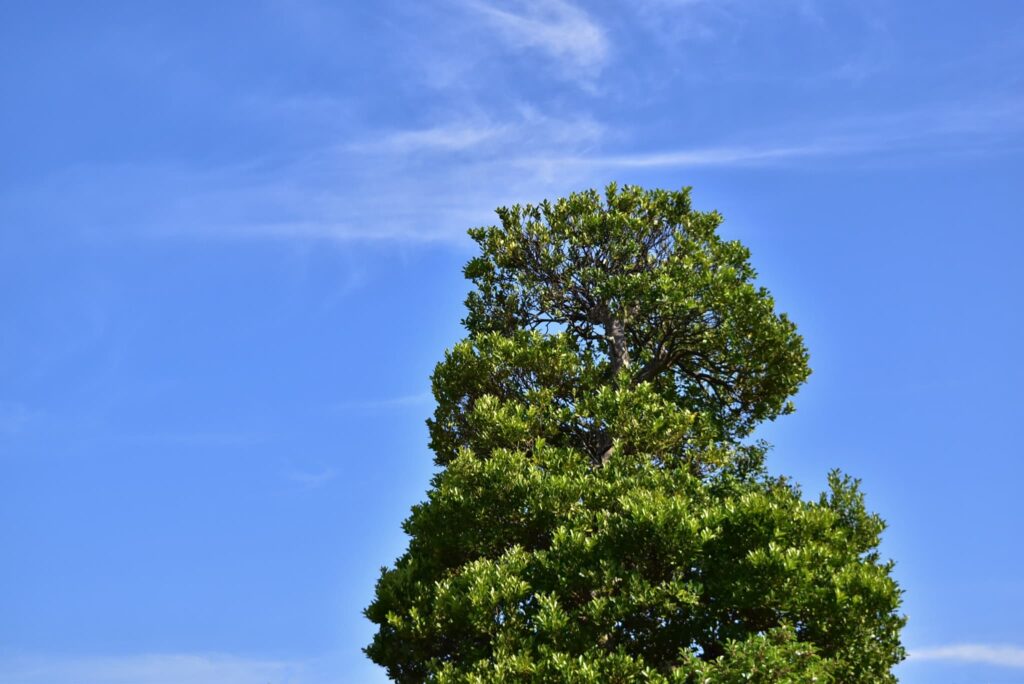
Mochi Tree is an evergreen tree in the family Aquifoliaceae, growing wild in mountain and coastal woodlands from southern Tohoku (Fukushima Prefecture) westward across Honshu, Shikoku, Kyushu, and Okinawa. Though it isn’t especially well known today, in an era when flashier garden plants have become more common, it remains an indispensable tree in traditional Japanese gardens. Outside Japan, it is also found in southern Korea and in warmer parts of China.
Role in Japanese Gardens
Aside from the red fruit that appears on female trees, Mochi Tree changes very little in appearance throughout the year, which makes it a popular choice for building the quiet backdrop of a garden composition. Specimens with a thick, dignified trunk are sometimes used as a garden’s central feature tree instead. Alongside Mokkoku (Ternstroemia gymnanthera) and Kinmokusei/Ginmokusei (Osmanthus), it is traditionally considered one of the “three great trees of Japanese gardening.”
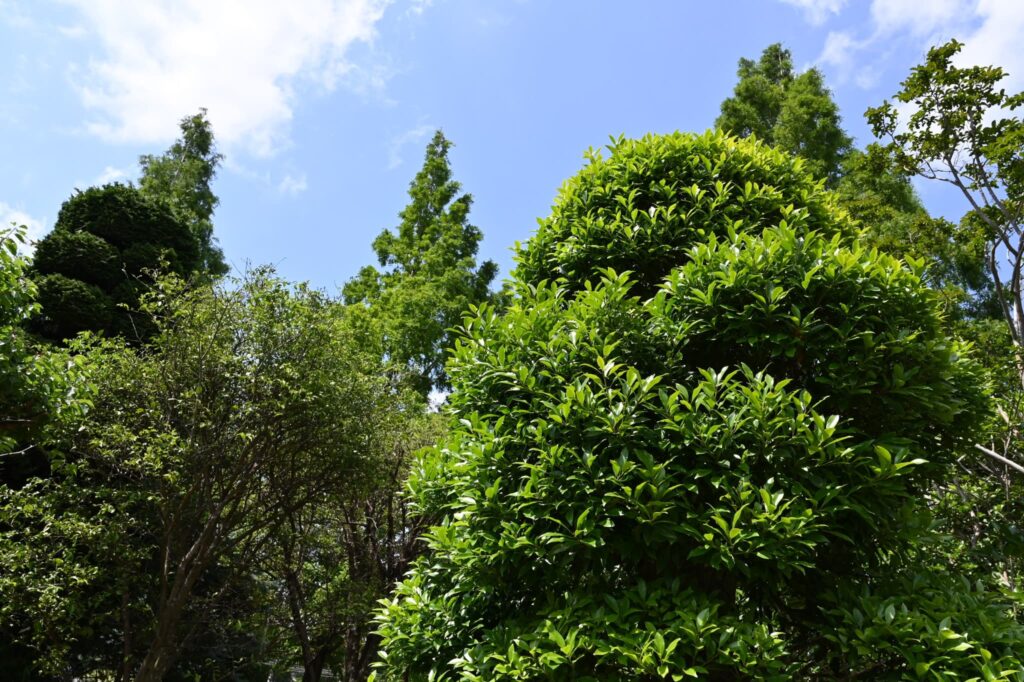
Like Shirakashi and Sudajii, Mochi Tree is also sometimes grown as a tall hedge; its stiff, hard leaves make for a particularly neat, orderly hedge form. Thanks to its tolerance for salt-laden coastal wind, it is used for windbreaks and storm protection along the coast, and its moisture-retentive leaves have also seen it used as a firebreak planting. It tolerates air pollution well, too.
Overview
| Item | Description |
|---|---|
| Family | Aquifoliaceae |
| Genus | Ilex |
| Species | I. integra |
| Scientific Name | Ilex integra |
| Common Name | Mochi Tree / Mochi Holly |
| Japanese Name | Mochinoki (モチノキ) |
| Native Range | Japan (southern Tohoku westward); also southern Korea and warm regions of China |
| USDA Hardiness | 7–9 |
| Plant Type | Evergreen Tree |
| Height | 10–20 m (occasionally over 20 m) |
| Trunk | Over 1 m in diameter |
| Flowering Season | April |
| Fruit Type | Vermilion drupe, about 1 cm, ripening November–December (female trees only) |
| Garden Use | Background/specimen tree, tall hedge, windbreak, firebreak |
Characteristics
| Feature | Description |
|---|---|
| Leaves | Alternate, leathery, glossy, smooth-edged on mature trees |
| Fruit | Vermilion, about 1 cm, four seeds (female trees only) |
| Bark | Grayish brown, smooth, finely streaked with age |
| Habit | Slow-growing; naturally oval form, often clipped into a sphere |
Foliage
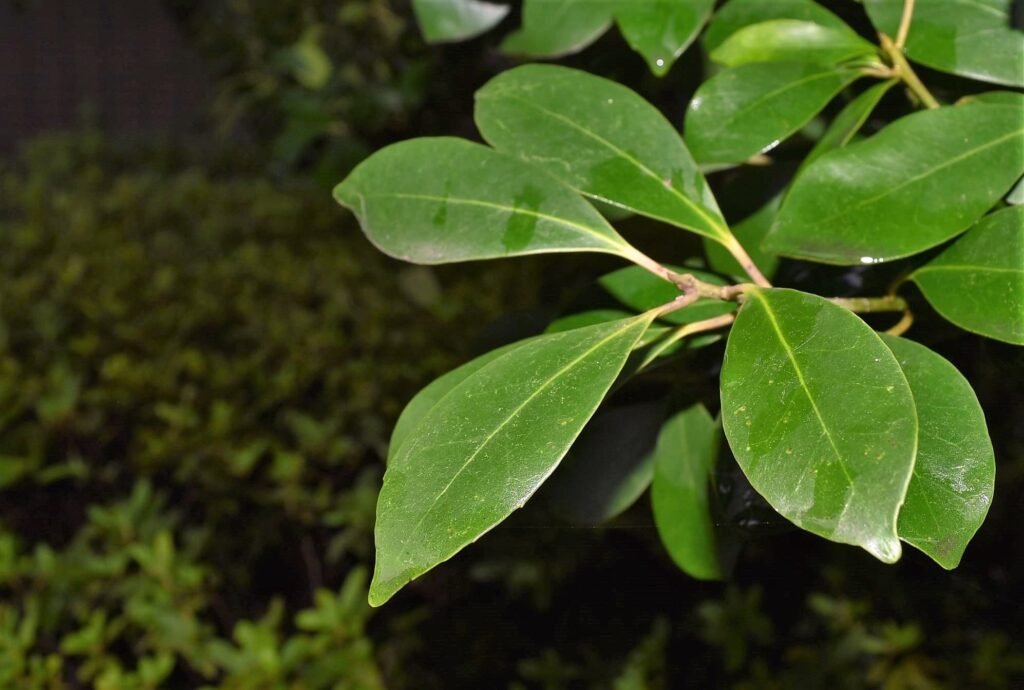
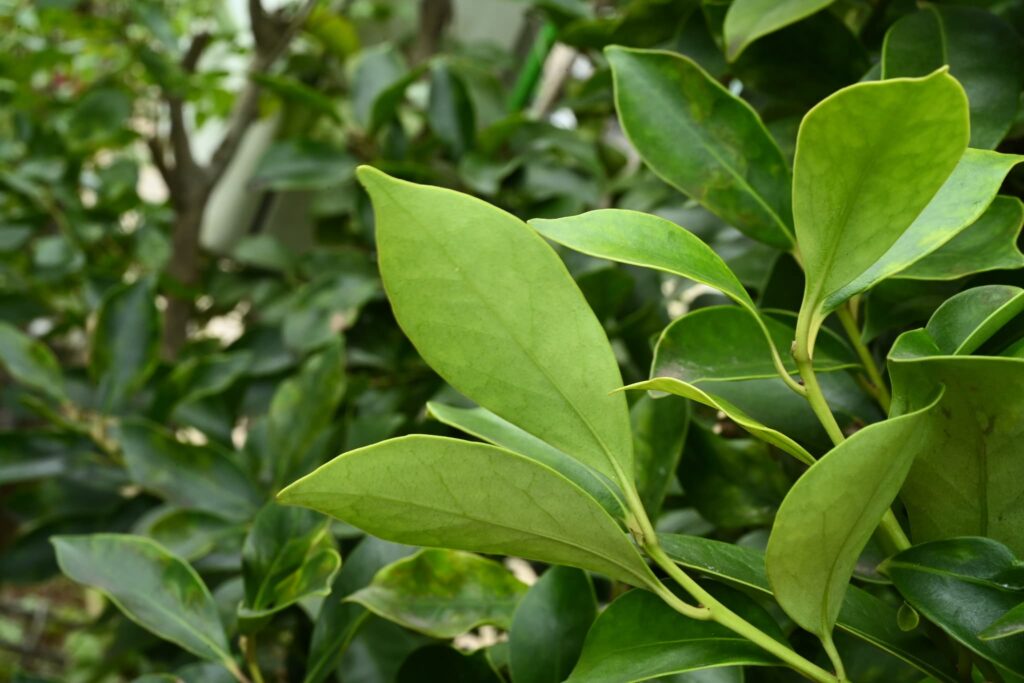
Mochi Tree leaves are oval with pointed ends, 4–8 cm long and 2–3 cm wide, arranged alternately along the branch. They are leathery, glossy on top, and a pale green underneath. Young trees typically show some faint teeth along the leaf margin, but on mature trees the margin is entirely smooth.
Flowers
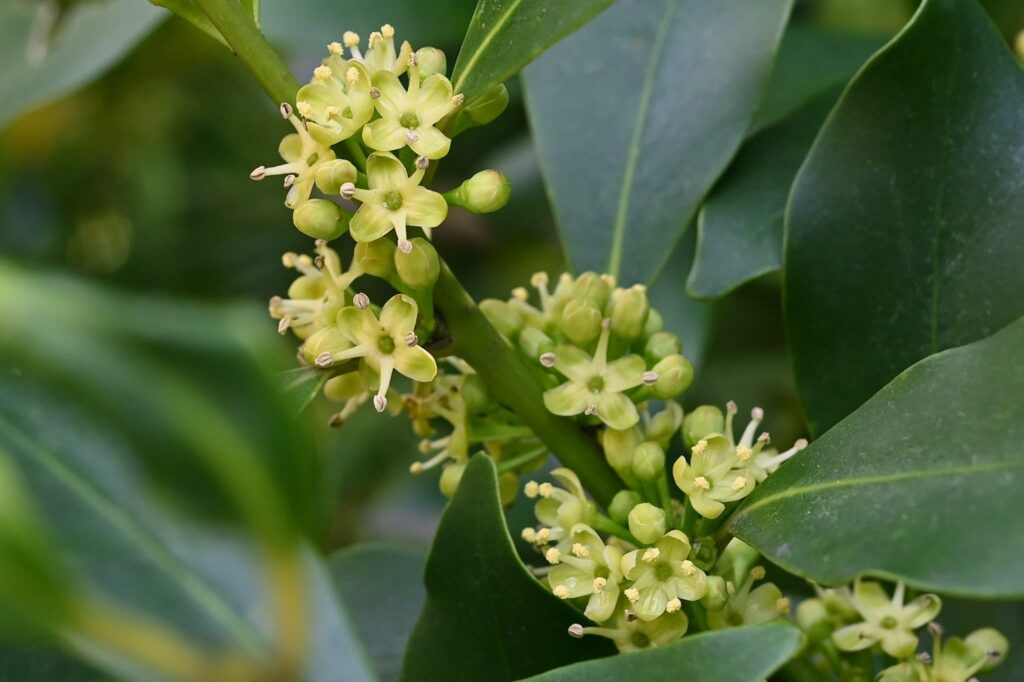
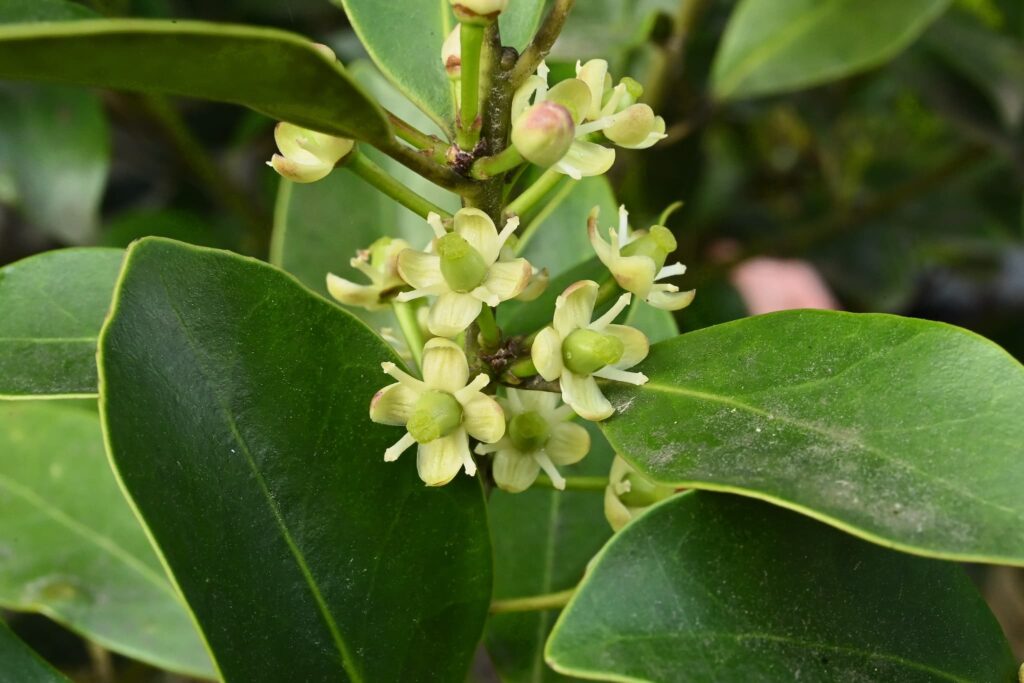
Mochi Tree is dioecious. In April, female trees produce flowers with a single pistil and four reduced, non-functional stamens; these female flowers usually appear sparsely, only one to four at a time, and are easy to overlook.
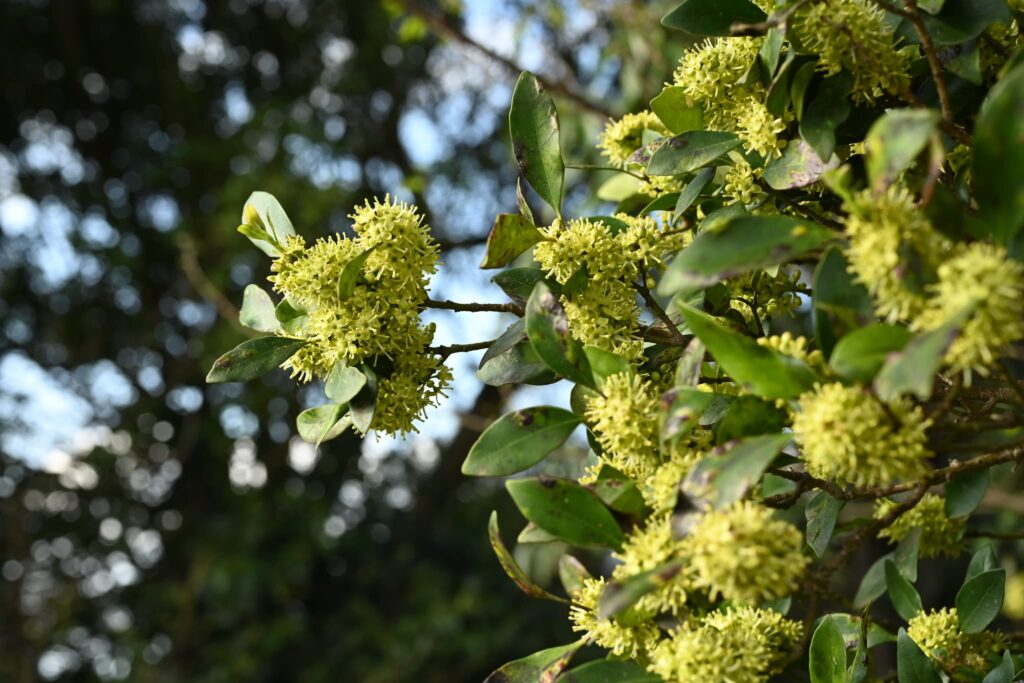
Male trees, by contrast, produce flowers with four functional stamens, gathered in dense clusters of two to fifteen blooms at the base of the leaves—much like the related Tarayo (Ilex latifolia)—which makes them considerably easier to spot.
Fruit
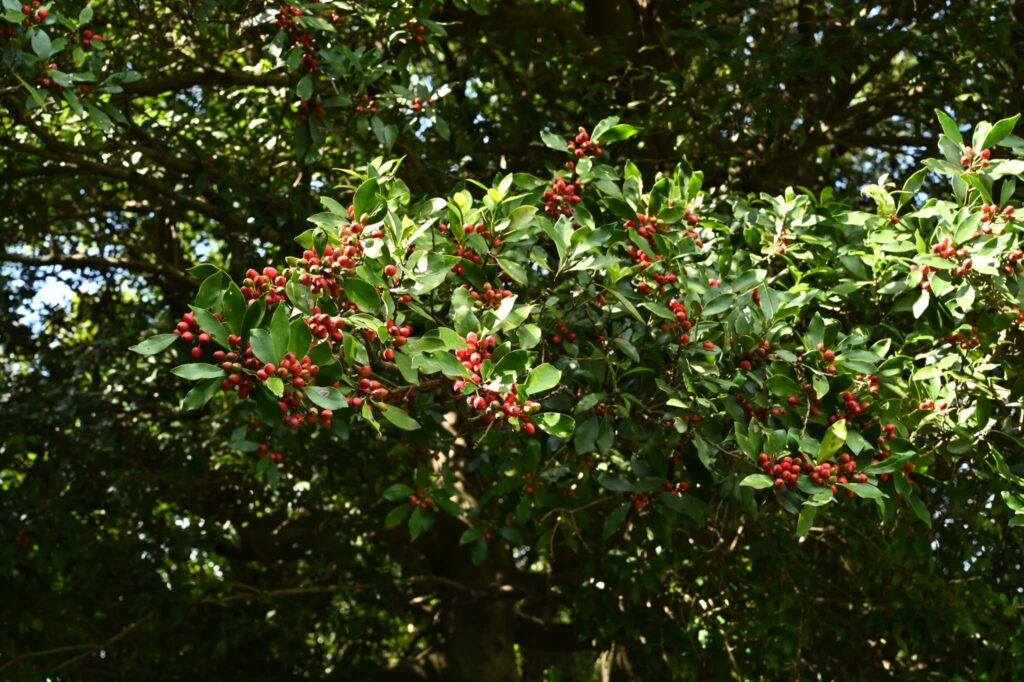
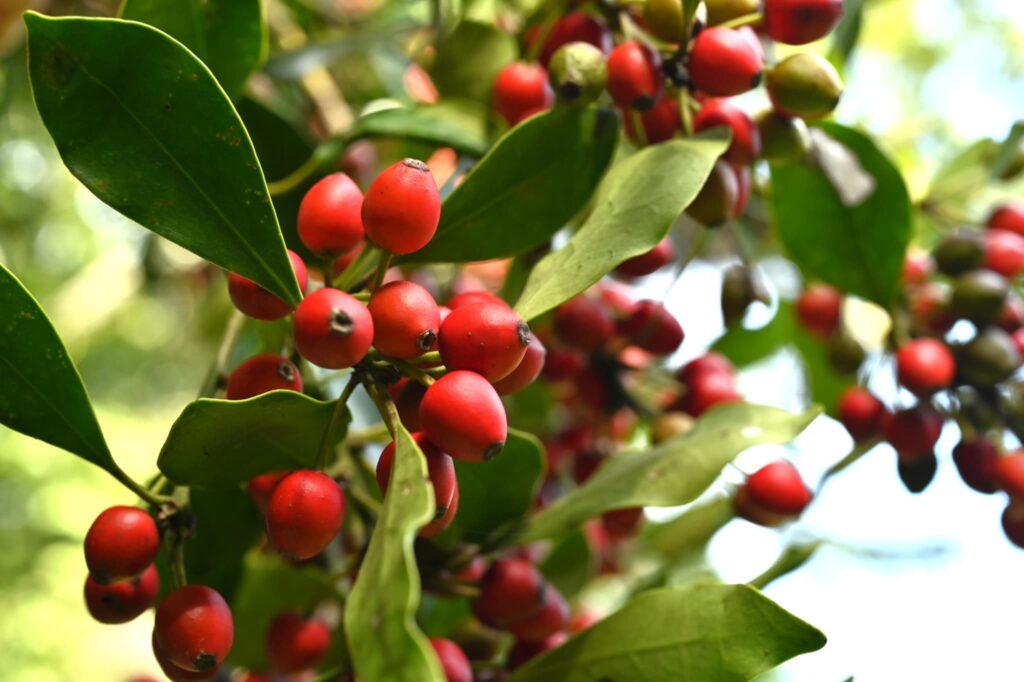
Female trees produce vermilion fruit about 1 cm across in autumn (around November–December). Although the fruit is eaten by several bird species, some often remains on the branches well into the new year, suggesting it is not among their preferred foods. Even so, it provides a valuable winter food source when other fruits have already disappeared.
Trunk & Bark
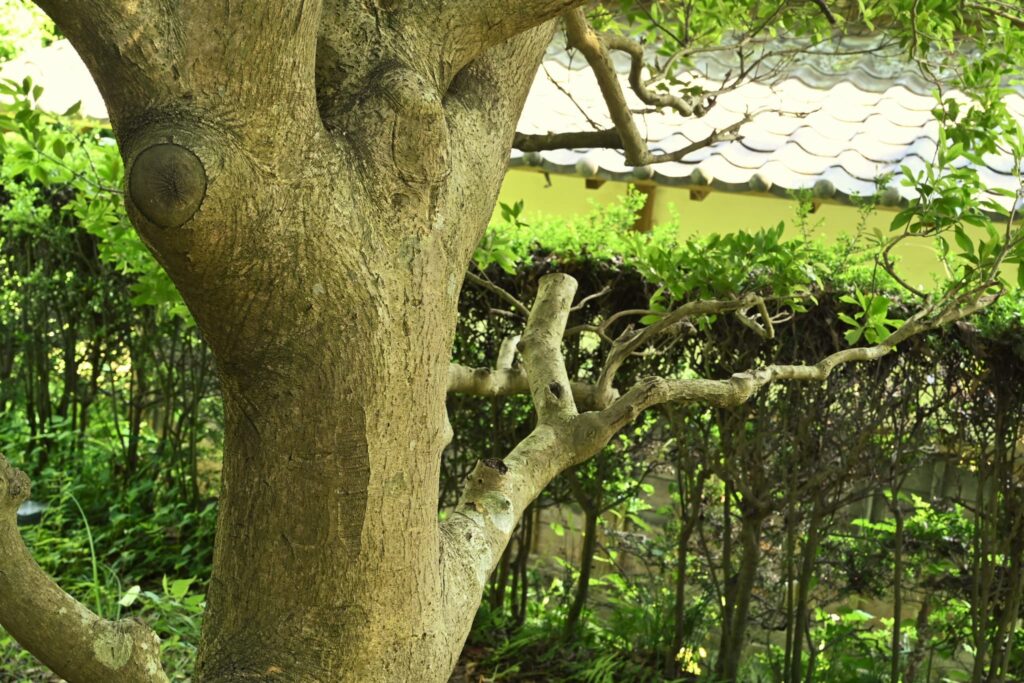
Left entirely unpruned, Mochi Tree can reach over 20 m in height with a trunk exceeding 1 m in diameter, though in gardens it is nearly always kept much smaller through regular maintenance. The bark is grayish brown, smooth when young, developing fine streak-like markings as the tree ages.
Mochi Tree wood is hard and fine-grained, and its whiteness has made it popular for carving, abacus beads (those from Banshu are especially well known), Buddhist prayer beads, and as a substitute for boxwood in combs and seals. Beyond birdlime, the bark is also used medicinally and as a source of dye.
Naming: Mochinoki and Torimochi
The name Mochinoki comes from torimochi (birdlime), a sticky adhesive traditionally extracted from the tree’s bark. Because the related tree Yamaguruma produces an even higher-quality birdlime, the two are sometimes referred to together under the combined name Torimochi-no-ki.
Although now prohibited by law, children in earlier generations would apply birdlime to the tip of a bamboo pole to catch wild birds and insects. Traditional birdlime was made by soaking bark stripped in summer in water for two to three months until it began to decompose, then crushing it in a mortar.
Ecology
Because its fruit often remains on the tree well into winter, Mochi Tree provides seasonal food for birds after many other fruiting trees have already been stripped. Birds help disperse the seeds, allowing the tree to regenerate naturally in suitable woodland habitats.
Growing Guide
| Item | Description |
|---|---|
| Growth Rate | Slow |
| Longevity | 100–300 years |
| Salt Tolerance | Excellent |
| Drought Tolerance | Moderate |
| Urban Tolerance | High |
Climate
Mochi Tree favors warm regions and is best planted from southern Tohoku southward. With the right site selection it can be grown in central Tohoku as well, though the leaves tend to yellow unattractively in winter that far north.
Sun & Soil
The tree prefers sun but tolerates partial shade well enough to be planted on the north side of a house. Leaf color tends to be better in a humid site than in a dry one; somewhat clay-rich soil with good moisture and nutrient retention is ideal.
Growth & Pests
Slow growth and a naturally tidy form are among Mochi Tree’s advantages, but dense branching can encourage scale insects, which in turn often lead to sooty mold. Leafroller caterpillars, horned wax scale, and cochineal wax scale are also occasionally seen.
Pruning
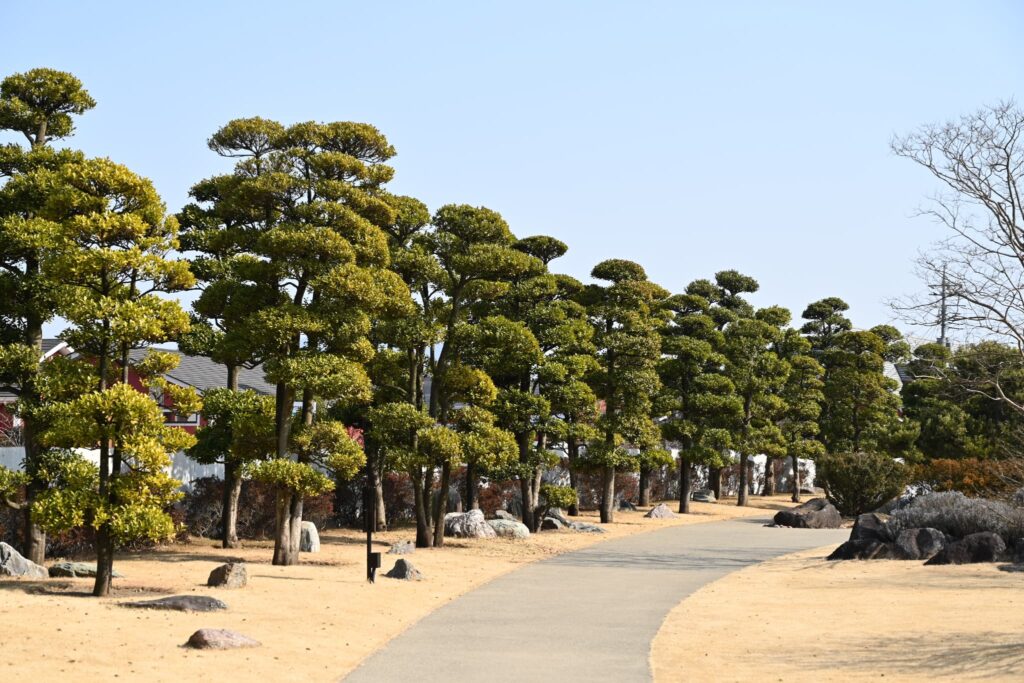
The tree’s natural form is roughly oval, but in garden use it is most often sheared into a spherical shape. It recovers well after shearing, but compared with fine-leaved plants like Japanese Holly, its larger leaves can look untidy for a while right after cutting.
The best times to prune are June–July and November–December; pruning twice a year, once in each window, gives the best results. Hard shearing should be reserved for trees that have grown reasonably large; younger specimens should have unwanted branches removed at their base rather than being sheared all over. Periodic thinning to open up the canopy is also worthwhile to help prevent the pest problems described above. Because flowers form at the base of the previous year’s branches, frequent shearing will significantly reduce flowering and fruiting.
Cultivars
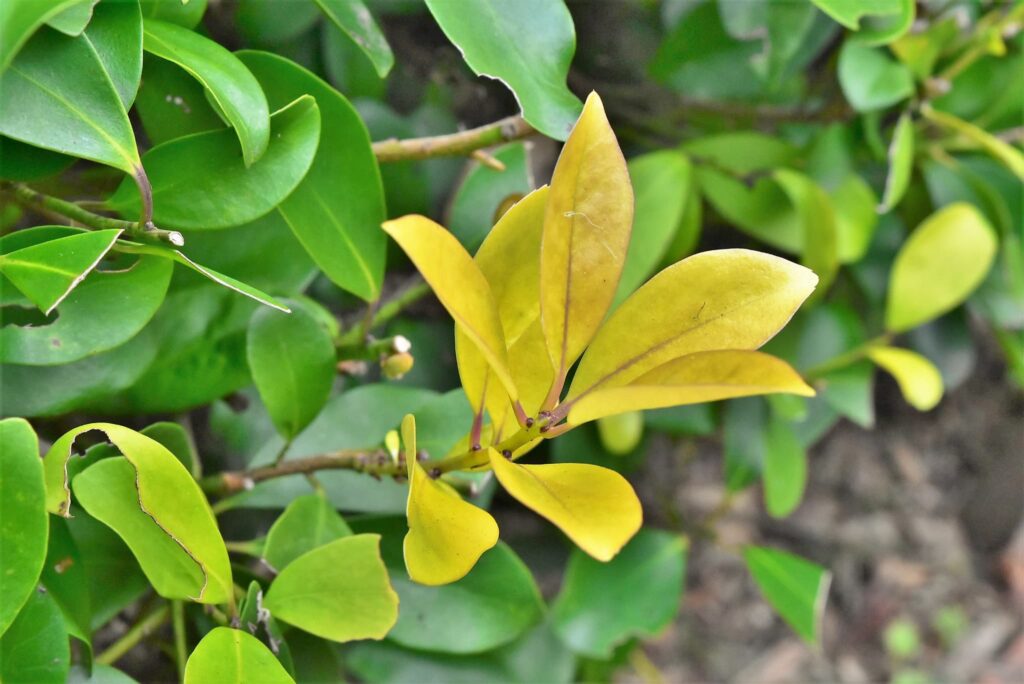
- Ougon Mochinoki (“golden-leaved Mochi Tree”) — a cultivar with yellow foliage.
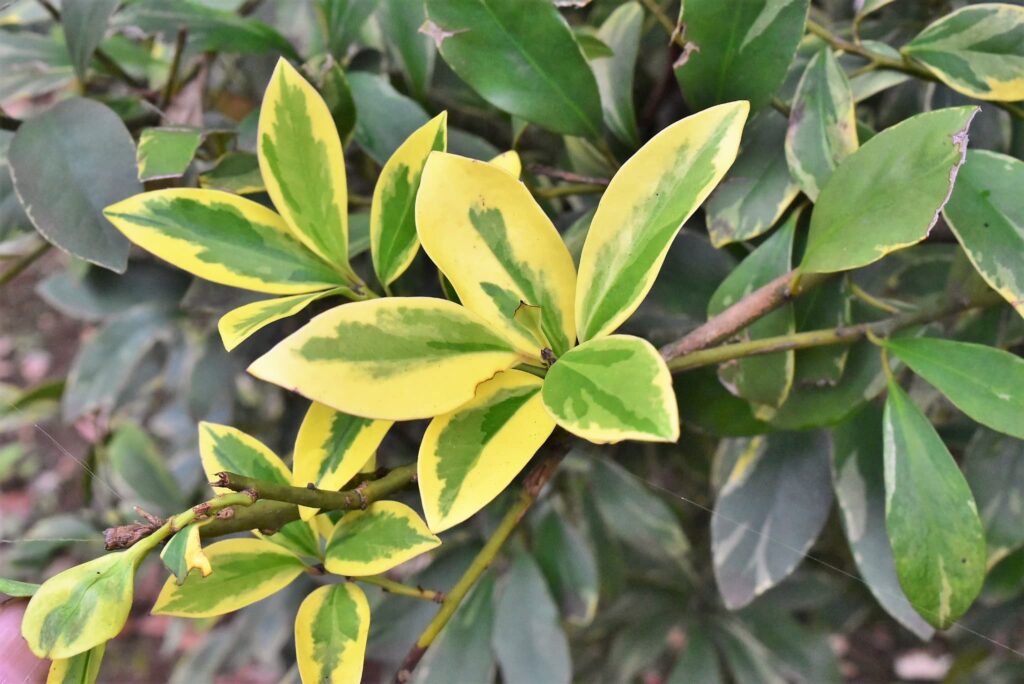
- ‘Shirofukurin’ and ‘Fuiri Mochi’ — cultivars with patterned, variegated leaves.
- Kiminomochi (“yellow-fruited Mochi Tree”) — a cultivar bearing yellow rather than vermilion fruit.
Among wild forms: Shiimochi, found in parts of western Japan; Himemochi, found only in mountains along the Sea of Japan coast; Shimamochi, native to the Ogasawara Islands; and its variety, Muninmochi. Himemochi is a snow-adapted variant, with narrower leaves that shed snow more easily and a habit of growing its trunk and branches more horizontally to avoid being toppled by heavy snowfall.
Similar Plants
・Japanese Holly (Ilex crenata)
・Tarayo (Ilex latifolia)
・Kuroganemochi (Ilex rotunda)
Trees Sharing the Name “Mochi”
A number of trees carry “mochi” in their Japanese name, some genuinely related to Mochi Tree and some not.
- Kuroganemochi (Ilex rotunda) — Mochi Tree’s leaf base and stalk are yellow-green, while Kuroganemochi’s are tinged purple; Kuroganemochi’s leaf color is also somewhat brighter overall. It was once used for birdlime just like Mochi Tree, but today is more commonly planted in parks and along streets.
- Hiiragimochi (Ilex cornuta, also called Shina Hiiragi) — in the same family as Mochi Tree, but with spiny, holly-like leaves that resemble False Holly (Hiiragi) far more than they resemble Mochi Tree’s smooth foliage.
- Kanamemochi (Photinia glabra) — distinguished by toothed leaf margins and red new growth. It belongs to the rose family, closely related to the popular ‘Red Robin’, and has no direct botanical relationship to Mochi Tree.
- Nezumimochi (Ligustrum japonicum) and Tounezumimochi (Ligustrum lucidum) — both evergreen trees in the olive family, with leaves as glossy as camellia’s and thin enough that the veins show through when held to the light. Their fruit ripens black, resembling mouse droppings—the source of their Japanese name.
Frequently Asked Questions
Q: Why is Mochi Tree considered one of the “three great trees” of traditional Japanese gardening?
Alongside Mokkoku and Kinmokusei/Ginmokusei, Mochi Tree has long been valued for qualities that suit the restrained aesthetic of traditional Japanese garden design: dense, glossy, year-round foliage, a naturally dignified form, and a quiet, understated presence rather than showy seasonal display. This combination of reliability and subtlety has kept it a garden staple for generations, even as it’s remained less well known to the general public.
Q: Why doesn’t my Mochi Tree ever produce fruit?
Mochi Tree is dioecious, meaning individual trees are either male or female, and only female trees bear fruit. If your tree is male, it will flower each spring but will never set fruit—plant a female specimen if you want to enjoy the vermilion berries.
Q: What was Mochi Tree traditionally used for?
Historically, its bark was processed into birdlime (torimochi), a sticky adhesive once used to catch small birds and insects—a practice reflected directly in the tree’s Japanese name and now prohibited by law. Its hard, fine-grained white wood has also long been used for carving, abacus beads, prayer beads, and as a substitute for boxwood.
Q: How can I tell Mochi Tree apart from Kuroganemochi?
Check the color where the leaf meets the stalk. Mochi Tree’s leaf base and stalk are yellow-green, while Kuroganemochi’s are tinged purple, with an overall brighter leaf color. Kuroganemochi is also more commonly seen today as a park and street tree, while Mochi Tree leans more toward traditional garden use.
Q: Does Mochi Tree need frequent pruning to look tidy?
Not really—it’s naturally slow-growing and holds its shape well without much intervention, which is one of its practical advantages in a garden setting. That said, dense, unthinned branching can encourage scale insects and sooty mold, so occasional thinning helps keep the tree healthy even if it isn’t strictly necessary for shape.
Q: Is Mochi Tree related to Japanese Holly?
Yes. Both belong to the genus Ilex, but Japanese Holly (Ilex crenata) has much smaller leaves and is more commonly used for clipped hedges and topiary, whereas Mochi Tree develops into a much larger tree with broad, glossy leaves.
Q: Why are the leaves of Mochi Tree so hard?
The thick, leathery leaves help reduce water loss and withstand strong coastal winds. Their toughness also makes the tree well suited for hedges and long-term garden plantings that require little maintenance.
Conclusion
Mochi Tree may not draw much attention on its own, but that understated consistency is exactly why it has remained one of the three great trees of Japanese gardening for centuries—a steady, glossy-leaved presence that quietly anchors a garden’s composition year-round. From its historical role supplying birdlime to its enduring use as a background and hedge tree today, Mochi Tree exemplifies a very particular kind of Japanese garden value: usefulness and restraint over spectacle. Even without spectacular flowers or dramatic autumn color, it remains one of the trees that best expresses the quiet elegance of a traditional Japanese garden.