Buddhist Pine (Podocarpus macrophyllus): Identification, Care & Uses
Buddhist Pine is one of Japan’s most famous garden trees, prized for its dense foliage and remarkable tolerance of pruning. This guide covers its identification features, bark, flowers, and fruits, based on observations of the plant as grown in Japan.
What Is Buddhist Pine?
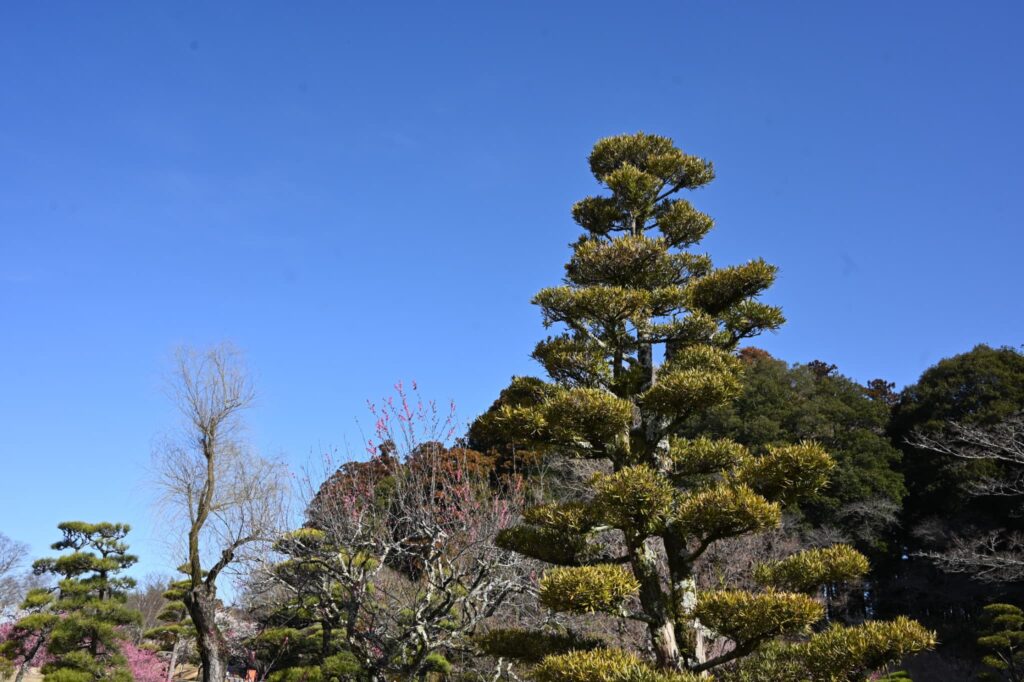
Buddhist Pine is an evergreen coniferous tree in the family Podocarpaceae, native to coastal mountain forests from the Boso Peninsula westward through Honshu, Shikoku, Kyushu, and the Ryukyu Islands, as well as Taiwan. It is by far the most widely planted and best-known of Japan’s maki trees — when Japanese speakers say simply maki, they almost always mean this species. Its exceptional tolerance of pruning has made it a staple of traditional Japanese gardens for centuries, where it is commonly trained into cloud-pruned forms (tamachirashi) or clipped hedges.
Overview
| Item | Description |
|---|---|
| Scientific Name | Podocarpus macrophyllus |
| Common Name | Buddhist Pine / Yew Plum Pine |
| Japanese Name | Inumaki (イヌマキ) |
| Family | Podocarpaceae |
| Native Range | Japan, Taiwan |
| Plant Type | Evergreen Coniferous Tree |
| Height | Up to 20 m (65 ft) |
| Trunk | Up to 1 m in diameter |
| Flowering Season | May–June |
| Fruit Type | Berry-like fruit with fleshy receptacle |
| USDA Zones | 7–11 |
| Sun Exposure | Full Sun to Partial Shade |
Characteristics
| Item | Description |
|---|---|
| Foliage | Thick, linear leaves, 10–18 cm long |
| Flowers | Dioecious; blooms May–June |
| Fruits | Two-part fruit, October–December |
| Bark & Timber | Grayish-white, shallow vertical fissures |
| Size & Growth | Moderate to fast, up to 20 m |
Foliage
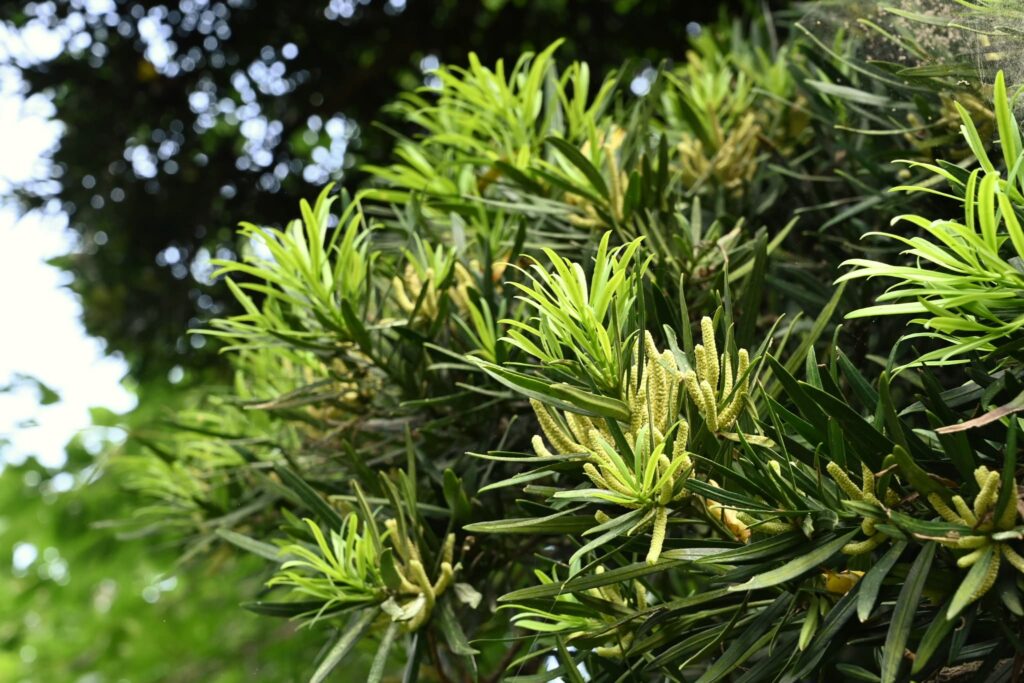
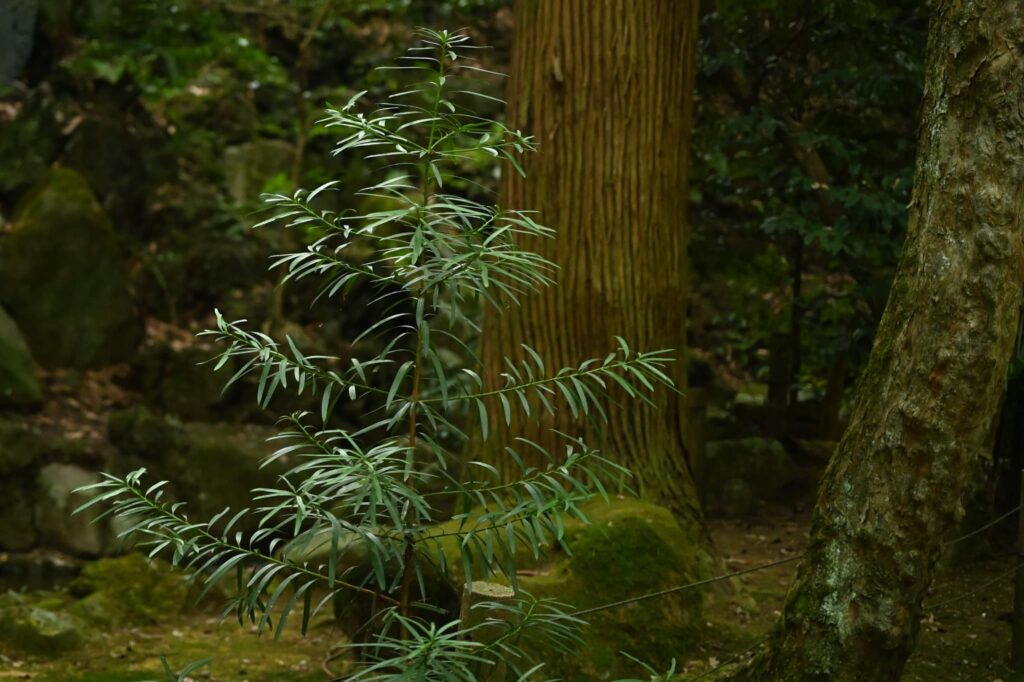
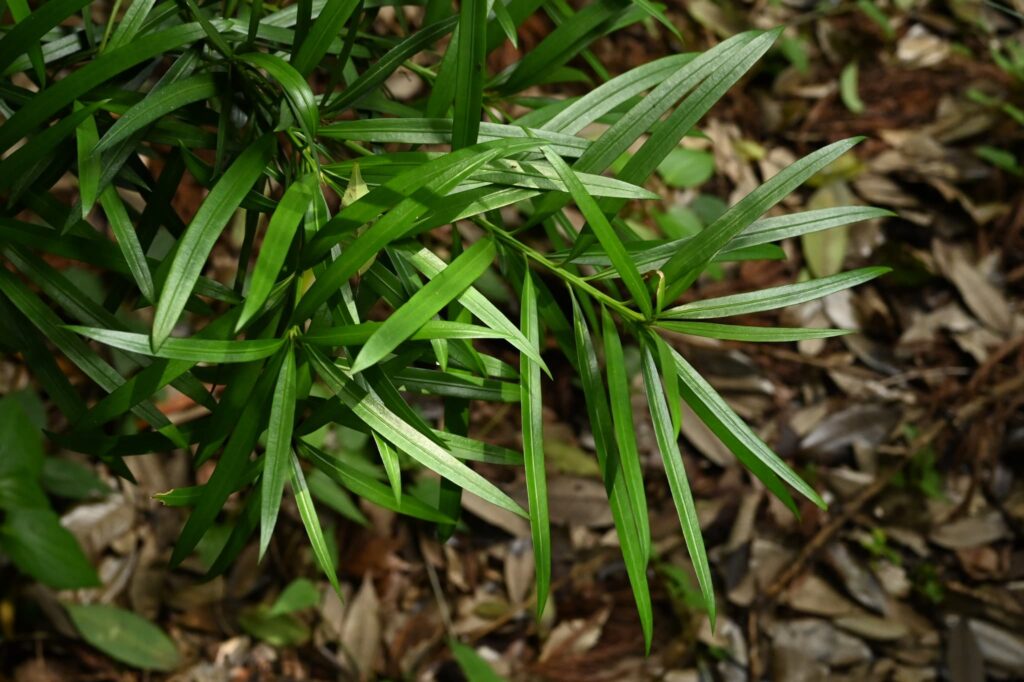
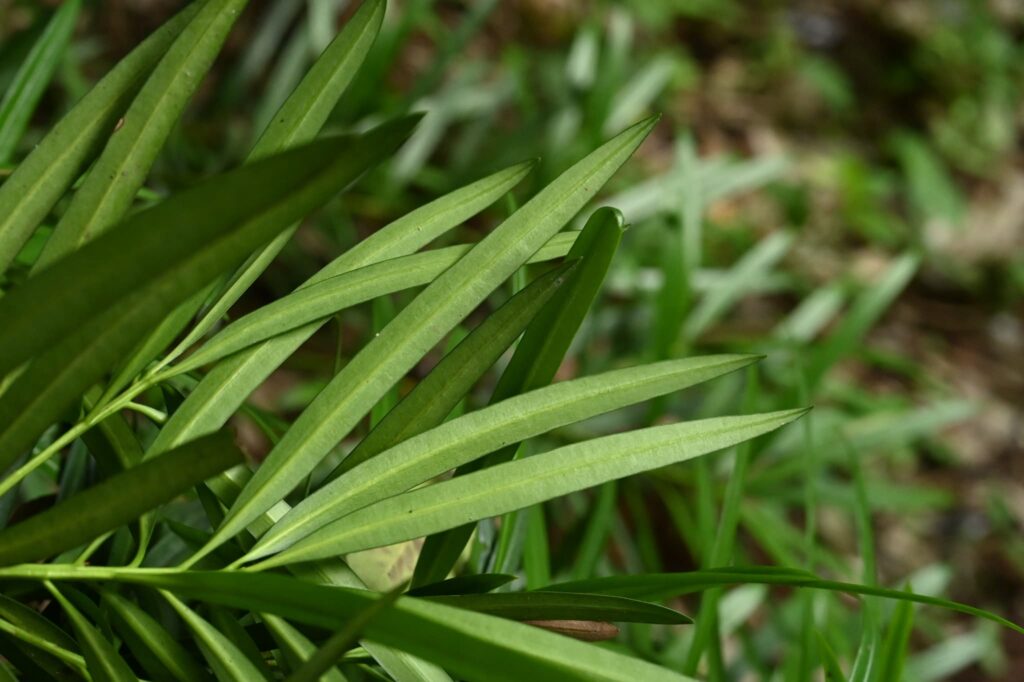
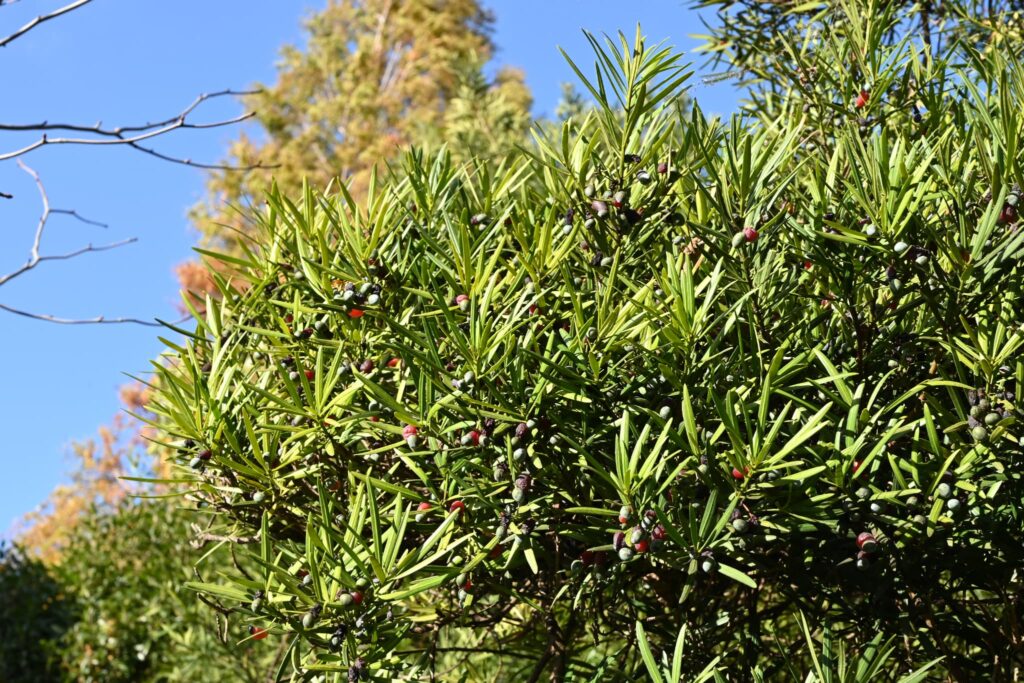
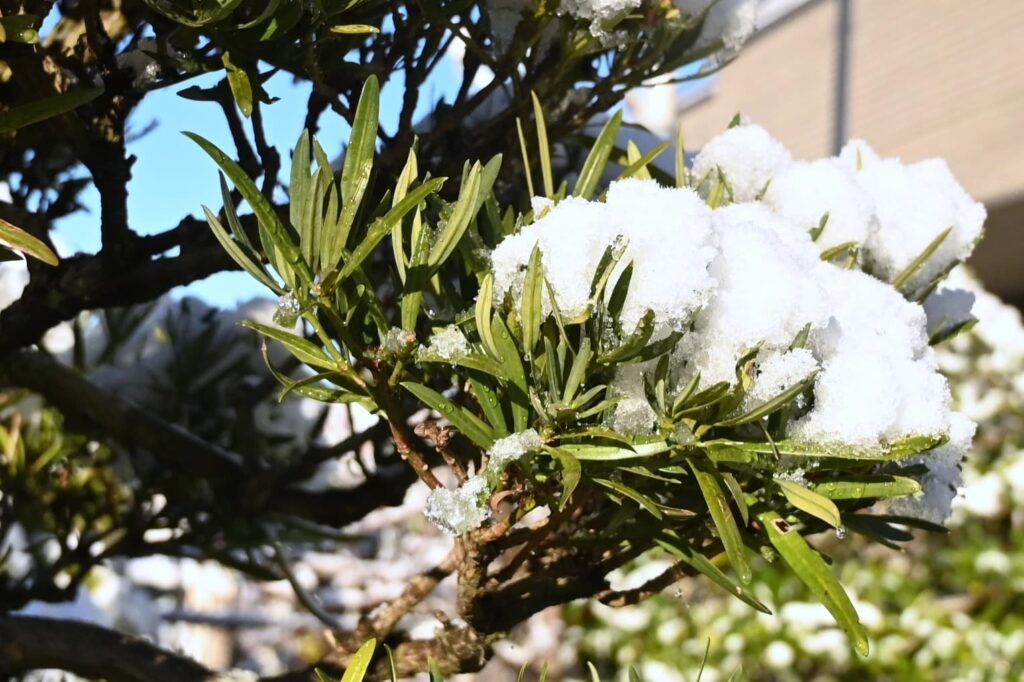
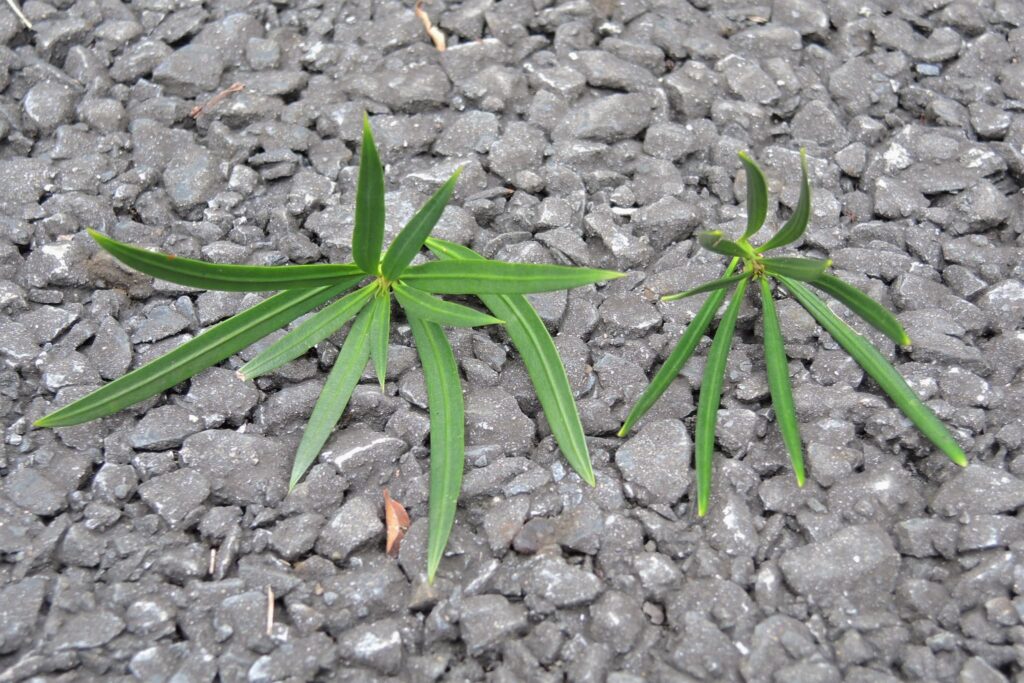
Despite being a conifer, Buddhist Pine’s leaves bear no resemblance to the sharp needles of pines or cedars. Instead, they are thick, elongated, and linear — soft to the touch despite their pointed tips. Each leaf measures 10–18 cm in length and up to 1 cm in width, arranged alternately along the branches. The margins are smooth without serration, and the underside has a yellowish tint with a raised central midrib.
Flowers
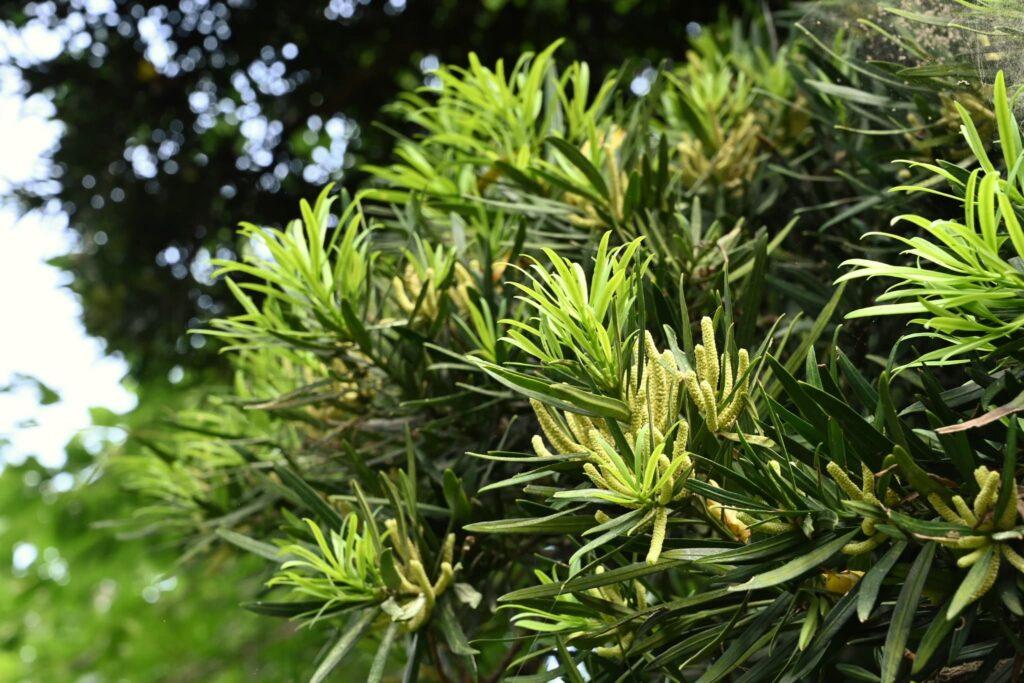
Buddhist Pine is dioecious — male and female flowers grow on separate trees. Both bloom in the leaf axils from May to June. Male flowers are cylindrical, about 3 cm long, composed of clustered stamens, and appear in small groups. Female flowers are small and spike-like, appearing singly. Flicking a male flower with a finger releases a visible cloud of pollen.
Fruits
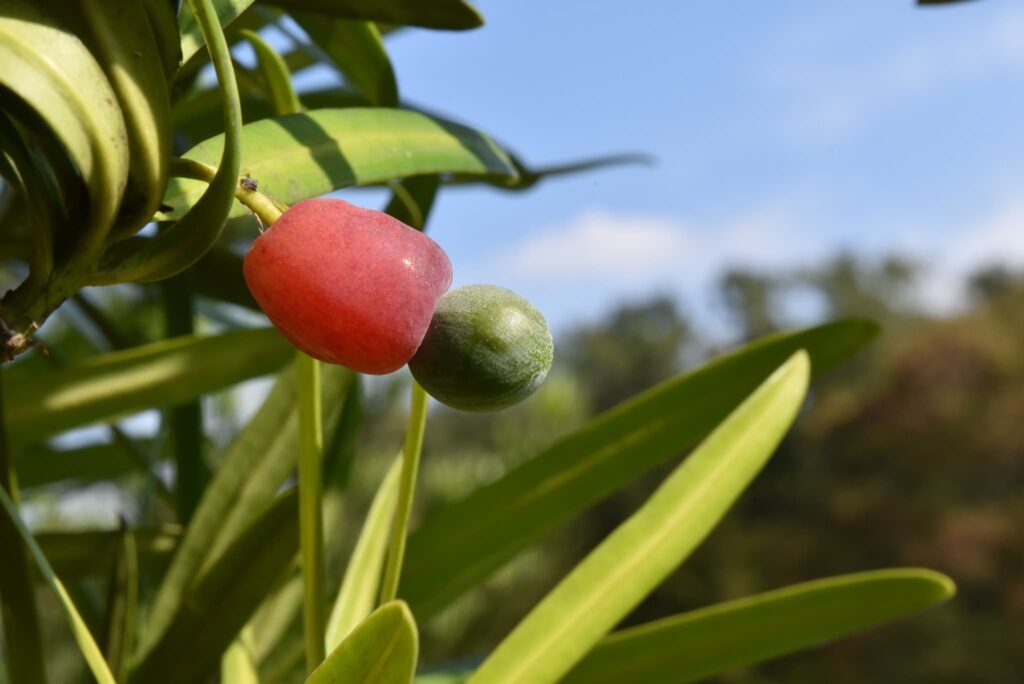
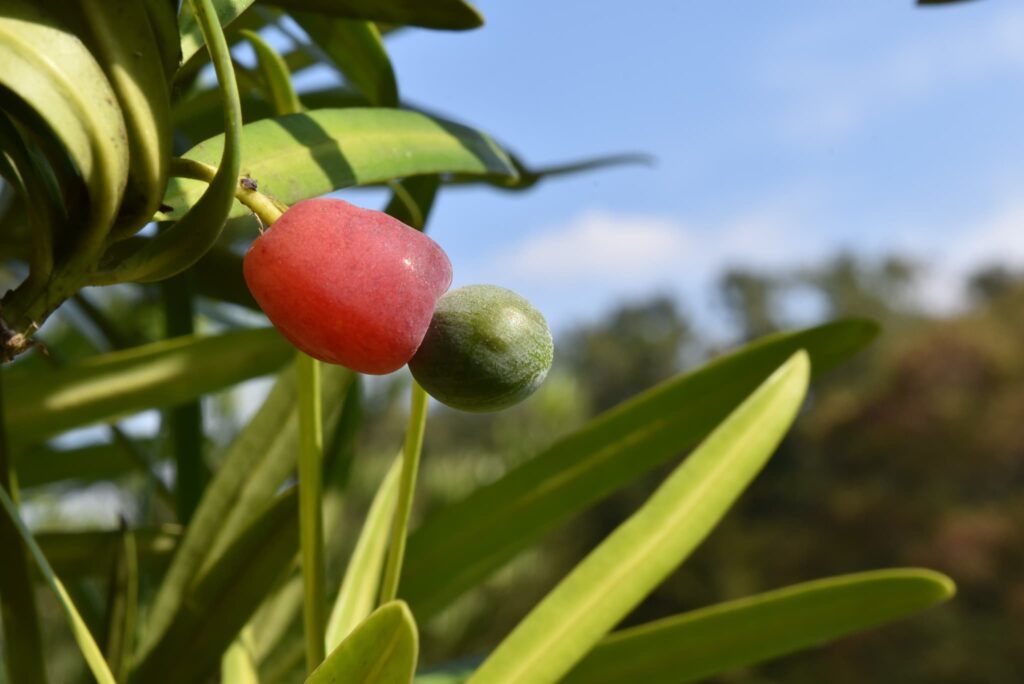
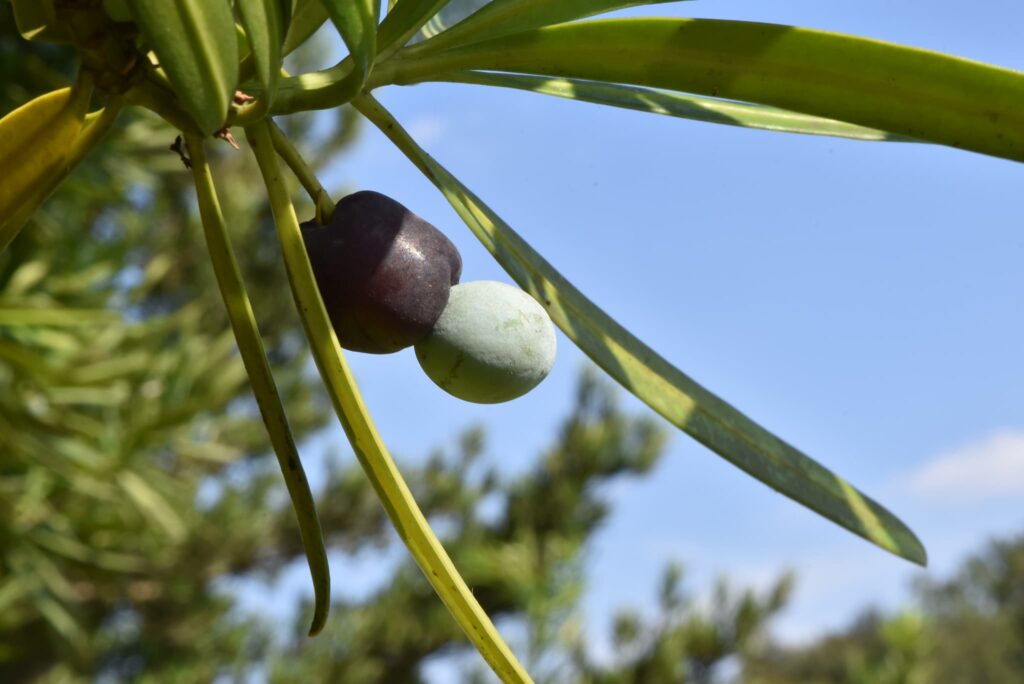
The fruit that develops on female trees has a distinctive two-part structure. The upper portion — a green, waxy seed — is the true botanical fruit. The lower red portion is the receptacle (kaku), the fleshy base that supports the seed. The receptacle ripens to a dark red-black color between October and December and is sweet and edible. The green seed, however, contains a toxic compound called inumaki lactone, which can cause vomiting and diarrhea if ingested. Various birds feed on the ripe receptacles and help disperse the seeds.
Bark & Timber
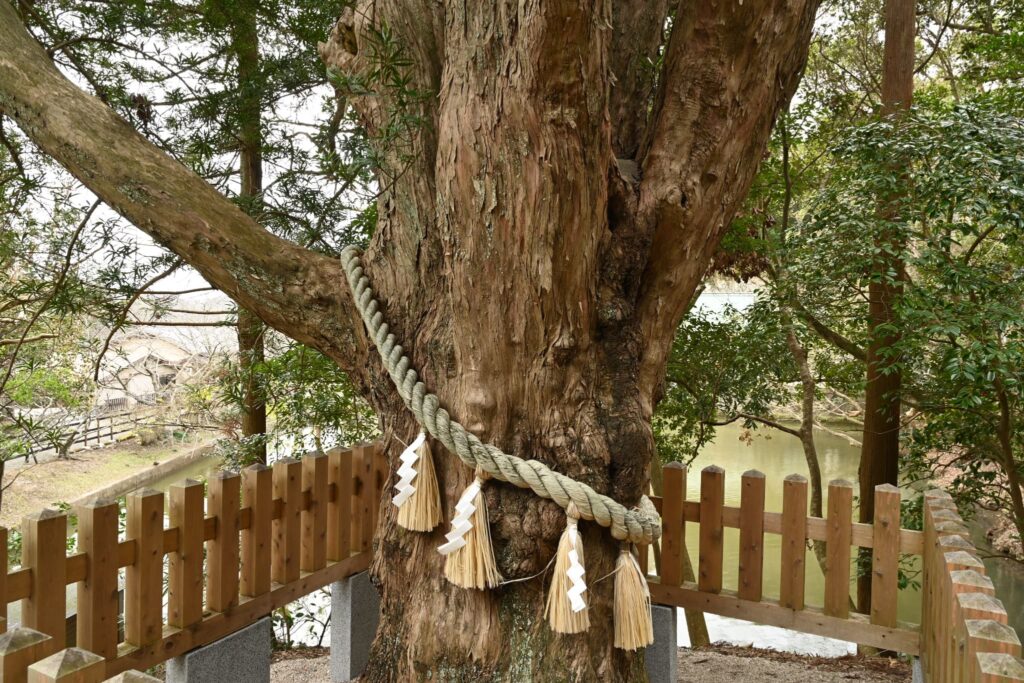
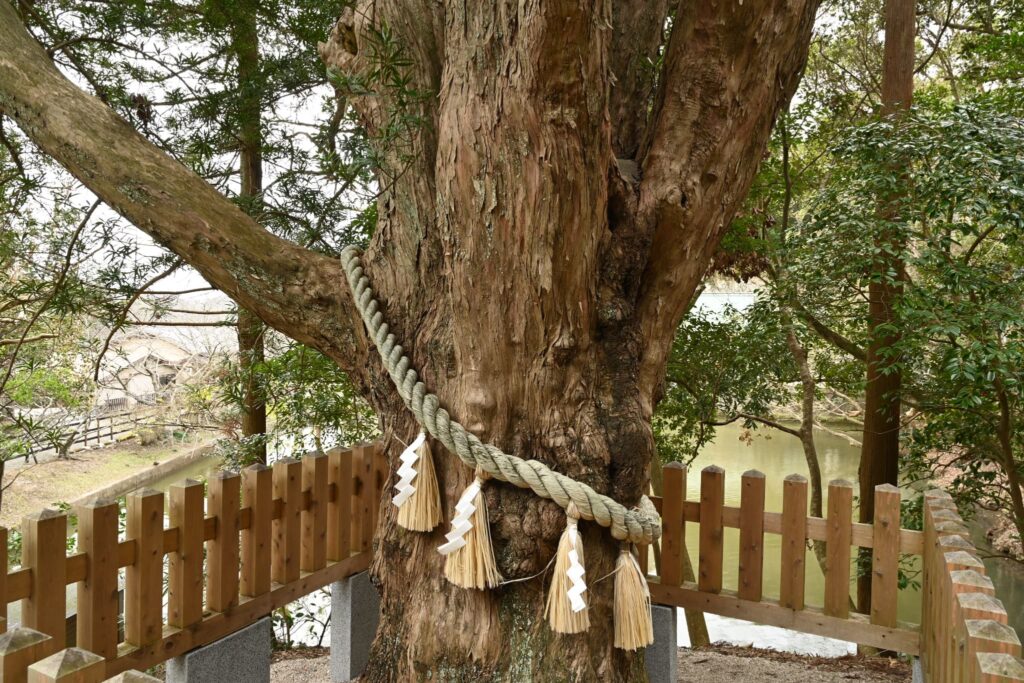
The trunk can reach up to 1 m in diameter. The wood is pale yellow, heavy, and hard, with excellent durability and water resistance — properties that have made it a valued construction material in termite-prone wetland environments, traditionally used for pillars, beams, and roof boards. It is also used for bathtubs, the body of the Okinawan sanshin lute, coffins, and firewood. The bark itself is grayish-white and develops shallow vertical fissures with age.
Size & Growth
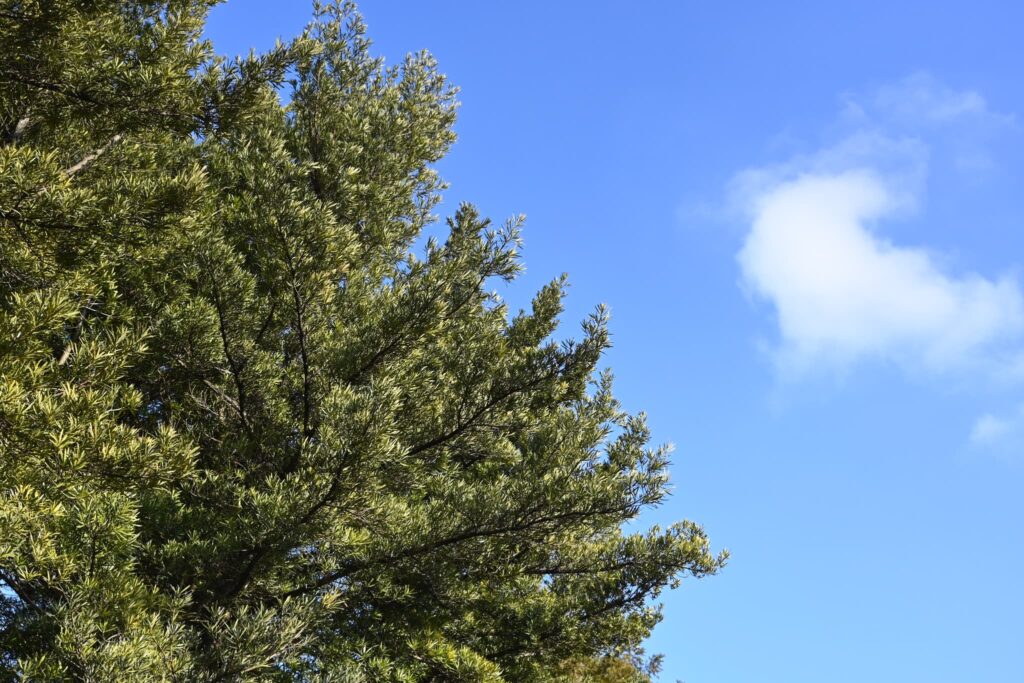
Buddhist Pine grows at a moderate to fast rate under warm conditions and can reach up to 20 m in height in the wild, though garden specimens are typically kept much smaller through regular pruning.
Uses & Cultural Significance
Name & Background
The Japanese name Inumaki combines inu (“dog”) with maki, a traditional name used for several valued evergreen timber trees. The prefix inu- was sometimes used in Japanese plant names to indicate a plant regarded as a lesser or substitute form of another, more highly valued species. In the case of Inumaki, the name has traditionally been associated with Hon-maki (“true maki”), a name historically applied to the Japanese Umbrella Pine (Sciadopitys verticillata).
The word maki itself has been used broadly for straight-growing, high-quality timber trees. In historical Japanese forestry and gardening traditions, the term could refer to several important conifers, including Japanese Cedar, Hinoki Cypress, Asunaro, and Japanese Umbrella Pine. Inumaki became especially valued for its durability and adaptability, even though its timber was generally regarded as less suitable for major structural purposes than that of some other maki trees.
Inumaki is also known as Kusamaki in some regions, a name associated with the distinctive odor of its freshly cut wood. Its durable, water-resistant timber has traditionally been used for pillars, beams, roof boards, bathtubs, furniture, and other practical applications. Today, however, the tree is perhaps best known outside the timber industry as one of Japan’s classic garden trees, valued for its dense foliage and exceptional ability to withstand pruning.
Traditional Wood Uses
When freshly cut, the wood has a distinctive odor, giving rise to the traditional name Kusamaki, referring to its fresh-cut scent. Its durability and water resistance have made it valuable for pillars, beams, roof boards, bathtubs, the body of the Okinawan sanshin lute, coffins, and firewood.
Growing Guide
| Factor | At a Glance |
|---|---|
| Light & Soil | Full sun preferred, tolerates partial shade; unfussy about soil type |
| Wind, Salt & Pollution Tolerance | Tolerates salt-laden sea breezes and air pollution |
| Cold Hardiness | USDA Zones 7–11; difficult in cold regions like Hokkaido |
| Pruning | Best hand-pruned for cloud pruning (tamachirashi) |
| Suitability for Home Gardens | Excellent; tolerates shade, pollution, and salt |
| Pests | Relatively resistant to pests and disease |
Light & Soil
Buddhist Pine is unfussy about soil type and grows vigorously across a wide range of conditions. While it prefers full sun, it tolerates partial shade well, making it suitable even for north-facing hedges — an advantage few conifers offer.
Wind, Salt & Pollution Tolerance
Buddhist Pine tolerates salt-laden sea breezes and air pollution, making it a popular choice for windbreaks, hedges, and privacy screens in coastal and urban areas. Its tolerance of these conditions is one reason it has long been widely planted in residential gardens and along roadsides in Japan.
Cold Hardiness
Buddhist Pine is a warm-climate species naturally found in coastal forests in mild regions. It is relatively cold-sensitive and can be difficult to cultivate in colder areas such as Hokkaido.
Pruning
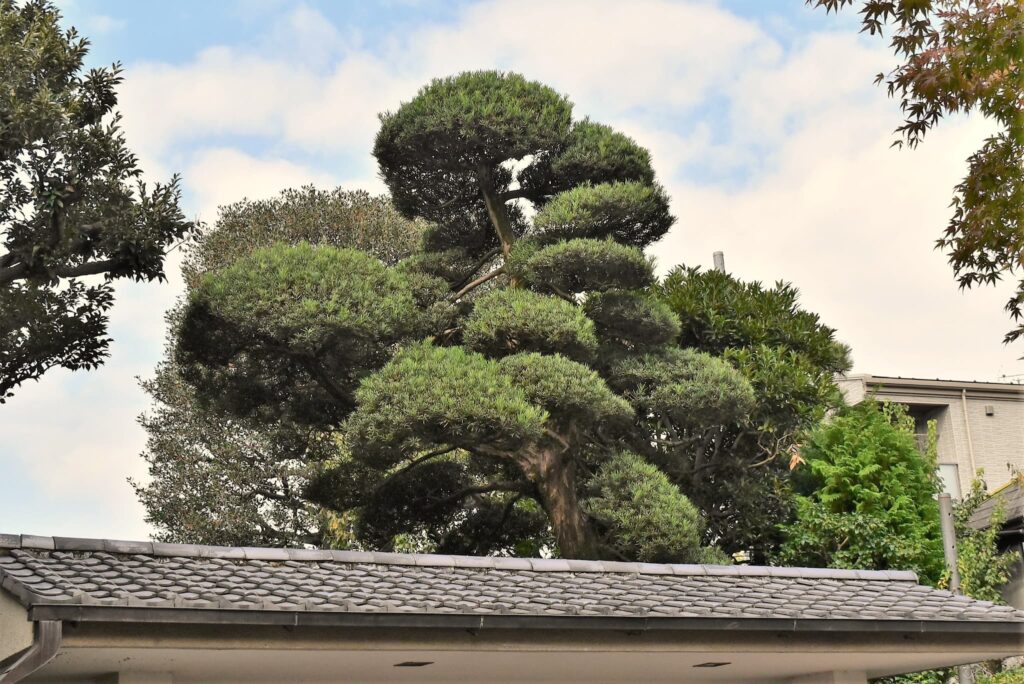
Buddhist Pine is one of Japan’s classic niwaki species. The most traditional style is cloud pruning (tamachirashi), in which the foliage is shaped into a series of rounded “clouds” along the branches. This style requires skilled hand-pruning — using hedge trimmers or shears tends to produce a coarse, unattractive result, particularly on larger, older specimens, which can be challenging to maintain without professional assistance.
Suitability for Home Gardens
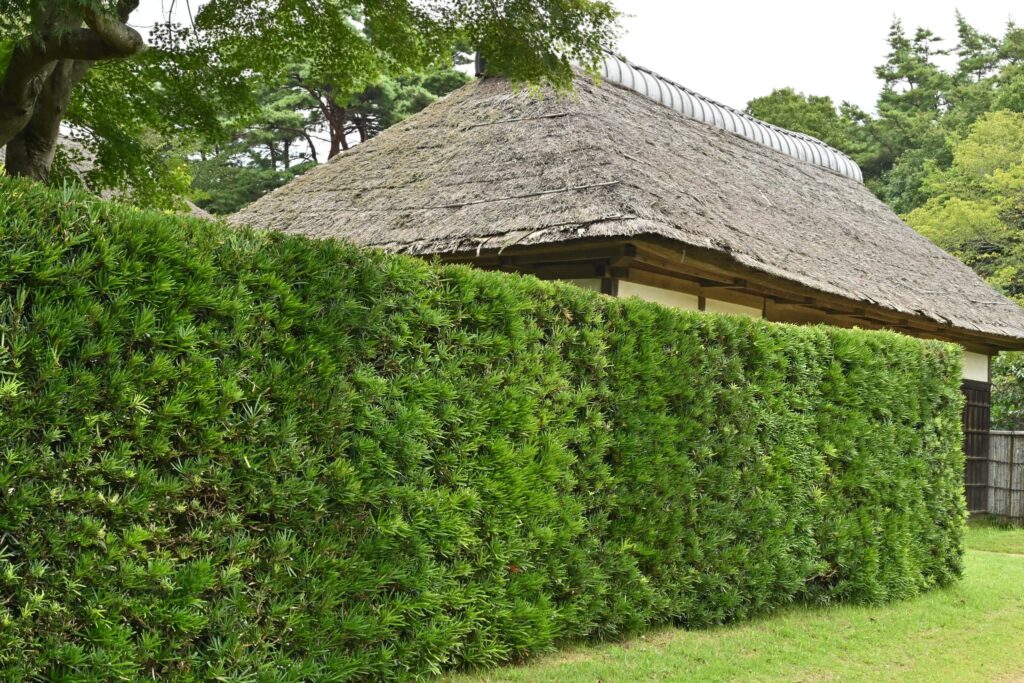
Buddhist Pine is an excellent choice for home gardens, particularly as a hedge, privacy screen, or Japanese-style garden tree. Its dense foliage, tolerance of shade, salt, and air pollution, and exceptional response to pruning make it remarkably versatile.
As a dioecious species, male and female trees are separate. Only female trees produce the characteristic two-part fruit, so a female specimen should be chosen if ornamental fruit is desired.
Pests
Buddhist Pine is relatively resistant to pests and disease, contributing to its reputation as a low-maintenance garden tree.
Similar Species
| Feature | Buddhist Pine (Inumaki) | Rakan Pine (Podocarpus nagi) | Japanese Umbrella Pine (Koyamaki) |
|---|---|---|---|
| Leaf shape | Long, flat, linear (10–18 cm) | Similar but shorter and smaller | Rod-like, needle-shaped |
| Maximum height | ~20 m | ~10 m | 40 m+ |
The most practical distinction between Buddhist Pine and Rakan Pine (Podocarpus nagi) is leaf size — Buddhist Pine’s leaves are noticeably larger and longer. Japanese Umbrella Pine (Sciadopitys verticillata) is fundamentally different in leaf shape and grows significantly taller.
Frequently Asked Questions
Is the fruit of Buddhist Pine edible?
Partially. The red receptacle (the lower, fleshy portion) is sweet and edible when fully ripe. However, the green seed attached to it contains a toxic compound and should not be eaten. Children and pets should be kept away from unripe or green fruit.
Is Buddhist Pine suitable for hedging?
Yes — it is one of the best hedge plants for Japanese-style gardens, particularly in coastal or urban settings where salt tolerance and pollution resistance are needed. It also tolerates shade, making it useful for north-facing boundaries.
How does Buddhist Pine differ from Japanese Umbrella Pine?
The two are frequently grouped together under the loose term maki, but they belong to entirely different plant families. Japanese Umbrella Pine is a premium ornamental tree with rod-like foliage, while Buddhist Pine has flat, strap-like leaves and is far more common and affordable.
Can Buddhist Pine be kept small?
Yes. It tolerates pruning well and can be maintained as a compact garden shrub or formal hedge. However, hand-pruning is preferable to mechanical trimming to maintain an attractive appearance.
Does Buddhist Pine cause allergies?
Unlike Japanese Cedar and Hinoki Cypress, Buddhist Pine is not a significant cause of seasonal allergies in Japan. Its pollen is released in relatively low quantities and is not widely implicated in hay fever.
Is Buddhist Pine poisonous?
The fleshy red receptacle is edible when ripe, but the green seed contains toxic compounds and should not be eaten.
How fast does Buddhist Pine grow?
Buddhist Pine grows at a moderate to fast rate under warm conditions and responds well to regular pruning.
Is Buddhist Pine good for niwaki?
Yes. Buddhist Pine is one of the traditional trees used for niwaki (Japanese garden tree training). Its dense foliage, vigorous regrowth, and excellent response to pruning make it ideal for cloud pruning and other sculptural forms.
Conclusion
Quietly elegant and remarkably versatile, Buddhist Pine has earned its place as one of Japan’s most enduring garden trees. While it carries the inu- (“lesser”) prefix in its name, there is nothing inferior about its adaptability, salt tolerance, and excellent response to pruning. Whether trained as an elegant niwaki, clipped into a coastal hedge, or grown as a specimen tree, Podocarpus macrophyllus brings a sense of calm refinement that few other conifers can match, making it one of the defining evergreens of the traditional Japanese garden.