Japanese Snowbell (Styrax japonica): Identification, Care & Uses
Japanese Snowbell (Styrax japonica) is a graceful deciduous tree native to Japan and other parts of East and Southeast Asia. It is best known for its fragrant, bell-shaped white flowers, which hang beneath the branches in late spring and early summer. This guide covers identification, flowers, fruits, bark, timber, traditional uses, wildlife value, cultivars, and cultivation, based on the characteristics of the species as grown in Japan.
What Is Japanese Snowbell?
Japanese Snowbell is a deciduous tree in the family Styracaceae. Its native range extends from Japan and the Korean Peninsula through China and Taiwan to parts of Southeast Asia and the northern Philippines. In Japan, it occurs from southern Hokkaido through Honshu, Shikoku, Kyushu, and the Ryukyu Islands.
The tree is valued for its graceful form and abundant white flowers, which appear on short lateral shoots and hang downward beneath the branches. It also has a long history of practical use in Japan. The fruit contains saponins and was traditionally used as a soap substitute and, historically, as a fish-stunning agent. Its fine-grained, relatively hard wood was also used for traditional tools, turned objects, umbrella components, and other crafts.
Overview
| Item | Description |
| Scientific Name | Styrax japonica Siebold & Zucc. |
| Common Name | Japanese Snowbell / Japanese Styrax |
| Japanese Name | Egonoki (エゴノキ) |
| Family | Styracaceae |
| Native Range | Japan, Korea, China, Taiwan, Southeast Asia, northern Philippines |
| Plant Type | Deciduous Broadleaf Tree |
| Height | Up to 12 m (40 ft) |
| Trunk | Usually relatively slender; up to about 30 cm in diameter |
| Flowering Season | May–June |
| Fruit Type | Dry, ovoid fruit containing a single hard seed |
| USDA Zones | Approximately 5–8, depending on cultivar and local conditions |
| Sun Exposure | Full Sun to Partial Shade |
Characteristics
| Item | Description |
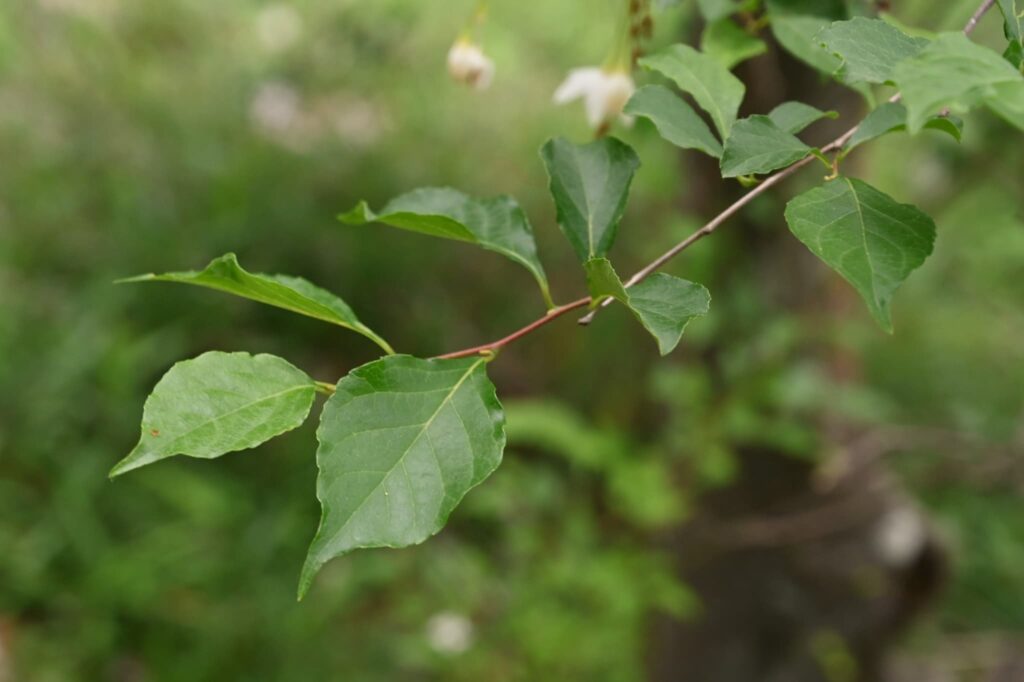
| Leaf | Simple, alternate, broadly elliptic to elliptic-oblong, about 4–8 cm long, pointed at the tip; margins shallowly toothed and sometimes nearly entire |
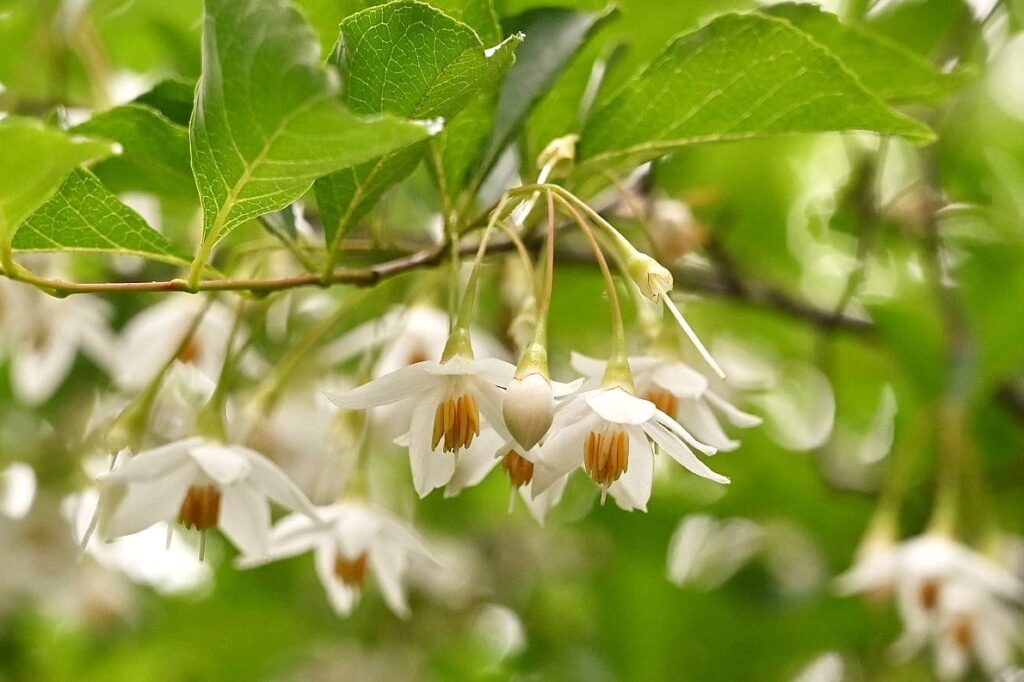
| Flower | White, bell-shaped and slightly fragrant; corolla deeply divided into five lobes; about 1.5–2.5 cm across, with 10 yellow stamens |
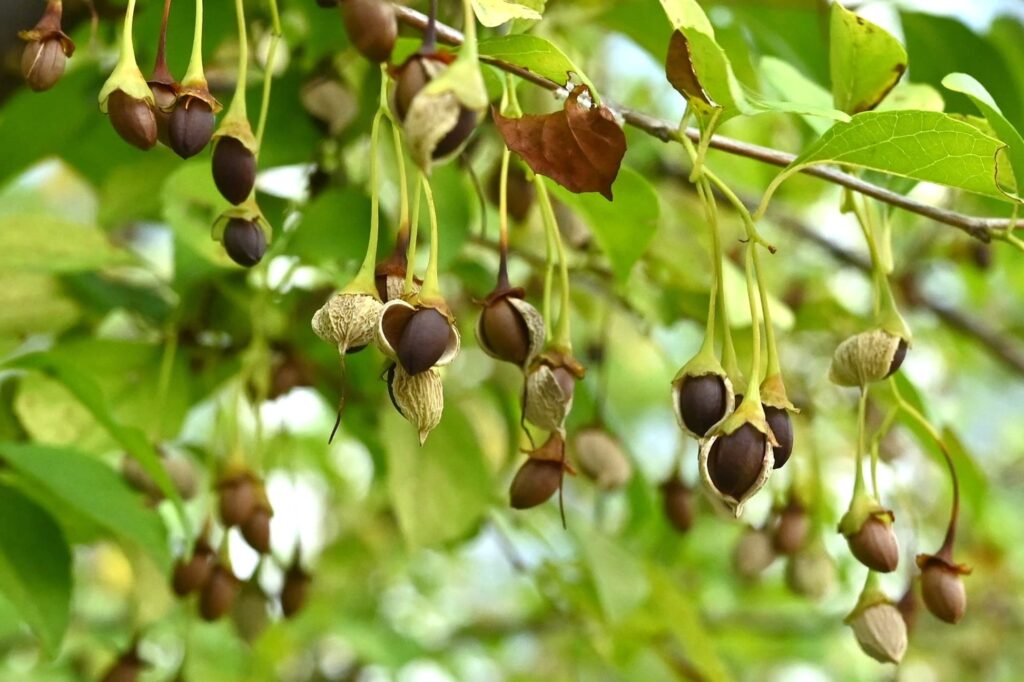
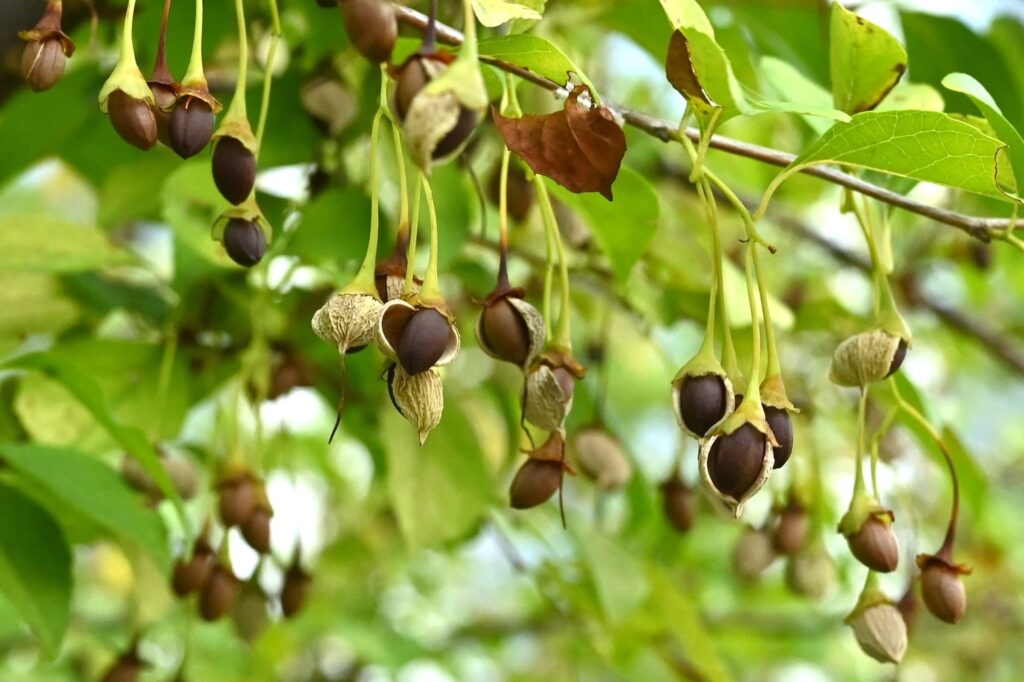
| Fruit | Pale green to gray-white, ovoid fruit, generally less than 2 cm long, containing one hard brown seed; the fruit surface becomes dry and splits or opens as it matures |
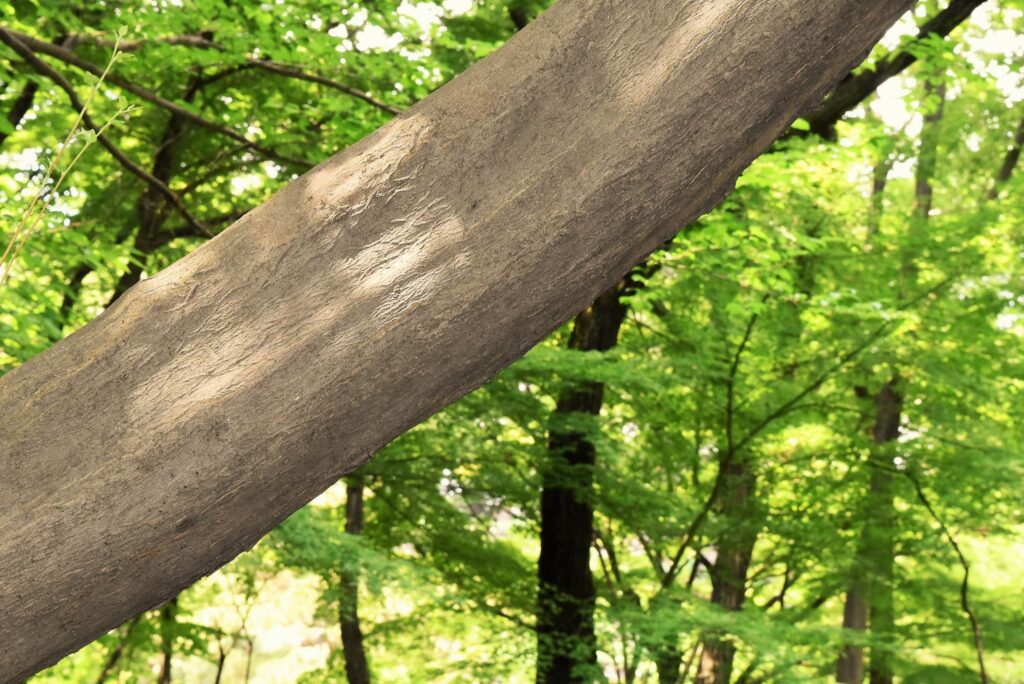
| Bark | Dark gray to gray-brown and relatively smooth when young, developing shallow longitudinal fissures with age |
| Habit | Deciduous tree with spreading branches; may develop as a single-stemmed or multi-stemmed specimen |
| Height | Up to about 12 m (40 ft) |
Foliage
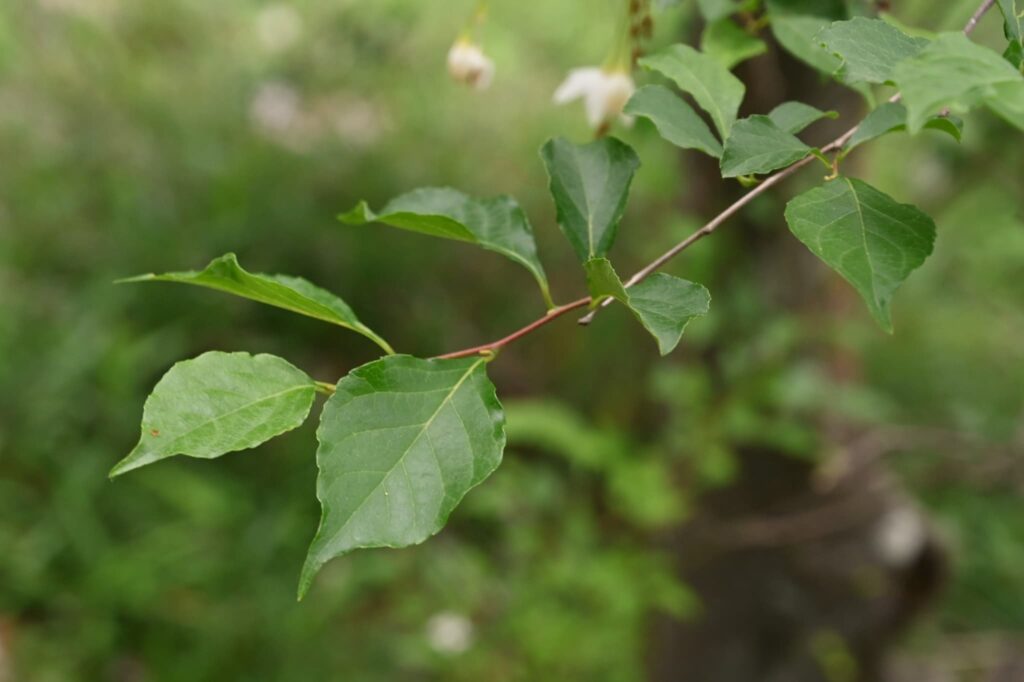
Leaves are simple and arranged alternately along the branches. They are broadly elliptic to elliptic-oblong, generally about 4–8 cm long, with a pointed or acuminate tip and a wedge-shaped base. The margins are shallowly toothed, although some leaves may appear nearly entire. The upper surface is dark green and usually smooth.
Flowers
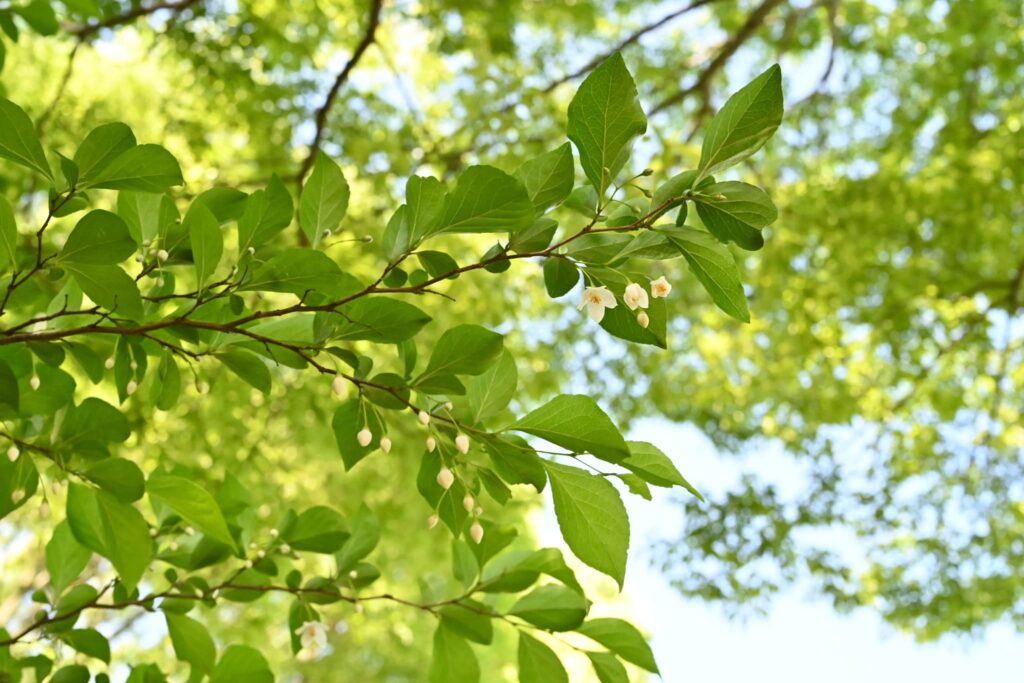
Japanese Snowbell flowers in May and June, producing numerous white, bell-shaped blossoms that hang downward from long flower stalks on short lateral shoots. The flowers are slightly fragrant and are among the tree’s most distinctive features.
The corolla is united near the base and deeply divided into five lobes rather than consisting of five completely separate petals. Each flower has about 10 yellow stamens. The flowers are generally less than 2.5 cm across, although apparent size varies with growing conditions and cultivar.
Pink-flowered cultivars are also grown as ornamental trees, most notably Styrax japonica ‘Pink Chimes’.
Fruits
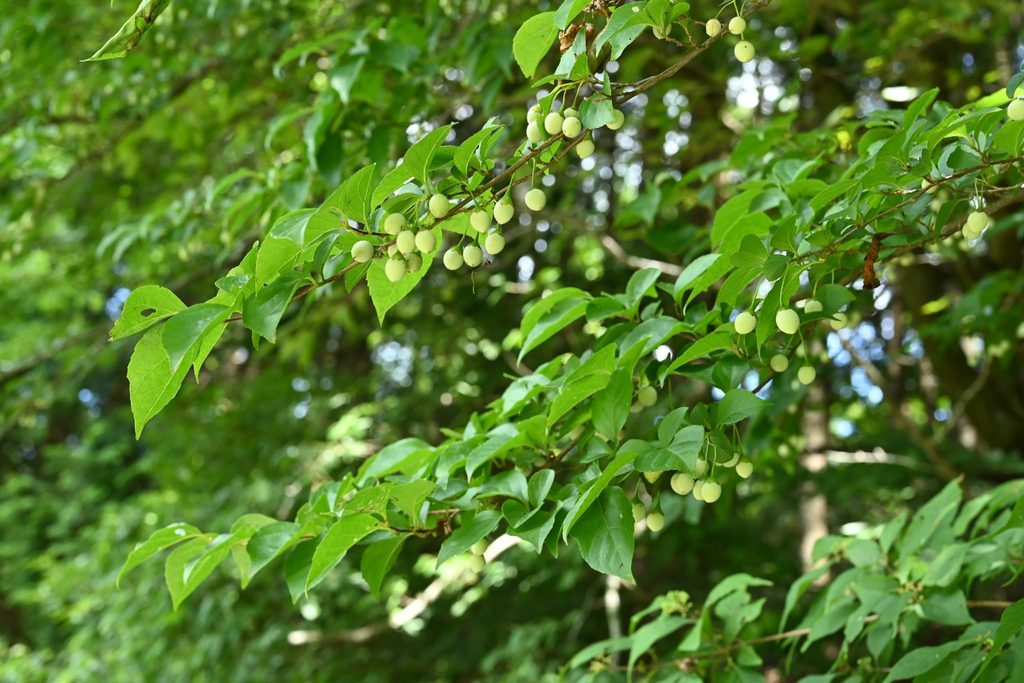
The fruit develops during summer and matures in autumn. It is generally ovoid, pale green to gray-white, and contains a single hard brown seed. As it matures, the dry fruit wall opens or splits to expose the seed. Japanese forestry references describe the mature fruit as spherical to ovoid and note that it releases a single hard seed.
The fruit and especially the fruit skin contain saponins, including egosaponin. The irritating taste of the fruit is thought to be the origin of the Japanese name egonoki, referring to its harsh or acrid quality. The fruit should not be eaten.
The saponin-containing fruit skin was traditionally used as a natural soap substitute. Crushed fruit was also historically released into streams to stun fish, allowing them to be collected. This traditional fishing practice is no longer permitted.
The fruit is also important to wildlife. Birds such as the Varied Tit (Sittiparus varius, Yamagara) remove the fruit skin and carry away the seeds. This behavior can contribute to the dispersal and caching of Japanese Snowbell seeds.
Bark & Timber
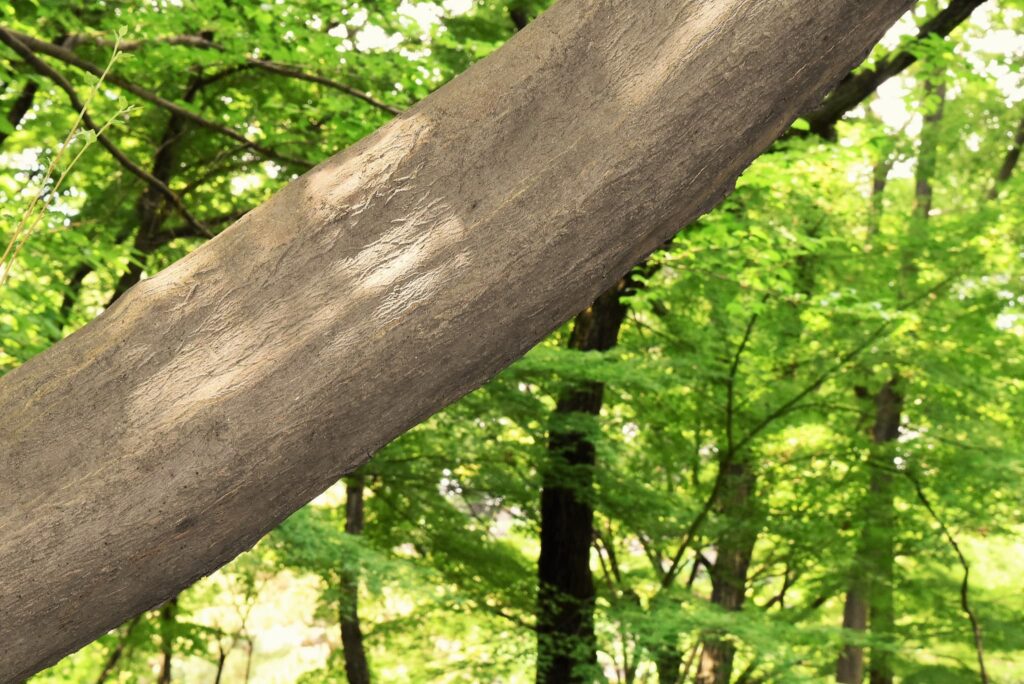
The bark is dark gray to gray-brown and relatively smooth on younger trees. With age, shallow longitudinal fissures may develop. Young branches can have a distinctive gray-brown to purplish-brown appearance.
The wood is pale yellowish-white to light yellow-brown, with little difference between heartwood and sapwood. It has a fine texture, generally straight grain, and an air-dry density of approximately 0.55–0.63. The wood is relatively hard but easy to work.
Because the tree usually does not develop a very large trunk, its wood has traditionally been used mainly for relatively small objects and components rather than large structural timbers. Uses have included turned objects, umbrella components, handles, wooden combs, shogi pieces, spinning and craft objects, kokeshi dolls, and other household implements. Japanese umbrellas (wagasa) are among its notable traditional applications.
Size & Growth
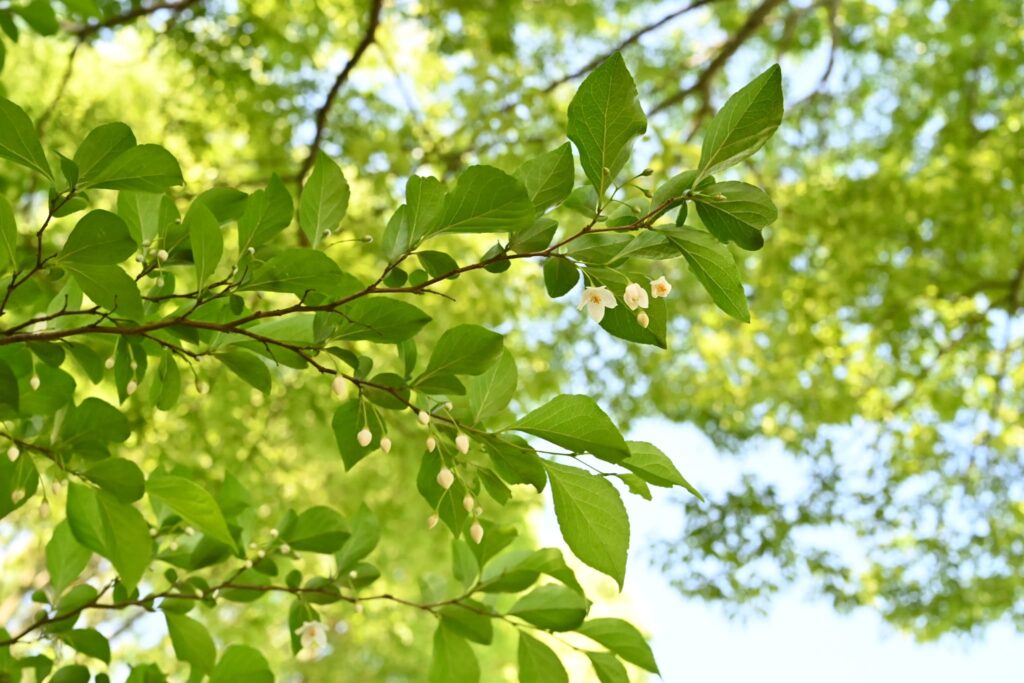
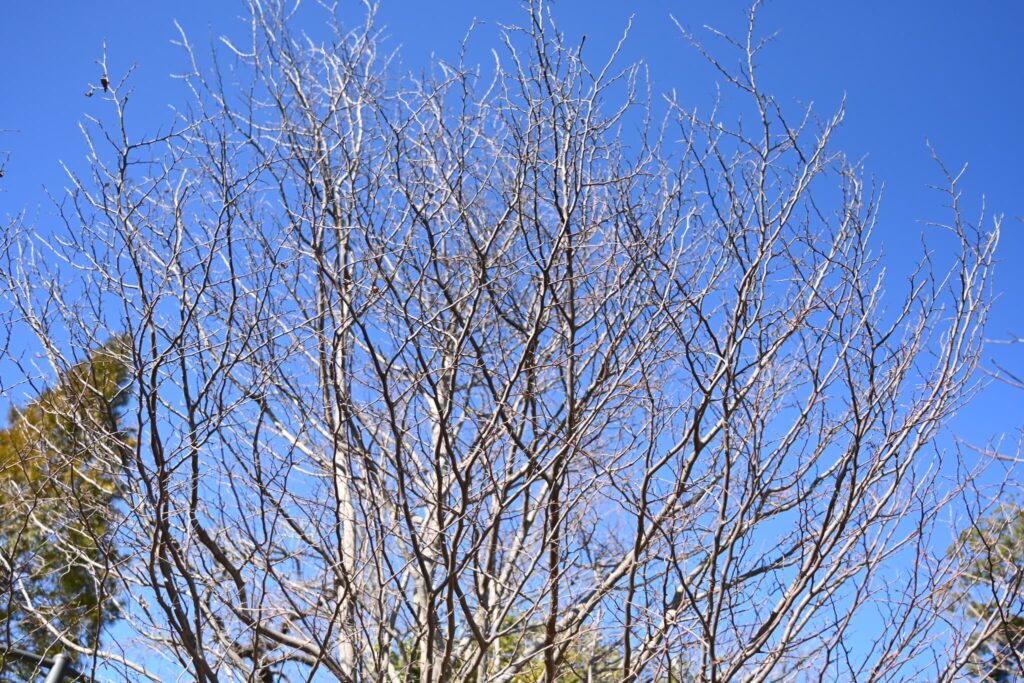
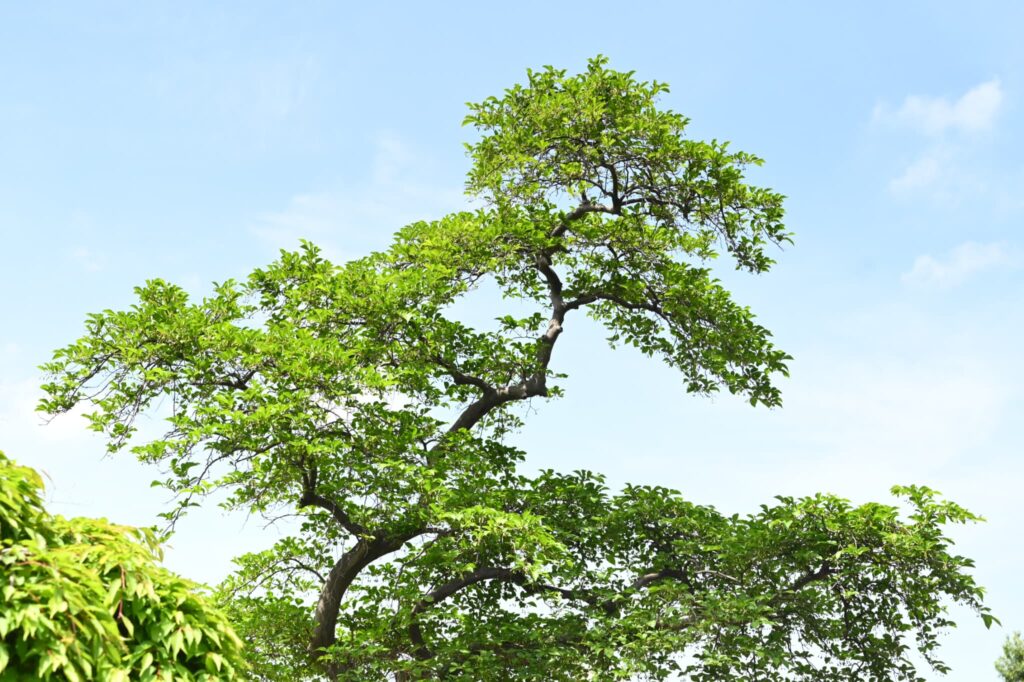
Japanese Snowbell generally grows to about 8–12 m (26–40 ft) tall, although size varies with growing conditions. Mature trees can develop a broad, rounded crown with spreading or somewhat horizontal branches. The tree may grow either as a single-stemmed specimen or with several stems arising from the base.
The natural form is one of its principal ornamental qualities, so allowing sufficient space for the crown to develop usually produces a better result than trying to maintain a tightly restricted shape.
Uses & Cultural Significance
Timber & Craft Uses
Japanese Snowbell has a long history as a useful timber tree in Japan. Its alternate name rokurogi refers to its use in rokuro turning, in which wood is shaped on a rotating lathe.
The wood is fine-textured, relatively hard, straight-grained, and easy to work. Traditional uses have included parts of Japanese umbrellas, umbrella handles, turned objects, wooden combs, shogi pieces, abacus beads, kokeshi dolls, and other small tools and crafts. It has also been used for various household and construction-related purposes.
The wood’s combination of workability, toughness, and relatively fine texture made it particularly useful for objects requiring bending, turning, or precise shaping. Historical examples include wooden components preserved among traditional Japanese objects.
Soap Substitute and Traditional Fishing
The fruit skin of Japanese Snowbell contains saponins that produce a soapy effect in water. For this reason, the fruit was traditionally used as a natural washing material and gave rise to the tree’s association with soap.
The same saponin-rich fruit was historically used in traditional fishing. Crushed fruits were introduced into streams to temporarily stun fish. This practice is now prohibited and should be regarded only as a historical use.
Name & Cultural Notes
The Japanese name Egonoki (エゴノキ) is generally associated with the acrid, irritating taste of the fruit. Japanese forestry references explain the name in relation to the fruit’s strong bitterness and throat irritation.
The tree is also known by traditional names including Rokurogi and Chishanoki. The latter name can cause confusion because Chishanoki is also used for another tree, Ehretia acuminata. For botanical identification, the scientific name Styrax japonica is therefore preferable.
The Japanese kanji name 野茉莉 is associated with the traditional Chinese naming of the plant.
Wildlife Value
Japanese Snowbell has a particularly interesting relationship with birds. The Varied Tit (Sittiparus varius), known in Japanese as Yamagara, is strongly associated with its fruits.
Rather than swallowing the whole fruit, the bird removes the fruit skin and carries away the seed. The behavior allows the bird to make use of the seed while also contributing to seed movement away from the parent tree.
This relationship is one of the more distinctive ecological features of Japanese Snowbell and helps explain why its fruit remains important even though it is not edible to humans.
Growing Guide
| Item | Description |
| Light | Full Sun to Partial Shade |
| Soil | Moist, fertile, humus-rich, well-drained soil |
| Water | Consistent moisture; avoid allowing the soil to dry out |
| Cold Hardiness | Approximately USDA Zones 5–8, depending on cultivar and local conditions |
| Wind | A sheltered position is preferable, especially where cold, drying winds are common |
| Pruning | Minimal pruning; remove dead, damaged, crossing, or poorly positioned branches |
| Pests | Generally relatively pest-free, although several insects are specifically associated with the species |
Light & Soil
Japanese Snowbell grows well in full sun to partial shade. It performs best in moist, fertile, humus-rich, well-drained soil. Acidic to neutral soil is suitable.
The species does not tolerate drought particularly well. Soil should not be allowed to dry out completely, especially during hot or prolonged dry weather. Maintaining consistent soil moisture is one of the most important factors in successful cultivation.
Wind & Snow Tolerance
Japanese Snowbell is best planted in a sheltered position, particularly where cold, drying winds are common. RHS recommends protection from cold drying winds and lists the species as H5 hardy under UK conditions.
In areas with heavy snowfall, protecting young or newly planted trees from excessive snow accumulation can be sensible, although the species does not require special winter treatment in most of its natural Japanese range.
Cold Hardiness
Japanese Snowbell is reasonably cold-hardy and can be grown in approximately USDA Zones 5–8, although actual performance depends on the cultivar, local exposure, soil moisture, and winter conditions. NC State lists the species across Zones 5a through 9b, while RHS rates it H5 under UK conditions.
The tree’s broad native distribution in Japan and continental East Asia also demonstrates considerable climatic adaptability. However, geographical distribution should not be treated as a direct equivalent of USDA hardiness zones.
Pruning
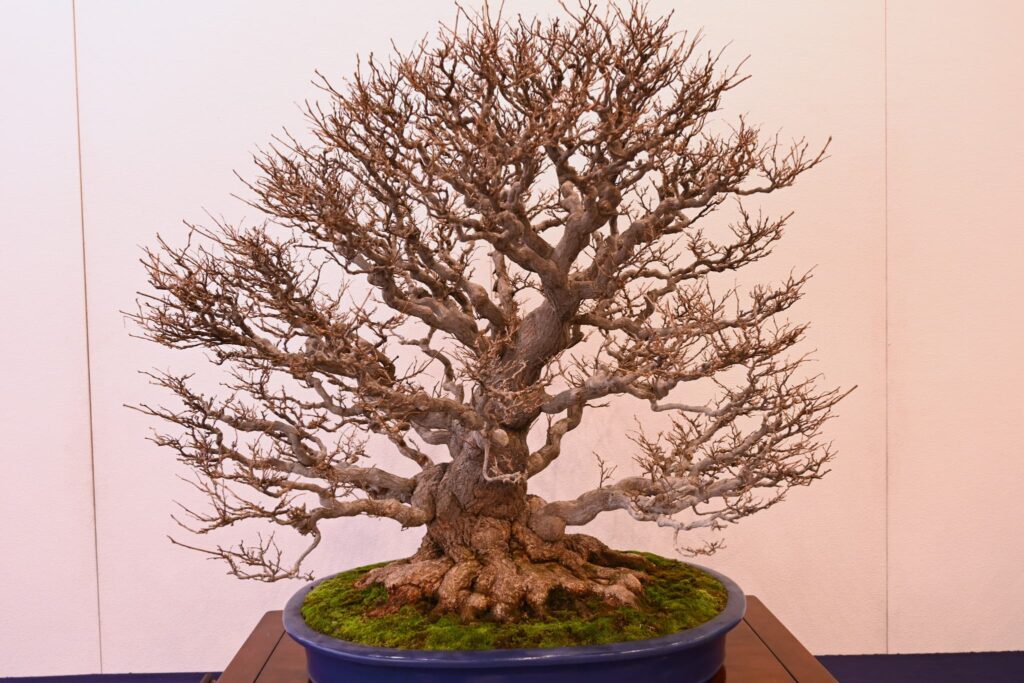
Japanese Snowbell generally requires little pruning. Its naturally spreading branches and rounded crown are important parts of its ornamental character, so excessive cutting should be avoided.
Remove dead, damaged, crossing, or poorly positioned branches as necessary. Winter pruning can be used to correct the shape or remove unwanted growth, but heavy pruning is unnecessary for a healthy tree.
When possible, preserve the tree’s natural branching structure rather than forcing it into a tightly controlled form.
Suitability for Home Gardens
Japanese Snowbell is well suited to gardens, parks, woodland-style plantings, and other locations where its natural form can be appreciated. It is particularly attractive as a specimen tree because its flowers are displayed beneath the branches and can be viewed from below.
Give the tree sufficient room to develop its spreading crown rather than planting it where frequent severe pruning will be necessary.
Because it is sensitive to drought, avoid extremely dry sites and provide irrigation during prolonged periods of hot, dry weather.
Pests
Japanese Snowbell is generally considered relatively free of serious pest problems, although several insects are specifically associated with the species. RHS describes it as generally pest-free.
The leaves may be attacked by the weevil Apoderus jekelii (Egotsurunekiotoshibumi), which rolls leaves into characteristic cylinders for reproduction.
The aphid Astegopteryx styracicola, known in Japan for producing distinctive “cat’s paw” galls on Japanese Snowbell, can deform winter buds and young growth.
The fruits may also be attacked by the larvae of the weevil Curculio egonis.
These insects are generally of specialist interest rather than major threats to established ornamental trees.
Cultivars
| Cultivar | Feature |
| Styrax japonica ‘Pink Chimes’ | Well-known pink-flowered selection with abundant pendent flowers |
| Styrax japonica ‘Emerald Pagoda’ | Upright, columnar form with a narrower habit |
‘Pink Chimes’ is particularly notable among cultivated forms. It is also associated with the Benibana Group in horticultural literature.
The weeping forms are useful where the natural downward movement of the branches is an important ornamental feature. ‘Emerald Pagoda’, by contrast, provides a more upright form for gardens where a narrower tree is preferred.
Styrax suberifolia, sometimes called Taiwan Egonoki, is not a cultivar of Japanese Snowbell and should not be included in a cultivar list. It is a separate species.
Similar Species
- Fragrant Snowbell (Styrax obassia, Hakuunboku) — a close relative with much larger leaves, often 10–20 cm long, and larger flower clusters. Its oversized foliage is one of the easiest ways to distinguish it from Japanese Snowbell.
- Shiraian Styrax (Styrax shiraianus, Kohakuunboku) — a Japanese relative that can resemble Japanese Snowbell but differs in leaf and floral characteristics.
- American Snowbell (Styrax americanus) — a North American relative with similar white, bell-shaped flowers.
- Taiwan Snowbell (Styrax suberifolia) — a separate species found in Taiwan and the southern part of the Japanese archipelago; it should not be confused with a cultivar of Styrax japonica.
- Japanese Honey Locust (Gleditsia japonica) — unrelated botanically, but worth comparing because its fruits also have a history of traditional use.
Japanese Snowbell and Fragrant Snowbell are particularly easy to confuse when only the flowers are visible. The much larger leaves of Styrax obassia provide one of the clearest identification differences.
Frequently Asked Questions
Why is Japanese Snowbell called a “snowbell”?
The common name refers to the tree’s white, bell-shaped flowers, which hang downward from the branches and resemble small bells or snow-covered ornaments.
Is the fruit of Japanese Snowbell poisonous?
The fruit and especially the fruit skin contain saponins, including egosaponin, and the fruit has an intensely irritating, acrid taste. It should not be eaten. The fruit’s historical use as a soap substitute and fish-stunning material is also related to its saponin content.
Is Japanese Snowbell suitable as a garden specimen?
Yes. Japanese Snowbell is an attractive specimen tree for gardens and parks, particularly where its spreading crown and pendent flowers can be viewed from below. It needs adequate soil moisture and enough space to develop naturally.
What does the name “Egonoki” mean?
The name Egonoki is generally associated with the harsh, acrid taste of the fruit. The fruit contains saponins that can irritate the throat and digestive system.
Can Japanese Snowbell timber be used for craft work?
Yes. Its pale, fine-textured, relatively hard wood is easy to work and has traditionally been used for turned objects, Japanese umbrella components, wooden combs, shogi pieces, abacus beads, kokeshi dolls, and other small craft and household objects.
How can Japanese Snowbell be identified when it is not flowering?
Look for its alternate, elliptic leaves with pointed tips and shallowly toothed margins, dark gray to gray-brown bark, and spreading branches. The bark is relatively smooth when young and develops shallow longitudinal fissures with age. The combination of these features can help distinguish it from related Styrax species even outside the flowering season.
How is Japanese Snowbell different from Fragrant Snowbell?
The easiest difference is leaf size. Japanese Snowbell (Styrax japonica) has relatively small leaves, generally around 4–8 cm long, whereas Fragrant Snowbell (Styrax obassia) has much larger leaves, often 10–20 cm long. The flower clusters of S. obassia are also generally larger and more conspicuous.
Conclusion
Japanese Snowbell is a distinctive Japanese native tree valued for far more than its delicate early-summer flowers. Its alternate pointed leaves, dark gray bark, pendent white blossoms, and autumn fruits make it readily recognizable, while its traditional uses reveal an important connection between Japanese trees and everyday life.
The saponin-rich fruit was once used as a natural washing material and in traditional fishing, while the fine, workable wood was used for umbrellas, turned objects, tools, and other crafts. Its relationship with birds such as the Varied Tit also gives the tree an interesting ecological role.
In cultivation, Japanese Snowbell is best allowed to develop its naturally graceful form in moist, fertile soil with adequate space. With its combination of ornamental beauty, practical history, wildlife value, and distinctive botanical features, Styrax japonica is one of the most interesting native flowering trees of the Japanese landscape.