Ginkgo (Ginkgo biloba): Identification, Care & Uses
Ginkgo (Ginkgo biloba) is one of the world’s oldest tree species and is often called a “living fossil.” This guide covers identification, leaves, flowers, seeds, cultivation, history, and practical uses, based on observations of the plant as grown in Japan.
What Is Ginkgo?
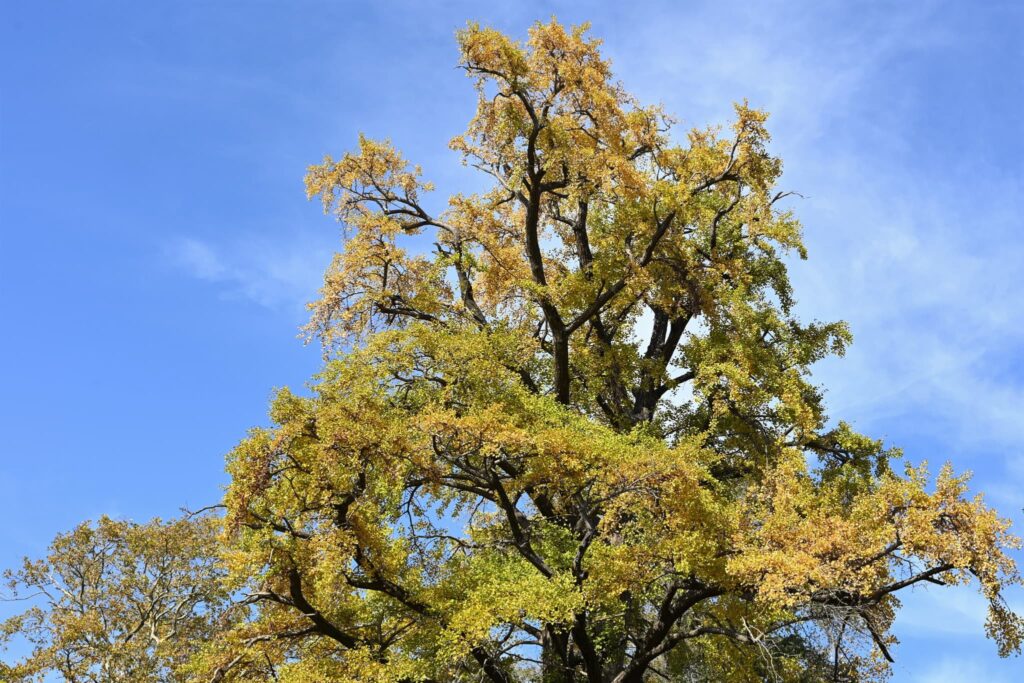
Ginkgo is a deciduous tree in the family Ginkgoaceae, widely planted in parks, schools, streets, and temple and shrine grounds across Japan. It is celebrated for its brilliant golden autumn foliage and is also one of the oldest living tree species on Earth. Its seeds (ginkgo nuts, or ginnan) are widely used in dishes such as chawanmushi (savory egg custard). Ginkgo is often called a “living fossil” because its lineage has survived for more than 200 million years and retains many features recognizable from ancient Ginkgo fossils. Today, Ginkgo biloba is the only living species in the family Ginkgoaceae.
Overview
| Item | Description |
|---|---|
| Scientific Name | Ginkgo biloba |
| Common Name | Ginkgo / Maidenhair Tree |
| Japanese Name | Icho (イチョウ) |
| Family | Ginkgoaceae |
| Native Range | China (introduced to Japan) |
| Plant Type | Deciduous Broadleaf Tree (gymnosperm) |
| Height | Up to 45 m (148 ft) |
| Flowering Season | April–May |
| Fruit Type | Ginkgo nuts (ginnan); not a true fruit |
| USDA Zones | 3–8 |
| Sun Exposure | Full Sun |
Characteristics
| Item | Description |
|---|---|
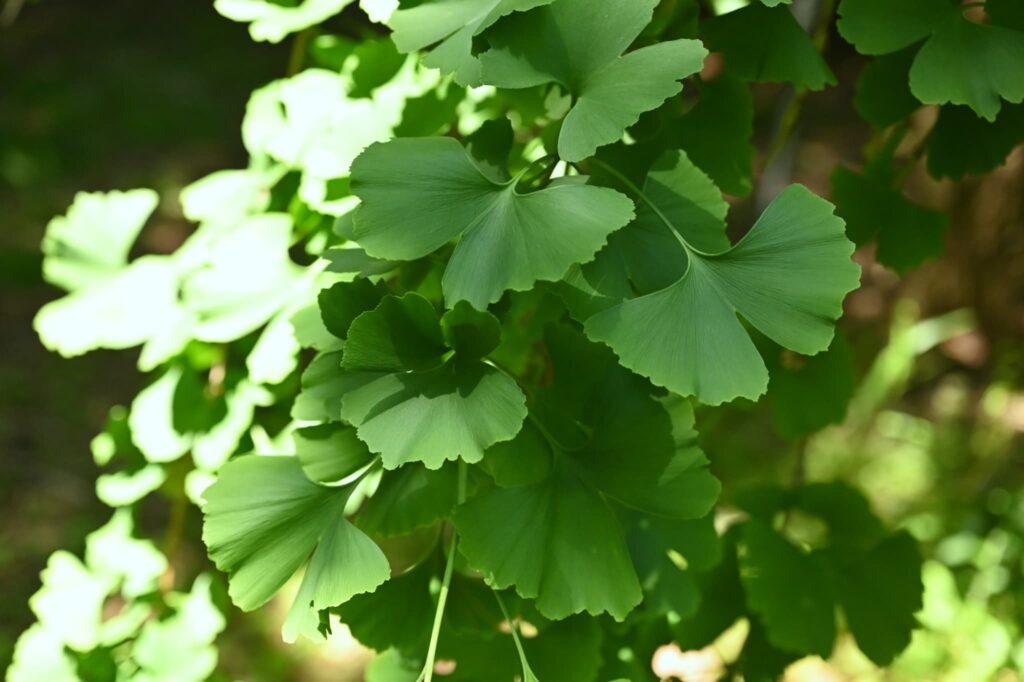
| Foliage | Fan-shaped, 5–7 cm wide, irregularly lobed and notched |
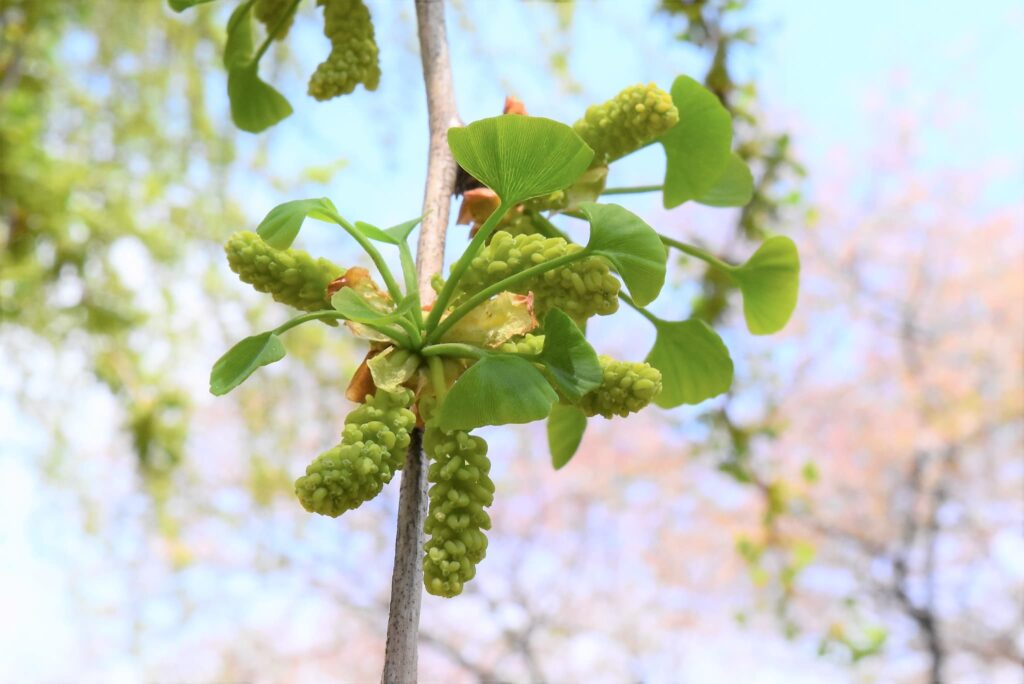
| Flowers | Dioecious, no petals; blooms April–May as leaves emerge |
| Fruit | Exposed seed (ginnan), ripens October–November |
| Bark | Corky, springy in texture; develops vertical fissures with age |
Foliage
Ginkgo leaves are fan-shaped, approximately 5–7 cm wide, with an irregularly lobed and notched upper margin. While individual leaf shape varies considerably between specimens, the species epithet biloba (“two-lobed”) references the characteristic central notch that divides many leaves into two distinct lobes. Long shoots produce leaves alternately; short spurs produce them in dense clusters.
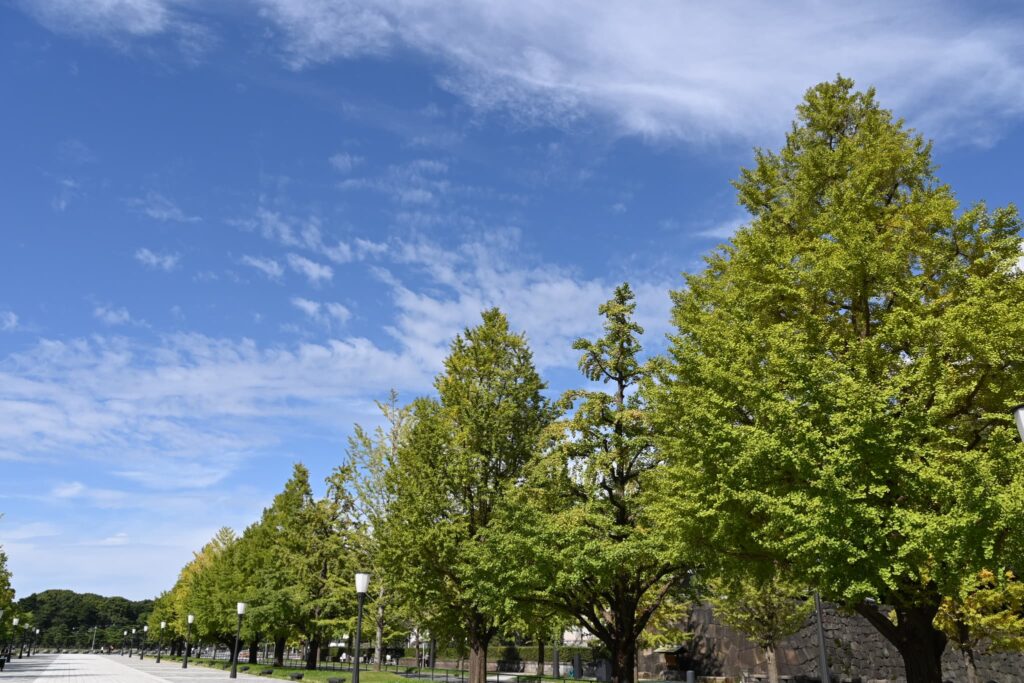
Though the leaf appearance is that of a typical broadleaf tree, Ginkgo is technically a gymnosperm — more closely related to conifers — and is classified accordingly here. The leaves are highly resilient, and the branches and trunk also show considerable resistance to burning, earning Ginkgo the name “fire tree” (hibuse no ki) in Japan. For this reason it has long been planted along streets and around schools as a fire-break.
Flowers
Ginkgo is dioecious, with male and female flowers blooming on separate trees in April to May as the leaves emerge. Neither is showy — there are no petals. Female flowers are green, bearing two exposed ovules at the tip of a long stalk, one of which develops into a seed. Male flowers are pale grayish-white, catkin-like, with stamens spirally arranged and two pollen sacs each. Wind carries the pollen over considerable distances to achieve fertilization — but in a remarkable botanical feature, fertilization itself occurs months later, around September to October, when the pollen tube produces motile sperm cells capable of swimming to the egg. The discovery of sperm cells in Ginkgo was made by Japanese botanist Sakugorō Hirase in 1896 — a landmark in plant biology.
Seeds (Ginnan)
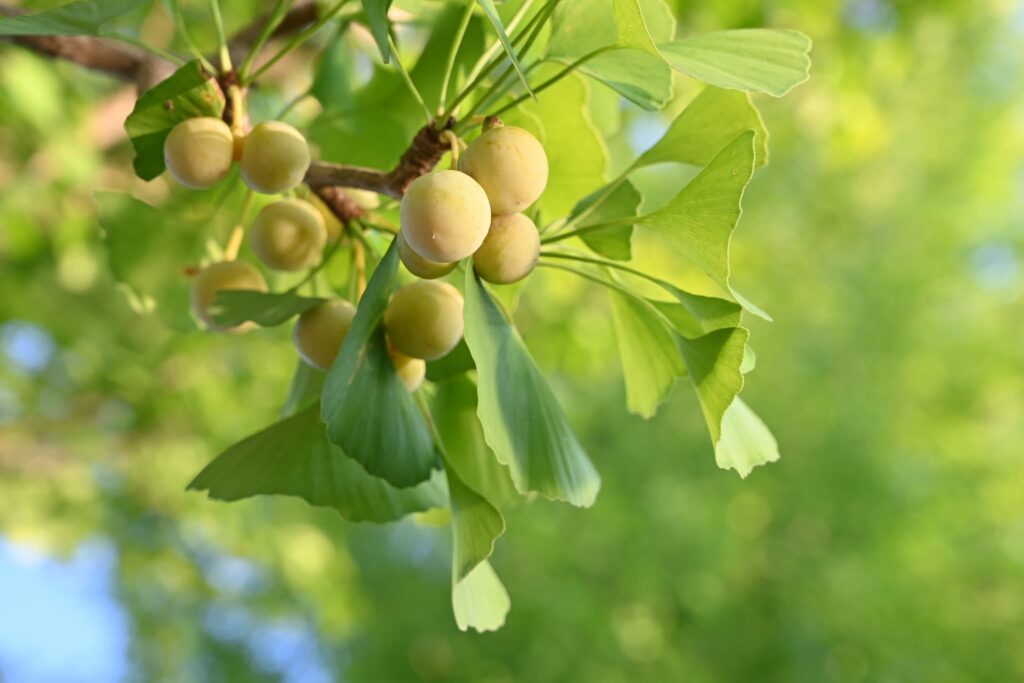
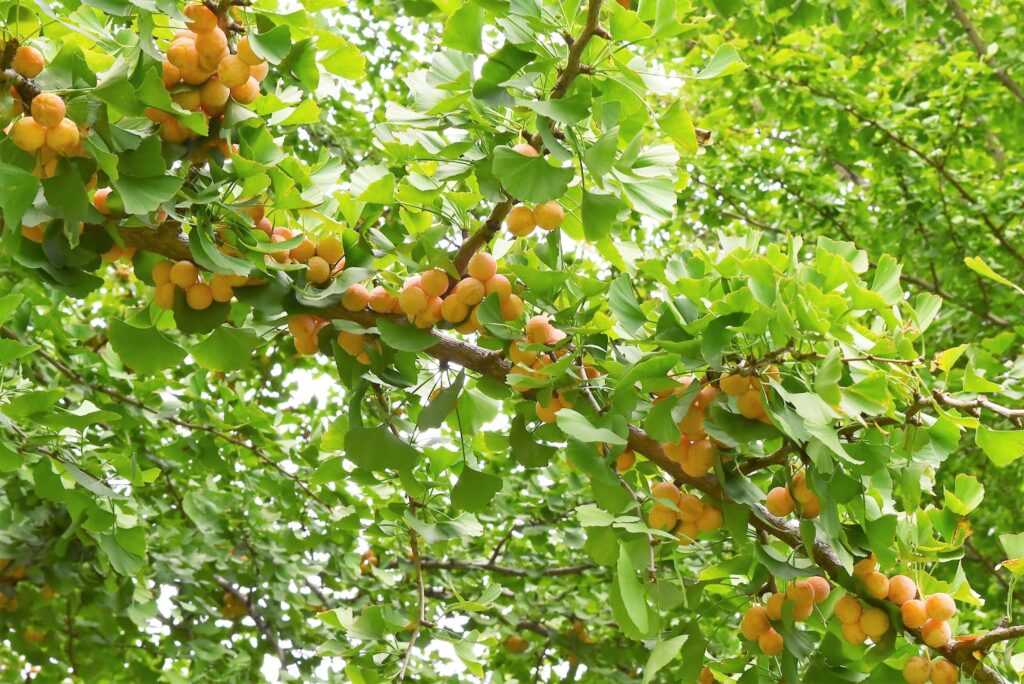
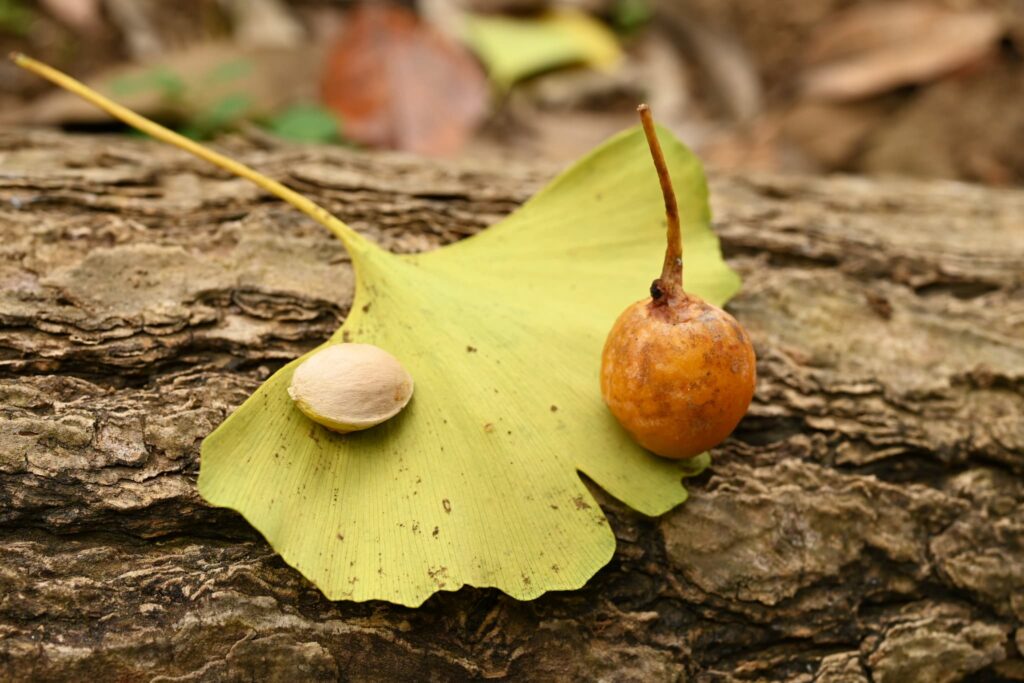
Ginkgo seeds ripen in October to November. Because Ginkgo is a gymnosperm, the seeds are not enclosed in a fruit — they are exposed seeds, making ginnan seeds themselves rather than fruit in the botanical sense. The fleshy outer layer (sarcotesta) is the source of the notorious odor. Beneath it, a hard white shell (sclerotesta) encloses the edible inner seed (embryo / endosperm). The outer layer contains toxic compounds — ginkgolic acid and ginkgotoxin — that can cause skin inflammation and blistering on contact, particularly in sensitive individuals.
The edible portion is used in cooking and traditional medicine. However, due to the unpleasant odor of fallen seeds, the mess they create, and the risk of skin irritation, male trees are now strongly preferred for street planting as they produce no seeds. Seeds germinate readily, and seedlings can often be found beneath parent trees — though a Ginkgo tree may take 30 years to begin bearing seeds.
Aichi Prefecture produces the largest quantity of ginnan in Japan. The town of Sobue in Inazawa City is a particularly well-known production area, where a cultivar called ‘Fujikuro’ is prized for its large size and texture. A word of caution: eating too many ginkgo nuts can cause poisoning.
The fleshy outer layer emits a strong odor when ripe, caused mainly by butyric acid. Despite the smell, the edible seeds inside are considered a delicacy in Japan.
Bark & Timber
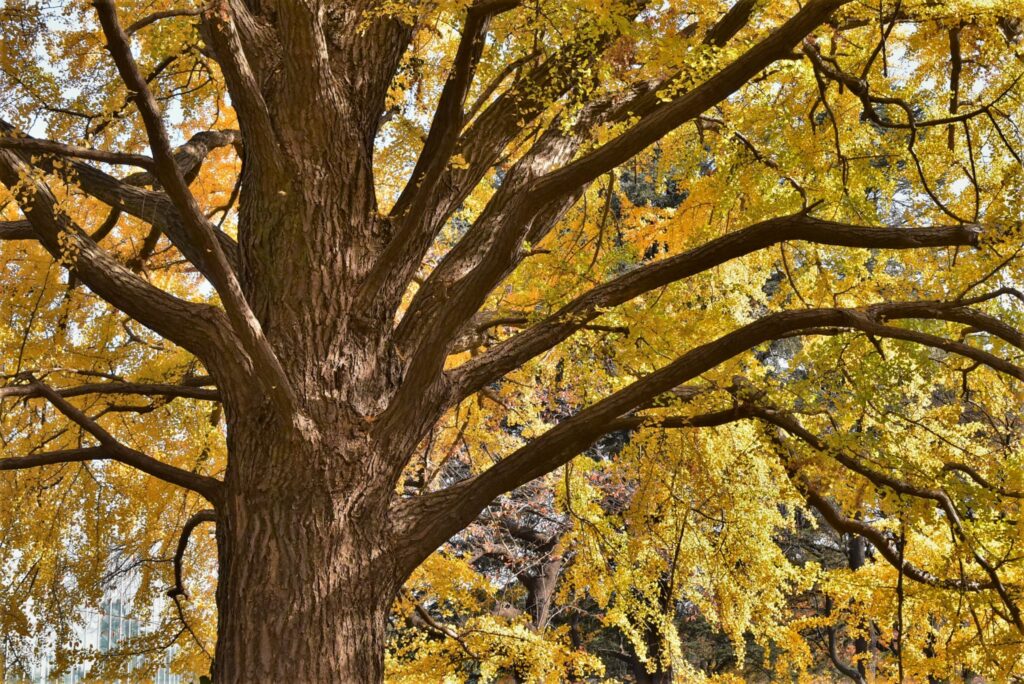
Ginkgo may reach 45 m in height, with trunk diameters of 2–5 m. The bark is notably corky in texture — large old trunks feel springy and warm to the touch. The thick corky bark provides excellent protection against fire, insects, and water loss, contributing to the tree’s remarkable longevity. The timber is rarely traded commercially, but where used — for cutting boards, go boards, shogi boards, and hat molds — it produces a beautiful cream-colored finish harder than Japanese Cedar, though somewhat lacking in long-term durability.
Size & Growth
Ginkgo is a fast-growing tree capable of reaching up to 45 m in height with a trunk diameter of 2–5 m at maturity. Its growth rate means pruning is usually necessary in garden settings, and a tree may take around 30 years before it begins bearing seed.
Uses & Cultural Significance
History & Introduction to Japan
Ginkgo is native to China and was later introduced to Japan, where it became deeply established in temple, shrine, and garden landscapes. The timing and route of its introduction remain uncertain. Some scholars associate its arrival with the Asuka period and the spread of Buddhism, while others suggest that it may have been introduced later, during the Muromachi period.
Today, Ginkgo is one of the most widely planted street trees in Japan because of its tolerance of air pollution, pruning, and compacted urban soils.
Name Origin
The Japanese name icho is thought to derive from the Chinese pronunciation yi-jiao (鴨脚, “duck foot”) — a reference to the distinctive fan-shaped leaves, which resemble a duck’s webbed foot. The kanji 公孫樹 (“grandfather-grandchild tree”) reflects the old saying that a tree planted by a grandfather will not bear fruit until the grandchildren’s generation. The character 銀杏 (ginnan or ginkgo) references the silver-colored, apricot-like appearance of the seeds.
Longevity & Sacred Trees
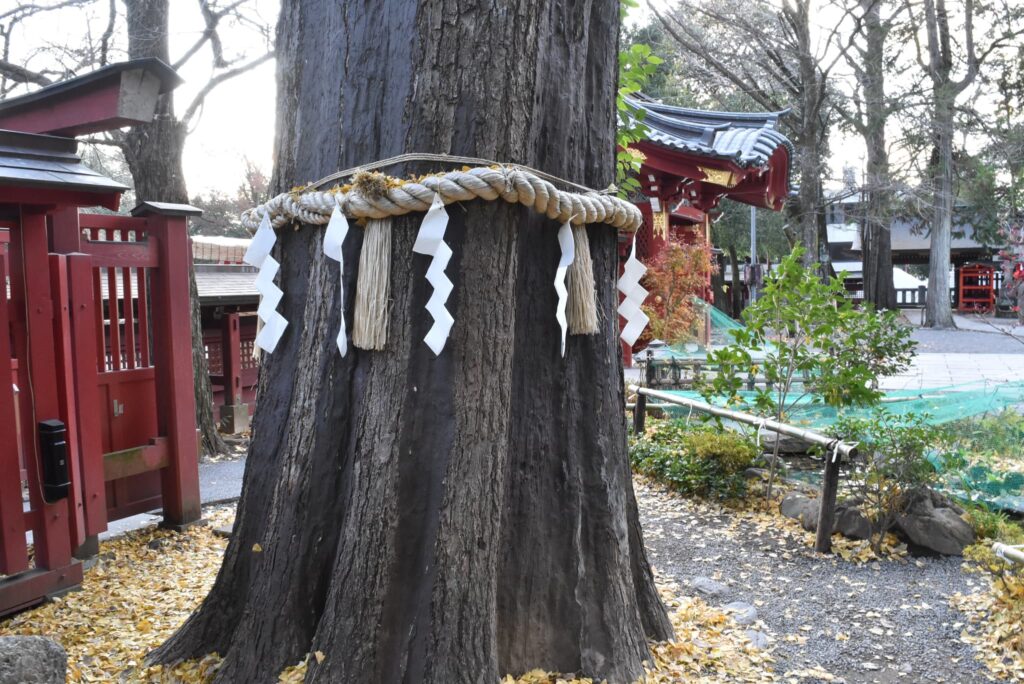
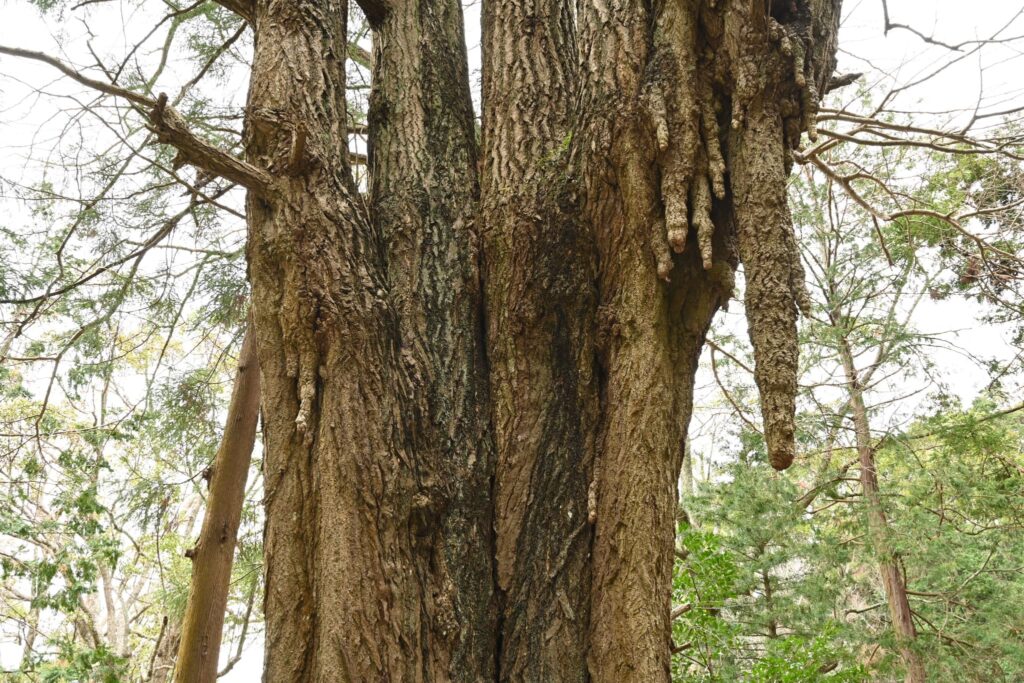
Ginkgo is often described as living for over 1,000 years, though most botanical sources suggest the actual lifespan is more likely several hundred years. Many long-lived specimens are designated natural monuments or revered as goshinboku (sacred trees) at Shinto shrines. Some ancient trees develop distinctive aerial roots (kikon) hanging from the trunk and major branches, resembling a woman’s breasts — a feature that gave rise to a folk tradition of praying before such trees for healthy lactation. Interestingly, these aerial roots most commonly develop on male trees, which produce no seeds and thus redirect surplus nutrients into root growth.
Autumn Color
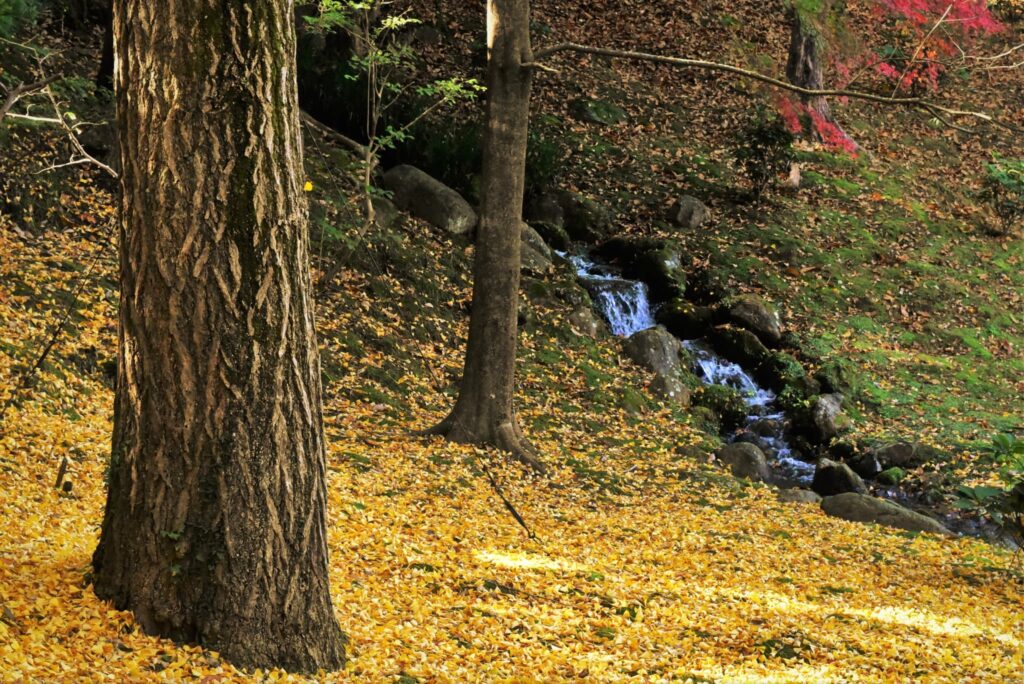
Ginkgo is among the last deciduous trees to color in autumn. In many parts of Japan, the leaves turn brilliant golden yellow from late November to early December before falling almost simultaneously over just a few days, creating the famous “golden carpet” seen beneath mature trees. Unlike many deciduous trees, Ginkgo produces a remarkably uniform golden-yellow autumn display because chlorophyll breaks down almost simultaneously across the canopy.
Growing Guide
| Item | Description |
|---|---|
| Light | Full Sun; grows poorly in shade |
| Cold Hardiness | USDA Zones 3–8; tolerates cold, drought, strong winds, air pollution, and poor soil |
| Wind Resistance | Deep roots make it fundamentally wind-resistant |
| Pruning | Fast-growing; usually needs pruning, but avoid excessive heavy pruning |
| Garden Suitability | Better suited to parks, streets, and large properties than typical residential gardens |
Adaptability
Ginkgo is remarkably tough — tolerating drought, cold, strong winds, air pollution, and poor soil. It is a sun-loving species, however, and grows poorly in shade. It can be planted from central Hokkaido southward.
Root System & Wind Resistance
Deep roots make Ginkgo fundamentally wind-resistant, and toppling in typhoons is uncommon. However, falling branches can damage nearby structures, making it generally unsuitable for typical residential gardens.
Pruning
Ginkgo grows quickly and pruning is usually necessary in garden settings. However, repeated heavy pruning each year tends to produce an ungainly, knobby branch structure — the gnarled, stub-covered form common in urban street trees is not the natural form of the species. Restraint is recommended.
Leaf Litter
The dense canopy provides excellent shade in summer, but the large autumn leaf fall requires considerable cleanup effort.
Pests & Disease
Ginkgo is exceptionally resistant to pests and disease — one of the most pest-resistant trees in cultivation. The main exception is occasional defoliation by caterpillars of the Japanese Oak Silkmoth (Caligula japonica), a large moth species, which can strip new leaves entirely.
Skin Sensitivity
People who are sensitive to ginkgo may develop contact dermatitis after handling the fleshy outer layer of the seeds.
Cultivars
The following are not strictly cultivars in the horticultural sense, but recognized forms based on genetically expressed characteristics:
| Form | Feature |
|---|---|
| Ohatsuki Icho | Seeds develop attached directly to the leaves; also called “fruit-bearing ginkgo” |
| Chichi Icho (“Breast Ginkgo”) | Develops drooping, knob-like aerial roots from the trunk and major branches. Genetically predisposed individuals develop these with age; those that produce aerial roots from a young age grow more slowly and are better suited to garden planting |
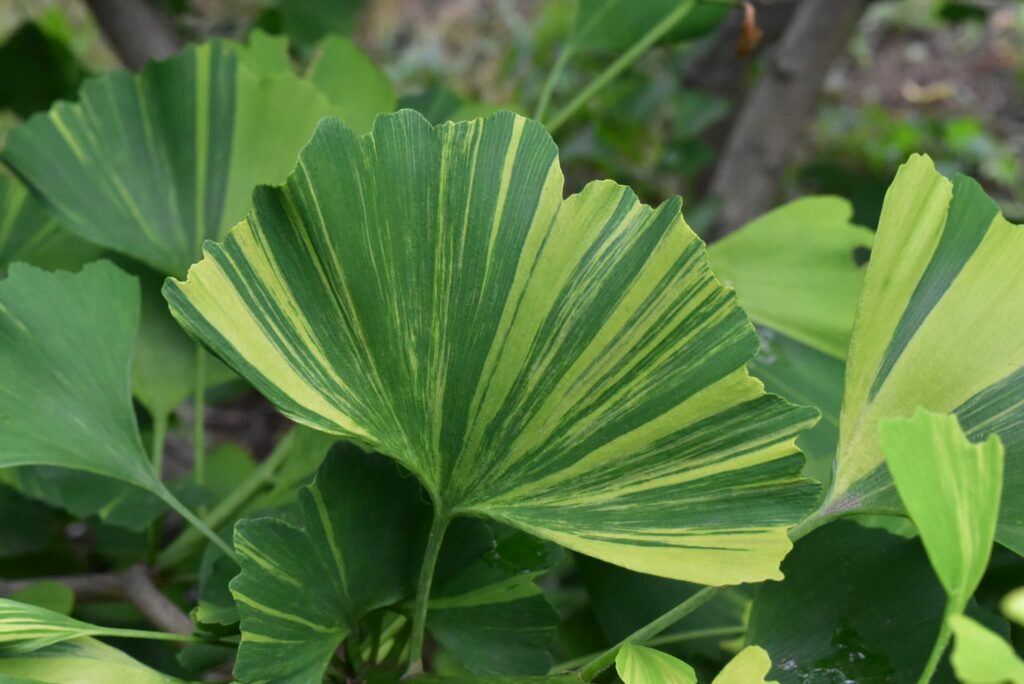
| Fuiri Icho | Leaves marked with cream-colored stripes or spots |
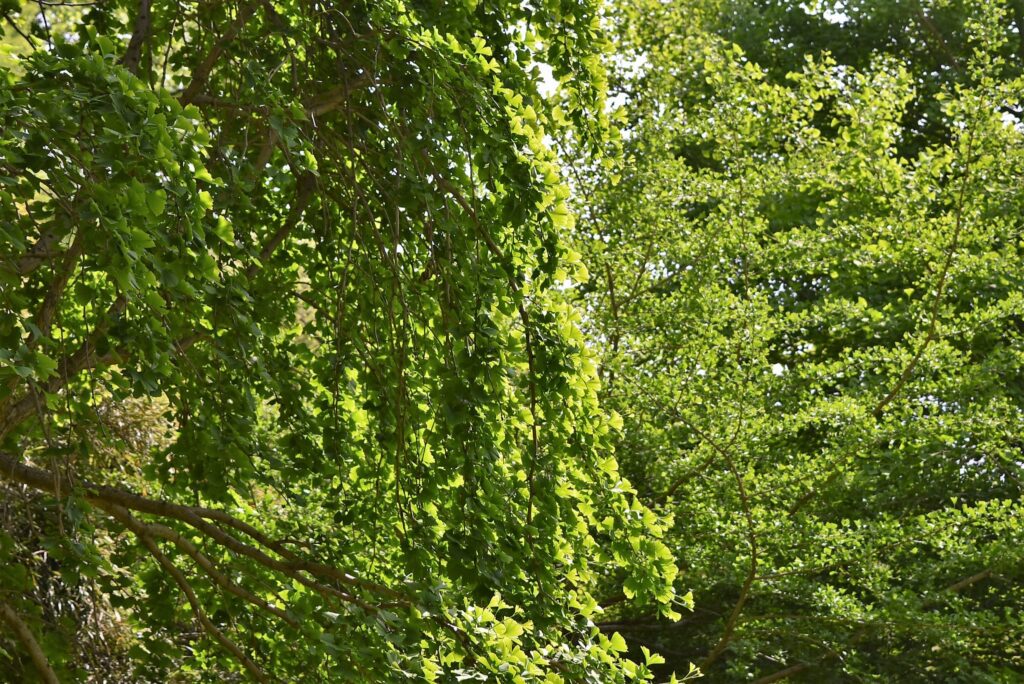
| Shidare Icho | Weeping form with pendulous branches |
| Hoki Icho (“Broom Ginkgo”) | Numerous upright branches giving a broom-like silhouette |
| Rappa Icho (“Trumpet Ginkgo”) | Leaves shaped like a trumpet or funnel |
Frequently Asked Questions
Is Ginkgo a deciduous tree or a conifer?
Technically neither — and both. Ginkgo is a gymnosperm like conifers, but it is deciduous like broadleaf trees. It belongs to its own unique order (Ginkgoales) with no living relatives, making it truly one of a kind.
Why do female Ginkgo trees smell so bad in autumn?
The fleshy outer seed coat (sarcotesta) contains butyric acid — the same compound responsible for the smell of rancid butter and vomit — as a natural deterrent against animals that might otherwise consume the seeds whole rather than dispersing them. Male trees, which produce no seeds, have no odor.
How can you tell male and female Ginkgo trees apart?
Without flowers or seeds, reliable identification is difficult. A traditional (but not scientifically reliable) rule of thumb held that deeply lobed, “trouser-like” leaves indicated a male tree and unlobed, “skirt-like” leaves a female — but leaf shape varies by branch position and tree age rather than sex. Male trees tend to grow more upright with less branching; females tend to spread more horizontally.
Is Ginkgo extract really effective for memory?
Ginkgo leaf extract has been studied extensively for cognitive function and circulation, but evidence for meaningful benefits in healthy people or for preventing cognitive decline remains mixed.
Why are male Ginkgo trees preferred for street planting?
Female trees produce seeds with a notoriously foul-smelling outer coat. The seeds fall in large quantities, create a slipping hazard, and can cause skin reactions. Male trees produce pollen but no seeds, making them far more practical for urban use.
Why is Ginkgo called a living fossil?
Ginkgo is called a “living fossil” because its lineage has survived for more than 200 million years and retains many features that can be recognized in ancient Ginkgo fossils. Today, Ginkgo biloba is the only living species in the family Ginkgoaceae.
Why do Ginkgo trees planted along streets usually produce no fruit?
Because almost all street trees are male cultivars. Female trees produce foul-smelling fruits, so they are rarely planted in urban areas.
Conclusion
Ginkgo (Ginkgo biloba) is one of the most distinctive trees in cultivation, recognized by its fan-shaped leaves, brilliant golden-yellow autumn color, and long history in Japan. Its unusual biology—including separate male and female trees and its status as the only living species of the Ginkgoaceae family—makes it equally interesting from a botanical perspective.
Ginkgo is exceptionally tolerant of cold, drought, air pollution, and poor urban soils, which explains its widespread use as a street and landscape tree. However, its eventual size, heavy leaf fall, and the foul-smelling seeds produced by female trees make it better suited to parks, streets, temple and shrine grounds, and other spacious sites than to most residential gardens.
For anyone interested in identifying Japanese trees, the fan-shaped leaves, dense leaf clusters on short shoots, and brilliant yellow autumn color provide some of the easiest ways to recognize Ginkgo.