Kobus Magnolia (Magnolia kobus): Identification, Flowers, Fruit & Growing Guide
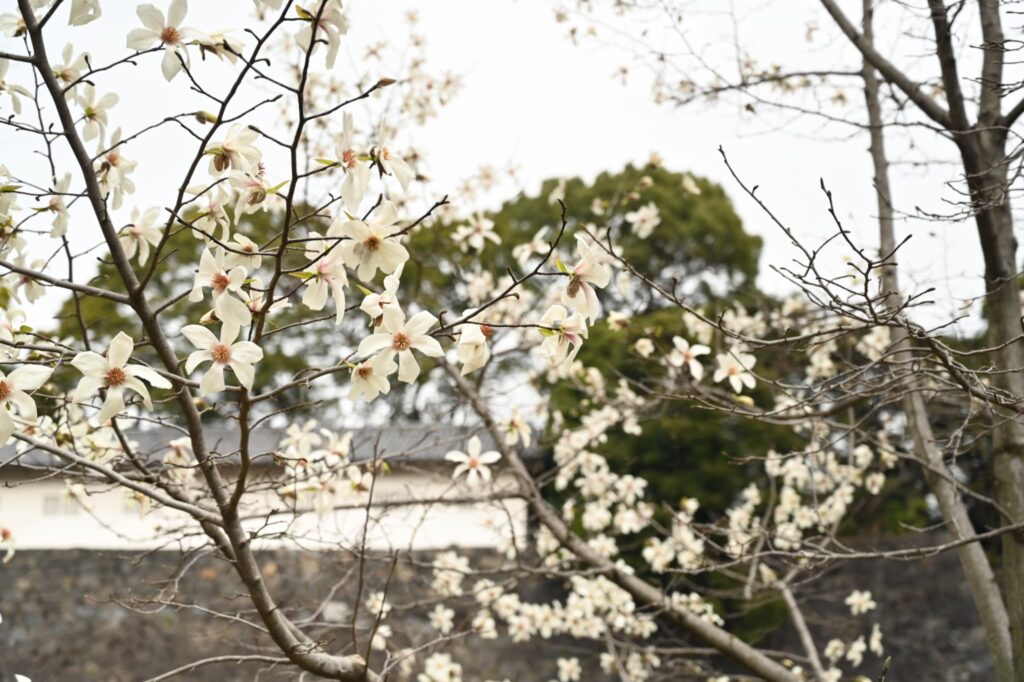
Kobus Magnolia is one of the classic harbingers of spring in Japan’s satoyama landscapes, its white flowers opening before the leaves emerge, and is also widely planted as a street and park tree for its broad, shade-giving canopy. This guide covers identification features, flowers, fruit, bark, cultivars, and care, based on observations of the tree as grown in Japan.
What Is Kobus Magnolia?
Kobus Magnolia is a deciduous broadleaf tree in the family Magnoliaceae, growing wild throughout Japan from Hokkaido in the north to Kyushu in the south, in mountain woodlands and sunny open fields. It flowers white in early spring and is one of the classic flowering trees associated with satoyama landscapes as a herald of the changing season. Because its large leaves cast good shade, it is also widely planted as a street and park tree. Though it carries a strongly Japanese image, it also grows wild on Jeju Island in Korea.
Overview
| Item | Description |
|---|---|
| Family | Magnoliaceae |
| Genus | Magnolia |
| Species | M. kobus |
| Scientific Name | Magnolia kobus |
| Common Name | Kobus Magnolia / Kobushi Magnolia / Northern Japanese Magnolia |
| Japanese Name | Kobushi (コブシ) |
| Native Range | Japan (Hokkaido to Kyushu); also Jeju Island, Korea |
| USDA Hardiness | 5–8 (approximately) |
| Plant Type | Deciduous Tree |
| Height | 15–25 m |
| Trunk Diameter | Up to about 70 cm |
| Flowering Season | Late March–early April |
| Fruit Type | Knobby aggregate fruit, about 10 cm, ripening in October |
| Garden Use | Street tree, park tree, satoyama-style specimen |
Characteristics
| Feature | Description |
|---|---|
| Leaves | Alternate, irregularly oval, smooth-edged, lemon-scented when bruised |
| Flowers | White, lemon-scented, opening before the leaves |
| Fruit | Knobby aggregate fruit; seeds hang on white threads when ripe |
| Bark | Grayish white, shallowly fissured with age |
Flowers
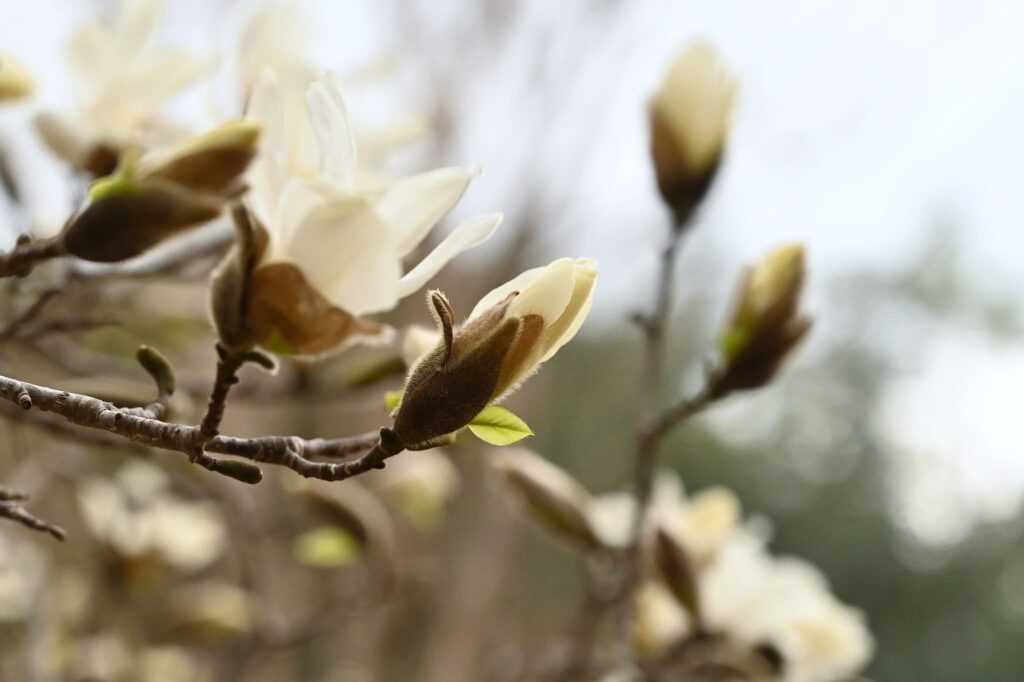
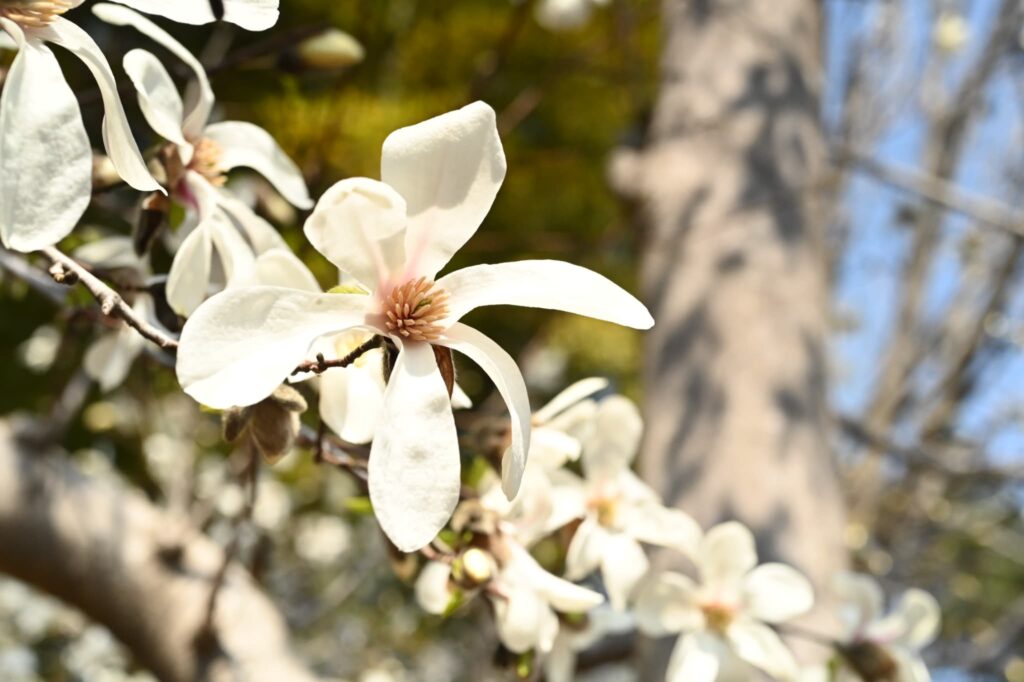
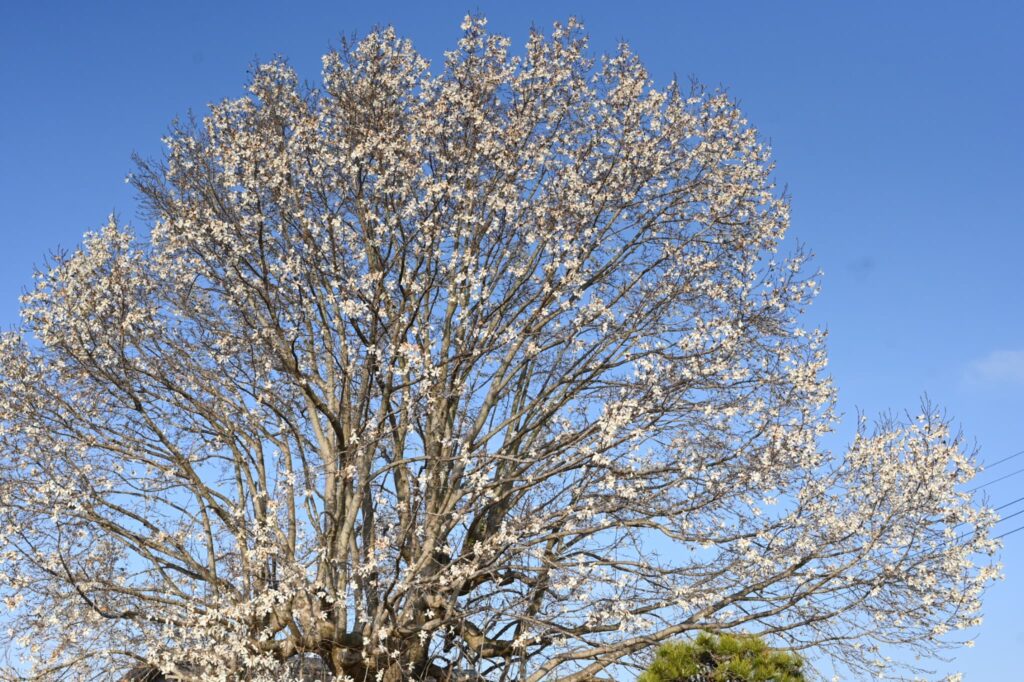
Kobus Magnolia flowers from late March to early April, earlier than the Somei-yoshino cherry. Flower buds are covered with three silvery, hairy protective scales, which resemble sepals. Before the leaves have unfurled, a single white flower, 6–10 cm across, opens at the tip of each small branch.
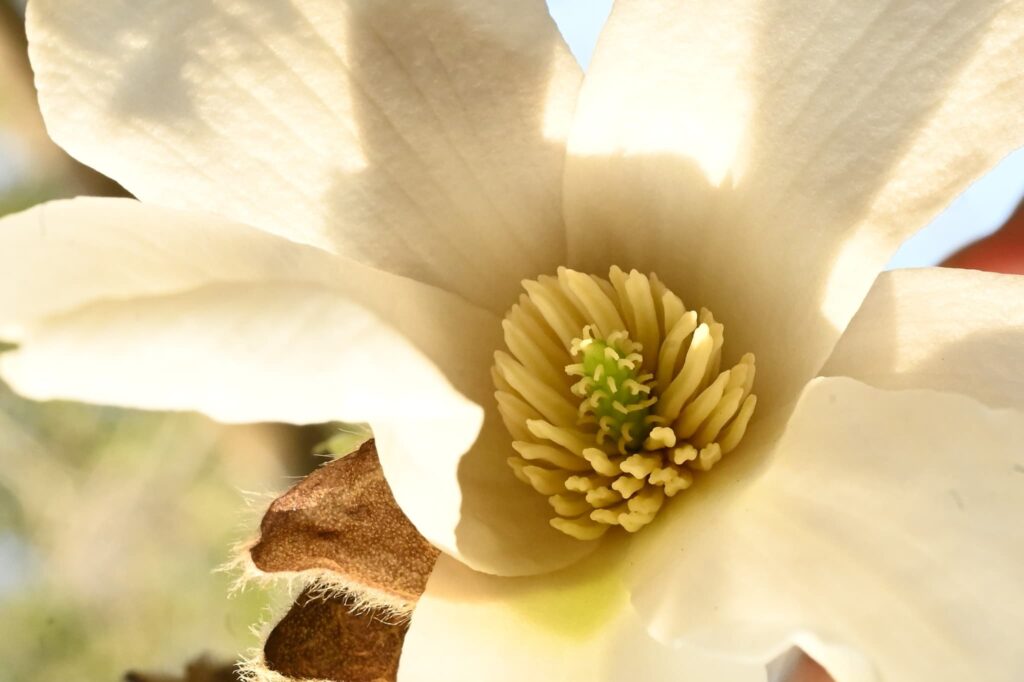
The petals are white, tinged reddish-purple on the outside. Of the nine petal-like segments, the three smallest and greenest are technically sepals rather than true petals. Just below the flower, one or two new leaves emerge early alongside it. The species is monoecious, with an elongated, rod-like floral receptacle inside the flower: green pistils spiral around its upper portion, and cream-colored stamens spiral around its lower portion.
The flowers carry a lemon-like fragrance and, along with the flower buds, are used to make flavored liqueur and tea. Dried flower buds are also used in traditional Chinese and Japanese herbal medicine under the name shini, for relieving sinusitis and rhinitis and as a mild pain reliever, with active compounds including citral, cineole, and eugenol. In traditional medicine, dried magnolia flower buds are known as shini and have been used for nasal and sinus-related complaints.
Folklore & Agricultural Tradition
Kobus Magnolia carries a number of alternate regional names—Tauchi-zakura (“rice-field-plowing cherry”), Taue-zakura (“rice-planting cherry”), Nawashiro-zakura (“seedbed cherry”), Tanemaki-zakura (“seed-sowing cherry”), and Imoue-bana (“potato-planting flower”)—despite not actually being a cherry at all. These names reflect the tree’s traditional role as a natural calendar: its bloom time was long used across Japan, and especially in the Tohoku region, as a signal for the start of seasonal farm work, with many additional local variants of these names still in regional use.
Kobus Magnolia is also the subject of a traditional belief that when sunlight is abundant, the tips of its flower buds point north, and that a year with an especially heavy bloom foretells a good harvest.
Foliage
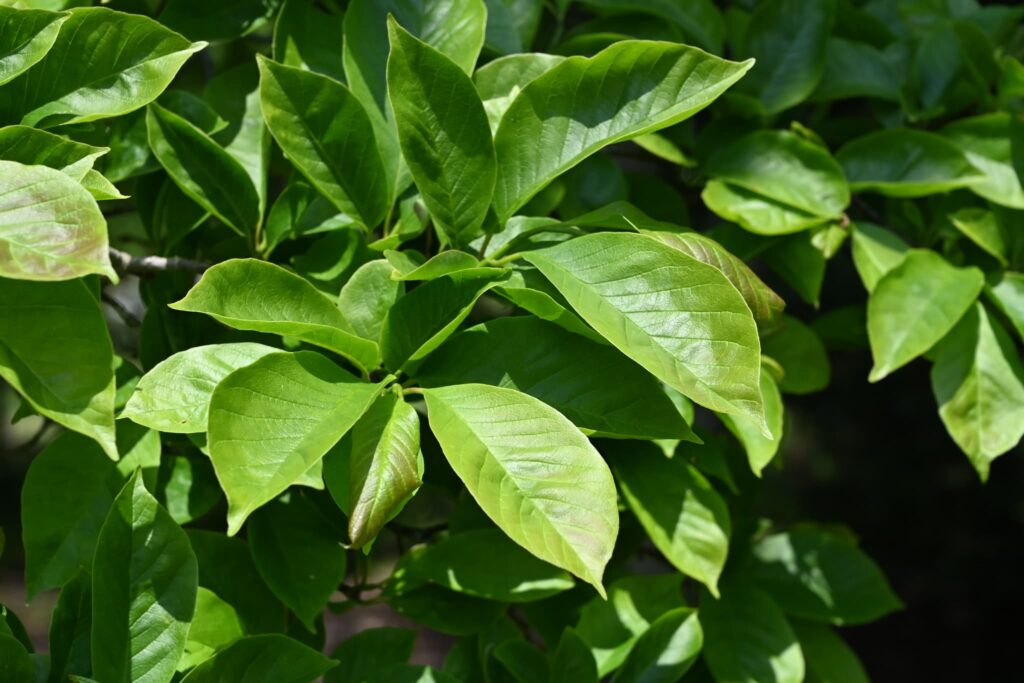
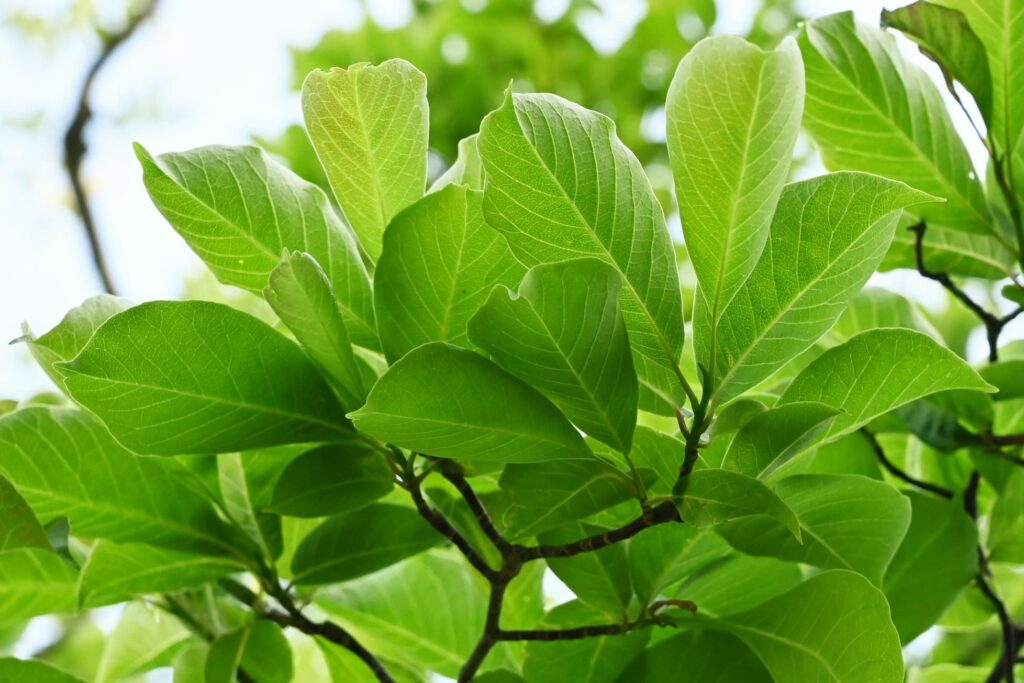
Leaves are 6–13 cm long and about 5 cm wide, an irregular oval shape with a pointed, slightly protruding tip. They grow alternately along the branch, with smooth (untoothed) margins and a pale green underside. Young leaves bear fine hairs, which disappear as the leaf matures. Both the branches and leaves carry a lemon-like fragrance, released strongly when broken or burned.
Flower buds and fruit have a distinctive fragrance and sharp, peppery bite when chewed—a trait reflected in the tree’s alternate names Yama-araragi (“mountain araragi,” referencing the pungency of Allium macrostemon) and the older name Kobushi-hajikami (“kobushi pepper,” referencing the pungency of sansho pepper or ginger). Neither the buds nor fruit are eaten as food; instead, this pungency has been put to use as a spice and as a dye source.
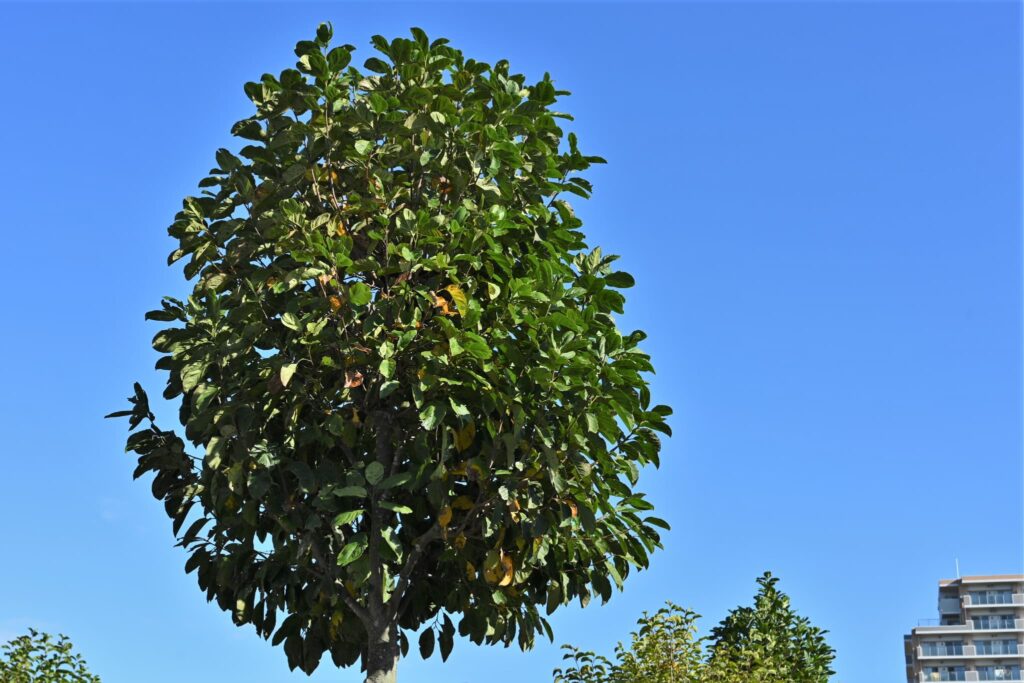
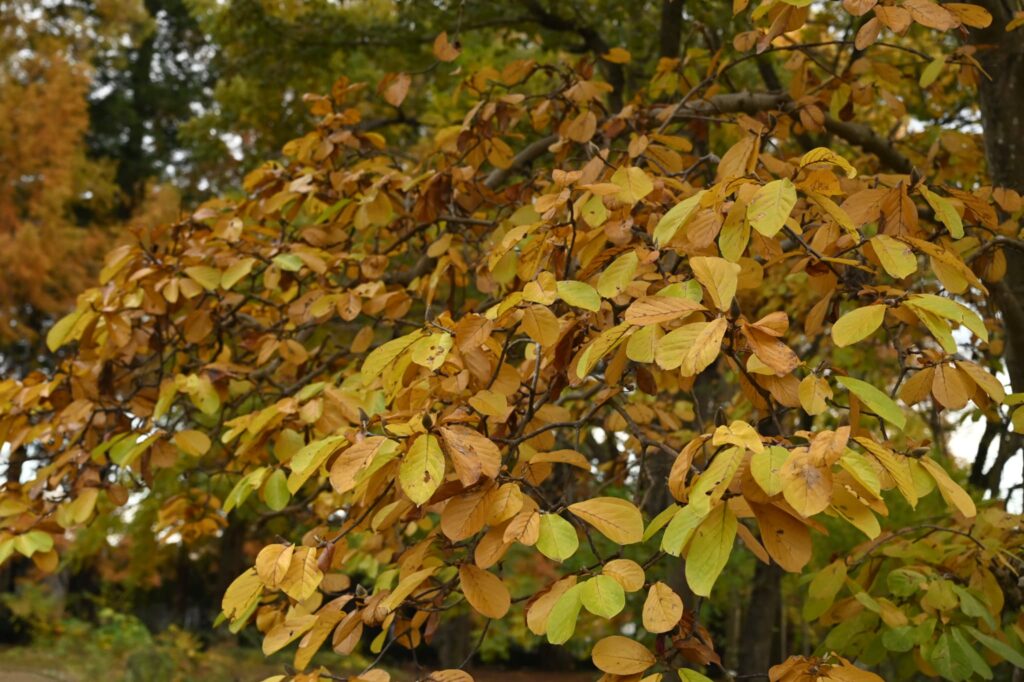
In autumn, the foliage turns a pale yellow, though the period of good color is fairly brief. Kobus Magnolia tends to draw little attention outside of its flowering season, but its bare winter branch structure has a certain strength and character, which is part of why it remains a popular choice as a garden tree even beyond bloom time.
Fruit
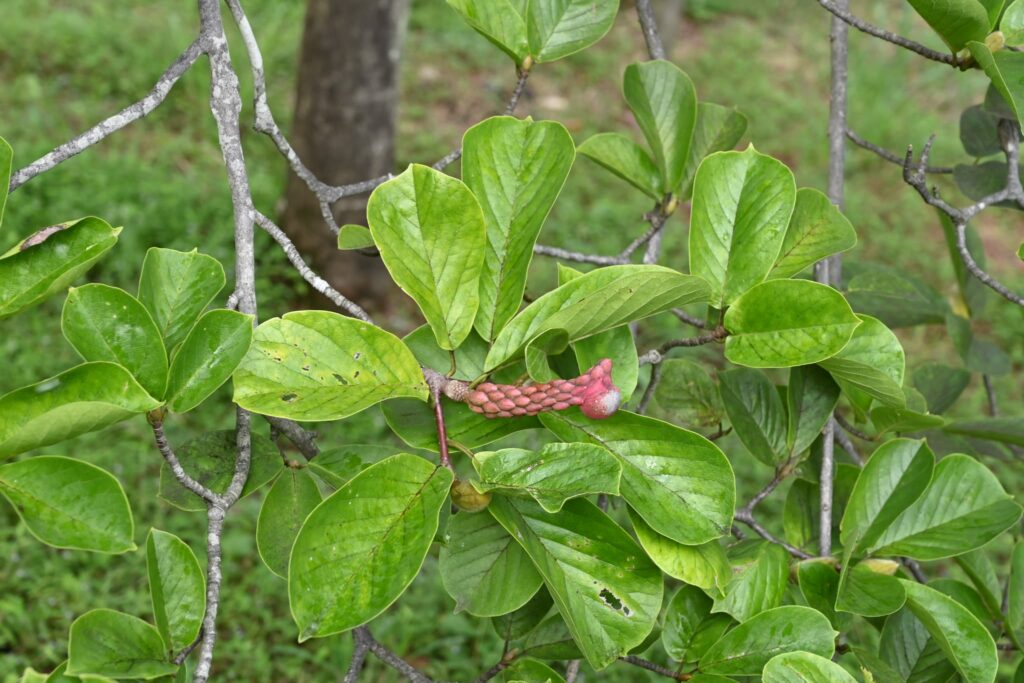
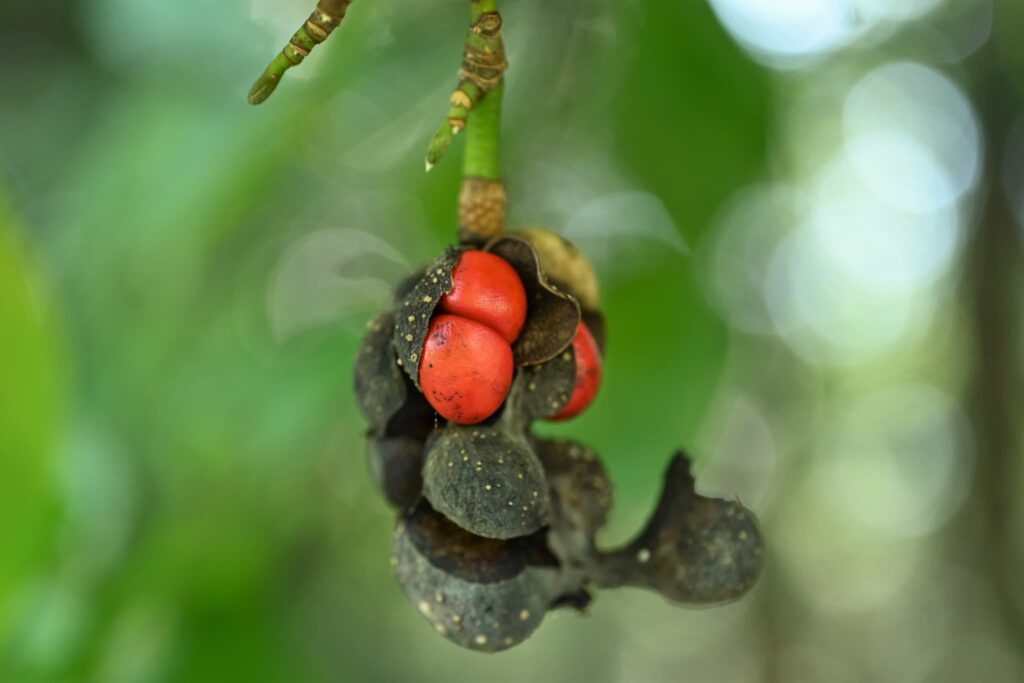
The fruit is a knobby aggregate structure up to about 10 cm long. When it ripens in autumn (October), it splits open naturally, and black seeds—each wrapped in a red aril—dangle out on fine white threads, creating an appearance that can seem somewhat unsettling up close. The seeds have a linear surface pattern. They typically fall soon after ripening, and birds such as the Japanese green woodpecker and narcissus flycatcher will feed on fruit that has already dropped to the ground.
Naming: Why “Kobushi”?
The name Kobushi is generally said to come from the knobby, irregular shape of the fruit, which resembles a clenched fist (kobushi)—though individual fruit shape varies considerably, and finding one that genuinely looks like a fist can be surprisingly difficult. The unopened flower bud, by contrast, more consistently resembles a fist shape, and some sources instead trace the name to the bud rather than the fruit.
Trunk & Bark
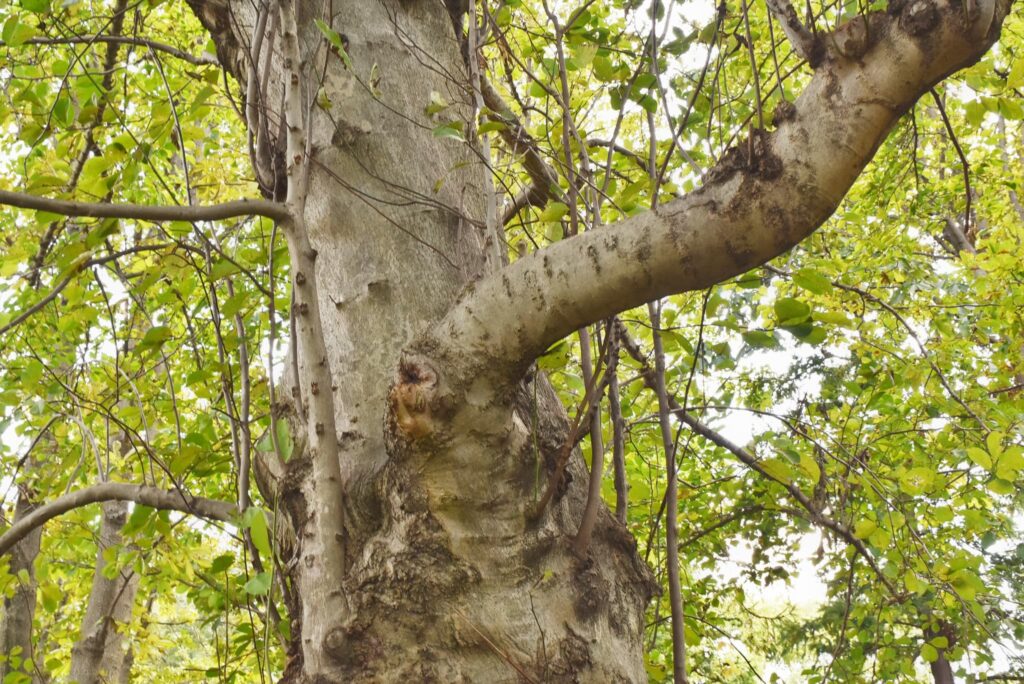
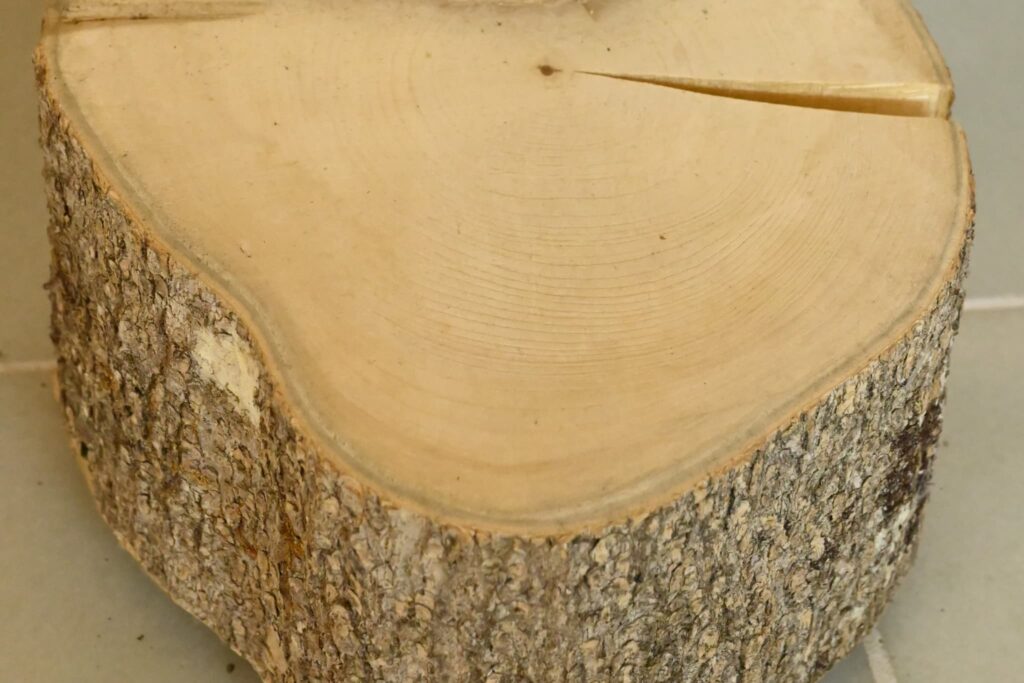
The trunk can reach up to about 70 cm in diameter. The bark is grayish white, developing shallow fissures with age. The wood resembles that of the related Japanese Bigleaf Magnolia (Houba) in appearance, but is harder and more difficult to work, with a quality generally considered inferior to Houba’s. It is occasionally used for tea-ceremony room alcove posts, tool handles, musical instruments, and furniture, and charcoal made from Kobus Magnolia wood has traditionally been used for polishing gold and silver.
Growing Guide
Climate & Site
Kobus Magnolia tolerates both cold and heat well and can be planted anywhere from Hokkaido to Kyushu. It also withstands strong wind, salt-laden coastal air, and poor soil, making it well suited to street and park plantings.
Pests
The tree is generally resistant to pests and disease, though it can occasionally be affected by wood-boring beetle larvae. Its flower buds are also sometimes eaten by brown-eared bulbuls, though less frequently than those of the related Shide-kobushi.
Growth & Flowering Timeline
Growth is somewhat fast, but a tree grown from seed can take close to ten years to reach flowering age, and as the tree matures, it tends to shift toward blooming only every other year.
Pruning & Space
Branching is simple, which keeps pruning maintenance relatively light, but both the tree and its leaves are on the large side, so for a smaller home garden, the more compact Shide-kobushi is generally a better fit.
Cultivars
- Kitakobushi — a cold-hardy variety of Kobus Magnolia found in Hokkaido, Tohoku, and Hokuriku, with larger leaves and flowers than the standard species.
Japanese-Magnolia-Magnolia-kobus Kitakobushi in flower.
Similar Plants
- Saucer Magnolia relative, Hakumokuren (Magnolia denudata) — bears larger, slightly more yellow-tinged flowers than Kobus Magnolia. Its flowers have six petals, plus three large white sepals in addition; unlike Kobus Magnolia, it lacks the small leaf that grows alongside the flower.
- Shide-kobushi / Star Magnolia (Magnolia stellata) — a compact species, along with its cultivar Beni-kobushi, well suited to smaller home gardens thanks to its lower stature and denser branching. A double-flowered hybrid between Kobus Magnolia and Shide-kobushi, ‘Ballerina’, has become especially popular in recent years as a symbol tree.
- Tamushiba / Willow-leafed Magnolia (Magnolia salicifolia) — grows at higher elevations than Kobus Magnolia and is more common along the Sea of Japan coast, largely absent from the Kanto and Tokai regions. Its flowers are more sparsely borne, smaller, and narrower-petaled than Kobus Magnolia’s, but more strongly fragrant. Its sepals are white rather than green, making them harder to distinguish from the petals, and its leaves are narrower, hairless, and pale on the underside. Tamushiba is also distinguished by its habit of producing several slender trunks in a clump.
- Kobushi-modoki / Haikobushi — a rare form discovered in 1948 in Aioi-cho, Tokushima Prefecture. Its flowers and leaves are larger than Kobus Magnolia’s but thinner, with especially delicate, easily damaged petals. Only a single wild specimen was ever found, and the form is believed extinct in the wild, though plants propagated by cuttings are grown in botanical gardens, flowering somewhat later in the season than standard Kobus Magnolia.
- Ogatama-no-ki (Michelia compressa) — a closely related evergreen tree that produces fruit similar to Kobus Magnolia’s, but with much smaller flowers that tend to be hidden within the foliage.
Difference Between Kobus Magnolia and Saucer Magnolia
Saucer Magnolia (Magnolia × soulangeana) is a hybrid ornamental tree, while Kobus Magnolia (Magnolia kobus) is a wild species native to Japan. Saucer Magnolia produces much larger, cup-shaped flowers in shades of pink, purple, or white, making it one of the most widely planted flowering magnolias in gardens. Kobus Magnolia bears smaller white flowers with a faint reddish-purple tint on the outside and often produces one or two young leaves alongside each flower, a feature Saucer Magnolia lacks. Kobus Magnolia is also generally taller, hardier, and more suitable as a street or park tree.
Difference Between Kobus Magnolia and Star Magnolia
Star Magnolia (Magnolia stellata, known in Japan as Shide-kobushi) is much smaller than Kobus Magnolia and is better suited to compact gardens. Its flowers have numerous narrow, strap-like petals, giving them a star-shaped appearance, whereas Kobus Magnolia has broader petals and a simpler flower form. Star Magnolia also flowers slightly earlier and develops a denser branching habit, while Kobus Magnolia eventually becomes a large shade tree reaching over 20 meters in height.
Difference Between Kobus Magnolia and Willow-leaf Magnolia
Willow-leaf Magnolia (Magnolia salicifolia, Tamushiba) grows naturally in cooler mountain regions and is distinguished by its narrow, willow-like leaves and stronger fragrance. Its sepals are white and blend with the petals, making them difficult to distinguish, whereas Kobus Magnolia has three green sepals that are clearly visible beneath the white petals. Tamushiba often develops several slender trunks from the base, while Kobus Magnolia usually forms a single stout trunk with a broad crown.
Frequently Asked Questions
Q: Why does Kobus Magnolia have so many folk names related to farming?
Its bloom time in early spring has traditionally served as a natural signal for the start of seasonal agricultural work, particularly rice-field preparation and planting. This gave rise to regional names like Tauchi-zakura (“rice-field-plowing cherry”) and Taue-zakura (“rice-planting cherry”), especially common in the Tohoku region, even though the tree isn’t actually a cherry at all.
Q: What’s the difference between Kobus Magnolia and Hakumokuren?
Hakumokuren’s flowers are larger and slightly more yellow-tinged, with six true petals plus three large white sepals. Kobus Magnolia’s flowers are somewhat smaller, tinged reddish-purple on the outside, and are accompanied by a small leaf growing alongside the flower—a feature Hakumokuren lacks entirely.
Q: Is Kobus Magnolia a good choice for a small garden?
Not ideally—both the tree and its leaves grow fairly large, and it can take close to a decade to flower from seed. For smaller home gardens, the more compact Shide-kobushi, or the popular double-flowered hybrid cultivar ‘Ballerina’, are generally better suited choices.
Q: Are the flower buds or fruit of Kobus Magnolia edible?
Not as food in the ordinary sense—though they have a distinctive fragrance and sharp, peppery bite, they’re used primarily as a spice and dye source rather than eaten outright. The flowers themselves, however, are used to flavor liqueur and tea, and dried flower buds have a long history of use in traditional herbal medicine for sinus and nasal complaints.
Q: How can I tell Kobus Magnolia apart from Tamushiba?
Check the sepals and leaves. Kobus Magnolia’s sepals are green and clearly distinct from its white petals, while Tamushiba’s sepals are white and much harder to tell apart from the petals. Tamushiba’s leaves are also narrower, hairless, and pale on the underside, and the tree often grows as several slender trunks in a clump rather than a single trunk.
Q: Why is it called Kobus Magnolia?
The name “Kobushi” is generally believed to come from the tree’s knobby, irregular fruit, which was thought to resemble a clenched fist (kobushi in Japanese). Some botanists, however, argue that the unopened flower buds are even more fist-like and may be the true origin of the name. Because both the fruit and the buds have been associated with this distinctive shape, the exact origin remains uncertain.
Q: Is Kobus Magnolia native to Japan?
Yes. Kobus Magnolia (Magnolia kobus) is native to Japan, where it grows naturally from Hokkaido to Kyushu in mountain forests, woodland edges, and open countryside. It is one of Japan’s best-known native flowering trees and has long been associated with the arrival of spring and traditional agricultural calendars. The species also occurs naturally on Jeju Island in South Korea, but its main natural range is Japan.
Q: How tall does Kobus Magnolia grow?
Kobus Magnolia can grow 15–25 meters tall in natural conditions, although trees planted in gardens are usually smaller depending on pruning and available space.
Q: Does Kobus Magnolia lose its leaves in winter?
Yes. Kobus Magnolia is a deciduous tree. It loses its leaves in autumn and displays its flowers on bare branches before new leaves emerge in spring.
Conclusion
Few trees announce the arrival of spring across Japan’s countryside as reliably as Kobus Magnolia, its fragrant white flowers opening on bare branches well before the leaves return. Its long association with the rhythms of rice cultivation, preserved in a whole family of regional folk names, sits alongside a more practical modern role as a tough, adaptable street and park tree—linking Japan’s agricultural past to its urban present in a single, unassuming spring bloom. Today, Kobus Magnolia remains one of Japan’s most recognizable native flowering trees, valued for its beauty, adaptability, and deep cultural significance.