Japanese Blue Oak (Quercus glauca): Identification, Care & Uses
Japanese Blue Oak (Quercus glauca), also known as Ring-cupped Oak, is one of Japan’s most widespread evergreen oaks. Its dark green leaves, pale hairy undersides, and coarse teeth concentrated toward the leaf tip make it distinguishable from other Japanese evergreen oaks. Historically valued as a hedge and coppice tree, it remains a dependable choice for background planting and clipped forms in Japanese gardens. This guide covers identification features, flowers, acorns, bark, cultivars, and care, based on observations of the plant as grown in Japan.
What Is the Japanese Blue Oak?
Japanese Blue Oak is an evergreen tree in the family Fagaceae, distributed from Miyagi and Ishikawa Prefectures westward across Honshu, Shikoku, Kyushu, and Okinawa. It is the most widely distributed of Japan’s evergreen oaks, and is a classic example of the trees that produce the acorns familiar to most people. Outside Japan, it is also found on Jeju Island in Korea, in China, and in the Himalayan region.
Because it prefers warmer conditions, Japanese Blue Oak is more common in western Japan. In many parts of the Kanto region, “the oak tree” (kashi no ki) most often refers to Shirakashi (Quercus myrsinifolia), while In parts of Kansaii region it more often means Japanese Blue Oak, which is a common sight from lowland areas up into the mountains.
Overview
| Item | Description |
|---|---|
| Scientific Name | Quercus glauca |
| Common Name | Japanese Blue Oak / Ring-cupped Oak |
| Japanese Name | Arakashi (アラカシ) |
| Family | Fagaceae |
| Native Range | Central and western Japan, from southern Miyagi and Ishikawa Prefectures southward to Okinawa; also found on Jeju Island (Korea), in China, and in the Himalayas |
| Plant Type | Evergreen Tree |
| Height | 15–20 m (occasionally taller) |
| Trunk | Greenish dark gray, remaining largely smooth even with age |
| Flowering Season | April–May |
| Fruit Type | Acorn, up to 2 cm long, ripening October–December |
| USDA Zones | 7–9 |
| Sun Exposure | Full sun to part shade |
Characteristics
| Feature | Description |
|---|---|
| Leaves | Alternate, oblong, coarsely toothed near the tip, hairy underside |
| Fruit | Small acorn with a striped cap, slightly larger than Shirakashi‘s |
| Bark | Greenish dark gray, smooth even with age |
| Habit | Fast-growing, tolerant of hard pruning, becomes a large tree if unchecked |
Foliage
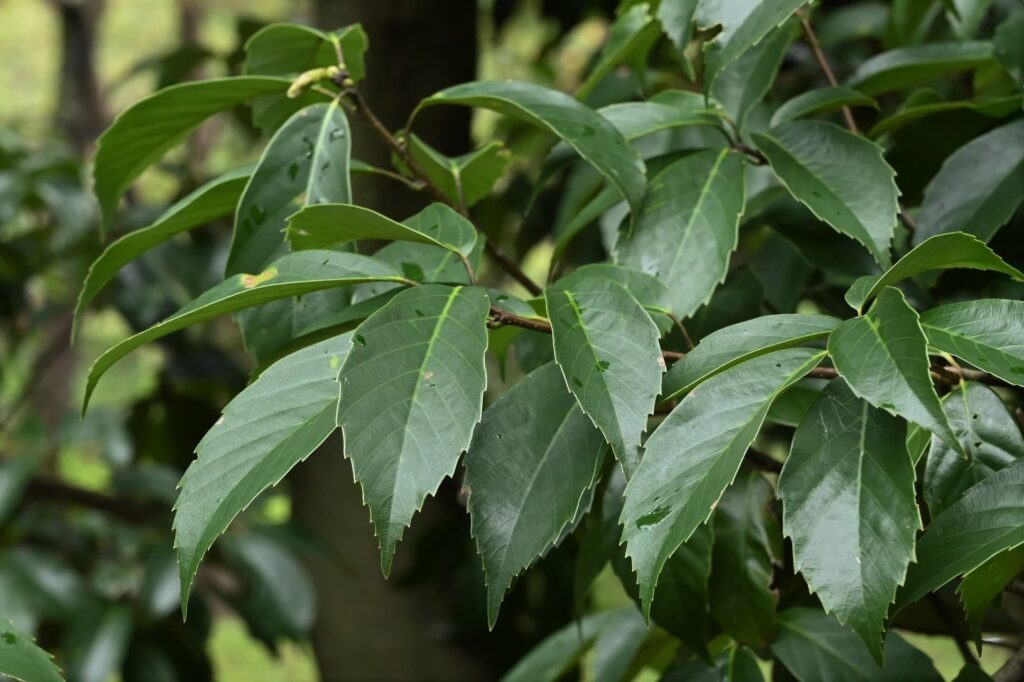
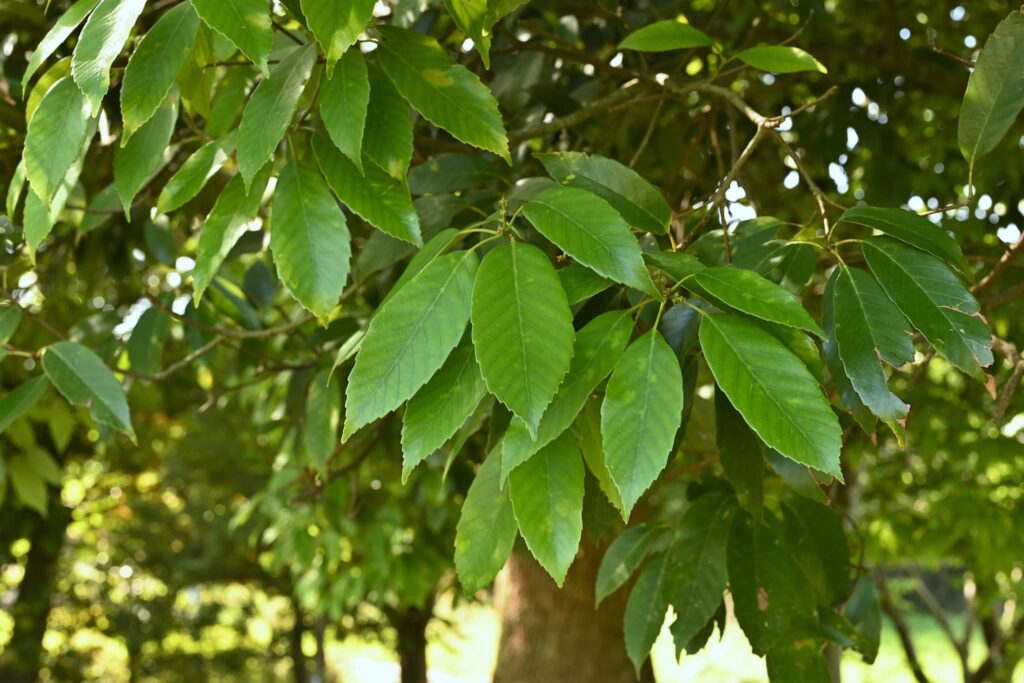
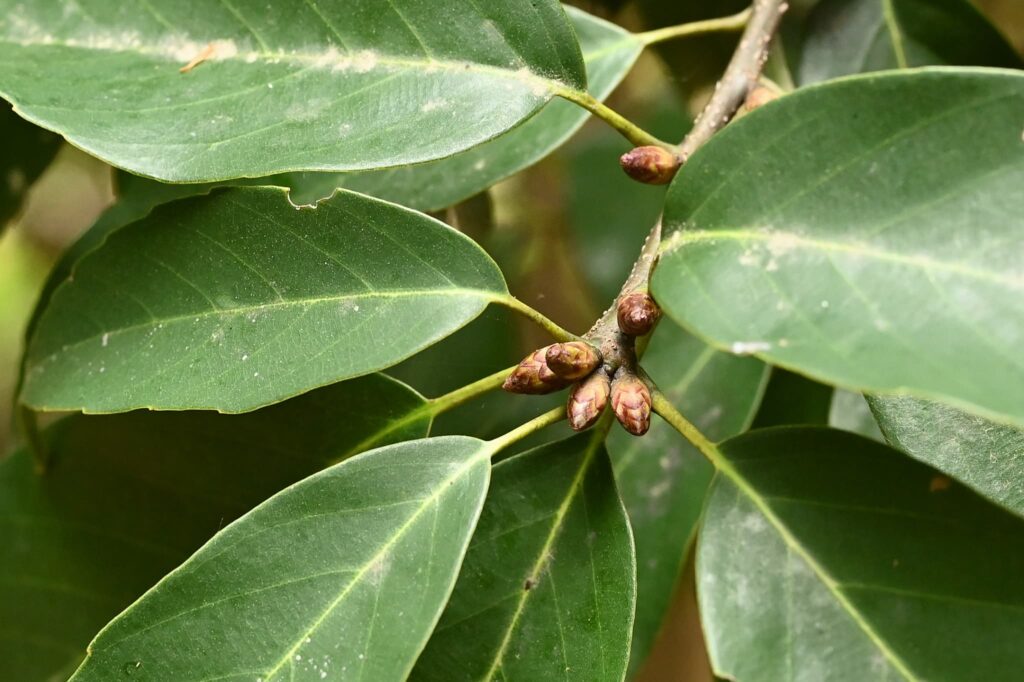
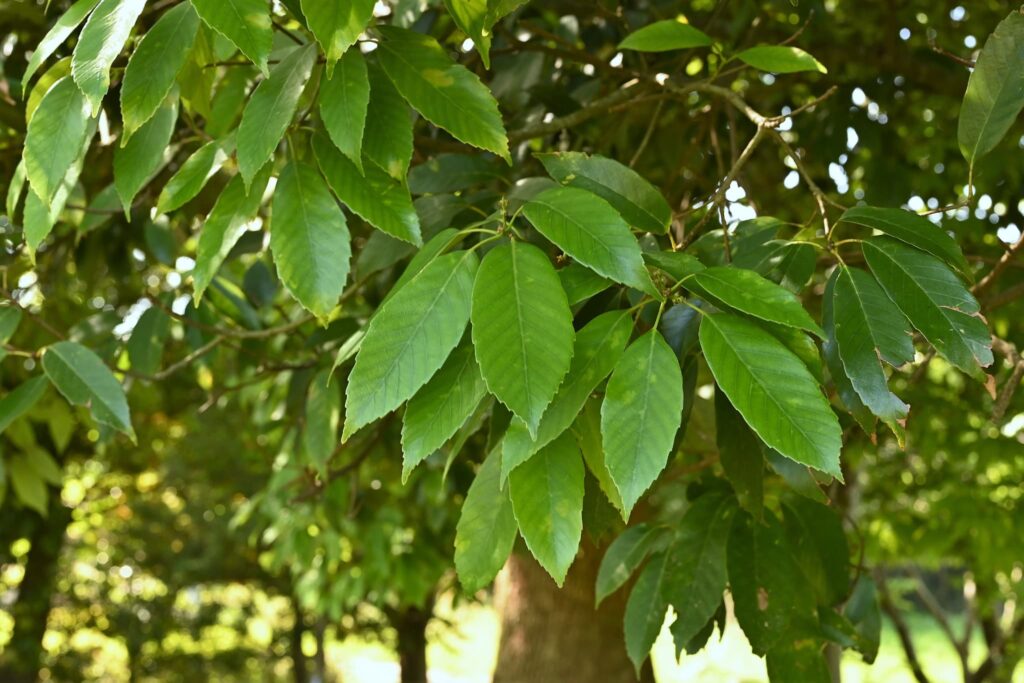
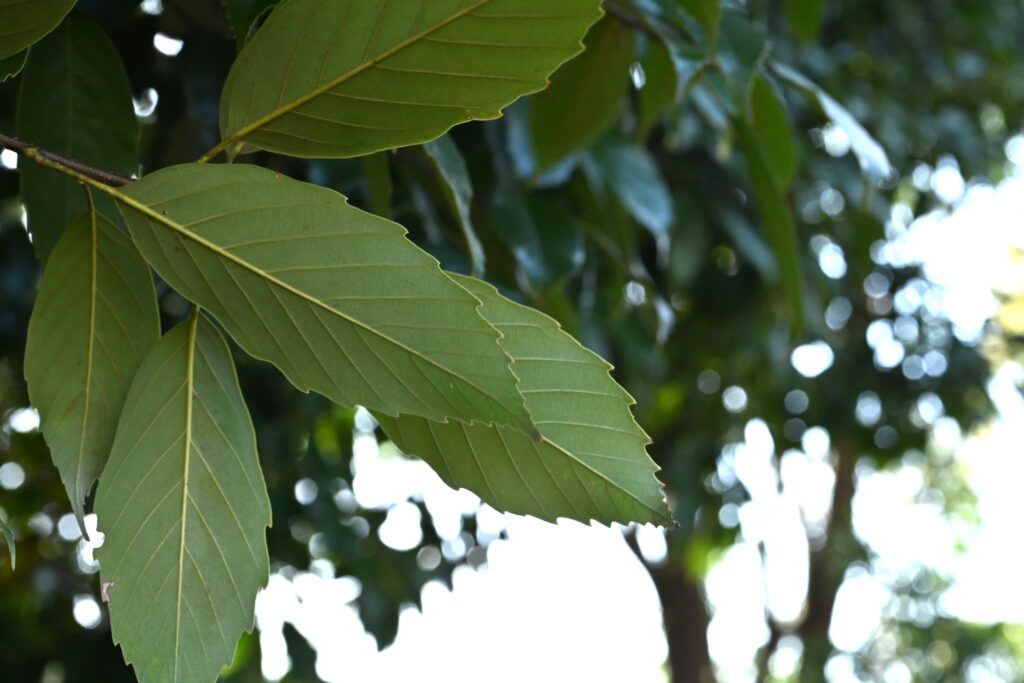
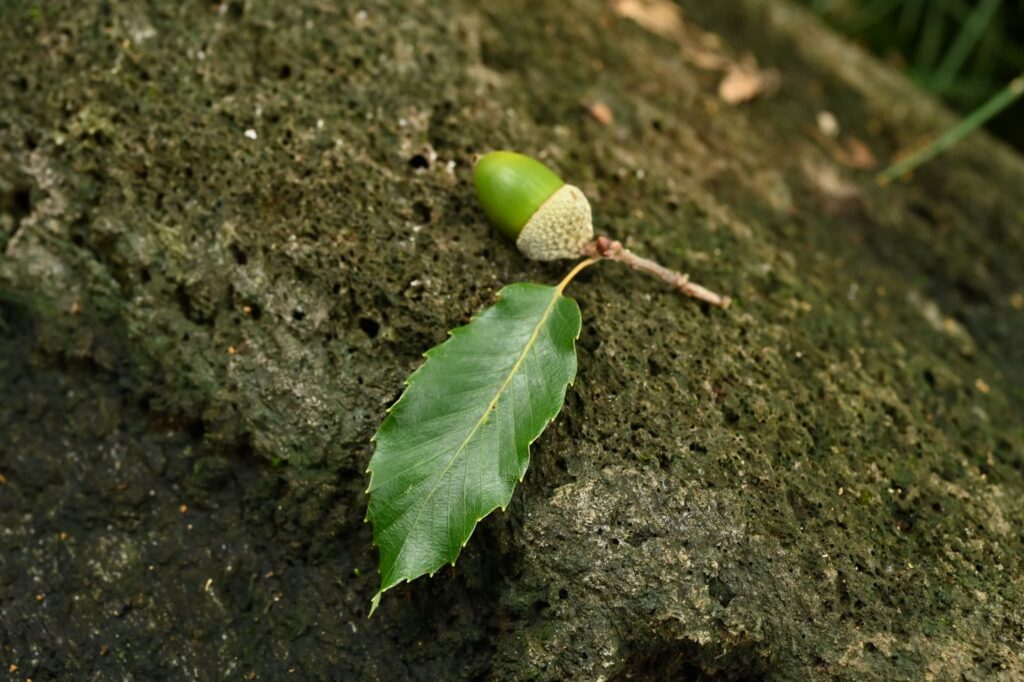
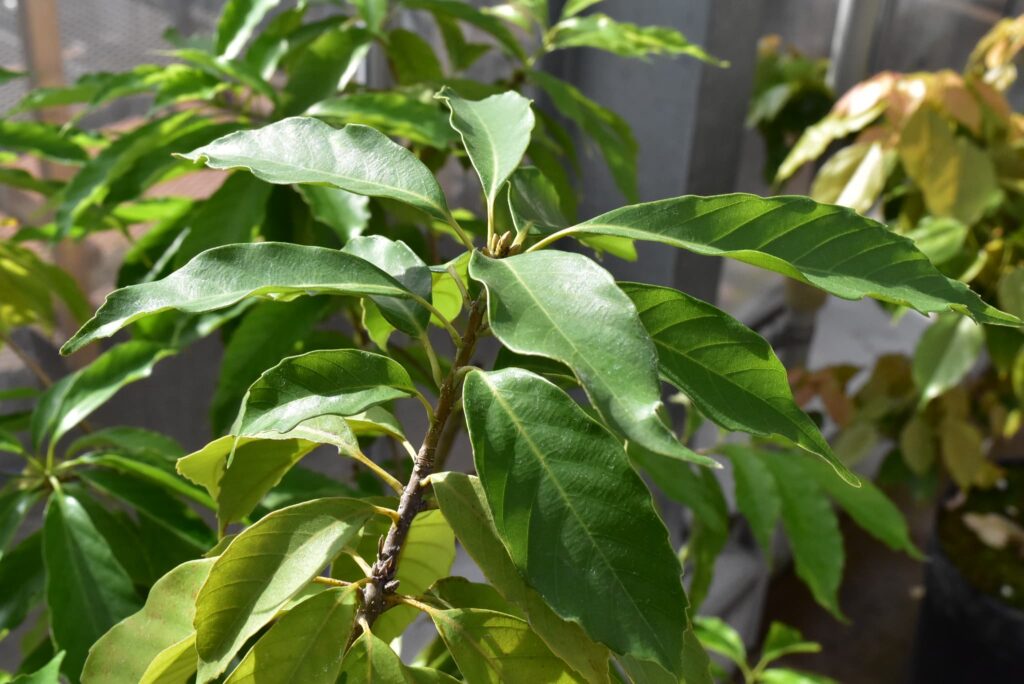
Leaves are 5–13 cm long and 3–6 cm wide, oblong, and arranged alternately along the branch. The tip narrows abruptly to a point, and the upper half of the leaf bears large, sharp teeth.
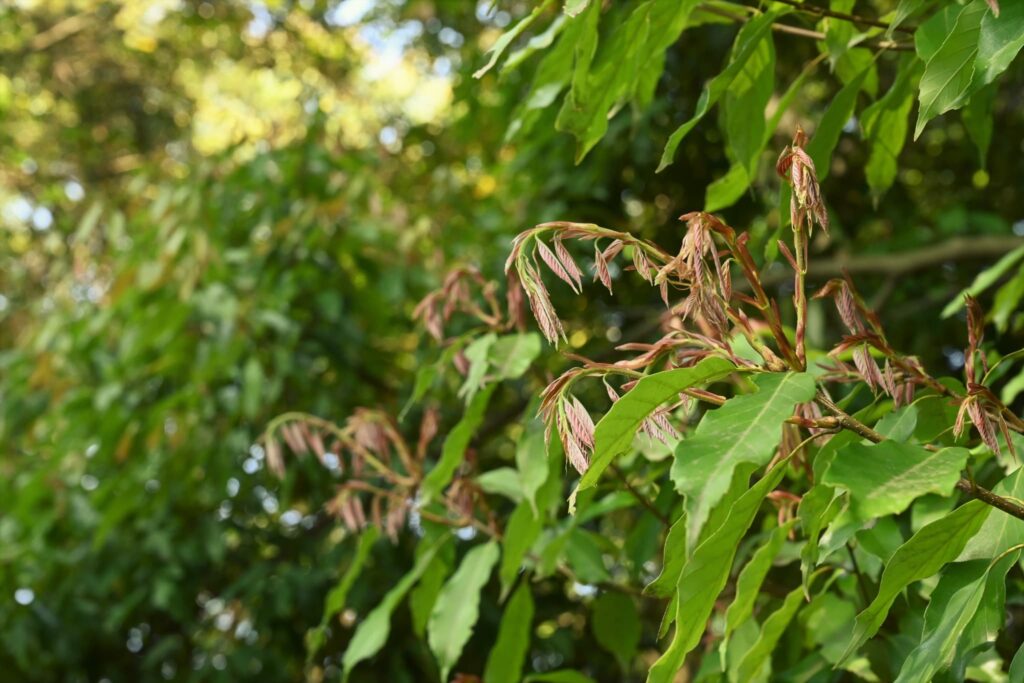
The upper surface is deep green with prominent veins, while the underside carries fine, pale brown silky hairs that give it a powdery white appearance. New leaves also have soft, silky down, which disappears as the leaf matures and fully unfurls.
Flowers
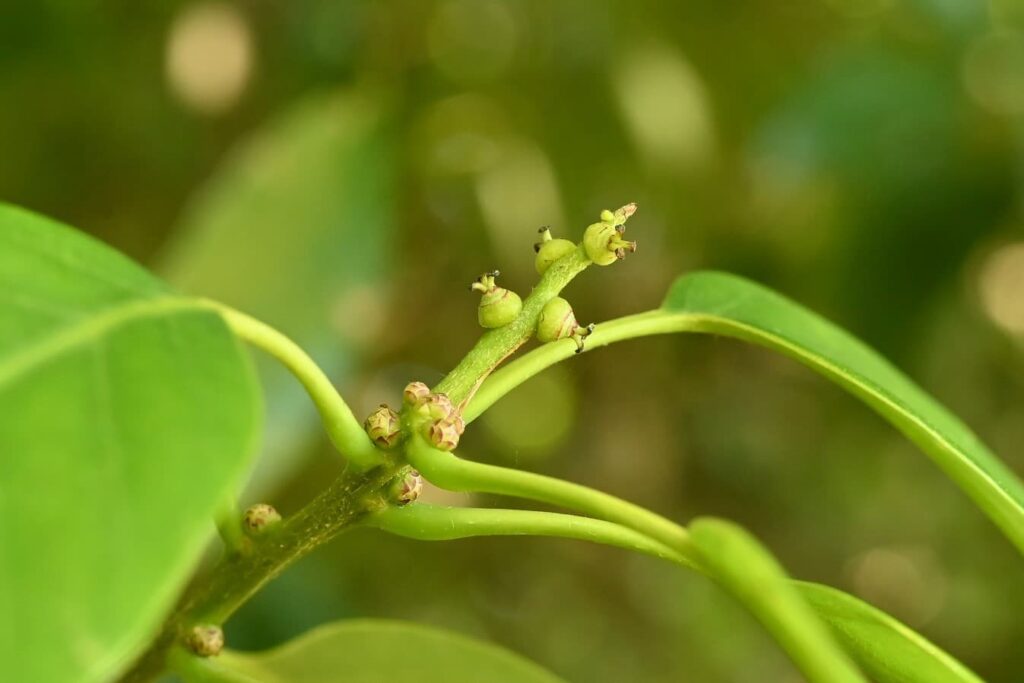
Japanese Blue Oak is monoecious and flowers in April and May. Male flowers form cord-like clusters 5–10 cm long, hanging in groups of two to three, while female flowers appear singly to a few at a time at the leaf axils near the tips of new shoots.
Fruits
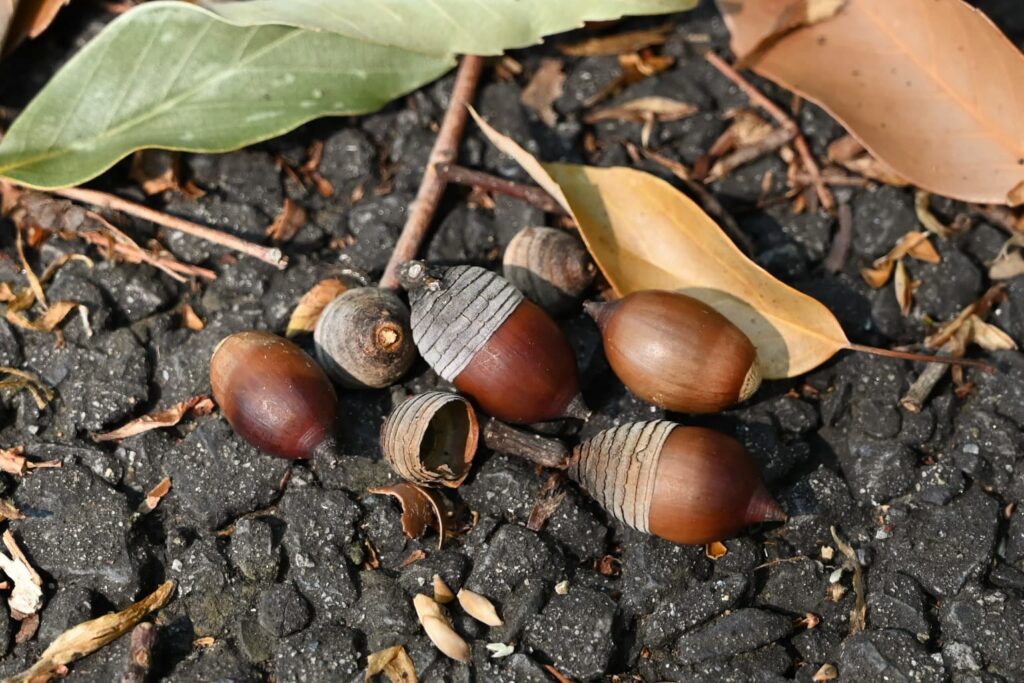
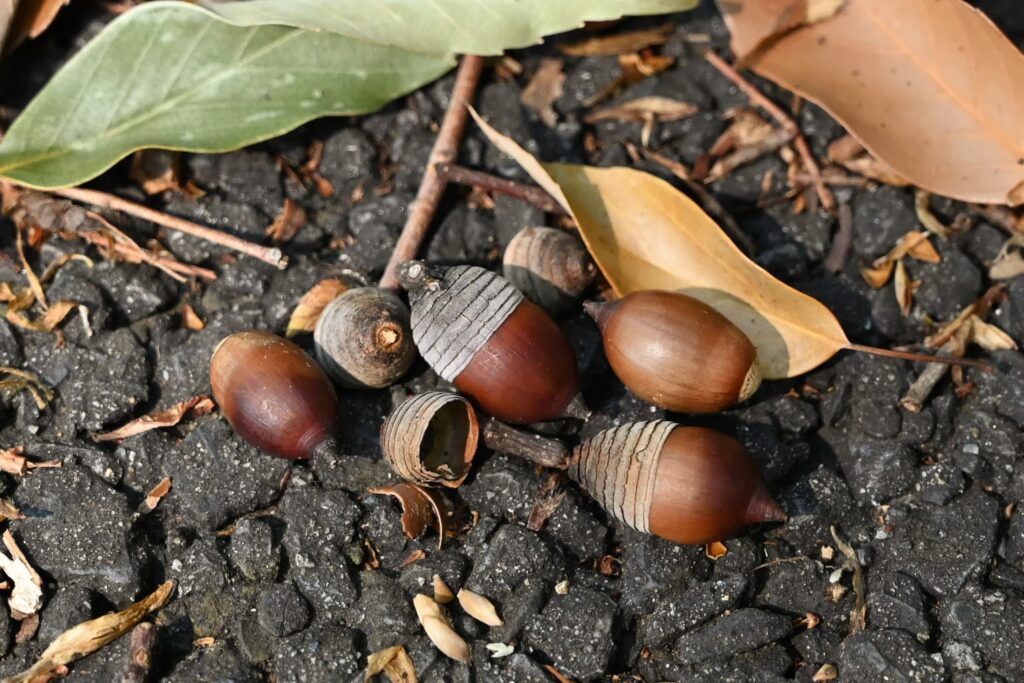
Female flowers develop into acorns just under 2 cm long, ripening between October and December of the flowering year. The acorn’s cap (cupule) bears five to seven horizontal ring-like bands, and is somewhat larger than that of Shirakashi.
Bark & Timber
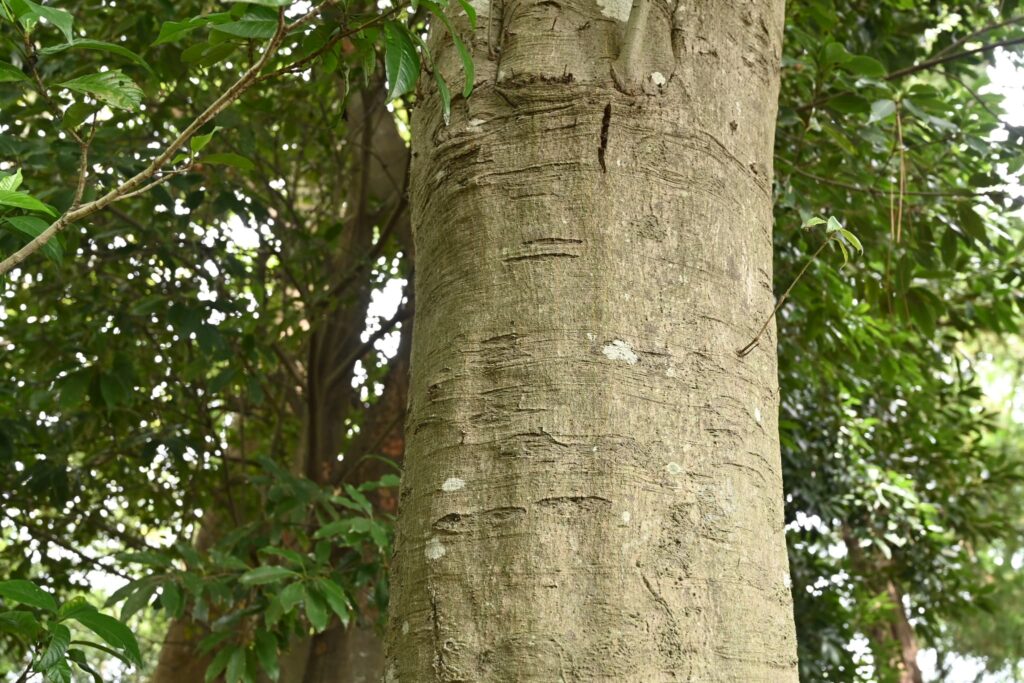
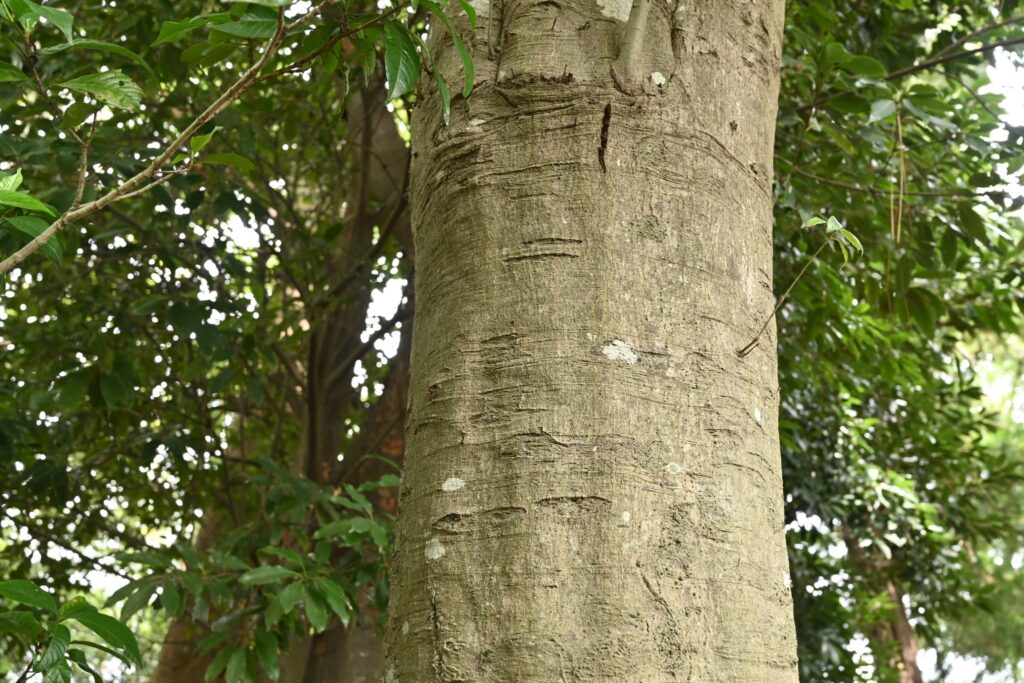
The bark is greenish dark gray and remains largely smooth even on mature trees, developing only shallow fissures with age. Unlike many deciduous oaks, Japanese Blue Oak retains relatively smooth bark throughout its life, making it a useful feature for identification.
The wood is hard and durable and has traditionally been used for construction, tool handles, vehicle parts, and charcoal. Japanese Blue Oak was also widely managed as coppice woodland, with regularly cut stems providing a renewable source of fuel before petroleum fuels became dominant.
The bark has also been used in traditional dyeing. Lye derived from the bark can produce reddish-brown tones when used with appropriate mordants.
Size & Growth
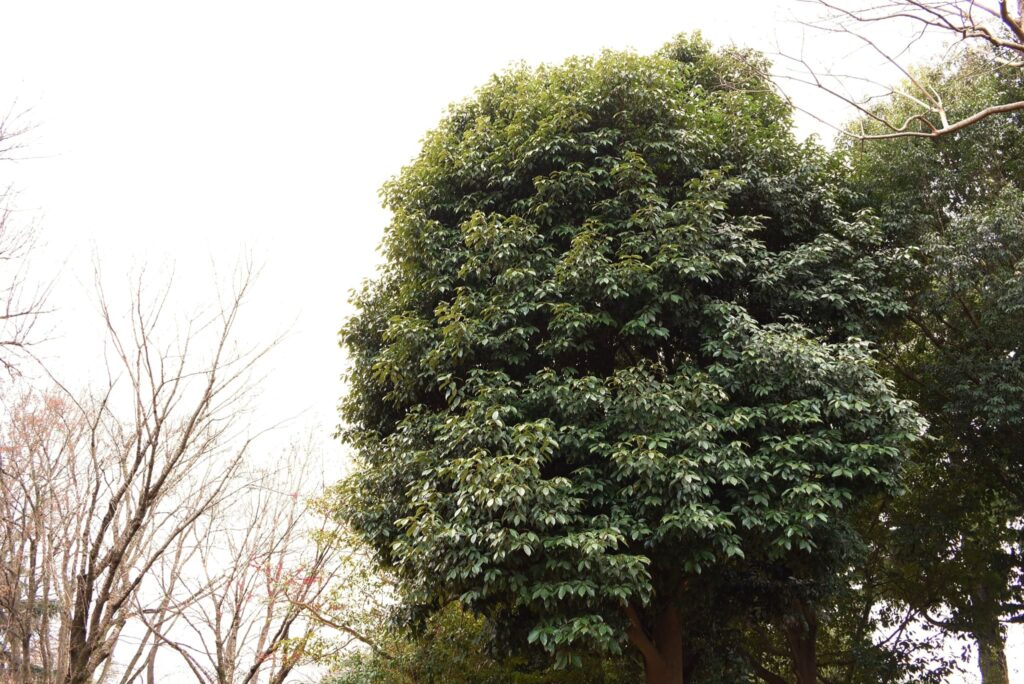
Growth is fast, and if left unchecked the tree will become quite large (15–20 m, occasionally taller), with lower branches tending to die back over time. Longevity runs 100–200 years. In a home garden setting, the top of the tree should be sheared back at least once a year to keep upward growth in check.
Uses & Cultural Significance
History as a Hedge Tree
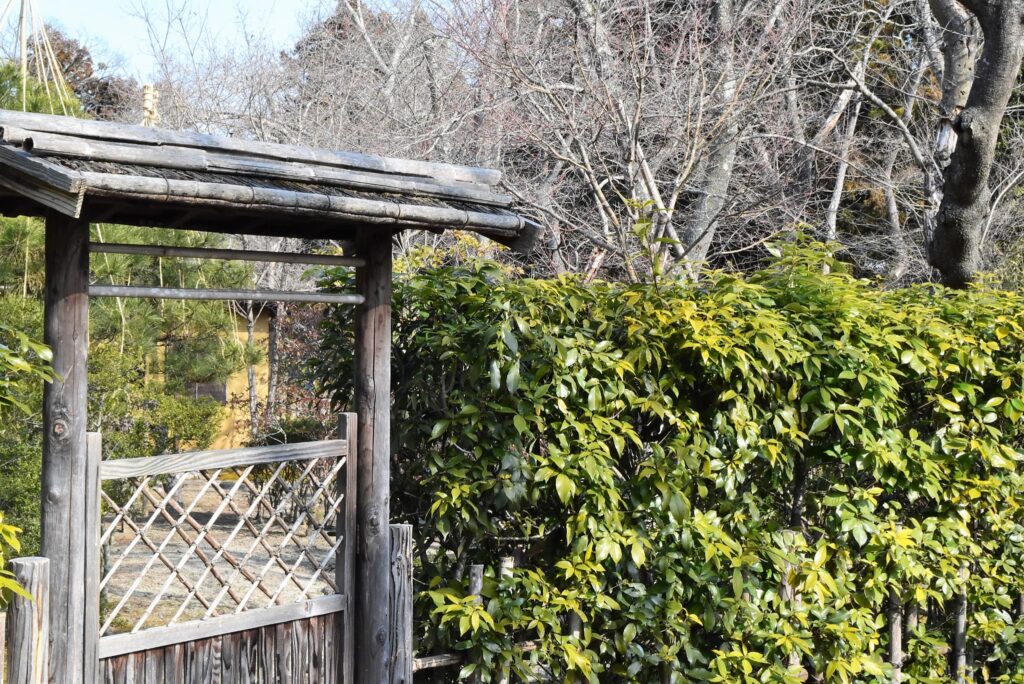
Japanese Blue Oak was once considered, along with Chinese Juniper and Ubame Oak, one of the three traditional hedge trees of the Kansai region, and was historically planted in large numbers — second only to Ubame Oak. It’s less commonly planted deliberately in home gardens today, but it continues to play a useful supporting role in overall garden composition.
Naming: Arakashi and Its Relatives
The Japanese name Arakashi is generally associated with the word ara, meaning “coarse” or “rough,” though explanations of the name vary. The name “Japanese Blue Oak” likely refers to the bluish-gray cast created by the fine silky hairs on the underside of the leaves.
Growing Guide
| Item | Description |
|---|---|
| Growth Rate | Fast |
| Longevity | 100–200 years |
| Salt Tolerance | Moderate |
| Drought Tolerance | High |
| Urban Tolerance | Good |
Light & Soil
Japanese Blue Oak grows best in full sun to partial shade and adapts to a range of reasonably well-drained soils. Once established, it is relatively drought tolerant, though excessively wet or poorly drained sites should be avoided. Compared with Shirakashi, it generally performs better in slightly warmer conditions.
Wind Tolerance
Its long history as one of the Kansai region’s principal hedge trees, planted for windbreaks and screening, points to solid wind tolerance once established.
Cold Hardiness
Japanese Blue Oak is generally listed for USDA Zones 7–9, although its performance at the colder end of this range can vary depending on provenance, summer heat, and winter severity. It is reliably hardy in Zone 8 and warmer, while trees can also be grown in suitable parts of Zone 7, particularly where summers are warm and severe winter cold is limited.
In Japan, it is naturally more common in warmer regions, from central and western Honshu southward, and is generally better suited to mild climates than to areas with severe winter cold.
Pruning
Japanese Blue Oak tolerates pruning well, and is often cut back hard, leaving a noticeably sparse, open branch structure. A form trained into a multi-stemmed clump with short, compact foliage — known as “Bokashi” — has a certain enduring popularity. Growth is fast, so shearing back the top of the tree at least once a year is usually necessary to keep it at a manageable size in a home garden.
Suitability for Home Gardens
Japanese Blue Oak is less frequently chosen deliberately for home gardens today than in the past, but it still plays a useful supporting role in overall garden design, typically as background or hedge planting rather than a specimen tree.
Pests
Japanese Blue Oak is generally regarded as a tough tree with relatively few serious pest or disease problems.
Cultivars and Varieties
Yokomegashi (also known as Shimagashi) — a cultivar with cream-colored, cloud-like patterning between the leaf veins, giving the foliage a brighter overall appearance.
Hiryugashi — a cultivar whose leaf tips are divided into feather-like segments. Other named forms include Hosoba Arakashi (narrow leaves), Hiroha Arakashi (broad leaves), Nagaba Arakashi (long leaves), and Hosomino Arakashi (slightly elongated acorns).
Amami Arakashi — a variety of Japanese Blue Oak (Quercus glauca) native to Amami Ōshima, Okinawa, and Yonaguni Island. It favors limestone-based soils and differs from the typical form in having narrower leaves and young leaves that often appear folded lengthwise. Its acorns are larger and more elongated than those of the typical Japanese Blue Oak.
It is one of the characteristic acorn-bearing trees of the Ryukyu Islands and is known locally by names such as Kugashi and Kashigi. It also serves as a host plant for the Japanese Oakblue butterfly.
Similar Species
Shirakashi / Japanese White Oak (Quercus myrsinifolia) — the more common evergreen oak in the Kanto region. Compared with Shirakashi, Japanese Blue Oak’s leaves are broader and more elliptic to oblong, with a deeper green color. Shirakashi’s leaf margin is toothed along its entire length, while Japanese Blue Oak’s teeth appear only near the tip. Japanese Blue Oak’s leaf underside also bears hairs, which Shirakashi’s lacks.
Akagashi / Japanese Evergreen Oak (Quercus acuta) — despite the similar Japanese name, it is a distinct evergreen oak species.
Ubame Oak (Quercus phillyraeoides) — another of the three traditional hedge trees of the Kansai region.
Chinese Juniper (Juniperus chinensis) — traditionally grouped with Japanese Blue Oak and Ubame Oak as one of the three traditional hedge trees of the Kansai region.
Frequently Asked Questions
How can I tell Japanese Blue Oak apart from Shirakashi?
Check three things: leaf shape (Japanese Blue Oak’s leaves are broader and closer to oval, with a deeper green color), tooth pattern (Japanese Blue Oak has teeth only near the leaf tip, while Shirakashi‘s teeth run along the entire margin), and the leaf underside (Japanese Blue Oak has fine hairs there, while Shirakashi’s is hairless).
Why is Japanese Blue Oak considered hard to identify?
Ironically, its lack of a strikingly distinctive appearance is its most defining trait — it’s a fairly generic-looking evergreen oak, which makes it one of the harder trees for beginners to recognize by leaf alone, especially since several other, similar-looking oaks grow in the same regions.
Is Japanese Blue Oak still commonly used as a hedge?
Less so than in the past. It was historically one of the three traditional hedge trees of the Kansai region, alongside Chinese Juniper and Ubame Oak, and was planted in large numbers. Today it’s less frequently chosen deliberately for home gardens, but it still plays a useful supporting role in overall garden design.
Does Japanese Blue Oak need much pruning?
If you want to keep it at a manageable size, yes — it grows quickly and will become a large tree if left alone, with lower branches often dying back in the process. In a home garden, shearing back the top of the tree at least once a year is usually necessary to control its height.
What is “Bokashi” style pruning?
It refers to training Japanese Blue Oak into a multi-stemmed, clump-forming shape with short, compact branches and foliage. The tree’s strong tolerance for hard pruning makes this style achievable, and it remains a popular way to give the plant a more sculptural, intentional presence in the garden.
Why is it called Japanese Blue Oak?
The name refers to the bluish-gray appearance of the leaf underside, which is covered with fine silky hairs. This pale, glaucous surface gives the foliage a subtle blue-green cast when viewed from below.
Is Japanese Blue Oak evergreen?
Yes. Unlike Konara Oak or Mizunara Oak, Japanese Blue Oak keeps its leaves throughout the year. Old leaves are shed gradually as new leaves emerge in spring, so the tree remains green in every season.
How fast does Japanese Blue Oak grow?
Japanese Blue Oak grows relatively quickly under favorable conditions. Because it responds well to pruning and produces vigorous new shoots, it has long been used for hedges, coppicing, and clipped garden forms in Japan.
Conclusion
Japanese Blue Oak may lack the instantly recognizable character of some other Japanese oaks, but that very plainness has made it a dependable, versatile presence in gardens and hedges across western Japan for generations. From its historical role as one of the Kansai region’s principal hedge trees to its more understated place today as background planting or a sculpted “Bokashi” specimen, Japanese Blue Oak continues to do quiet, reliable work wherever it’s planted.