Camphor Tree (Cinnamomum camphora): Identification, Care & Uses
All photographs on this page were taken in the field, and all growing notes are based on observations of the plant as grown in Japan.
What Is the Camphor Tree?
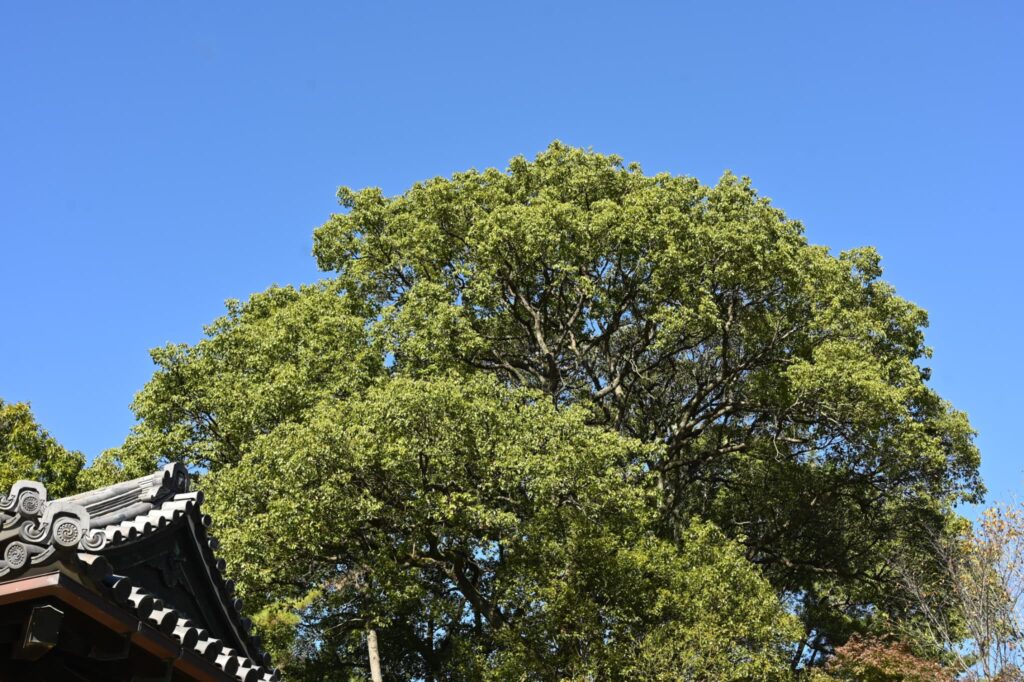
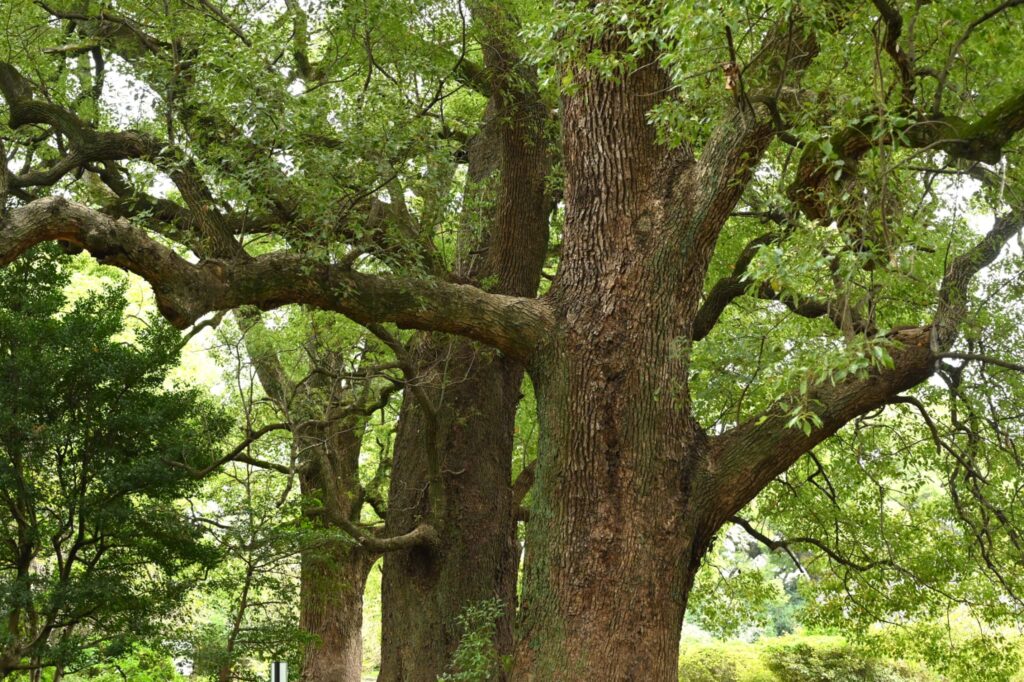
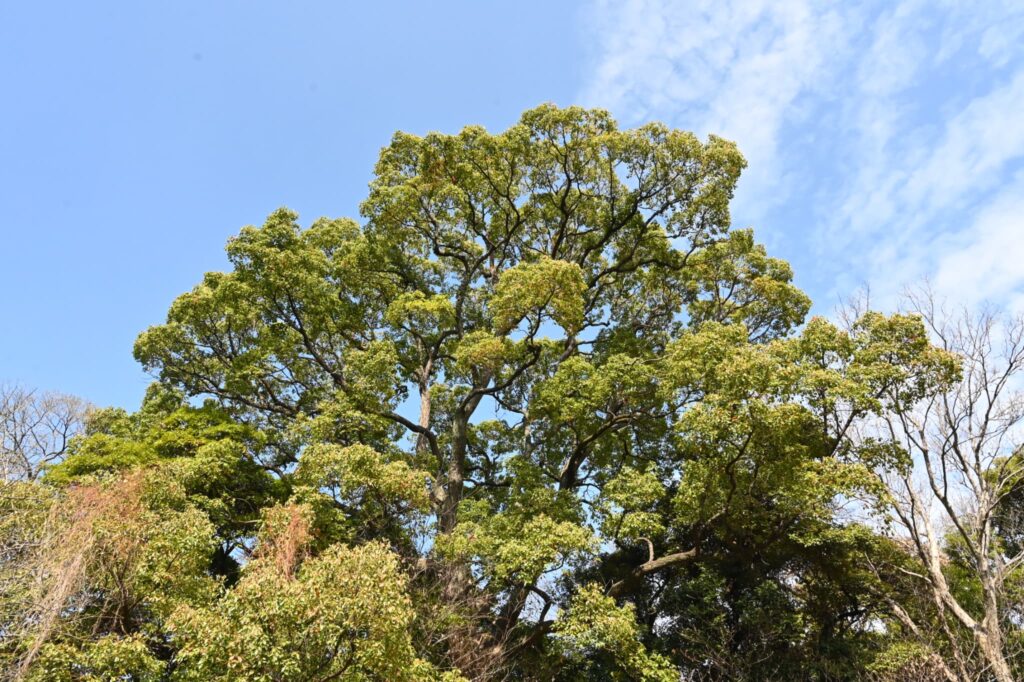
The Camphor Tree is an evergreen broadleaf tree in the genus Cinnamomum, family Lauraceae, native to warm regions of Japan, particularly western and southern Japan. Its glossy, light-green new foliage is strikingly beautiful, and crushed leaves release a distinctive minty, camphor-like fragrance. Outside Japan, it is also found on Jeju Island in South Korea, along the coast of southern China, Taiwan, and Vietnam.
Camphor, a waxy, aromatic compound with insect-repelling properties and the active ingredient in traditional mothballs and medicinal preparations, can be extracted from the tree’s timber and foliage. From the Meiji era onward, Camphor Trees were widely planted across Japan for commercial camphor production, which means the boundaries of its original natural range are no longer entirely clear. The Camphor Tree has long been established in warm regions of Japan, although its status as an indigenous species in parts of Japan has been debated.
Overview
| Item | Description |
|---|---|
| Scientific Name | Cinnamomum camphora |
| Common Name | Camphor Tree / Camphor Laurel |
| Japanese Name | Kusunoki (クスノキ) |
| Family | Lauraceae |
| Native Range | East Asia (China, Taiwan, Vietnam, Korea, Japan) |
| Plant Type | Evergreen Broadleaf Tree |
| Height | Up to 50 m (165 ft) |
| Trunk | Up to 8 m in diameter on exceptional specimens |
| Flowering Season | May–June |
| Fruit Type | Drupe |
| USDA Zones | 8–11 |
| Sun Exposure | Full Sun to Partial Shade |
Characteristics
| Item | Description |
|---|---|
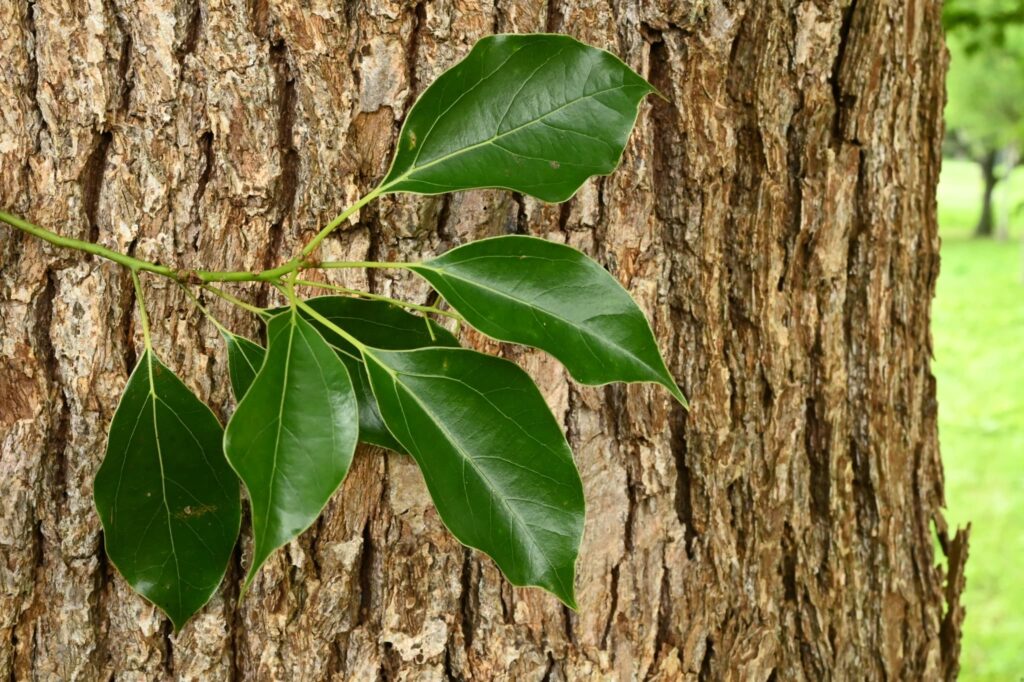
| Foliage | Leathery, oval, alternate; 5–12 cm long, 3–6 cm wide; three prominent veins from the base |
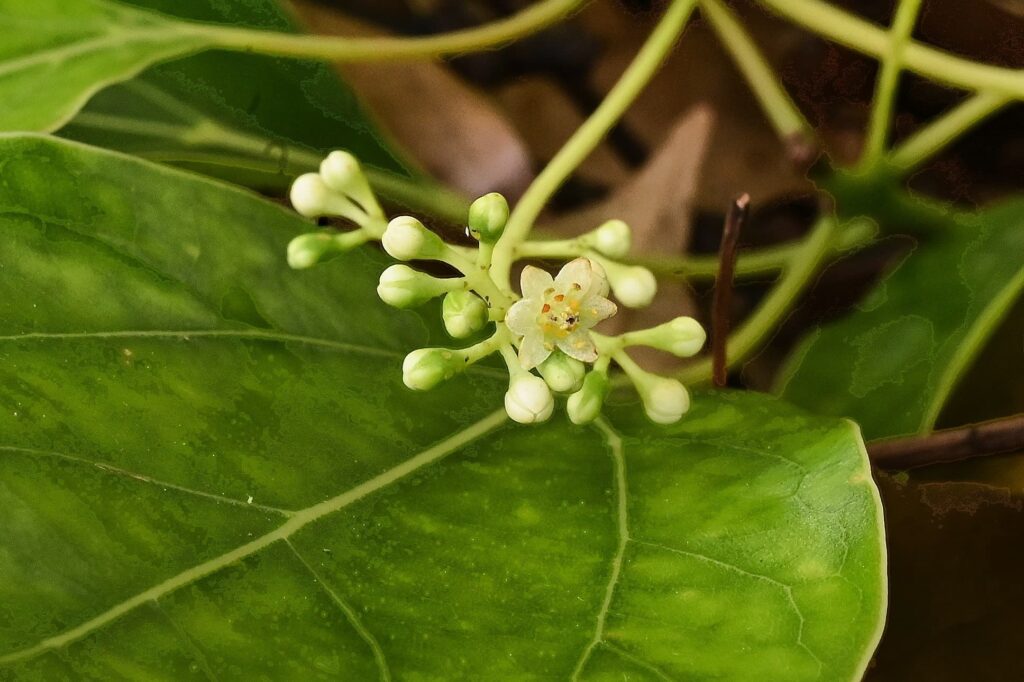
| Flowers | Cream-colored, 3–5 mm, borne in conical panicles from the leaf axils |
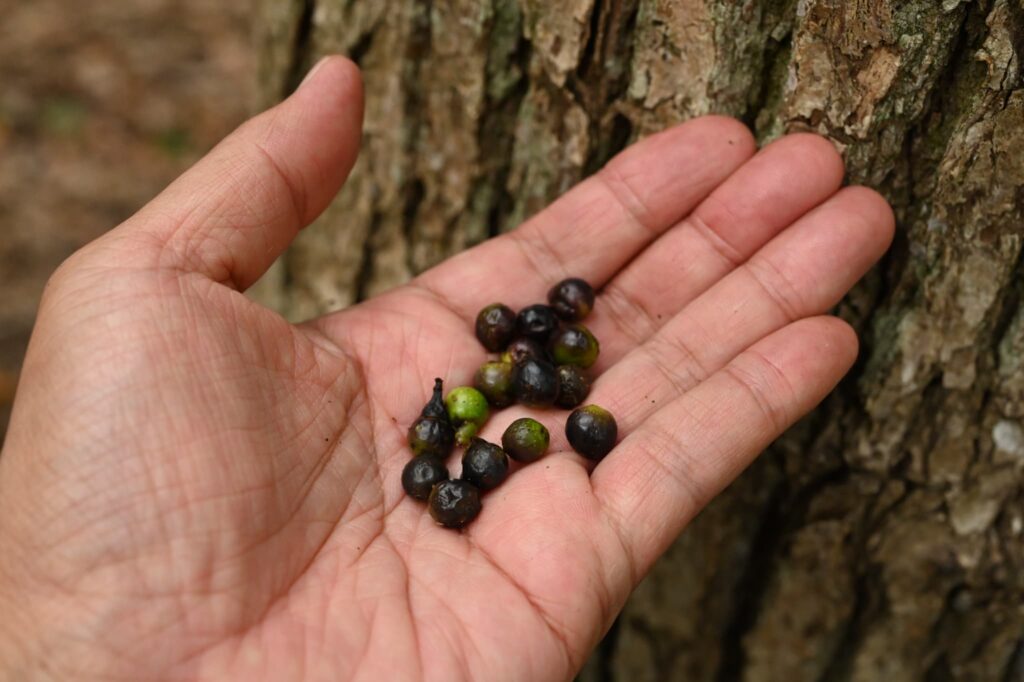
| Fruits | Drupe, ~8 mm, ripens purple-black in autumn |
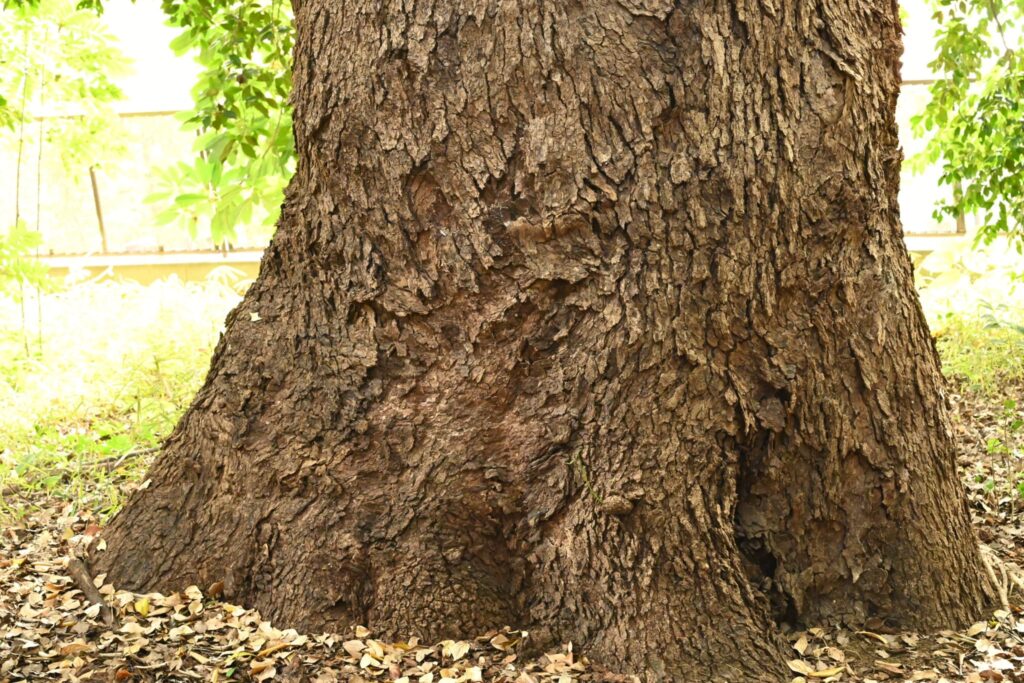
| Bark | Light brown, finely fissured vertically |
Foliage
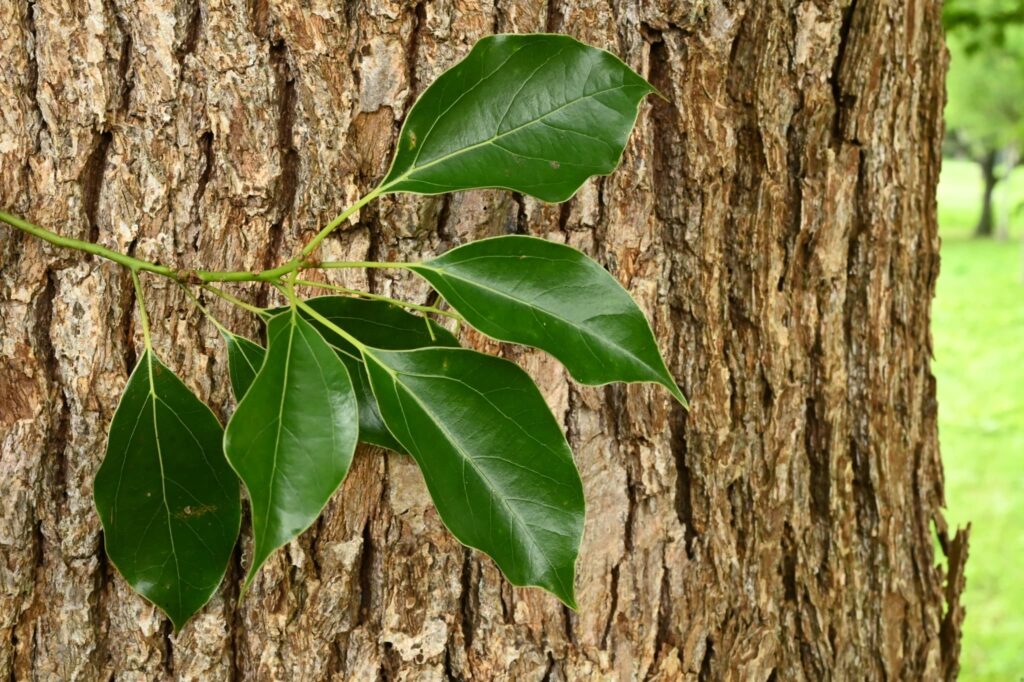
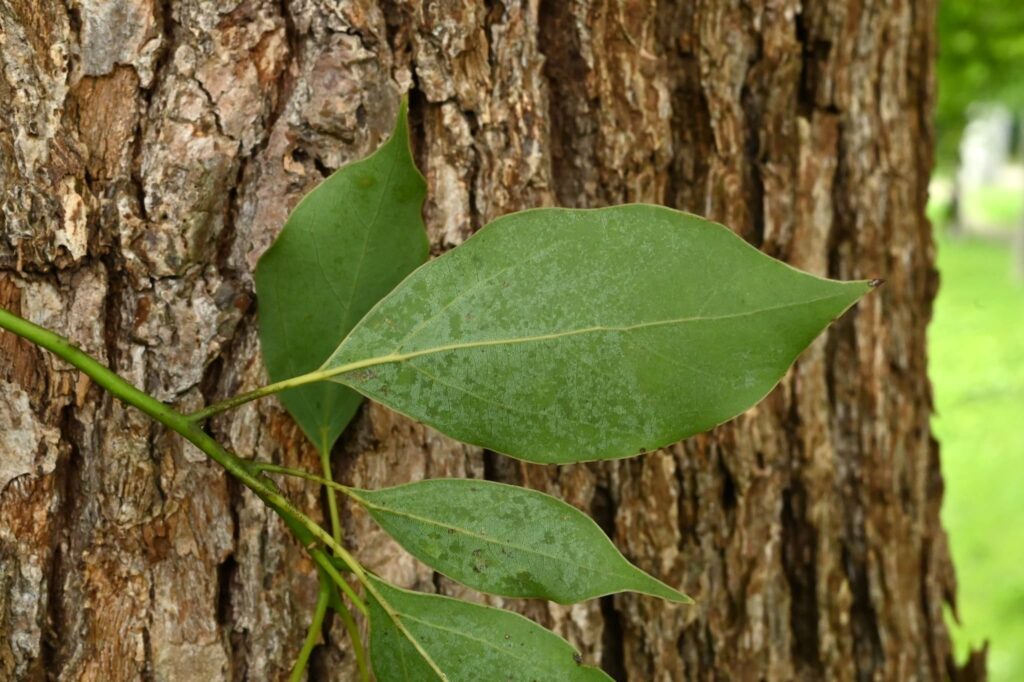
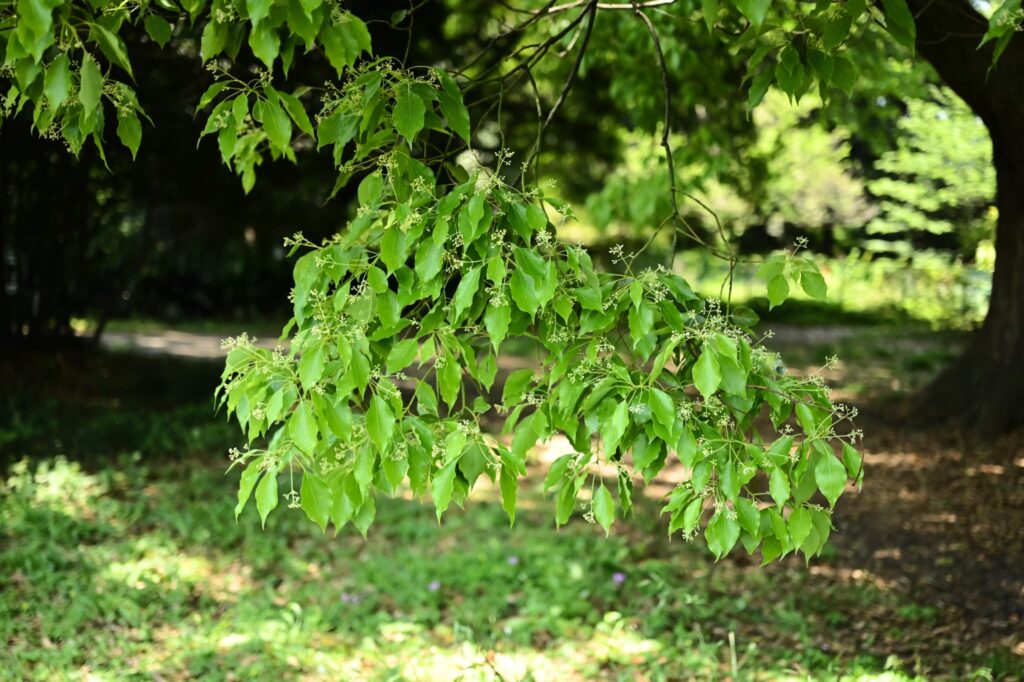
Camphor Tree leaves are leathery and oval-shaped, alternately arranged along the branches, measuring 5–12 cm in length and 3–6 cm in width. The upper surface is glossy; the underside is pale whitish-green. Though an evergreen, the leaves are relatively thin-textured, with gently wavy (but not serrated) margins.
A key identifying feature is the three prominent veins (triplinerved venation) that radiate from near the base of each leaf. At the junction of these veins, small pouches called dani-beya (“mite chambers”) provide a microhabitat for gall mites (Eriophyidae) — a distinctive quirk of this species.
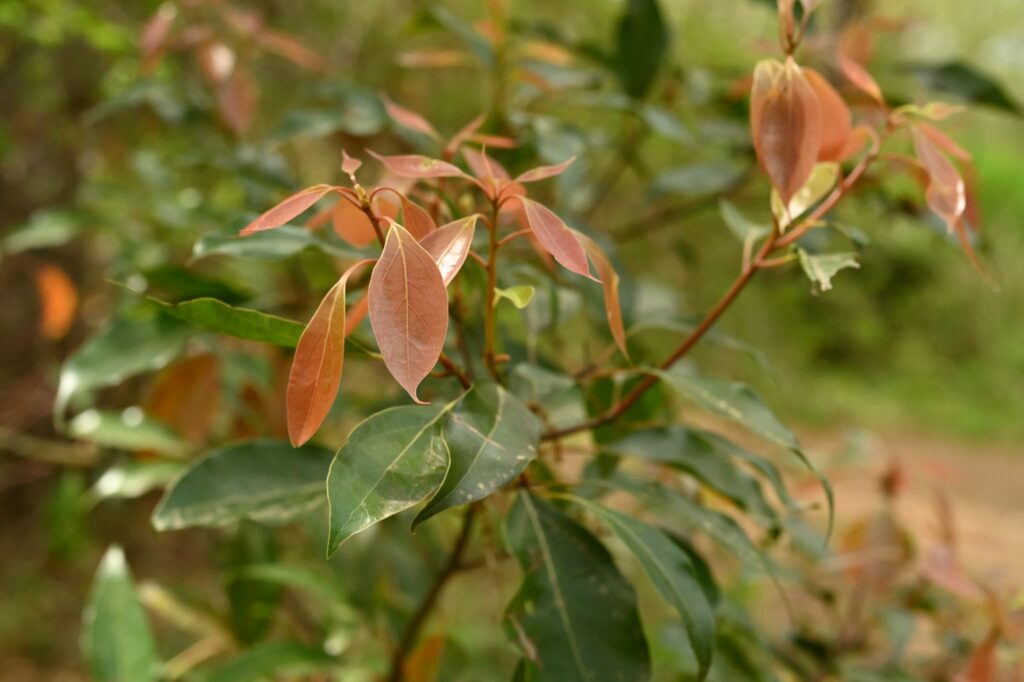
Leaves have a lifespan of about one year. In spring to early summer (around Golden Week in the Kanto region), the entire tree sheds its old leaves and replaces them with new growth simultaneously. Two color variants exist: specimens with red new leaves and red petioles are called Akagusu (“red camphor”), while those with green new growth are called Aogusu (“green camphor”). Akagusu is generally preferred for garden planting for its attractive spring flush of color.
Flowers
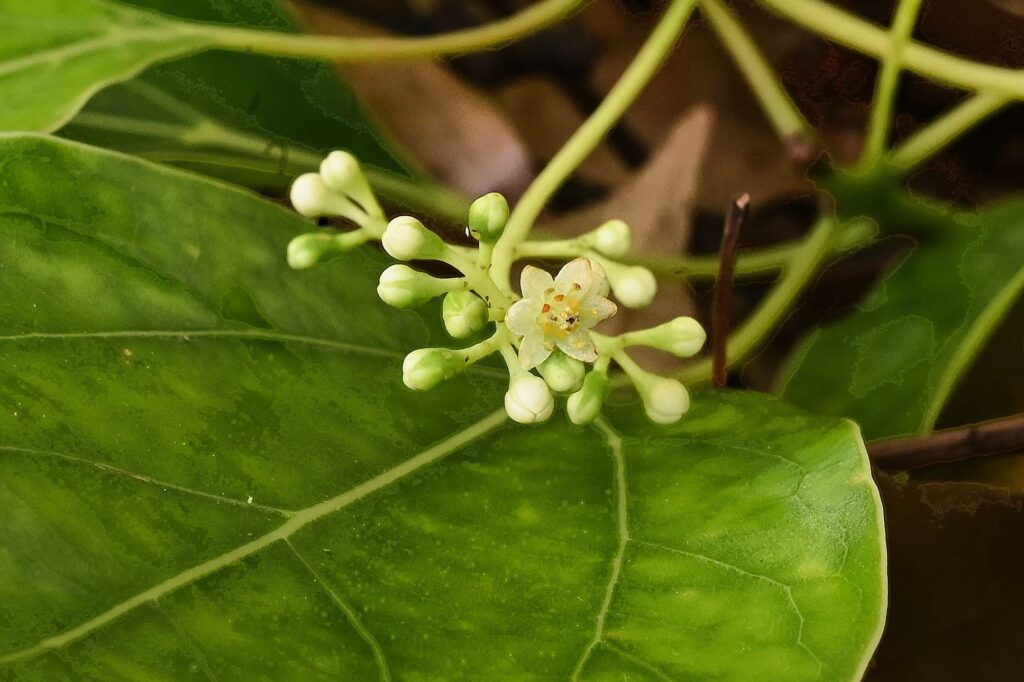
Like its relatives Cinnamon and Yabunikkei, the Camphor Tree produces elongated conical flower clusters (panicles) from the leaf axils in May to June, bearing small cream-colored flowers. Each flower is 3–5 mm in diameter with 9–12 stamens and a single pistil. The flowers are inconspicuous but notable enough that Saga Prefecture has designated the Camphor Tree flower as its official prefectural flower.
Fruits
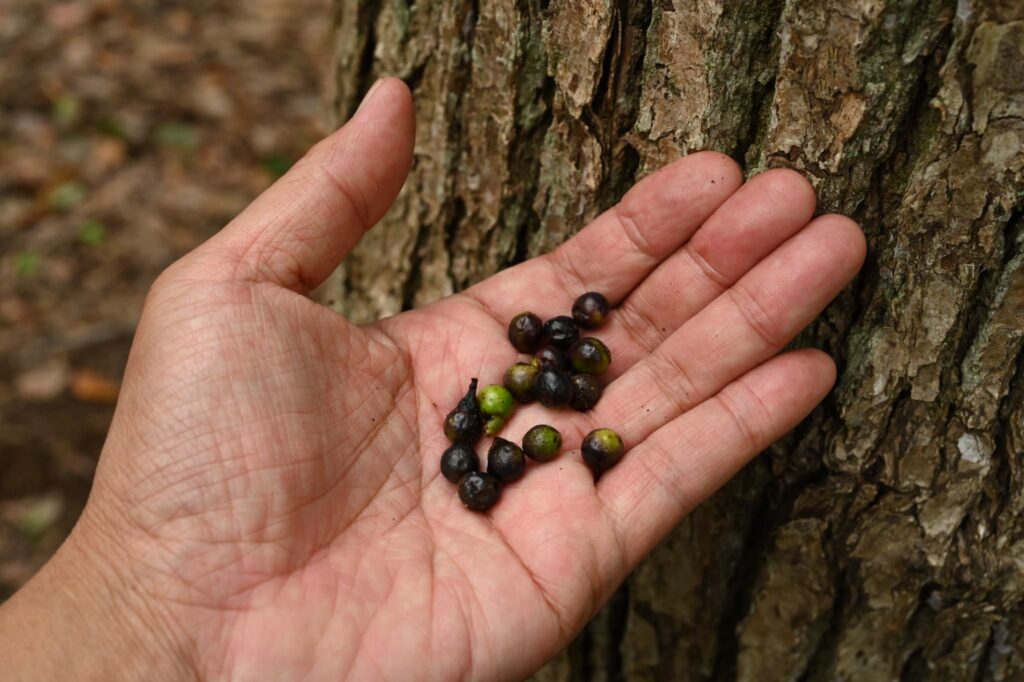
The green fruit that follows the flowers grows to about 8 mm in diameter and ripens to a dark purple-black color in autumn (October to November). Each fruit contains a single seed, which germinates relatively readily when sown. Birds such as White-cheeked Starlings and crows eat the fruit, though its camphor-like scent makes it unappealing by most standards.
Bark & Timber
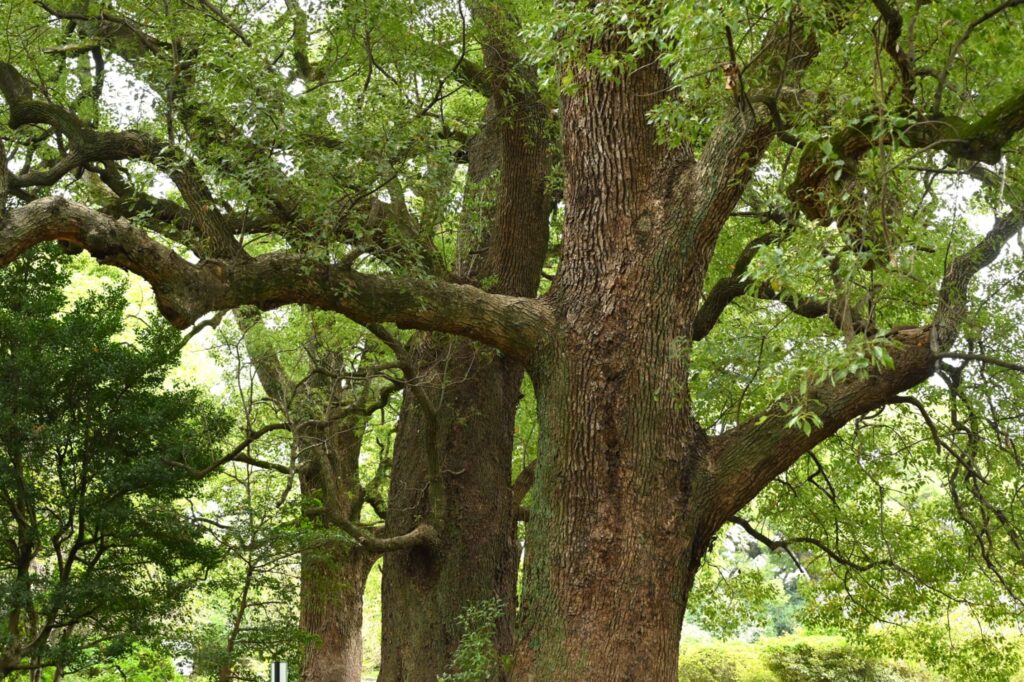
The bark is light brown, finely fissured in a vertical pattern, and on very large old trees often hosts the epiphytic fern Lepisorus thunbergianus growing in the crevices. The timber has a wide range of traditional applications — construction, furniture, sculpture, Buddhist altars, Buddhist statuary (particularly from the Asuka period), wooden fish drums (mokugyo), dugout canoes, and wooden boxes. Its durability is exemplified by the great torii gate of Itsukushima Shrine in Hiroshima, whose two main pillars are made from natural Camphor Tree trunks. Even long after milling, the wood retains its characteristic camphor fragrance — and Camphor Tree wood chips are sometimes used in dog park surfaces for their deodorizing and insect-repelling properties.
Size & Growth
In typical conditions, Camphor Trees reach around 20 m in height with a trunk diameter of 3–5 m. Exceptional specimens can exceed 50 m in height and 8 m in diameter. The Camphor Tree holds the record for the largest trunk girth of any tree in Japan — the Great Camphor Tree of Kamo (Kamo no Okusunoki) at Hachiman Shrine in Aira District, Kagoshima Prefecture, has been confirmed by the Ministry of the Environment as Japan’s largest tree, with an estimated age of 1,500 years and a trunk circumference of 24 m. It is also worth noting that among all Japanese tree species, Camphor Tree produces the widest trunks — surpassing even Japanese Cedar in girth.
Uses & Cultural Significance
Shade, Symbolism & Urban Presence
The Camphor Tree’s dense canopy and impressive size make it a popular choice for providing shade in public spaces — planted at the entrances of commercial buildings and company headquarters as a symbol tree, as well as in parks and along streets. One of the most famous urban examples stands alone at the Shibuya Scramble Crossing in Tokyo, on the station side of the intersection.
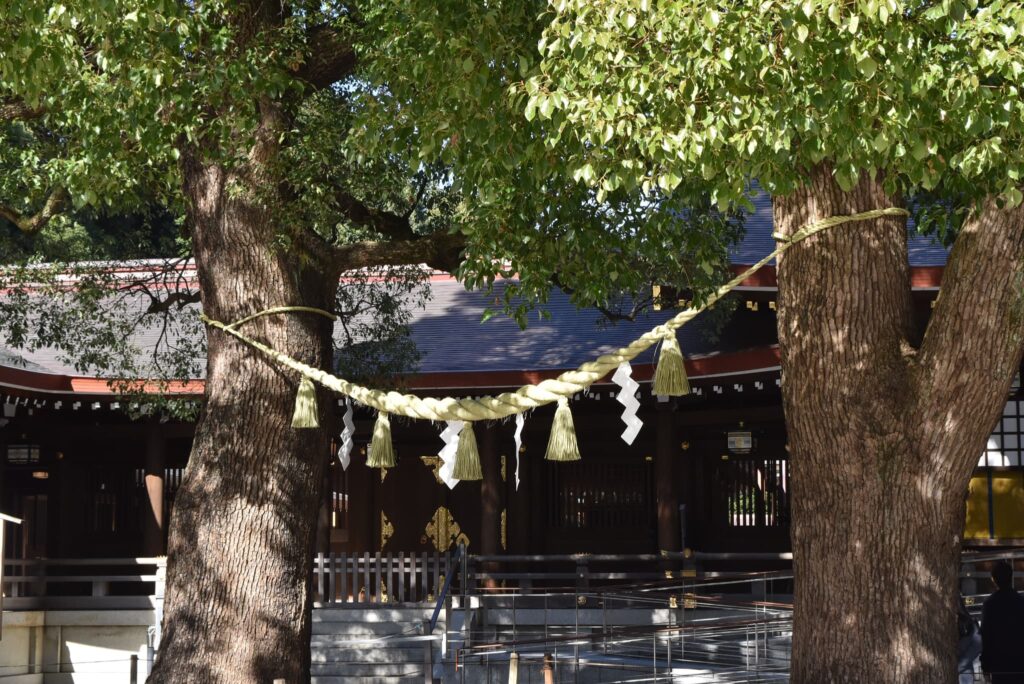
Its extraordinary longevity — specimens living over a thousand years are not uncommon — has long associated the Camphor Tree with sacred and auspicious significance. Many ancient individuals are designated as natural monuments or revered as goshinboku (sacred trees) at Shinto shrines and Buddhist temples. In Japan, mysterious, unidentified trees of remarkable size are sometimes colloquially called nanja-monja — and the tree behind this nickname is often a Camphor Tree or a Japanese Snowbell (Chionanthus retusus).
Name Origin
Several theories surround the etymology of kusunoki. The leading explanations include derivations from kushiki ki (“wondrous tree”), kusunoki (“fragrant tree”), kusai ki (“smelly tree”), and kusuri no ki (“medicine tree”) — all referencing the tree’s distinctive scent and chemical properties. In Japanese, it is written as either 樟 or 楠, though strictly speaking 楠 originally referred to the Tabunoki (Machilus thunbergii), making 樟 the more technically correct character for this species.
Growing Guide
| Item | Description |
|---|---|
| Light | Full Sun to Partial Shade |
| Soil | Fertile, well-drained; broadly adaptable |
| Cold Hardiness | USDA Zones 8–11; northern limit roughly coastal Miyagi Prefecture |
| Pruning Season | Responds well to pruning; avoid heavy pruning in late autumn or winter |
| Garden Suitability | Not generally recommended for home gardens |
Light & Soil
Camphor Tree prefers fertile soil in full sun, but is broadly adaptable — it grows in a variety of soil types and tolerates partial shade. Its suitability as a street tree reflects its strong resistance to air pollution.
Wind & Snow Tolerance
The branches are notably flexible, giving large trees considerable wind resistance. However, this flexibility also means branches can snap unexpectedly under the weight of a person climbing — caution is advised. Heavy snow and typhoon-force winds can break branches and reduce the tree’s aesthetic appeal.
Cold Hardiness
Camphor Tree has relatively limited cold hardiness. The northern limit for safe outdoor planting is roughly the coastal areas of Miyagi Prefecture, with Ibaraki Prefecture and further west considered a reliable safe zone. Even within this range, severe winter cold can damage the upper canopy. Young trees require winter protection — during the construction of Meiji Jingu Shrine in Tokyo, newly planted specimens were wrapped in straw (komo) for insulation during winter. The tree is also sensitive to dry, cold winds.
Pruning
Camphor Tree responds well to pruning and can be maintained in a compact form. However, heavy pruning after autumn — especially in winter — can cause dieback and should be avoided.
Suitability for Home Gardens
While technically possible to grow in a home garden, Camphor Tree develops an extremely aggressive root system that, over time, is highly likely to damage paving, walls, and underground structures. The tree is also considered highly flammable due to its high oil content. For these reasons, it is generally not recommended for residential gardens — its magnificent form is best enjoyed in parks, shrine grounds, and other spacious public settings.
Pests
The Camphor Tree is highly resistant to most insects — its camphor content deters the majority of pests. However, the caterpillars of the Blue Triangle Butterfly (Graphium sarpedon) feed exclusively on its leaves, and as Camphor Tree planting has expanded, so has this striking butterfly’s range. Young caterpillars hide on the underside of leaves, while older larvae become visible on the upper surface. Moth larvae — including those of Krananda semihyalina, Cyana species, and the Japanese Oak Silkmoth — may also occasionally damage new foliage. Bagworm cases (minomushi) should be removed from branches as soon as they are spotted.
Cultivars
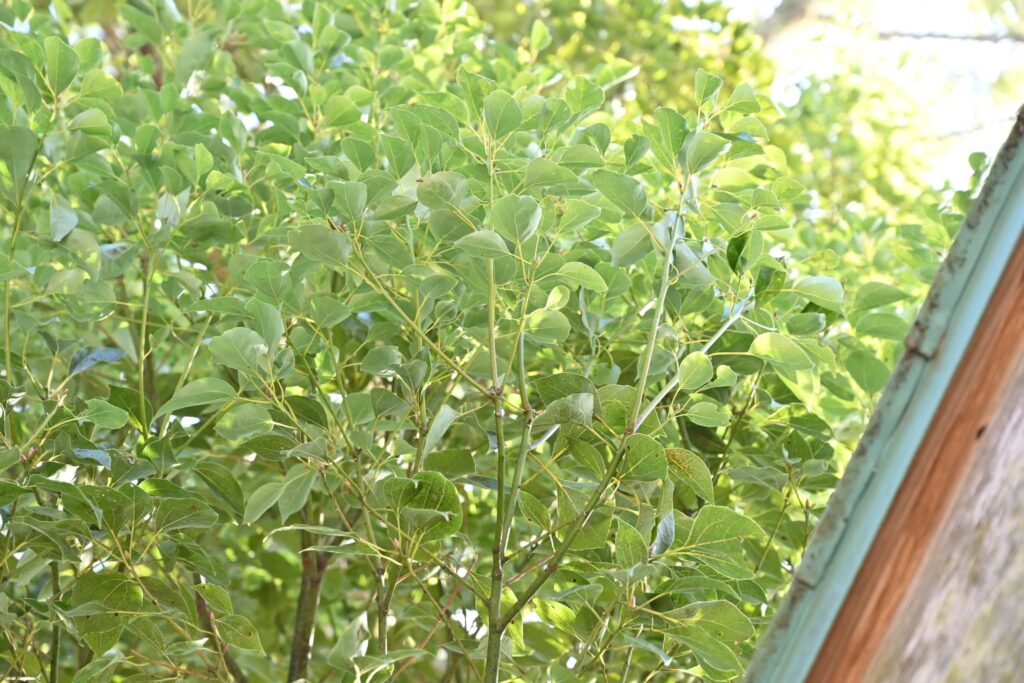
Marubа Kusunoki — First described as a new species by the renowned botanist Dr. Tomitaro Makino in 1940, based on a specimen he observed at Tsukuba Shrine. While standard Camphor Tree leaves have a length-to-width ratio of approximately 1:2 to 1:2.5, Marubа Kusunoki leaves are proportionally broader at 1:1.3 to 1:1.6 — rounder in comparison, though still clearly oval rather than truly circular.
Similar Species
| Species | Key Difference |
|---|---|
| Tabunoki (Machilus thunbergii) | Thicker, darker green leaves (Camphor Tree is lighter green); flowers more conspicuous; also known as Inugusu |
| Shirodamo (Neolitsea sericea) | Similar leaves but larger, with a distinctly white underside; striking new growth visible even in dim woodland |
| Yabunikkei (Cinnamomum yabunikkei) | Similar aromatic leaves, but the leaves are generally narrower and the tree remains smaller than Camphor Tree. Common in the warm forests of western Japan. |
| Akahada Kusunoki (Cinnamomum pseudopedunculatum) | Found in Okinawa and Taiwan; bark peels to reveal pale reddish-brown new bark; leaf undersides darker, more similar in color to upper surface |
Frequently Asked Questions
Is the Camphor Tree the largest tree in Japan?
Camphor Trees include some of Japan’s largest individual trees. The Great Camphor Tree of Kamo in Kagoshima is particularly famous for its enormous trunk, with a circumference of about 24 m.
Why does the Camphor Tree smell like mothballs?
The camphor compound found throughout the tree’s tissues is the same substance historically used in mothballs and medicinal preparations. The scent is strongest in the leaves and freshly cut wood.
Is it safe to plant a Camphor Tree in a garden?
Generally not recommended for residential gardens. The root system is extremely powerful and will eventually damage surrounding structures. The tree also grows very large and requires substantial long-term space.
What is the Blue Triangle Butterfly’s connection to Camphor Tree?
The Blue Triangle (Graphium sarpedon) uses Camphor Tree as its primary larval host plant. As urban Camphor Tree planting has increased, this beautiful iridescent butterfly has expanded its range accordingly — a rare case of urban greening directly benefiting a butterfly species.
Why are Camphor Trees so common at Shinto shrines?
Their extraordinary longevity — often exceeding a thousand years — combined with their impressive size and presence makes them natural candidates for sacred tree status. Many ancient specimens predate the shrine buildings around them and are revered as living connections to the divine.
Is Camphor Tree invasive?
Yes. Outside its native range — particularly in parts of Australia, Hawaii, and the southern United States — Camphor Tree is considered invasive because birds readily disperse its seeds.
Conclusion
The Camphor Tree (Cinnamomum camphora) is one of Japan’s most distinctive evergreen trees, recognized by its aromatic foliage, three-veined leaves, rapid growth, and massive trunk. Its ability to live for centuries has made it an important tree in Japanese shrines, temples, parks, and historic landscapes.
Although it tolerates a wide range of growing conditions, its enormous eventual size and powerful root system make it unsuitable for most residential gardens. It is best planted where it has ample room to develop, or appreciated as a mature specimen in parks, shrine grounds, and other spacious landscapes.
For anyone interested in identifying Japanese trees, the Camphor Tree is especially recognizable by its fragrant leaves, characteristic triplinerved venation, and colorful spring flush of new foliage.