Tea Plant (Camellia sinensis): Identification, Care & Uses
Tea Plant (Camellia sinensis) is one of Japan’s most culturally important plants. This guide includes identification features, bark, flowers, fruits, and photographs taken in Japan.
What Is the Tea Plant?
The Tea Plant is a member of the Camellia family (Theaceae), native to southwestern China and parts of Southeast Asia. It was introduced to Japan from China during the Nara to Heian periods for medicinal use, and it was Zen Buddhist monks of the Kamakura period — most notably Eisai of the Rinzai school — who popularized the culture of picking young shoots to brew Japanese tea.
While deeply associated with Japanese culture, the name cha derives from the Chinese reading of the character 茶, reflecting a drinking tradition in China dating back to at least the 5th century. Tea leaves contain caffeine, catechins, and tannins — compounds that stimulate the central nervous system, promoting alertness, and also have diuretic and detoxifying properties.
Overview
| Item | Description |
| Scientific Name | Camellia sinensis |
| Common Name | Tea Plant / Tea Tree |
| Japanese Name | Chanoki (チャノキ) |
| Family | Theaceae |
| Native Range | Southwestern China and Southeast Asia |
| Plant Type | Evergreen Shrub to Small Tree |
| Height | Up to 4 m (13 ft) when unpruned |
| Flowering Season | October–November |
| Fruit Type | Capsule |
| USDA Zones | 7–9 |
| Sun Exposure | Full Sun |
Characteristics
Foliage
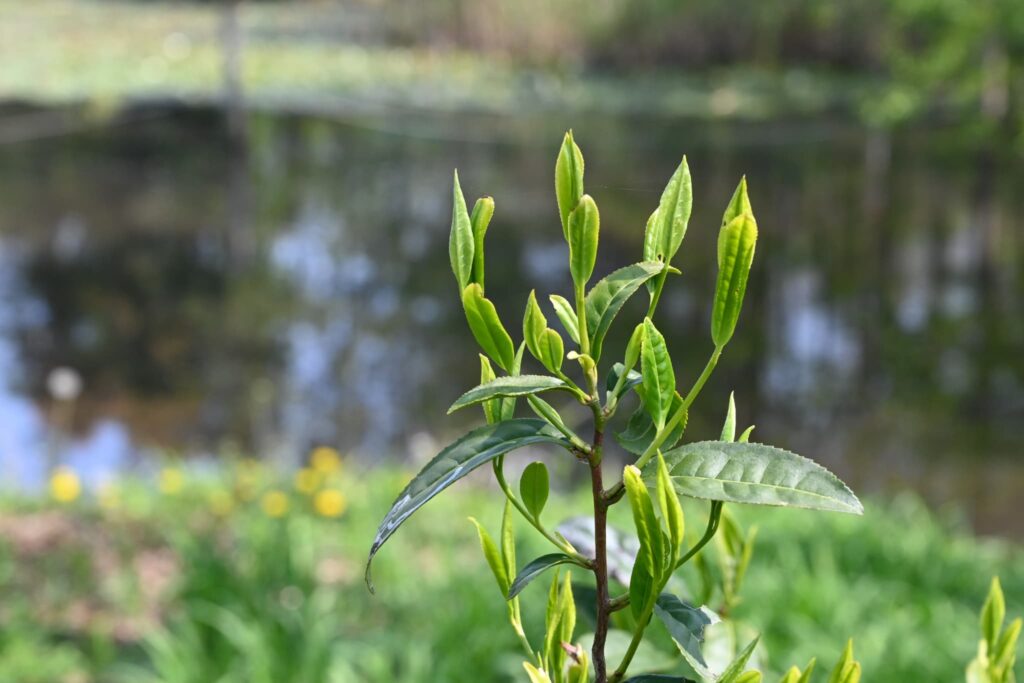
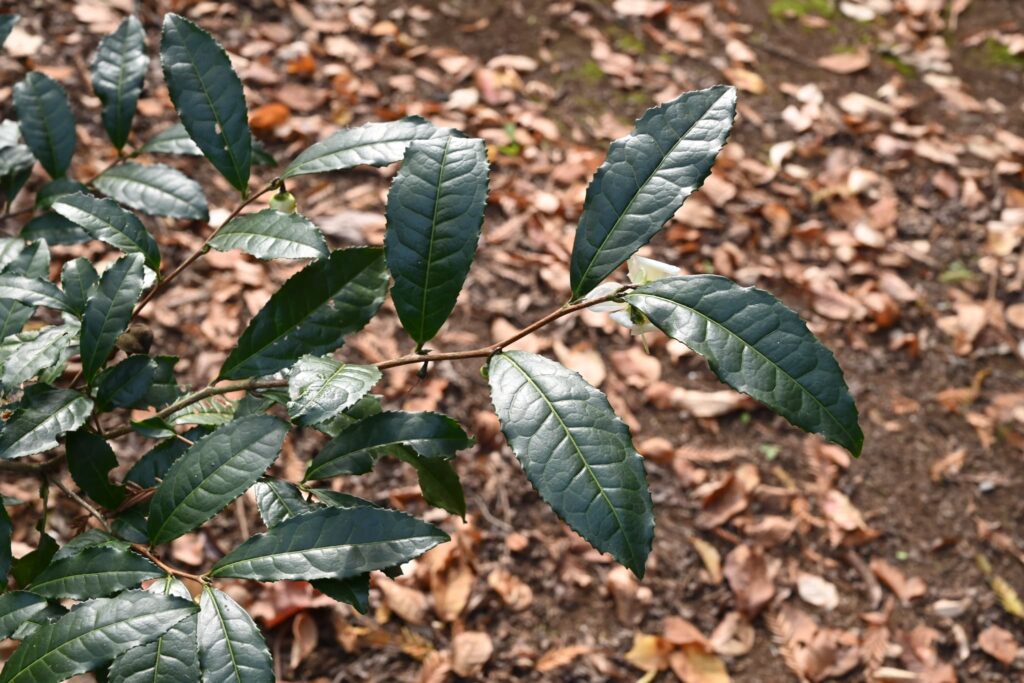
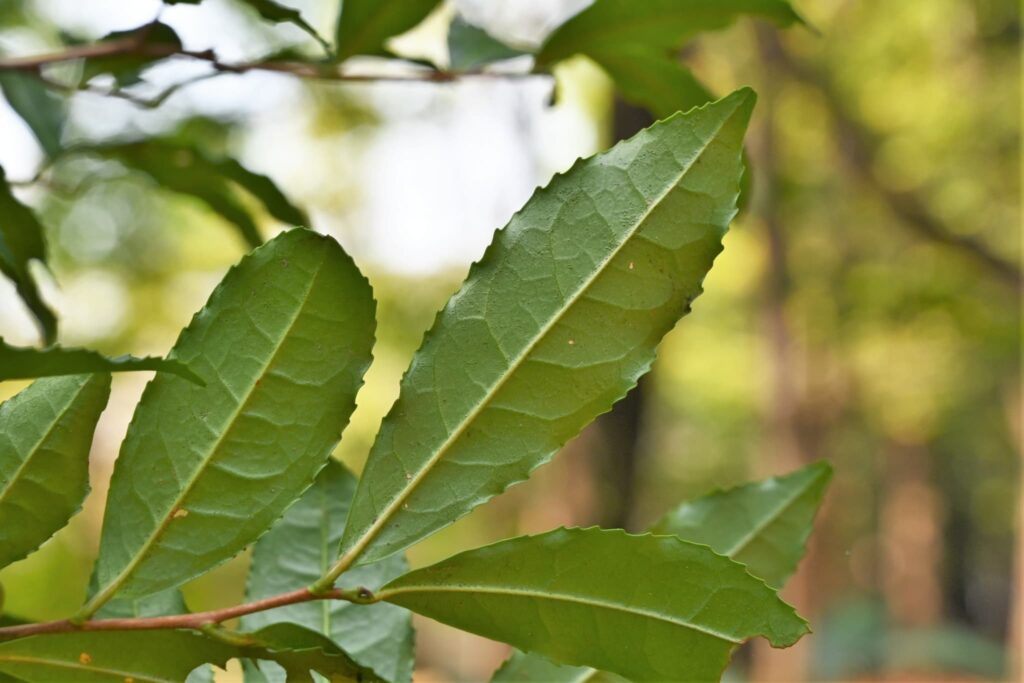
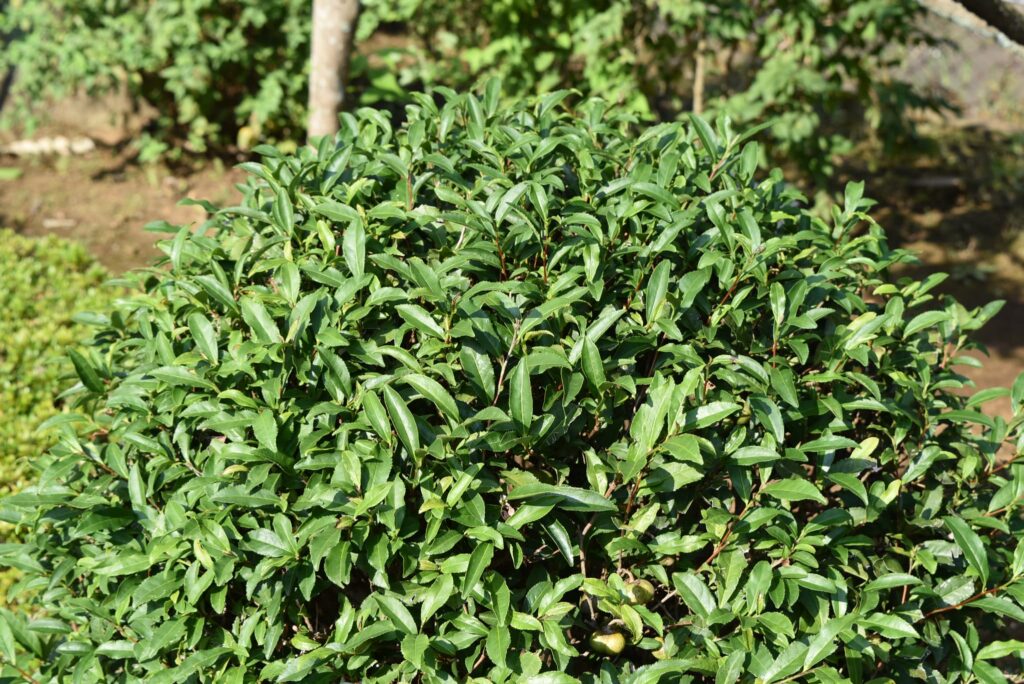
Tea Plant leaves are thinly leathery in texture, with wavy serrated margins, arranged alternately along the branches. The leaf tip is bluntly pointed, the midrib is sunken, and the base is wedge-shaped — characteristic features for identification. Traditionally, the auspicious date for harvesting tea leaves was the 88th night after the first day of spring (hachiju-hachi ya) — leaves picked on this date were believed to confer longevity.
Flowers
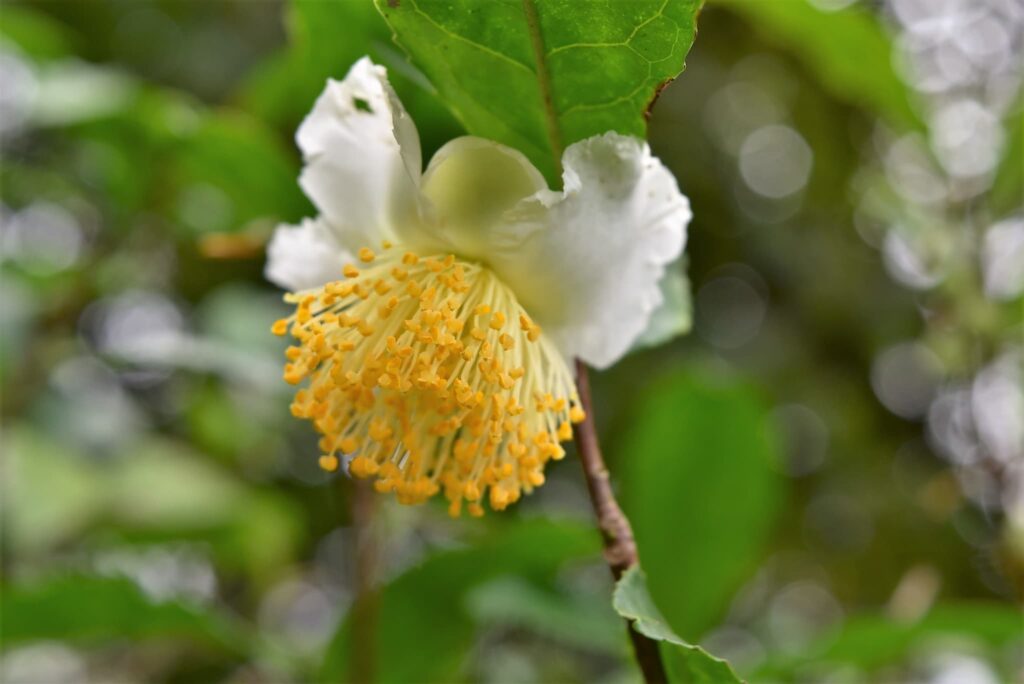
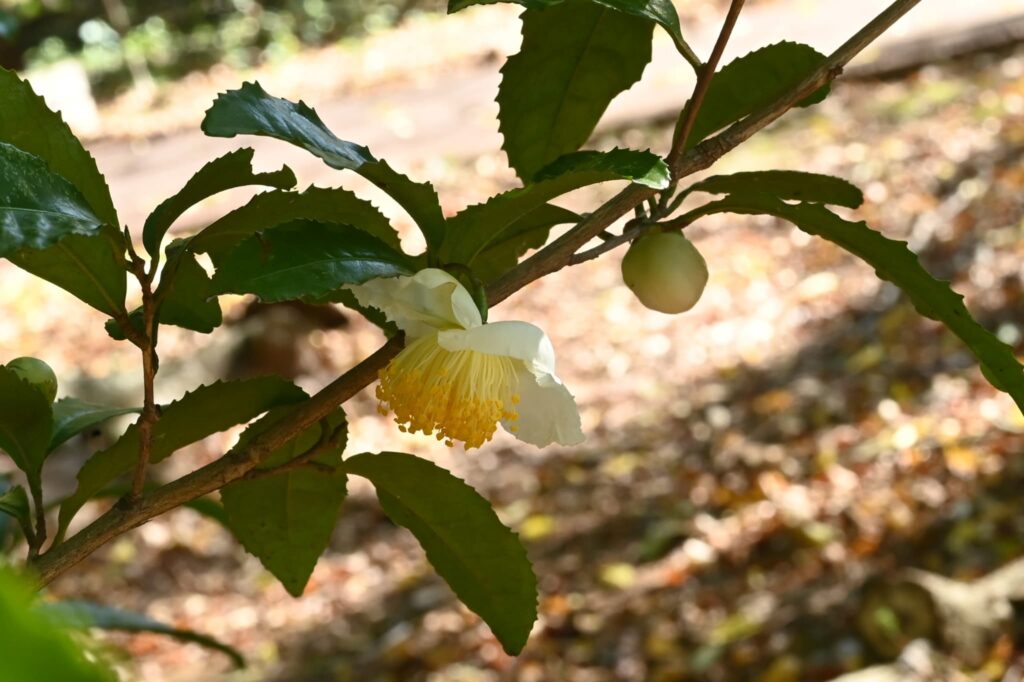
Tea Plants flower from October to November — the same season as Camellia and Sasanqua, to which it is closely related. Small white flowers, 2–3 cm in diameter, bloom quietly in the leaf axils near branch tips, releasing a faint, delicate fragrance. Unlike Camellia and Sasanqua, Tea Plant flowers hang on longer stalks, causing them to droop in clusters of 1–3 blooms — a subtle but distinguishing feature.
The flower center holds a style (pistil) with a three-lobed tip, surrounded by numerous yellow stamens. The 5–7 petals are nearly circular with a slightly notched tip, arranged in a broadly circular pattern. The understated beauty of the flowers — never showy, always quietly present — aligns naturally with Japanese aesthetic sensibilities, and ornamental cultivars bred specifically for their flowers have also been developed.
Fruit
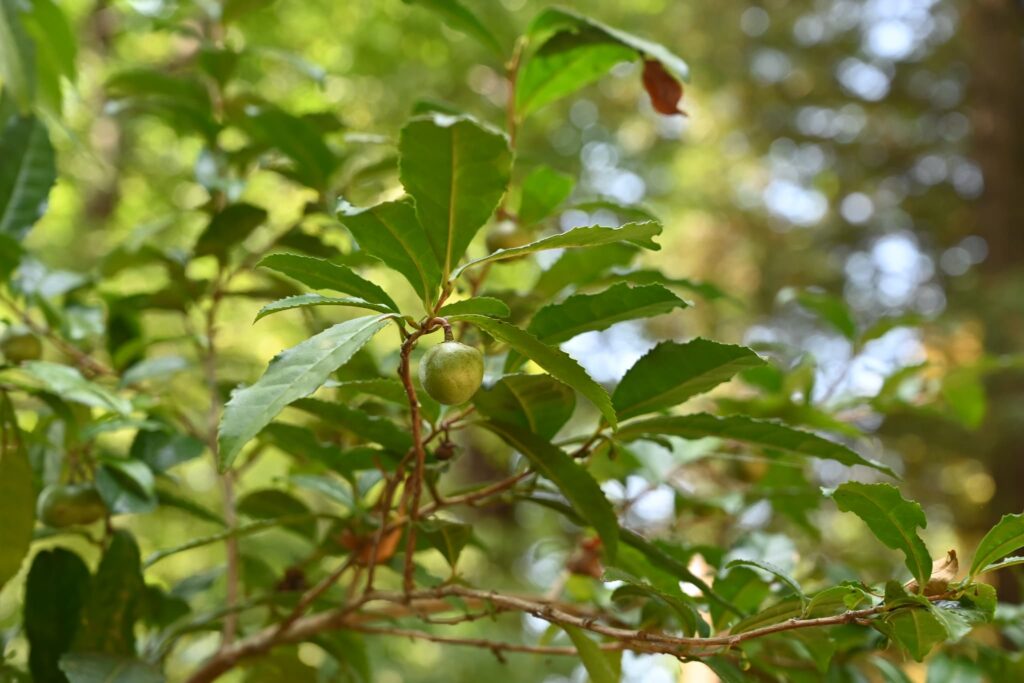
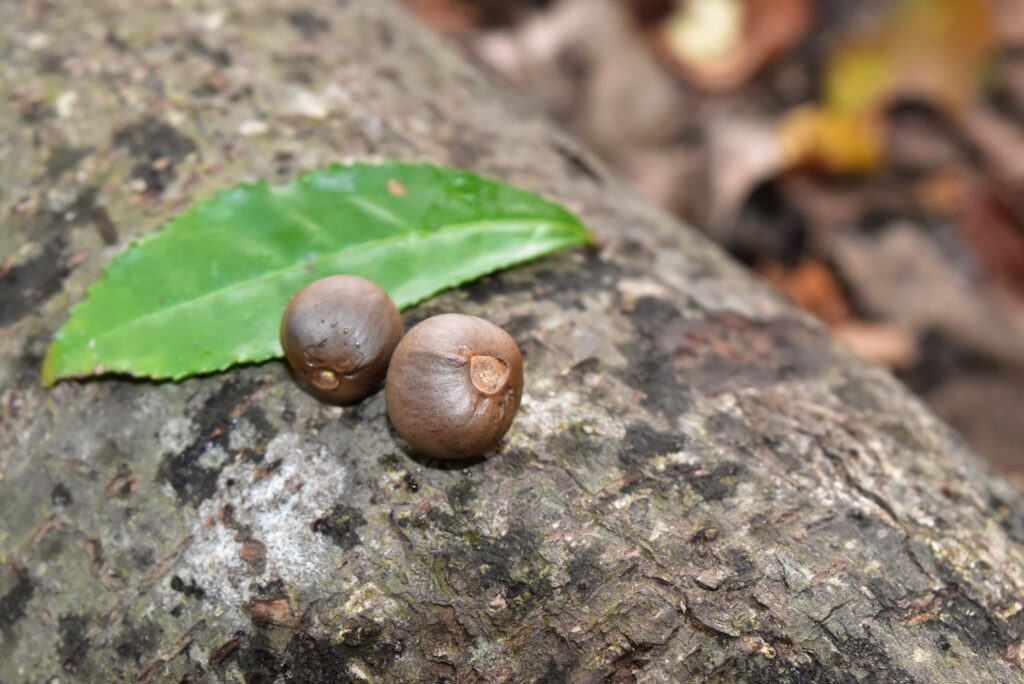
The dark brown fruit ripens around November, resembling a smaller, more triangular version of Camellia or Sasanqua fruit. As the season progresses, the fruit capsule splits into three sections, revealing three brown seeds. Each seed is roughly spherical, 1–1.5 cm in diameter.
Trunk & Bark
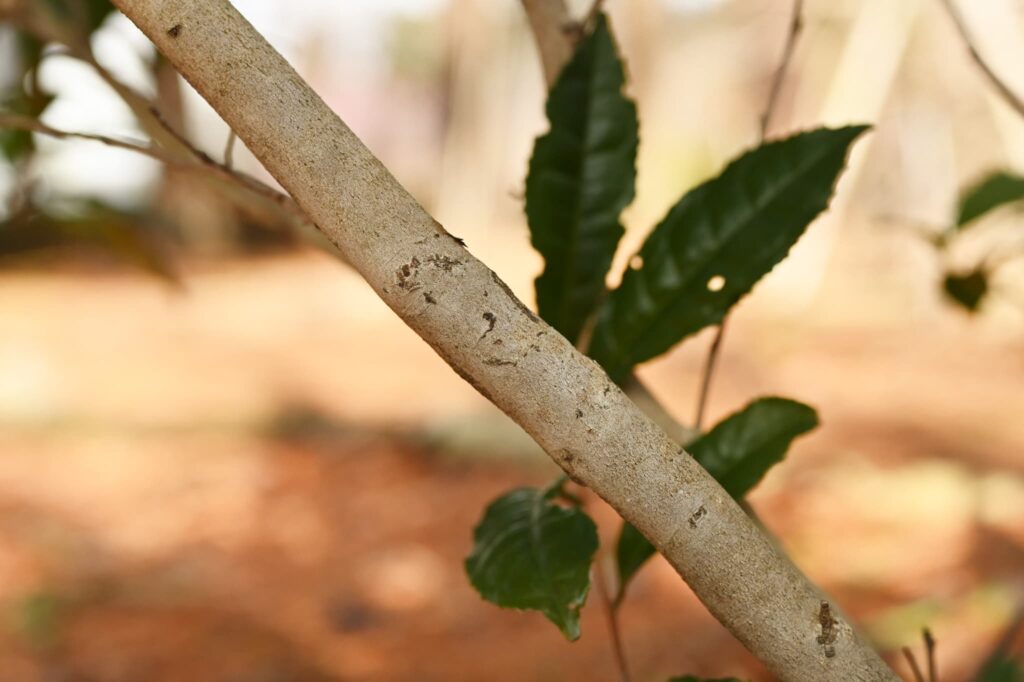
In commercial tea plantations, the Tea Plant is routinely pruned to a low, dome-shaped shrub and rarely allowed to develop a significant trunk. Left unpruned, however, it grows into a small tree reaching around 4 m in Japan — and in truly wild conditions, can reach 15 m or more.
The bark is smooth and pale gray, with subtle yellowish-brown tones. With age, shallow vertical fissures begin to develop, giving older trunks a slightly rougher texture. In mature trees, the trunk can reach up to 40 cm in diameter. Young branches are grayish-yellow; new shoots are distinctly reddish-purple, covered in fine white hairs — a feature that makes newly emerging growth easy to identify and, not coincidentally, marks the tender young shoots most prized for tea production.
History & Introduction to Japan
Tea was introduced to Japan from China during the Nara to Heian periods, initially valued for its medicinal properties. It was the Zen monk Eisai (1141–1215) who transformed tea drinking from an elite novelty into a cultural institution, bringing tea seeds back from China and promoting the practice as beneficial for health. Over the following centuries, the Japanese tea ceremony (chado) evolved into one of the country’s most refined and enduring cultural arts.
Although Tea Plants are now found growing semi-wild in shaded mountain forests across Japan, the species has no original native population here — all wild-looking specimens are believed to have escaped from cultivation in tea gardens. Such naturalized plants are sometimes called yamacha (“mountain tea”).
Green Tea vs. Black Tea
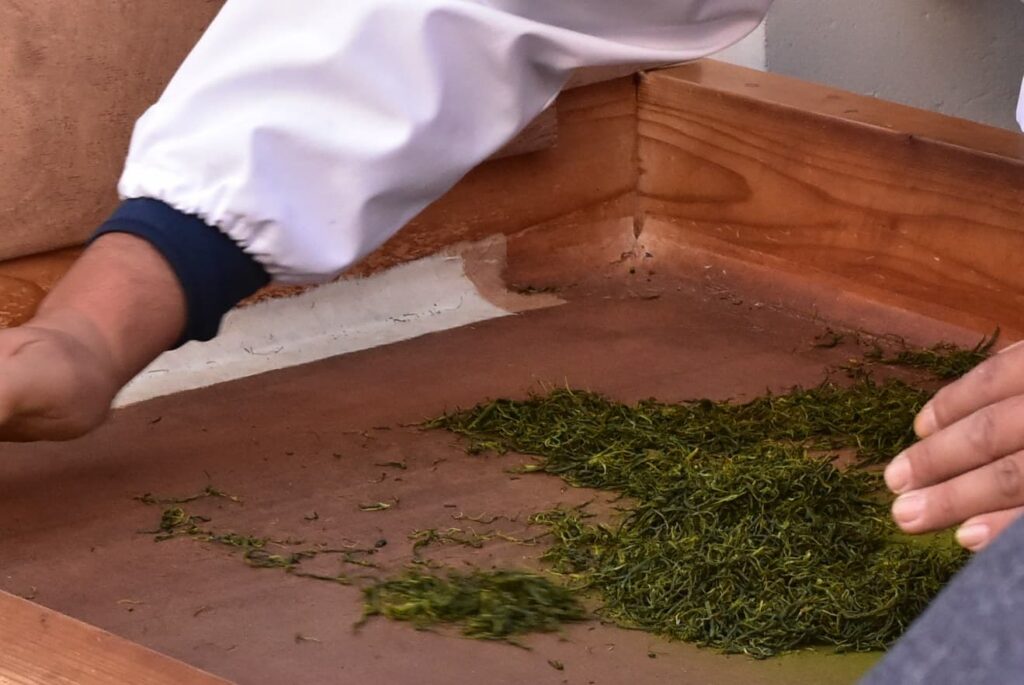
The Tea Plant is broadly divided into two botanical varieties: Camellia sinensis var. sinensis (Chinese variety) — smaller-leaved and shorter, used for green tea — and Camellia sinensis var. assamica (Assam variety) — larger-leaved and taller, used primarily for black tea. Importantly, however, the difference between green tea, black tea, and oolong tea lies not in the plant variety but in the processing method — the same leaves from a green tea cultivar can be processed into black tea or oolong by varying the degree of oxidation.
Growing Guide
Climate
Tea Plant is fundamentally a warm-climate species, best suited to cultivation from Honshu southward to Okinawa.
Soil & Sun
It prefers fertile, well-draining soil in full sun.
Pruning & Form
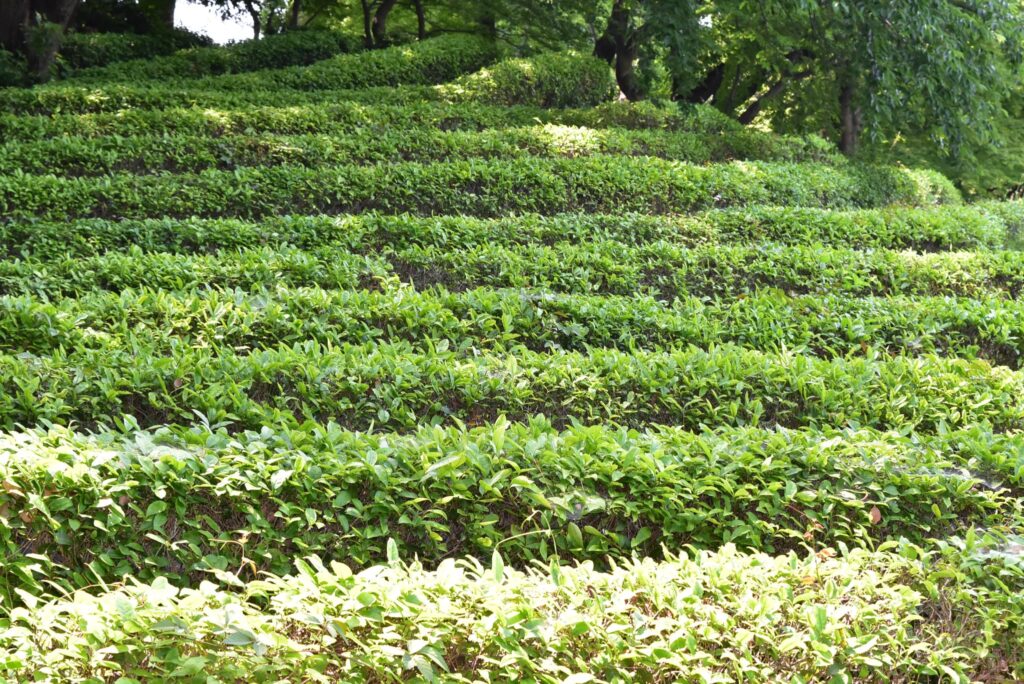
As the name chatsumi (tea picking) suggests, the Tea Plant has vigorous regenerative growth and tolerates clipping extremely well. While allowing the natural form is an option, unpruned plants can reach around 4 m in height and tend to become somewhat untidy. For this reason, most cultivated specimens are clipped into a neat semicircular (“kamaboko”) dome shape — the iconic form seen in Japan’s tea plantations.
Pests
One significant pest concern is the Tea Tussock Moth (Euproctis pseudoconspersa, Chadokuga) — a moth whose caterpillars carry urticating (itch-causing) hairs that can cause severe skin irritation and rashes on contact. This pest makes Tea Plant problematic as a hedge plant in residential settings.
Cultivars
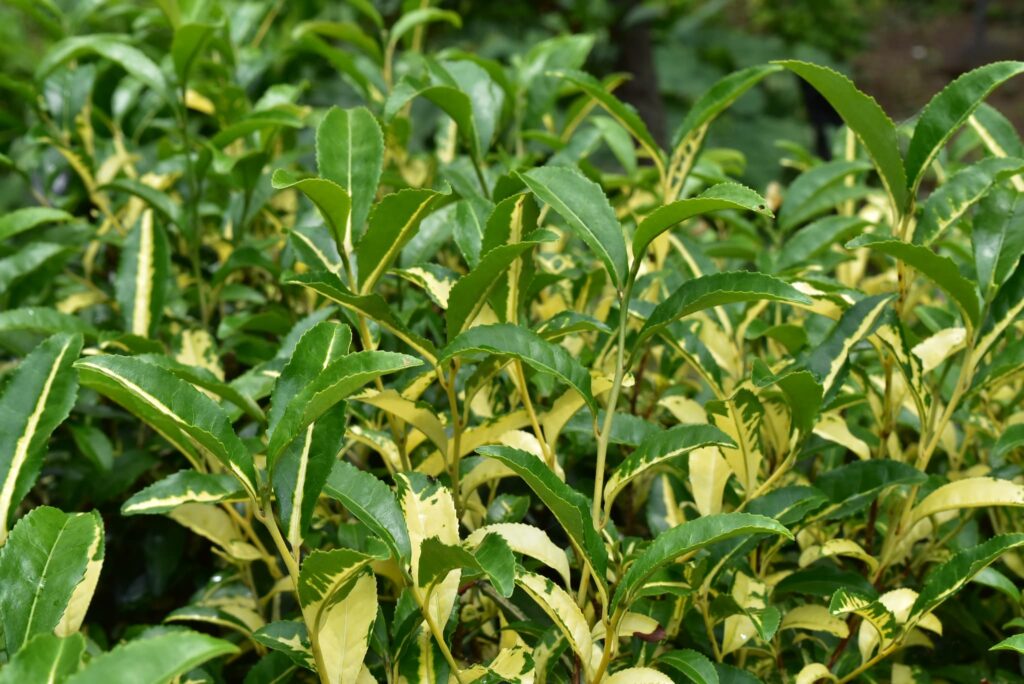
Ornamental Cultivars
- Benibana-cha (Chinese origin) — pale pink flowers
- Kotencha — another Chinese pink-flowered form
- Fuiri Chanoki — variegated foliage
- Numerous hybrids with Sasanqua and Camellia also exist
Tea Cultivars for Japanese Tea Production
Japan’s tea industry uses dozens of named cultivars. The most widely grown is ‘Yabukita’, which accounts for the vast majority of Japanese tea cultivation and is used for premium teas including gyokuro. Other notable cultivars include Yamatomidori, Asatsuyu, and Hatsumidori. The principal tea-producing regions of Japan are Shizuoka, Uji (Kyoto), and Sayama (Saitama).
Frequently Asked Questions
Q: Is Japanese green tea made from a different plant than black tea?
Not necessarily. Both green tea and black tea can be produced from the same Camellia sinensis plant. The key difference is processing: green tea leaves are steamed or pan-fired to prevent oxidation, while black tea leaves are fully oxidized. Oolong falls between the two. In practice, different cultivars are often preferred for each style.
Q: Why do tea plants grow in rows in Japanese tea gardens?
The rows allow efficient harvesting of new shoots and facilitate the characteristic dome-shape clipping (kamaboko) that promotes dense, even new growth. The clipped surface is where new shoots develop — the ones harvested for tea.
Q: What is hachiju-hachi ya (the 88th night)?
It refers to the 88th night after Risshun (the first day of spring, around February 4), falling around May 1–2. Leaves harvested on this date are traditionally considered the finest and most auspicious of the year — a belief immortalized in the well-known Japanese folk song Cha-tsumi (“Tea Picking”).
Q: Can the Tea Plant be used as a garden hedge?
Technically yes, but caution is advised due to the Tea Tussock Moth (Chadokuga), whose caterpillars’ urticating hairs can cause painful skin reactions. For this reason, it is generally not recommended for hedging in residential gardens.
Q: What is the difference between the Tea Plant and Camellia or Sasanqua?
All three belong to the same family (Theaceae) and bear similar flowers. The most reliable distinguishing feature is the flower stalk — Tea Plant flowers hang on longer stalks and droop in small clusters, while Camellia and Sasanqua flowers sit directly on the branch with little or no stalk. Tea Plant flowers are also smaller and more delicate in appearance.
Q: Can you grow Tea Plant at home?
Yes. Tea Plant grows well in gardens or large containers in USDA Zones 7–9. Regular pruning keeps the plant compact and encourages fresh shoots.
Conclusion
Few plants have shaped human civilization as profoundly as Camellia sinensis. From its origins in the misty mountains of southwestern China to the refined tea ceremony rooms of Kyoto, from the rolling green hills of Shizuoka to the afternoon teacups of Britain, the Tea Plant has followed human culture across the globe for over a thousand years. In Japan, it is at once an agricultural staple, a vehicle for one of the world’s great aesthetic traditions, and a quietly beautiful flowering plant in its own right — one whose small white autumn flowers, easily overlooked beside the ceremony they make possible, embody the Japanese ideal of subtle, unhurried beauty. Few plants have influenced human culture more deeply than the Tea Plant.