Japanese Maple (Acer palmatum): Identification, Care & Uses
The Japanese maple, known in Japanese as Iroha momiji, is one of the most beloved ornamental trees in Japan, prized for its delicate palmate leaves and brilliant autumn color. This guide covers its identification features, growing conditions, and cultural significance, based on observations of the plant as grown in Japan.
What Is the Japanese Maple?
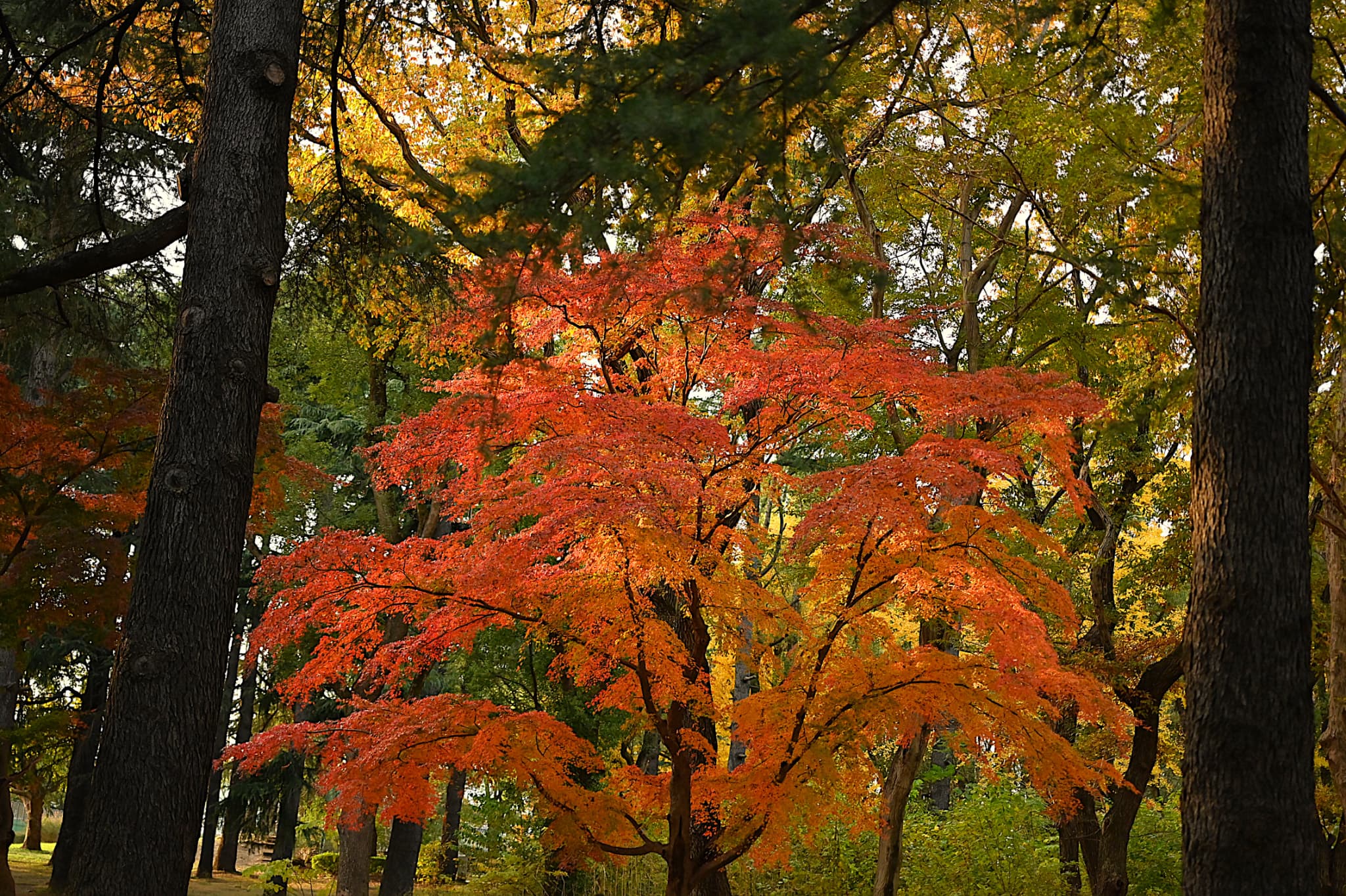
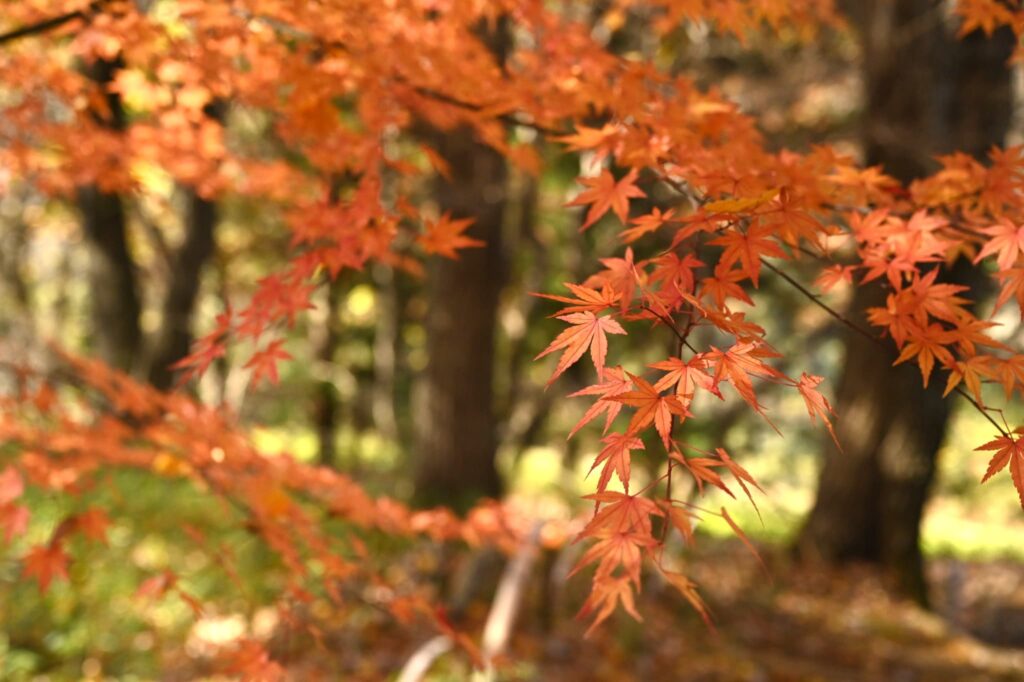
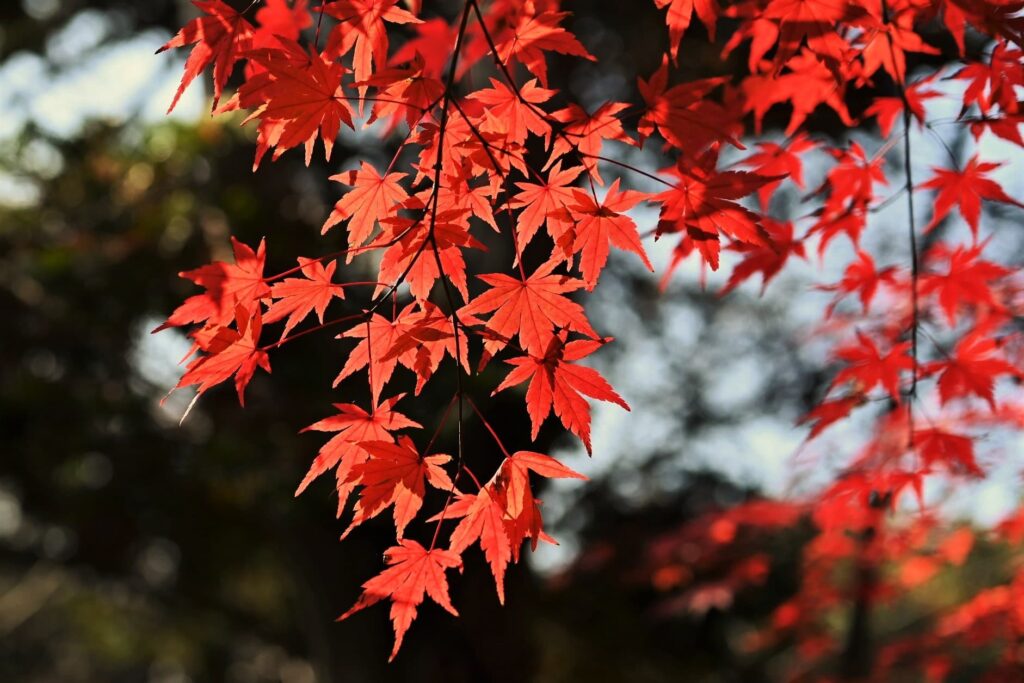
The Japanese maple is one of the most iconic deciduous trees in Japan. It is known for its delicate palmate leaves, which display brilliant colors in autumn, and this striking foliage has made it one of the most popular ornamental trees worldwide.
It is native to central and southern Japan and southwestern Korea. In Japan, it occurs naturally from central Honshu southward through Shikoku and Kyushu, growing naturally from mountainous terrain down to lowland areas. Thanks to its strong reproductive vigor, it also establishes readily in the woodlands and waterside areas of satoyama (rural, semi-wild landscapes) in warmer regions. Around 30 maple species are native to Japan, but this one — alongside Acer amoenum and Acer japonicum var. matsumurae — is considered one of the three representative maples of Japan because of its finely divided leaves and vivid autumn color, and it is the species most commonly planted in parks and gardens.
Overview
| Item | Description |
|---|---|
| Scientific Name | Acer palmatum |
| Common Name | Japanese Maple |
| Japanese Name | Iroha momiji |
| Family | Sapindaceae |
| Native Range | Central and southern Japan and southwestern Korea |
| Plant Type | Deciduous tree |
| Height | Typically 5–10 m in the wild; many cultivated forms remain 2–8 m |
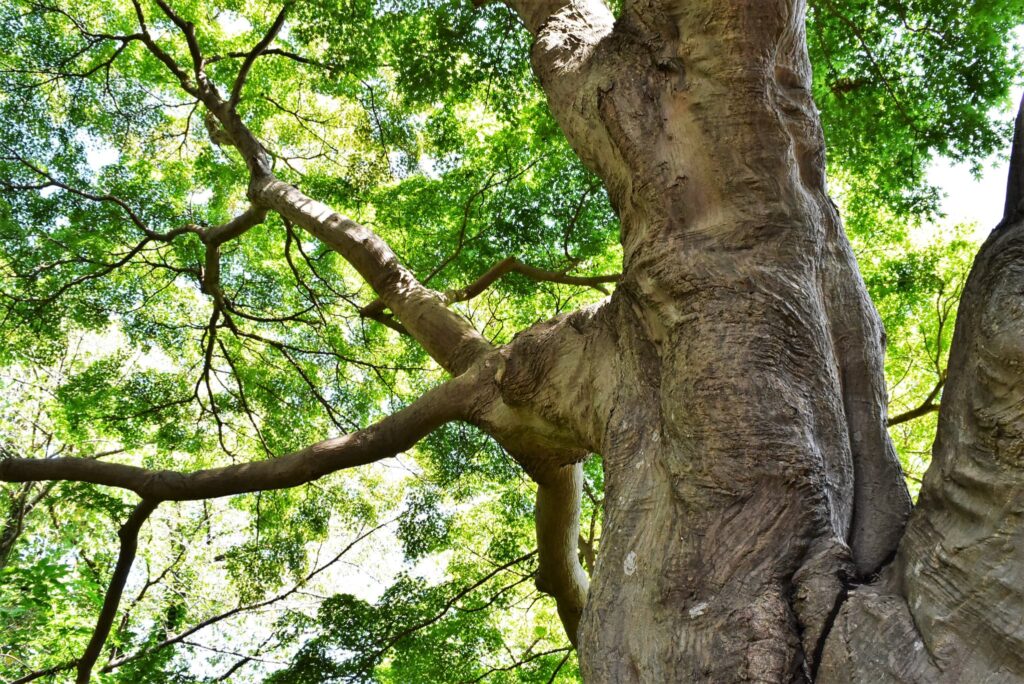
| Trunk | Often irregular or crooked; up to about 1 m in diameter at maturity |
| Flowering Season | Spring (April–May) |
| Fruit Type | Paired winged samaras |
| USDA Zones | 5–8 (some cultivars to Zone 9 with protection) |
| Sun Exposure | Partial shade to full sun |
Characteristics
| Item | Description |
|---|---|
| Leaves | 3–7 cm across, typically divided into 5–7 lobes, opposite arrangement | |
| Flowers | Small, drooping, deep red, about 5 mm across |
| Fruits | Paired samaras, 1–2 cm long, green ripening to red |
| Bark | Green when young, aging to pale grayish-brown with shallow fissures |
Foliage
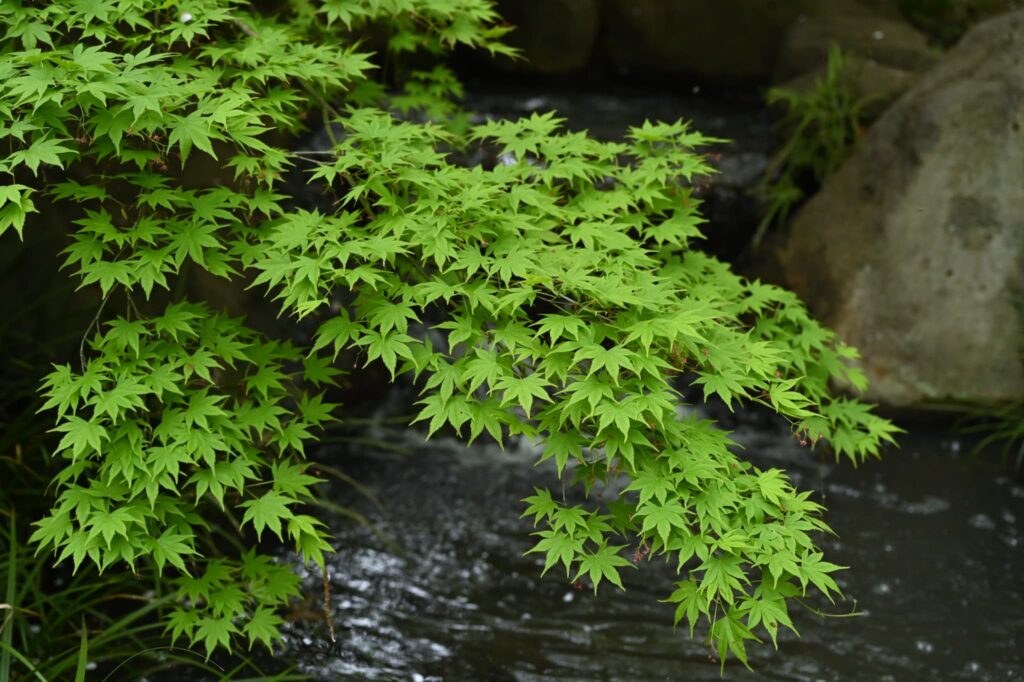
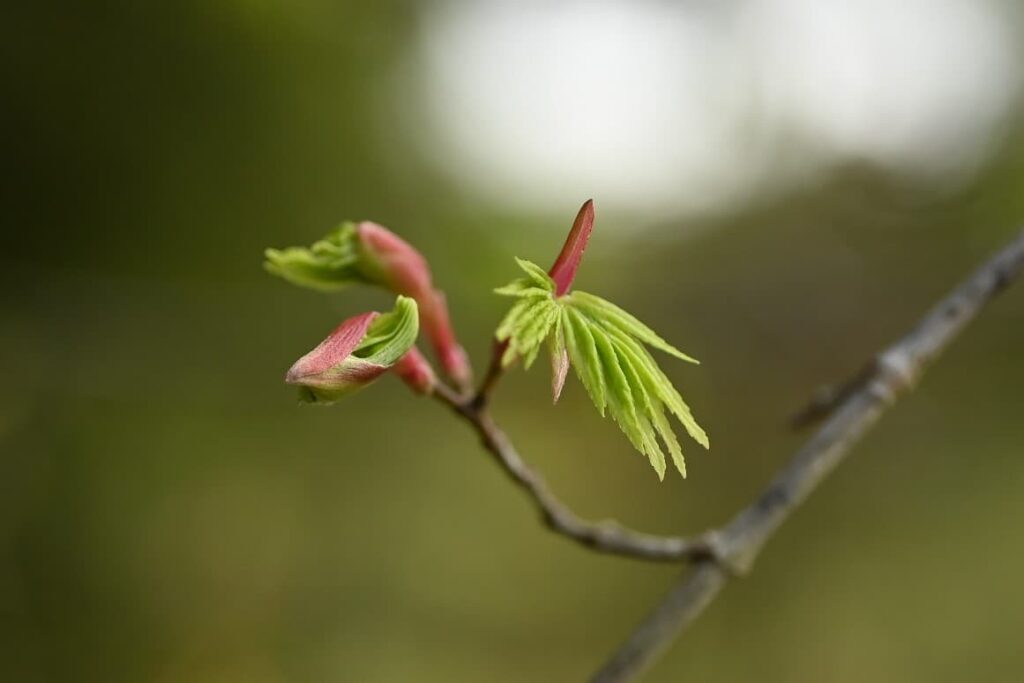
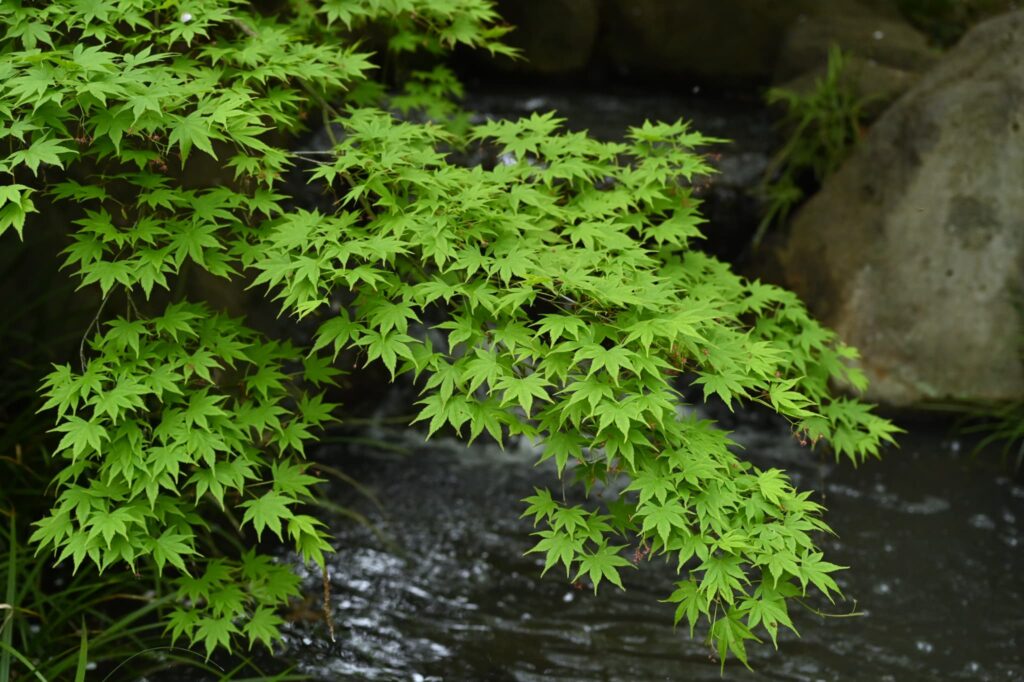
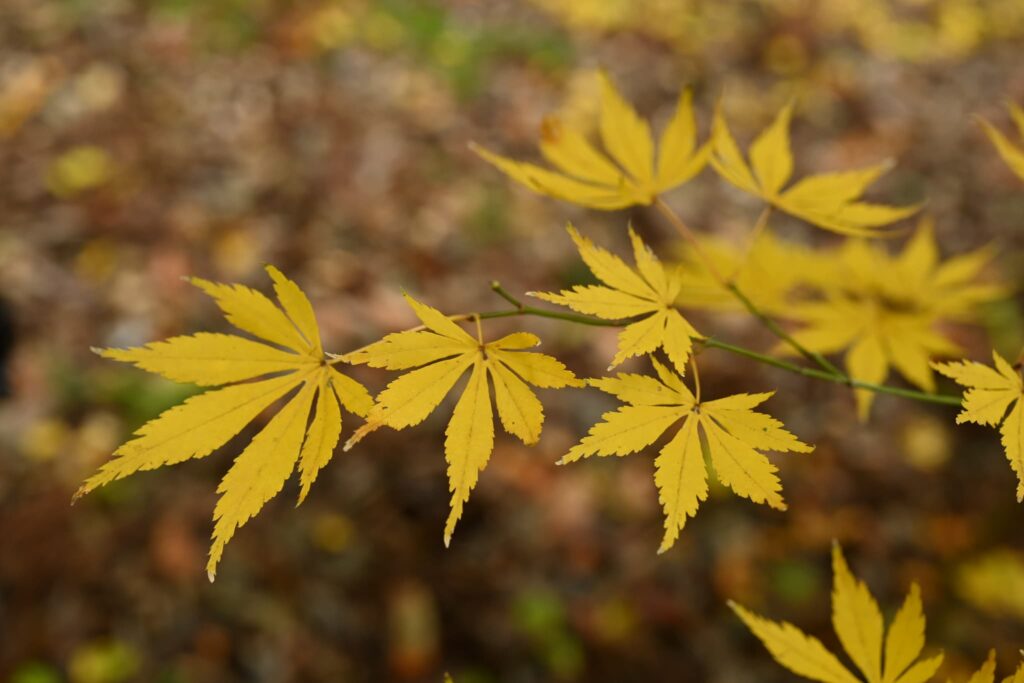
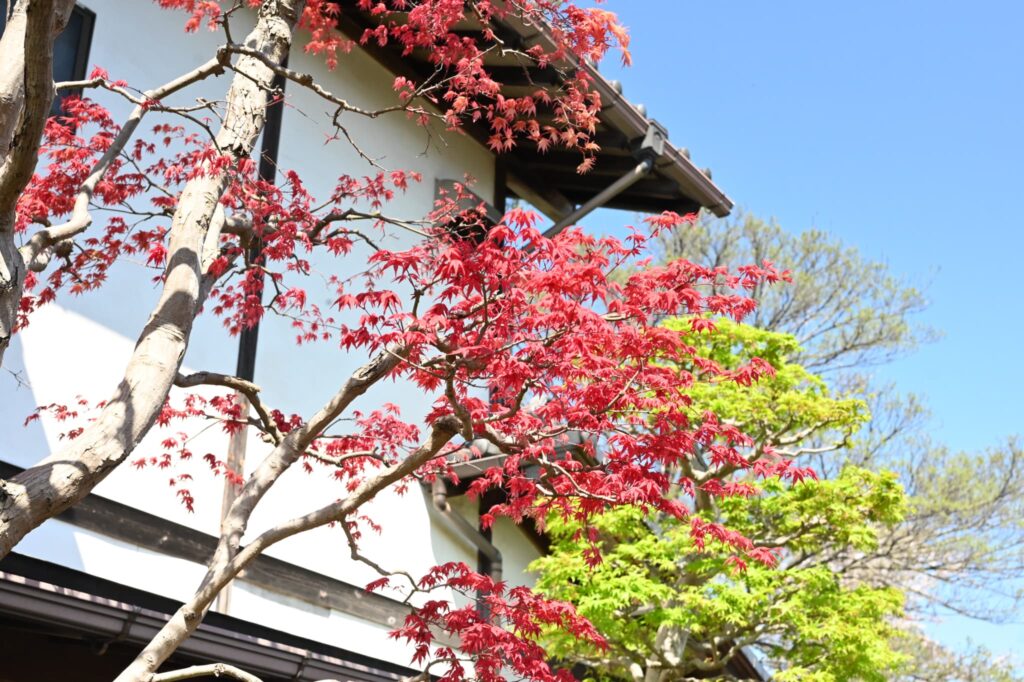
The leaves are typically palmately divided into five to seven lobes, although the depth and number of lobes can vary considerably. The leaves are relatively small, measuring about 3–7 cm across excluding the petiole, and are borne in opposite pairs along the branches — among Japan’s native maples, this species has some of the smallest leaves. The leaf tips are pointed, the margins are irregularly double-serrated, and fine hairs can be found at the base of the veins on the underside of young leaves, gradually disappearing as the leaves mature.
Flowers
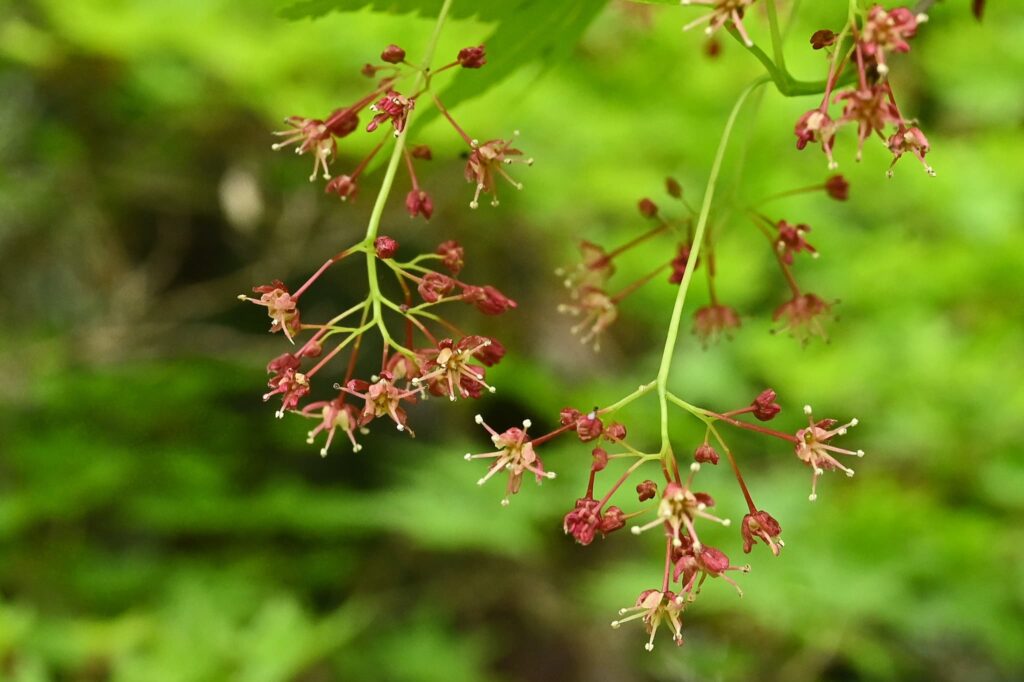
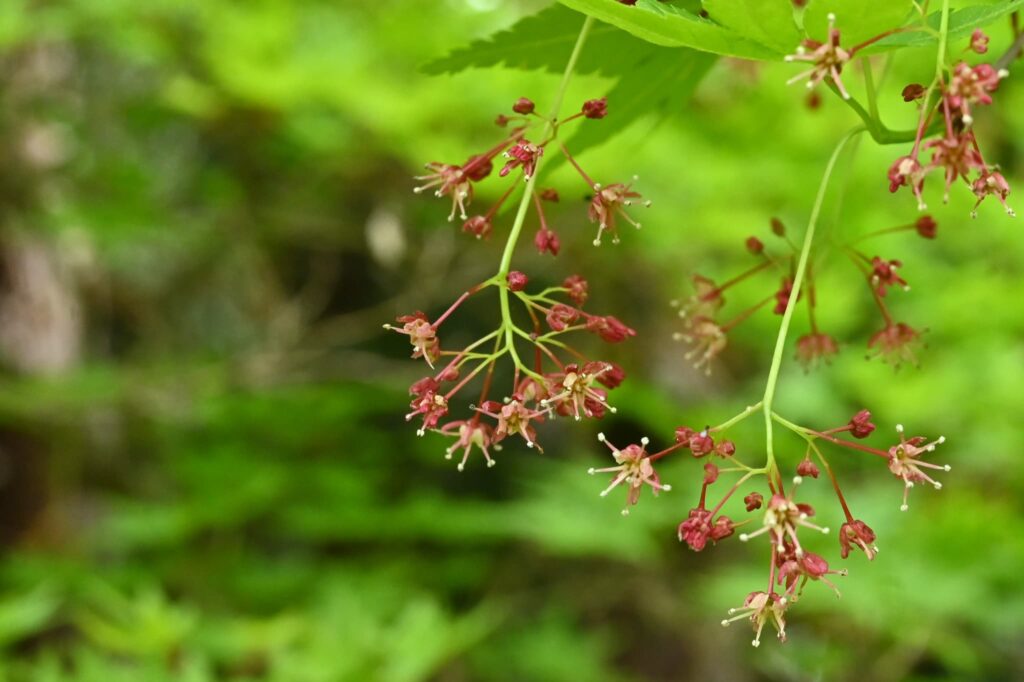
Although often overlooked, the Japanese maple produces small, drooping deep-red flowers from April to May as the new leaves emerge in spring. The species is monoecious, with clusters containing both male and bisexual flowers, and each inflorescence typically bears around 20 flowers hanging from the tips of the branches.
The flowers are about 5 mm in diameter, with five sepals, five petals, and eight stamens. Bisexual flowers have a flattened ovary and small, reduced stamens, while male flowers have well-developed stamens and a small, vestigial pistil. One useful identification feature is that the flower stalks and leaf stalks are generally hairless.
Fruits
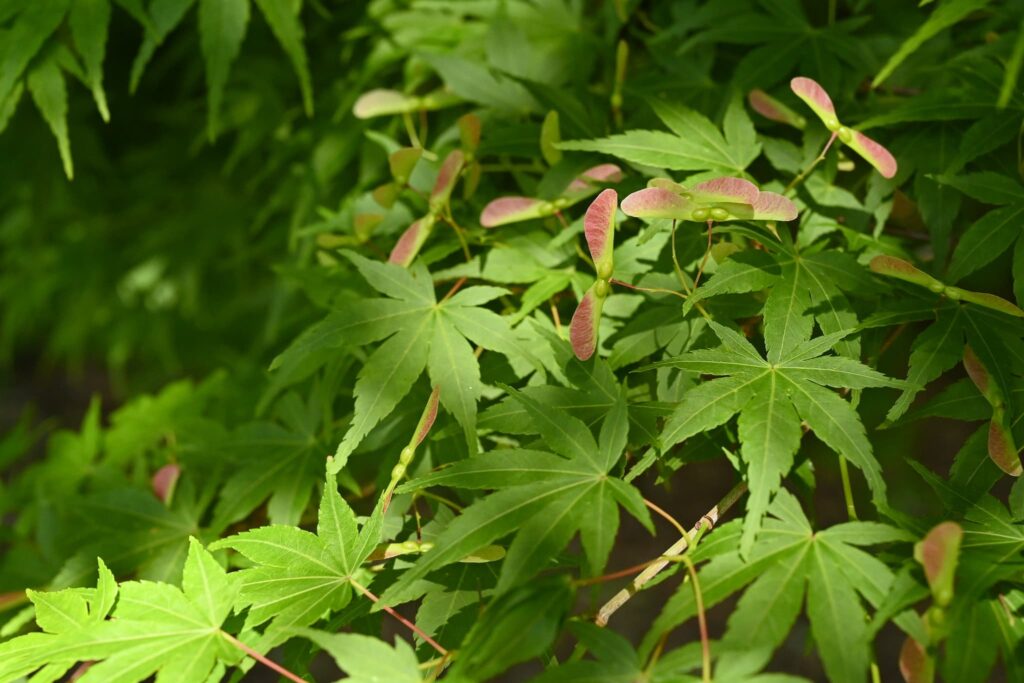
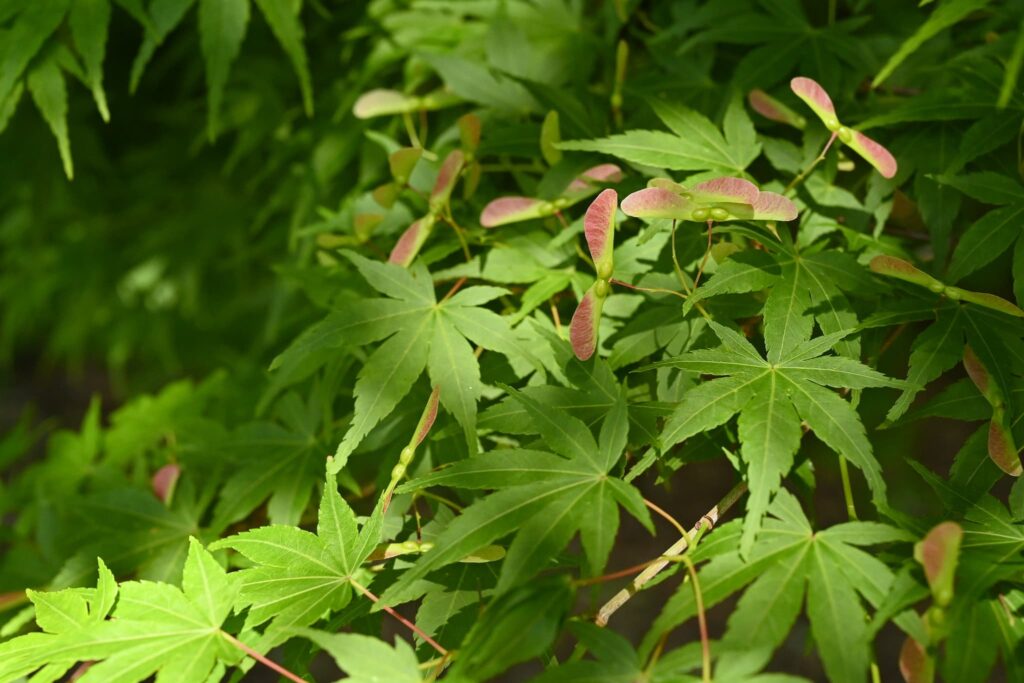
Following the flowers, paired winged fruits measuring about 1–2 cm in length are produced. The fruits are green at first, ripening to red during the summer, and their wing-like structures aid in wind dispersal. In autumn, the fruits separate into two samaras that spin through the air as they are carried by the wind.
Bark & Timber
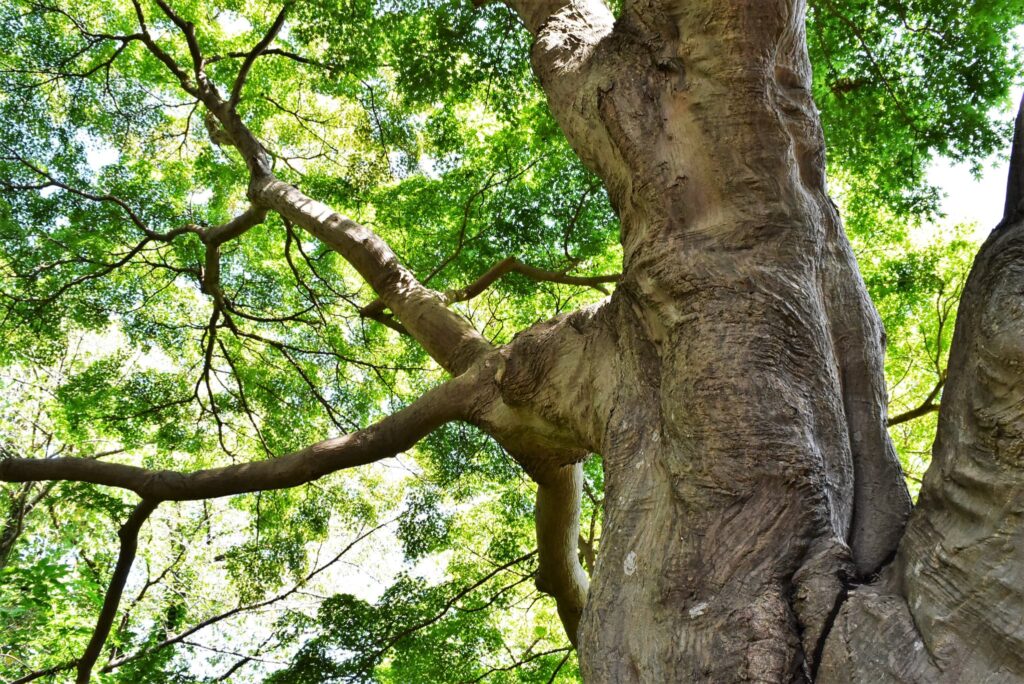
The bark of young trees is green, gradually becoming pale grayish-brown with age and developing shallow vertical fissures. Compared with many maple species native to Europe and North America, the bark remains relatively smooth. The trunk is often irregular or somewhat crooked, but the wood is occasionally used for timber and tool making.
Size & Growth
In its natural habitat, Acer palmatum can develop into a small tree around 5–10 m tall, occasionally larger. In gardens, however, size varies greatly depending on the cultivar. Many commonly grown forms remain between 2 and 8 m, while dwarf cultivars may stay under 2–3 m even at maturity.
Uses & Cultural Significance
The Japanese name Iroha kaede is traditionally associated with the iroha syllabary, although the exact origin of the name is explained in different ways. While Iroha kaede is the more formal name, Iroha momiji is also commonly used. Because it has some of the smallest leaves among Japan’s native maples, it is alternatively known as Koha kaede, or “small-leaf maple.”
The word momiji itself is believed to derive from the old Japanese verb momizu, meaning “to take on color,” or from the noun form of momizu (絞り出す), the process of squeezing out red dye from safflower — and over time it came to refer broadly to trees that change color in autumn. Kaede, meanwhile, comes from kaerude (“frog hand”), a reference to the leaf’s resemblance to a frog’s webbed foot. Another alternate name, Takao momiji, comes from Mt. Takao in northwestern Kyoto, long famous as a spot for viewing autumn color; the name is sometimes applied jointly to this species and the related Acer amoenum (Takao kaede).
In Japan, the tradition of viewing autumn foliage is called momijigari, or “maple-leaf hunting.” Rather than collecting leaves, the practice refers to traveling to scenic locations to admire the vibrant colors of autumn — a custom closely associated with the Japanese maple’s striking fall display.
The Japanese maple also has a long history of cultivation in Japan. Its branches and leaves show considerable natural variation, and horticultural cultivars have been bred from it since ancient times — from the late Edo period to the early Meiji period, breeding was especially active, and at its peak several hundred named cultivars existed, said to number more than 200, though the origins and genetic backgrounds of many have since been lost. The character 楓, often used in Japanese personal names, is generally associated with this tree, although in Chinese the same character refers to a different tree, the sweetgum (Liquidambar formosana). In bonsai circles, the Japanese maple is sometimes referred to as “Yama momiji,” although the true Yama momiji is a distinct, related species.
Growing Guide
| Item | Description |
|---|---|
| USDA Hardiness Zones | 5–8; some cultivars to Zone 9 with protection from intense afternoon sun |
| Light | Partial shade to full sun; afternoon shade recommended in hot climates |
| Soil | Moist, well-drained, organically rich; slightly acidic to neutral (pH 5.5–7.0) |
| Watering | Regular during establishment; moderately drought-tolerant once established |
Light & Soil
Japanese maples grow best in partial shade to full sun. In cooler climates (Zones 5–6), full sun is usually acceptable, while in hotter climates (Zones 8–9), afternoon shade is recommended to prevent leaf scorch. Varieties with red foliage generally develop better color with several hours of sunlight each day.
The species prefers moist, well-drained soil rich in organic matter, growing best in slightly acidic to neutral soil (pH 5.5–7.0). Heavy clay soils that remain waterlogged after rain should be avoided, and a layer of organic mulch helps maintain soil moisture and keep roots cool.
Because the Japanese maple is such a popular and well-known tree for its autumn color, it is often planted without much thought — but it dislikes dry conditions, and if planted in a parched urban site and left exposed to intense summer sun, it can lose vigor and die within a few years. A humid site is preferable, but if light is too weak, the branches and leaves become leggy and sparse, and the autumn color tends to disappoint as well. The ideal planting site is therefore one with moderate sunlight and consistent humidity — for example, a spot where a large tree or building blocks the harsh afternoon sun. Once established, ongoing care is fairly low-maintenance aside from pruning; applying an organic fertilizer such as rapeseed meal at the base during the dormant period (around December) helps stabilize growth.
Wind & Snow Tolerance
Japanese maples have relatively shallow root systems and benefit from mulching around the base. Planting in windy locations should be avoided, as strong winds can damage leaves and increase water loss. Protection from intense afternoon sun and drying winds is especially important for finely dissected cultivars.
Cold Hardiness
The species is suitable for USDA Zones 5–8, with some cultivars tolerating Zone 9 if protected from intense afternoon sun. Extreme winter cold below about −29°C (−20°F) may damage young trees.
Pruning
Despite its graceful appearance, the Japanese maple grows quickly — in lowland areas of the Kanto region, even a seedling grown from seed can reach about 150 cm in just four to five years, and young branches continue to extend vigorously afterward, quickly becoming dense and overgrown if left unchecked.
That said, the species generally does not respond well to pruning, and hard pruning during summer in particular is likely to cause dieback in the cut branches. Because it is also difficult to prune while preserving a natural branch structure, a Japanese maple generally needs a fair amount of space when planted in a home garden.
Among professional gardeners, it is often said that maples “dislike metal.” Regardless of the scientific basis for this, snapping soft young branches off by hand — rather than cutting them with shears or a saw — tends to produce a better overall branch structure. For branches thicker than a finger, however, the timing of pruning needs more care.
Maples are also vigorous at drawing up sap, which becomes obvious the moment you prune one yourself: cutting a thick branch during the warmer months leaves a visibly wet cut surface. If left as is, nutrient-rich sap continues to bleed from the cut, which can dry out and weaken the whole tree, and the exposed sap can also attract pests. In much of Japan, particularly in the warmer lowland regions where the species is commonly grown, the preferred pruning period is generally from mid-October to mid-December, shortly after leaf fall — missing this window means sap flow resumes and pruning risks causing dieback. Thin, brittle twigs that snap cleanly are an exception to this timing rule.
Most trees are pruned from the top down, but maples often look better when pruned from the lower branches upward, following the natural curve that rises from the base of the trunk; branch tips should also be left as untrimmed as possible. Japanese maples are sometimes used as hedging, but because maples grow quickly, a hedge shape doesn’t hold for long — forcing it into a tight, boxy form tends to result in a rough, unsightly hedge within a few years.
Suitability for Home Gardens
With a modest height range (2–8 m for most cultivars, with dwarf varieties staying under 2–3 m) and shallow, mulch-friendly roots, the Japanese maple is well suited to home gardens, courtyards, and containers, particularly where afternoon shade can be provided in warmer climates.
Common Problems & Pests
The most common cause of a Japanese maple dying is pruning at the wrong time of year, as noted above — pruning during summer in particular should be strictly avoided unless the goal is actually to remove the tree.
Recent extreme summer heat is another major threat, since intense sunlight itself can cause dieback, so keeping the tree consistently watered during the summer months is important.
Pest damage is also common — depending on the environment, dozens of pest species may appear — but two are especially worth watching for: a small reddish-brown aphid that attacks new spring growth, and a scale insect that clings to the bark and drains the tree’s nutrients. Aphids and scale insects can be managed through appropriate horticultural controls, depending on the severity of the infestation.
Larval damage from longhorn beetles boring in from the base of the trunk is another cause of decline. If beetles are present, sawdust-like frass and droppings typically appear at the base of the trunk between April and June, and pesticide treatment is recommended; on young trees, feeding marks on the bark can also be a telltale sign.
Cultivars
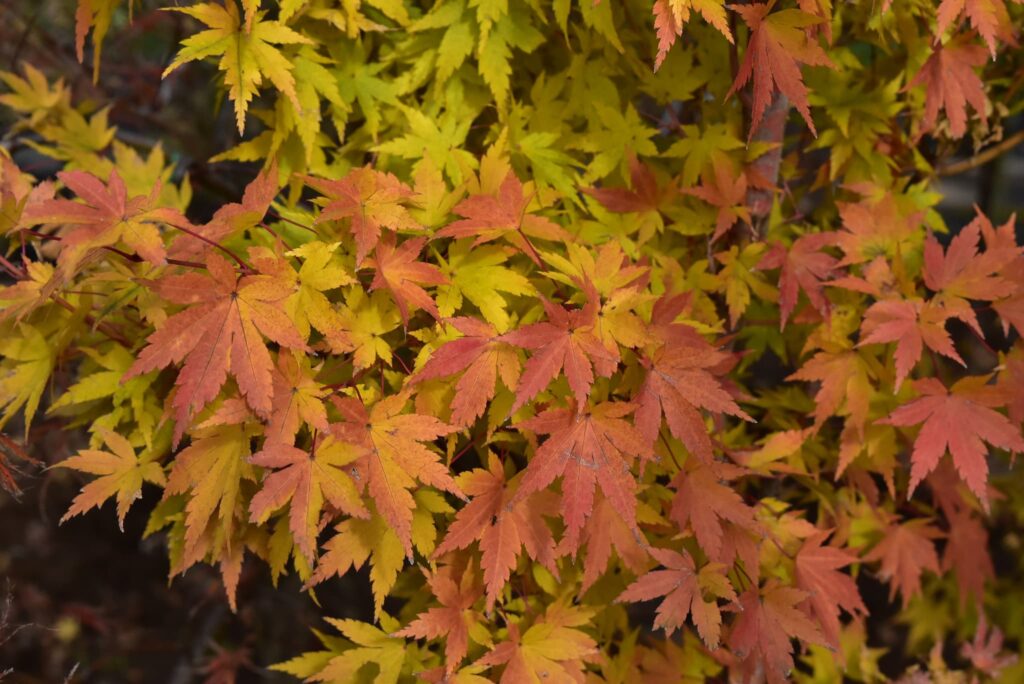
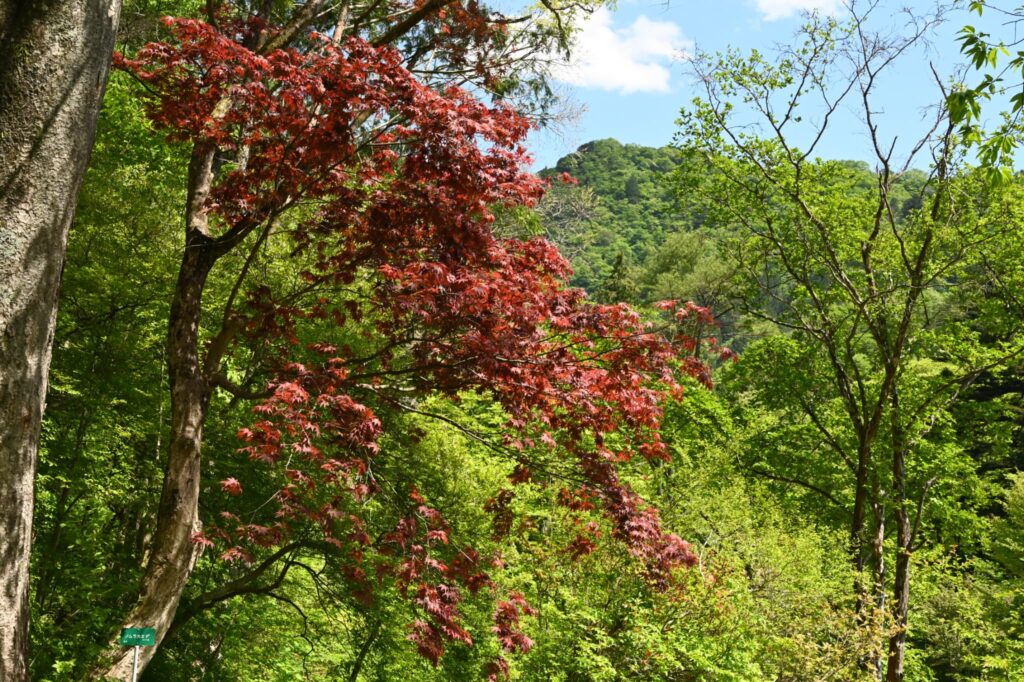
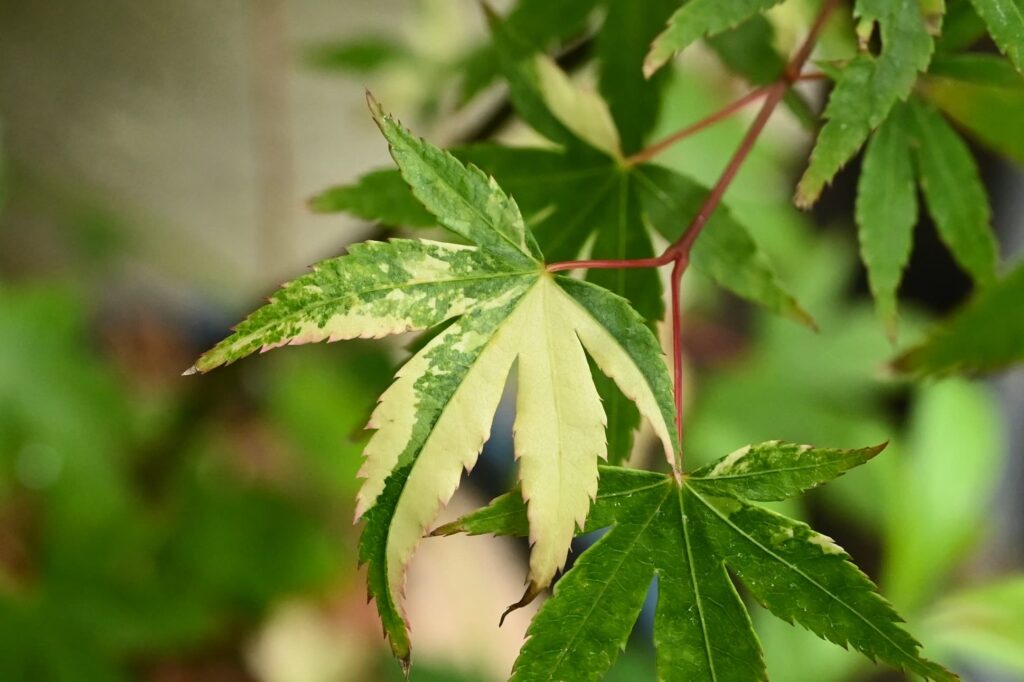
Breeding of the Japanese maple was especially active from the late Edo period into the early Meiji period, and several hundred named cultivars are said to have existed at the peak, though the parentage of many has since been lost. Notable cultivars, in addition to those above, include:
- Takao — not a formally registered cultivar, but a name traditionally given since the Edo period to individual trees with especially beautiful leaf shape and autumn color; trees carrying this name still remain in various regions.
- Akajinishiki (Seigai) — a cultivar with vivid red new growth; it stays narrow rather than spreading and grows upright.
- Chishio — another cultivar prized for the vivid red of its new growth, but with a more spreading, horizontal branch habit than Akajinishiki.
- Oridononishiki — a variegated cultivar whose new leaves show yellow mottling that turns red as the leaves mature.
- Deshojo — a cultivar whose new leaves emerge a striking red; it is widely available in the nursery trade.
Similar Species & Related Forms
Several closely related maples and cultivated forms are commonly associated with or confused with Acer palmatum:
Closely Related Species
- Oomomiji (Acer amoenum) — a close relative with larger leaves and, typically, larger winged fruits than the Japanese maple.
- Yamamomiji (Acer palmatum var. matsumurae) — another closely related maple, sometimes loosely referred to by the same “Yama momiji” name used informally for Japanese maple in bonsai circles, though the true Yamamomiji is a distinct entity.
Common Cultivated Forms
- Beni-shidare (weeping red maple) — a weeping cultivar group with red foliage and pendulous branches.
- Ao-shidare (weeping green maple) — a weeping cultivar group similar in form to Beni-shidare, but with green rather than red foliage.
Frequently Asked Questions
How fast does a Japanese maple grow?
Japanese maples are generally slow to moderate growers compared with many other trees. Typical growth is about 15–30 cm per year under normal conditions, though some faster varieties may reach 30–60 cm per year.
How tall does a Japanese maple get?
Most garden-grown Japanese maples remain between about 2 and 8 m tall, depending on the cultivar. Dwarf forms may stay under 2–3 m even at maturity, while trees growing in the wild can become larger.
Why are Japanese maple leaves turning brown?
Japanese maple leaves usually turn brown because of leaf scorch caused by heat, drought, wind, or intense sunlight. Poor drainage, overwatering, fertilizer burn, and certain diseases can also cause browning. Maintaining consistent soil moisture and protecting the tree from extreme conditions helps prevent the problem.
Can Japanese maple grow in full sun?
Japanese maples can grow in full sun, but they generally perform best when protected from intense afternoon heat. In warm climates, partial shade helps prevent leaf scorch and keeps the foliage looking its best throughout the growing season.
Is Japanese maple native to Japan?
Yes. Acer palmatum is native to Japan and is one of the country’s best-known native ornamental trees. Its natural range extends from central and southern Japan to southwestern Korea.
Conclusion
Native to Japan and cultivated for centuries, Acer palmatum is far more than simply a tree with red autumn leaves. Its remarkable variation in leaf shape, branching habit and seasonal color has produced hundreds of garden forms, while wild trees remain an important part of Japan’s mountain and satoyama landscapes. In cultivation, its greatest beauty comes from allowing its naturally delicate branch structure to develop rather than forcing it into a rigid shape.