Nandina (Nandina domestica): Identification, Care & Uses
Nandina (Nandina domestica), known in Japan as Nanten, is one of the country’s best-known evergreen shrubs, prized for its clusters of bright red berries and vivid winter foliage color. This guide covers identification features, bark, flowers, fruit, cultivars, and care, based on observations of the plant as grown in Japan.
What Is the Nandina?
Nandina is widely cultivated and naturalized in Japan, where it has long been associated with traditional gardens and rural landscapes. Its native range is generally considered to be central and southern China, while its long-established presence in Japan has given it a deep place in Japanese horticultural culture.
Overview
| Item | Description |
|---|---|
| Scientific Name | Nandina domestica |
| Common Name | Nandina / Heavenly Bamboo / Sacred Bamboo |
| Japanese Name | Nanten (ナンテン) |
| Family | Berberidaceae |
| Native Range | Central and southern China; widely cultivated and naturalized elsewhere in East Asia |
| Plant Type | Evergreen Shrub |
| Height | Up to 5 m (rarely, when left unpruned); typically 1–3 m in gardens |
| Trunk | Clumping, multi-stemmed; individual stems 2–3 cm diameter |
| Flowering Season | Early summer (May–June) |
| Fruit Type | Round red berry, ripening October–November and often persisting through winter |
| USDA Zones | 6–9 |
| Sun Exposure | Prefers partial, humid shade |
Characteristics
| Feature | Description |
|---|---|
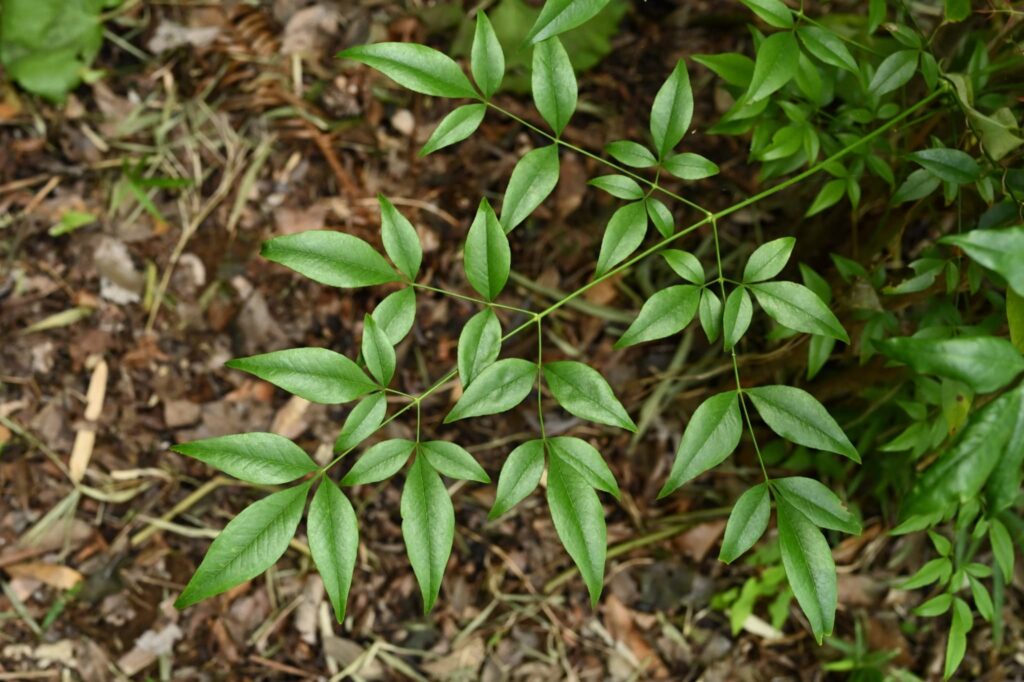
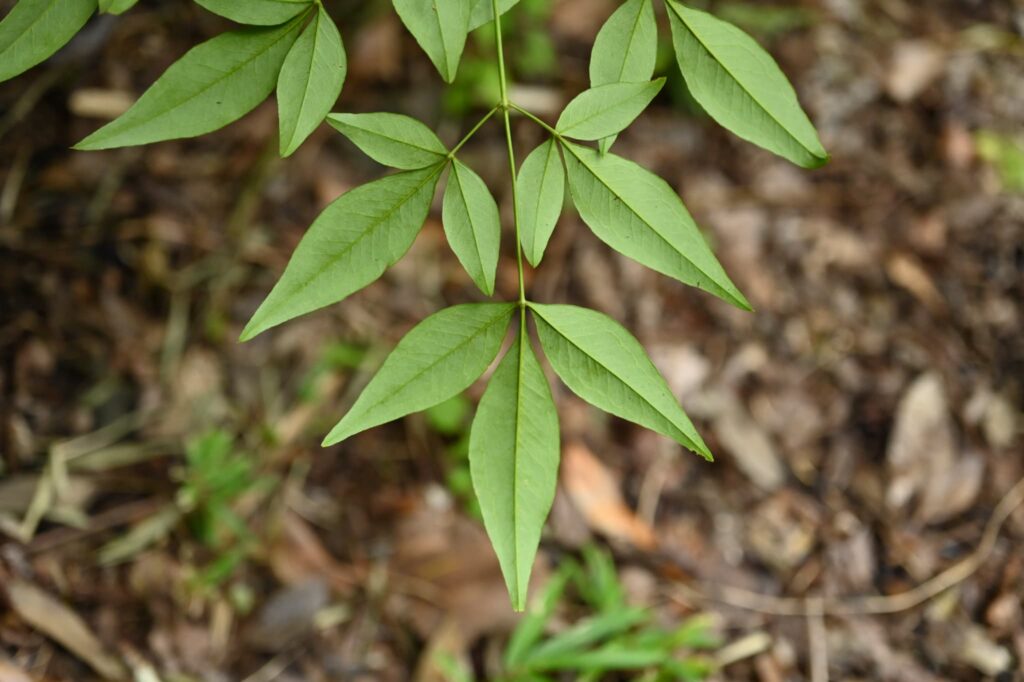
| Foliage | Leathery, diamond-shaped leaflets in large feather-like compound leaves |
| Flowers | Small white flowers in cone-shaped clusters, lightly fragrant |
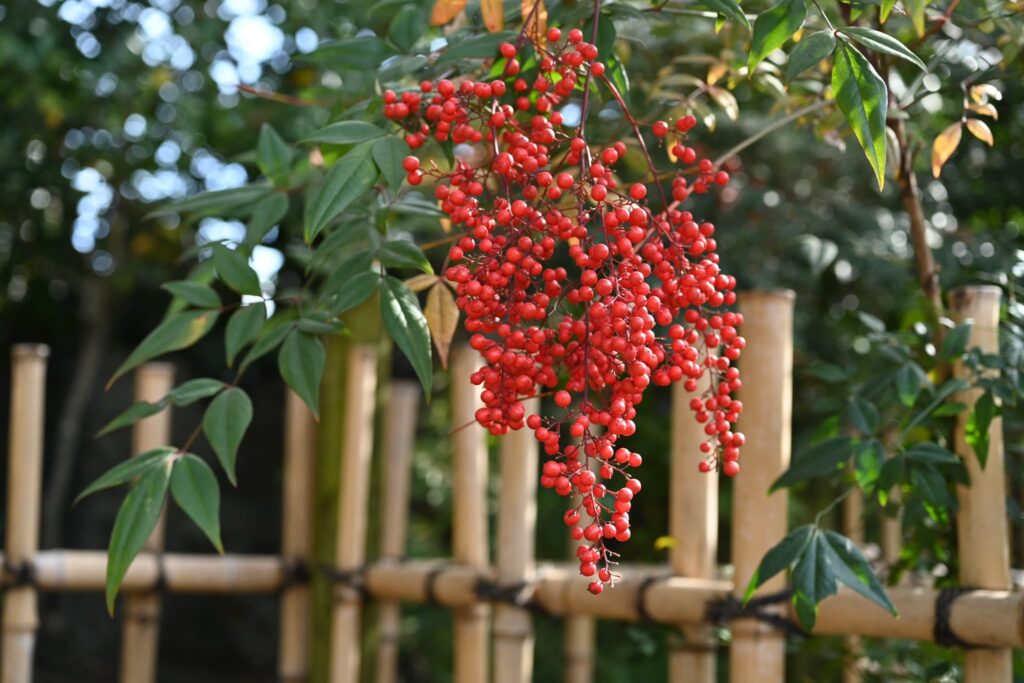
| Fruits | Round, bright red berries, about 6–8 mm across, usually containing two seeds |
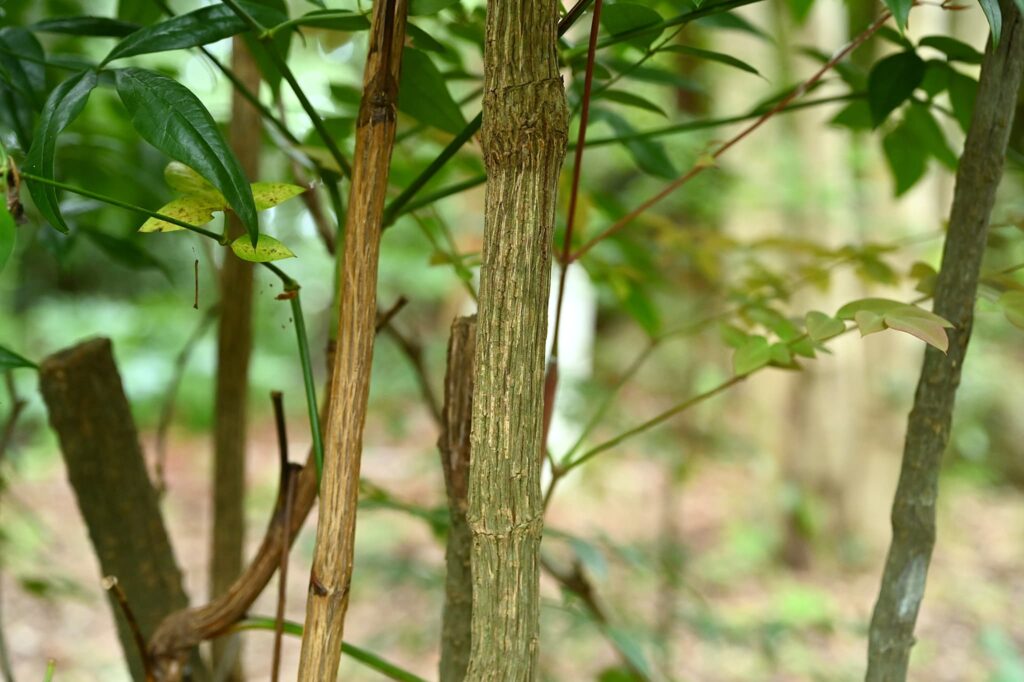
| Bark | Grayish brown to grayish white; inner wood yellow |
Foliage
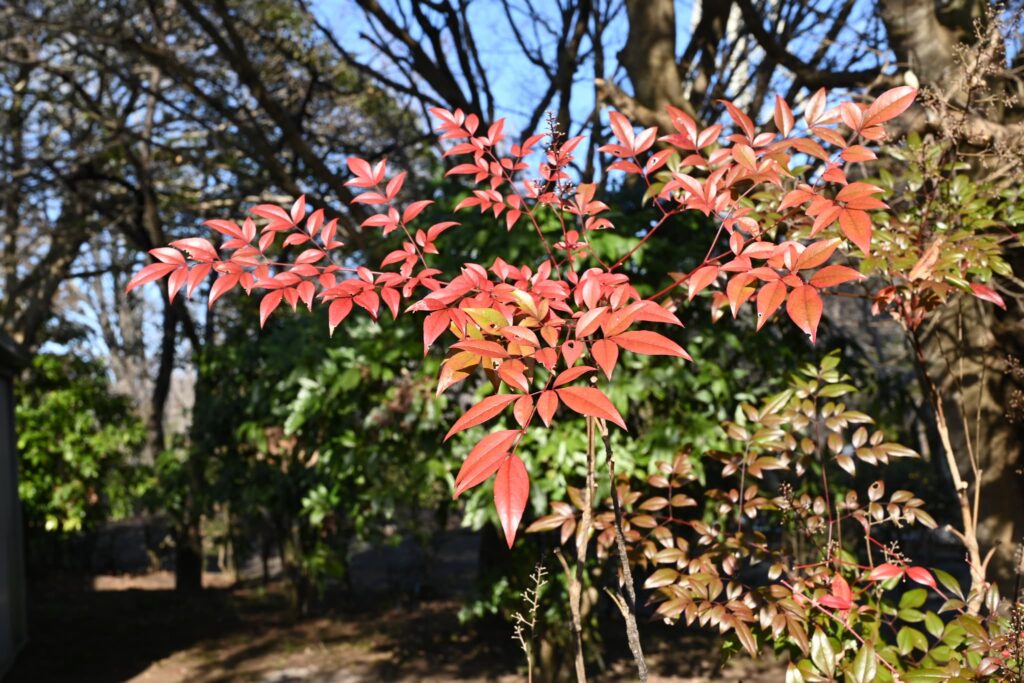
Nandina leaves are leathery, 3–7 cm long, made up of small, diamond-shaped leaflets roughly 2 cm wide gathered into large, feather-like compound leaves 20–50 cm in overall length. The leaflets have pointed tips and a glossy, deep green surface. Nandina is evergreen and does not truly turn color in the way deciduous trees do, but exposure to winter cold causes portions of the foliage to flush an attractive red.
Flowers
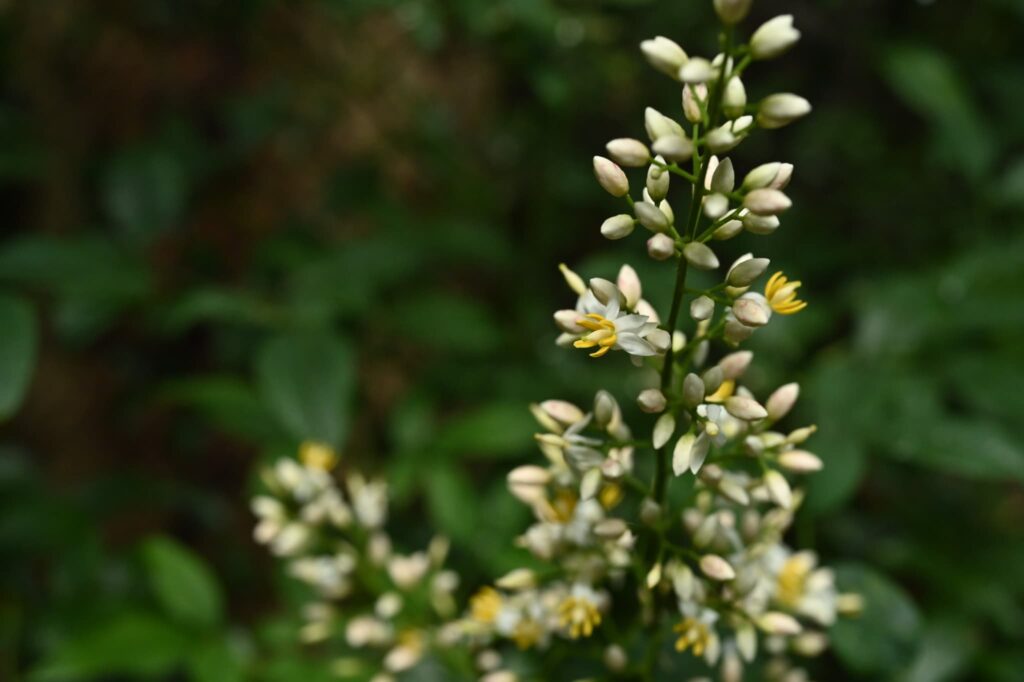
Nandina blooms in early summer (May–June), producing numerous small white flowers in large, cone-shaped panicles at the ends of the stems. Each flower has six petals and yellow anthers surrounding the central pistil.
Fruits
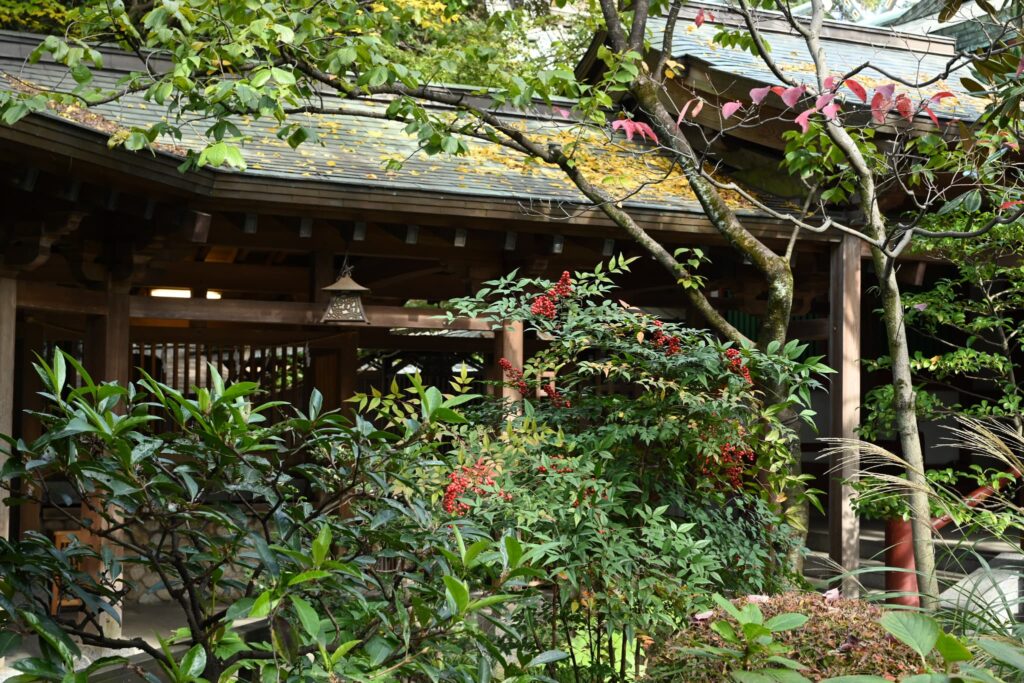
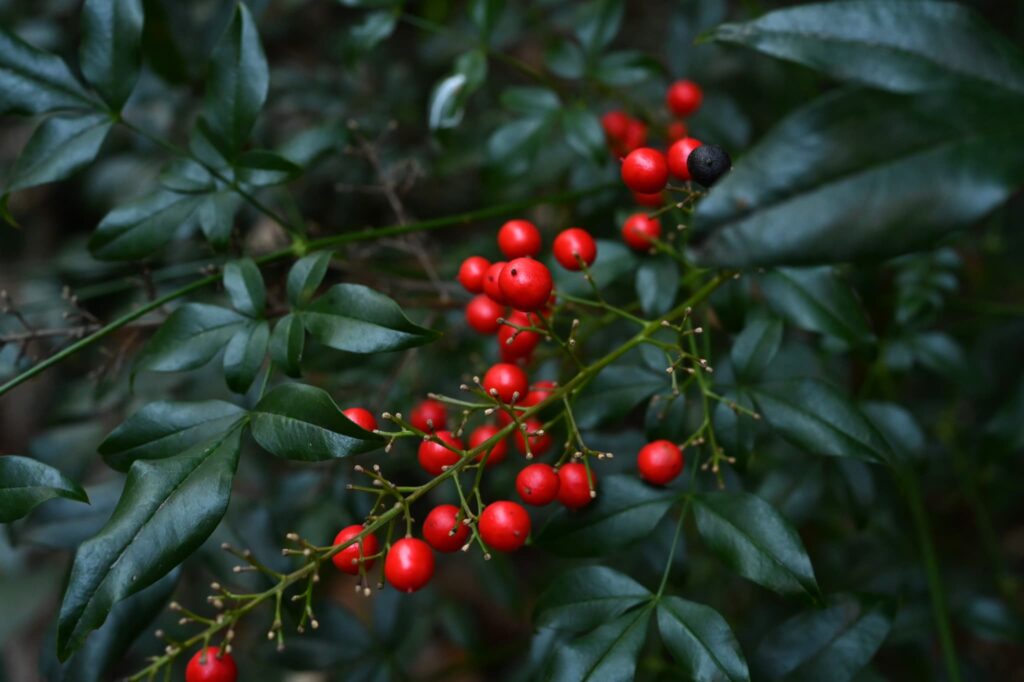
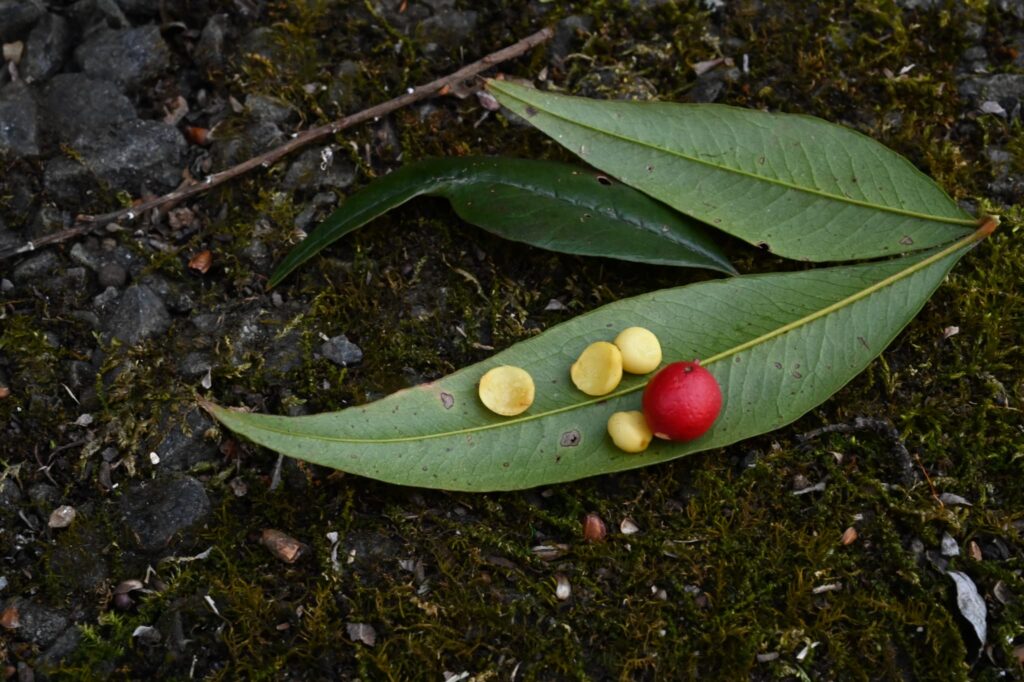
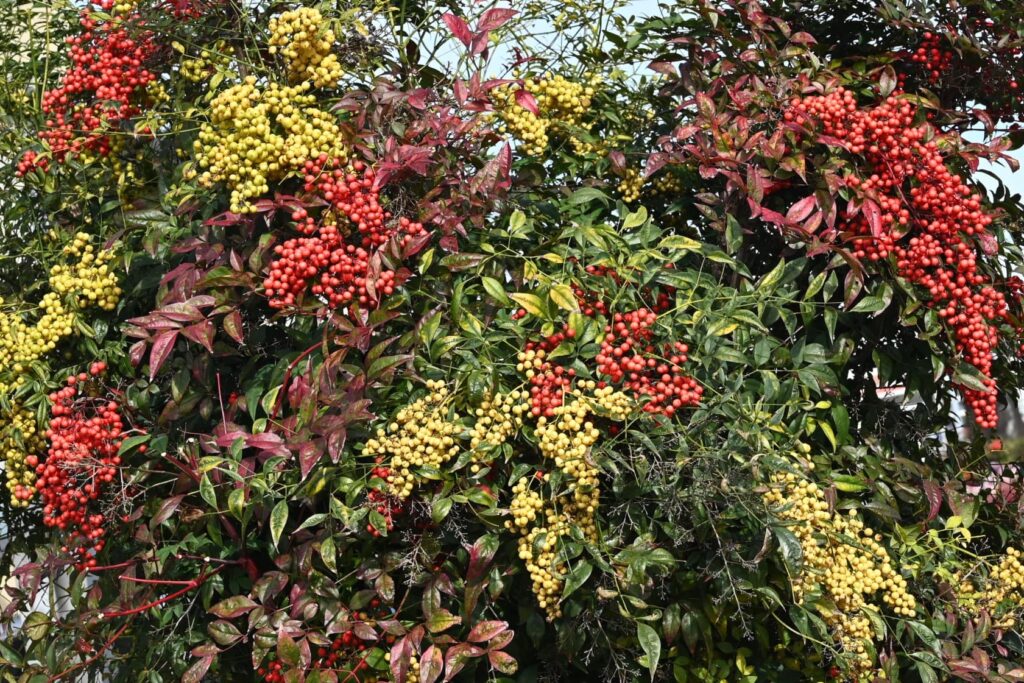
The fruit ripens between October and November into a round, bright red berry about 6–7 mm across, containing two seeds. Like the leaves, the berries contain compounds related to cyanogenic glycosides; dried, they are used in Chinese and Japanese herbal medicine (nantenjitsu) as a cough remedy and throat lozenge ingredient. Appearing bright red at a season when few other flowers or fruits are showy, the berries are conspicuous and are eaten by birds such as brown-eared bulbuls, thrushes, and daurian redstarts.
Bark & Timber
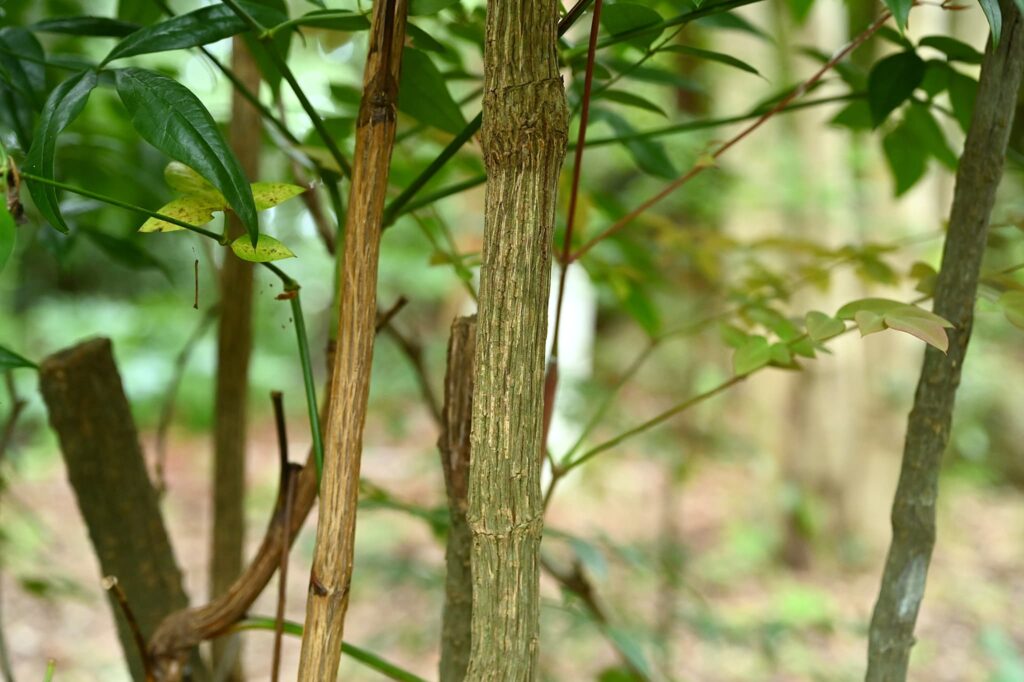
Nandina grows in a clumping, multi-stemmed form with relatively little branching, sending up straight canes that can exceed 5 m if left entirely unpruned. The bark is grayish brown to grayish white and Nandina wood has traditionally been regarded in Japan as having antibacterial properties ; chopsticks made from Nandina wood has traditionally been used for auspicious chopsticks and toothpicks (“nanten-bashi”), whose name evokes the idea of turning away misfortune.
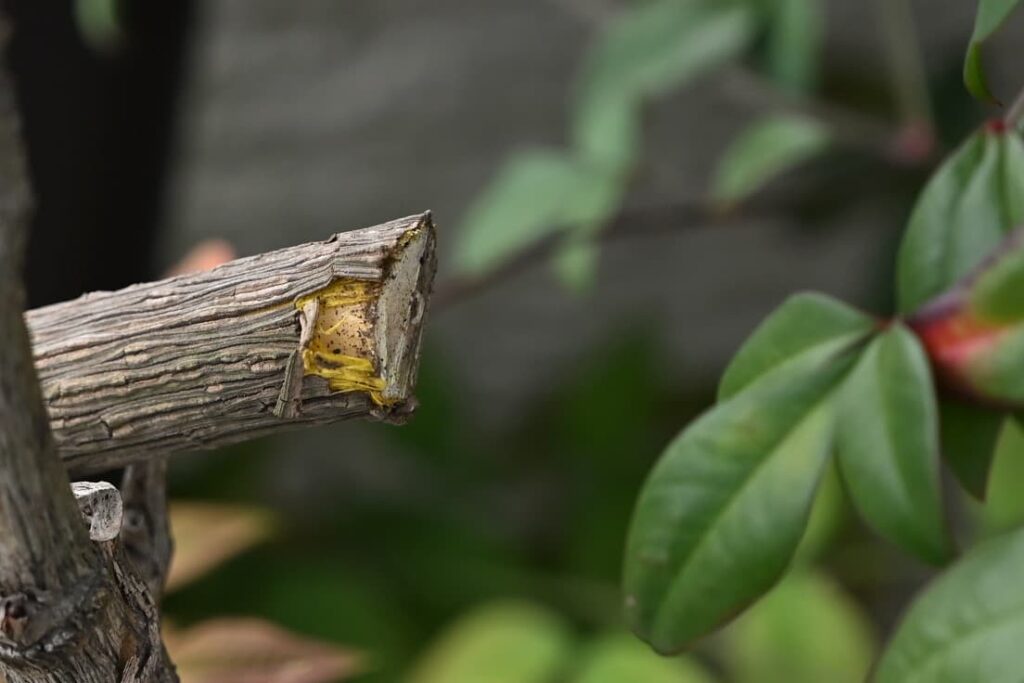
Individual stems are usually only 2–3 cm in diameter, but where multiple stems fuse together to form a trunk around 10 cm across, the wood has historically been prized for elegant tokobashira (decorative alcove posts), as seen at Kinkaku-ji’s Sekka-tei teahouse and at Taishakuten. The wood itself is yellow, and freshly pruned cut surfaces also show this yellow color.
Size & Growth
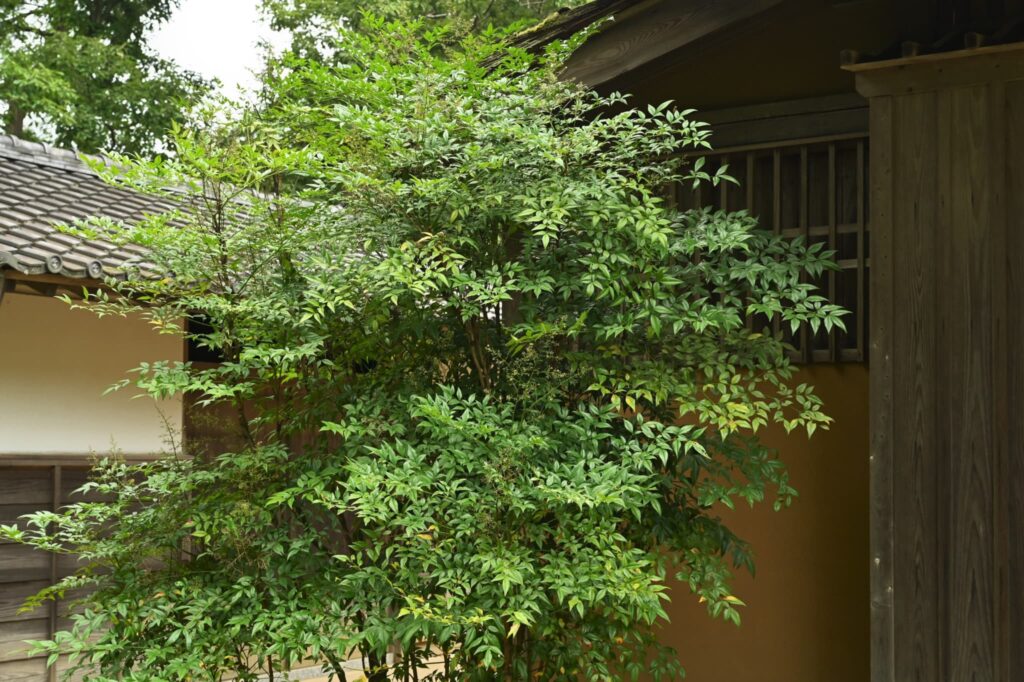
Left unpruned, plants can reach 3–4 m, and large, overgrown specimens tend to fruit poorly. As the plant matures, older branches die back one by one, leading to a top-heavy silhouette. In gardens, Nandina usually reaches 1–3 m depending on the cultivar, while wild plants can occasionally grow taller.
Uses & Cultural Significance
Name Origin
The name Nanten is a Japanese (on’yomi) reading of shortened Chinese names for the plant, “南天燭” or “南天竹.” The first, meaning roughly “southern heavenly lamp,” alludes to wild birds gathering to feed on its berries as if drawn to a lantern. The second compares the plant’s habit of sending up multiple stems to that of bamboo (竹). In China too, Nandina was traditionally used as a New Year’s decoration on household altars.
In Japan, because the characters for its name can also be read as a pun on 難転 (“turning away misfortune”), Nandina has been considered an auspicious plant since the Edo period. It has traditionally been planted by entryways, near restrooms, and in the “demon’s gate” direction (northeast) believed to invite bad luck, as a charm against fire and evil — a custom whose traces can still be seen around Japan today.
Traditional and Practical Uses
The leaves were traditionally placed in lacquered food containers with dishes such as sekihan and fish. Their traditional use was associated with the plant’s antimicrobial properties and with the belief that they helped preserve food.
Nandina leaves have been used for both celebratory and funerary purposes, but custom dictated that the leaf be placed face-up for a happy occasion such as sekihan, and face-down for a Buddhist rite. There was also once a custom in which a samurai commander, before heading off to battle, would arrange a Nandina branch in his quarters.
Numerous garden cultivars were developed during the Edo period, and the plant remains a garden and bonsai staple valued for its red fruit and winter foliage color.
Growing Guide
| Item | Guidance |
|---|---|
| Light & Soil | Prefers moist, well-drained soil and grows in sun or partial shade. More sunlight generally produces stronger red coloration, while partial shade is well tolerated. |
| Wind & Snow Tolerance | Older, tall stems can become top-heavy and may be vulnerable to strong winds, particularly when grown in exposed locations. |
| Cold Hardiness | Winter cold triggers red foliage color; generally hardy in warm-temperate Japan |
| Pruning | Winter through spring (December–March); base-level cuts only |
| Suitability for Home Gardens | Well suited to small gardens; dislikes transplanting, so choose its location carefully |
| Pests | Generally resistant; watch for scale insects and Ricania shantungensis |
Light & Soil
Nandina grows naturally in warm regions and tolerates both sun and partial shade. It prefers moist, well-drained soil but can tolerate periods of dry weather once established. More sunlight generally produces stronger red coloration, while partial shade is also well tolerated.
Wind & Snow Tolerance
Older, tall stems can become top-heavy and may be vulnerable to strong winds, particularly in exposed locations.
Flowering & Fruiting Notes
Flowering coincides with the rainy season, but the flowers dislike heavy rain, and excessive rainfall during bloom can reduce fruit set. Newly formed berries are too hard for birds to eat, but as they ripen and soften later in the season, birds — mainly brown-eared bulbuls — can strip a plant of its fruit quite quickly depending on the surrounding environment. Because birds that eat the berries scatter the seeds as they fly about, self-sown Nandina volunteers are common.
Pruning
Nandina dislikes being cut back hard, so pruning should focus on removing unwanted stems at or near ground level rather than shortening branches partway along their length. Hard heading cuts can leave an unattractive, weakly branched plant. For this reason, pruning should be kept to the minimum needed to maintain shape, working from the base of unwanted stems rather than shearing the foliage.
Pests
In Japan, Nandina may also be affected by the planthopper Ricania shantungensis, which lays eggs on the stems. Infested branches can be removed and discarded.
Cultivars & Forms
- Kinshi Nanten (“thread-leaf Nandina”) — a cultivar with fine, thread-like leaves that was fashionable in the Edo period.
- Otafuku Nanten — a compact cultivar that stays low and turns red for most of the year except midsummer and midwinter; popular in parks, gardens, and commercial landscaping, though it does not produce the typical Nandina berries. Its name (from otafuku, a round-faced comic mask) refers to its rounder leaflets compared to standard Nandina.
- Shiromi (White-fruited) Nandina — a form with cream-colored berries, also known as Shironanten, Shirominonanten, or Kiminonanten, since the fruit color is neither quite white nor quite yellow. Planting it alongside ordinary Nandina, so that red and white berries appear together, is considered auspicious. It does not develop red autumn foliage. Historically it was considered even more medicinally potent than ordinary Nandina, prized in particular as a treatment for eye ailments.
- Orizuru (“paper crane”) Nandina — a rare cultivar with densely curled, twisted leaves, valued as a specialty item; its name compares the leaf texture to folded-paper cranes.
- Nandina ‘Twilight’ — a relatively recent U.S.-developed cultivar, with white-variegated green leaves and pink new growth, giving an attractive three-color effect; it stays about as compact as Otafuku Nanten, making it appealing even to gardeners who consider standard Nandina old-fashioned.
- Other forms include Fujimi Nandina (pale purple fruit), Urumi Nandina (orange fruit), and Shina Nandina (small leaves with fruit that doesn’t hang pendulously).
Similar Plants
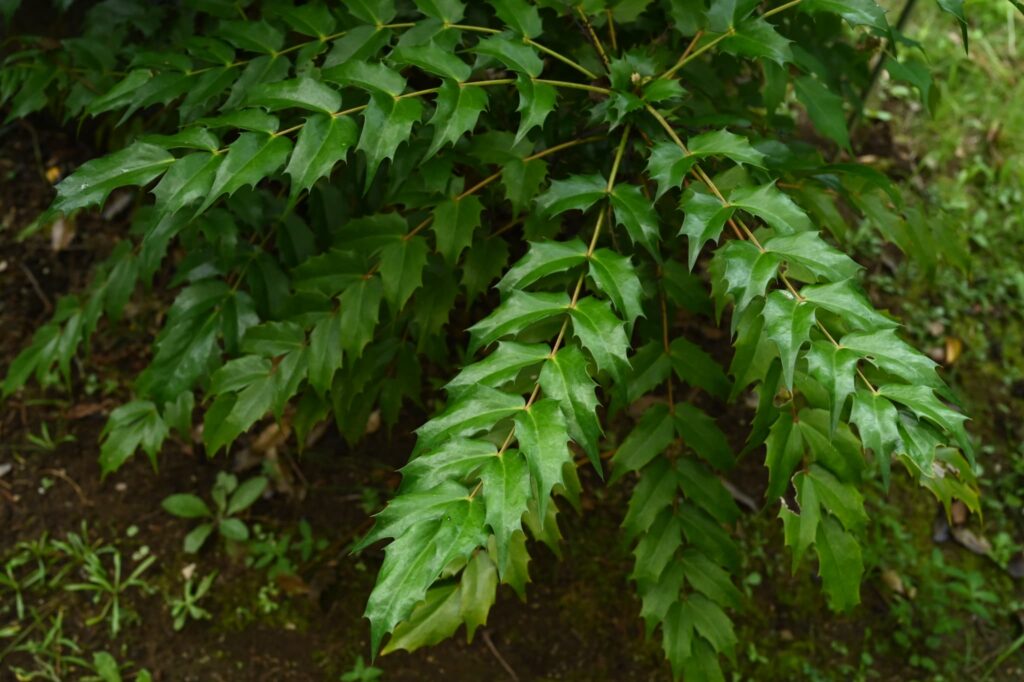
- Mahonia japonica (Hiiragi Nanten) — an unrelated but visually similar barberry-family shrub, also holly-leaved.
- Mahonia fortunei
- Vicia unijuga (Nanten-hagi) — a legume whose name references Nandina despite being an entirely different plant.
Frequently Asked Questions
Is Nandina poisonous?
Nandina contains cyanogenic glycosides and should not be eaten. The berries can be toxic when consumed in large quantities, so pets and livestock should be kept from eating them.
Can birds eat Nandina berries?
Birds such as bulbuls and thrushes do eat the berries in Japan, but the fruit contains cyanogenic compounds, so large quantities may be harmful.
Why is Nandina considered lucky in Japan?
Nandina has long been regarded as a symbol of good fortune and protection. Its Japanese name, Nanten (南天), sounds similar to a phrase meaning “to turn misfortune into good fortune” (nan o tenjite fuku to nasu). For this reason, it is often planted near entrances, temples, and traditional homes.
Can Nandina grow in shade?
Yes. Nandina grows well in partial shade and even tolerates fairly deep shade. However, plants grown in sunnier locations usually produce brighter red autumn and winter foliage and heavier crops of berries.
When should I prune Nandina?
The best time to prune Nandina is from late winter to early spring before new growth begins. Rather than shearing the entire plant, remove a few of the oldest stems at ground level each year. This keeps the plant healthy and preserves its natural form.
How tall does Nandina grow?
In gardens, Nandina usually reaches 1–3 m (3–10 ft) in height, depending on the cultivar. Wild plants can occasionally grow taller, but most ornamental varieties remain compact and are well suited to small gardens.
Why doesn’t my Nandina produce berries?
Nandina produces berries only after flowering. Excessive pruning immediately before or during flowering can remove flower buds and reduce fruit production. Insufficient sunlight may also decrease flowering and berry set.
Does Nandina lose its leaves?
No. Nandina is an evergreen shrub, although older leaves are replaced gradually throughout the year. In colder regions, the foliage often turns bright red during winter before returning to green in spring.
Conclusion
Nandina is one of the most familiar traditional shrubs in Japanese gardens, valued for its evergreen foliage, red winter berries, seasonal leaf color, and long cultural association with good fortune. Its unusual combination of ornamental value, traditional uses, and distinctive growth habit makes it an especially characteristic Japanese garden plant.