Japanese Camellia (Camellia japonica): Identification, Care & Uses
Japanese Camellia is one of Japan’s oldest and most culturally important ornamental flowering trees, celebrated for its restrained, tea-ceremony-worthy blooms and long prized as a source of camellia oil. This guide covers identification features, flowers, fruit, bark, cultivars, and care, based on observations of the plant as grown in Japan.
What Is Japanese Camellia?
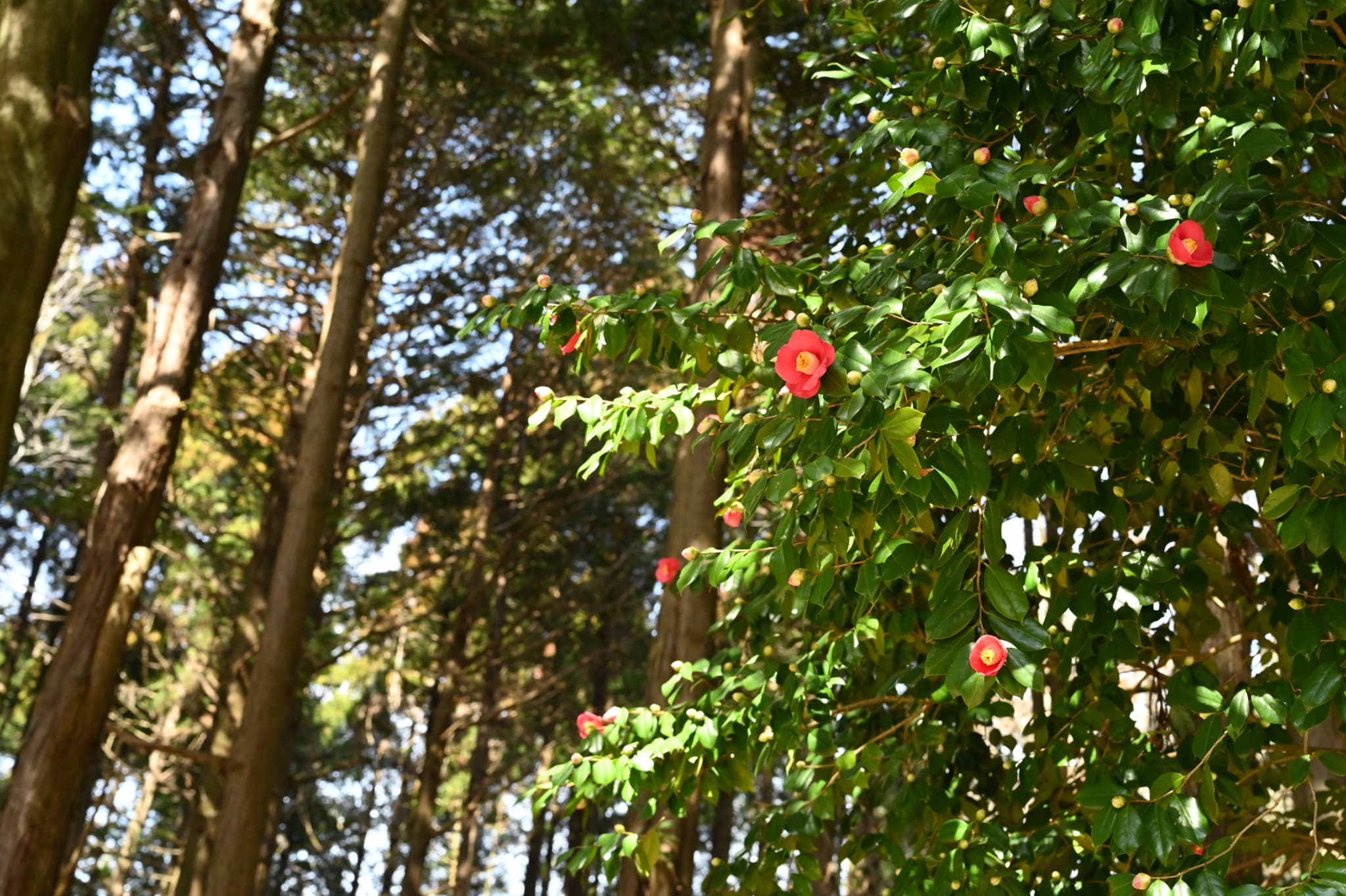
Japanese Camellia is an evergreen tree in the family Theaceae, native to East Asia, including Japan. In Japan, it grows wild in broadleaf evergreen forest from the Natsudomari Peninsula in Aomori Prefecture—its northern natural limit—to Okinawa. It is more common along the coast in the Tohoku region, while elsewhere it’s also found inland in the mountains. The Izu Seven Islands, especially Ōshima, have long been celebrated as a classic destination for viewing wild Japanese Camellia.
When the word “Tsubaki” is used on its own, it generally includes cultivated garden varieties as well; when the emphasis is specifically on the wild, original species, it is called Yabu-tsubaki—literally “thicket camellia,” referencing its habit of growing wild in brushy woodland.
Overview
| Item | Description |
|---|---|
| Scientific Name | Camellia japonica |
| Common Name | Japanese Camellia |
| Japanese Name | Yabu-tsubaki (ヤブツバキ), or simply Tsubaki |
| Family | Theaceae |
| Native Range | East Asia, including Japan, Korea, parts of China and Taiwan |
| Plant Type | Evergreen Tree |
| Height | Up to over 15 m |
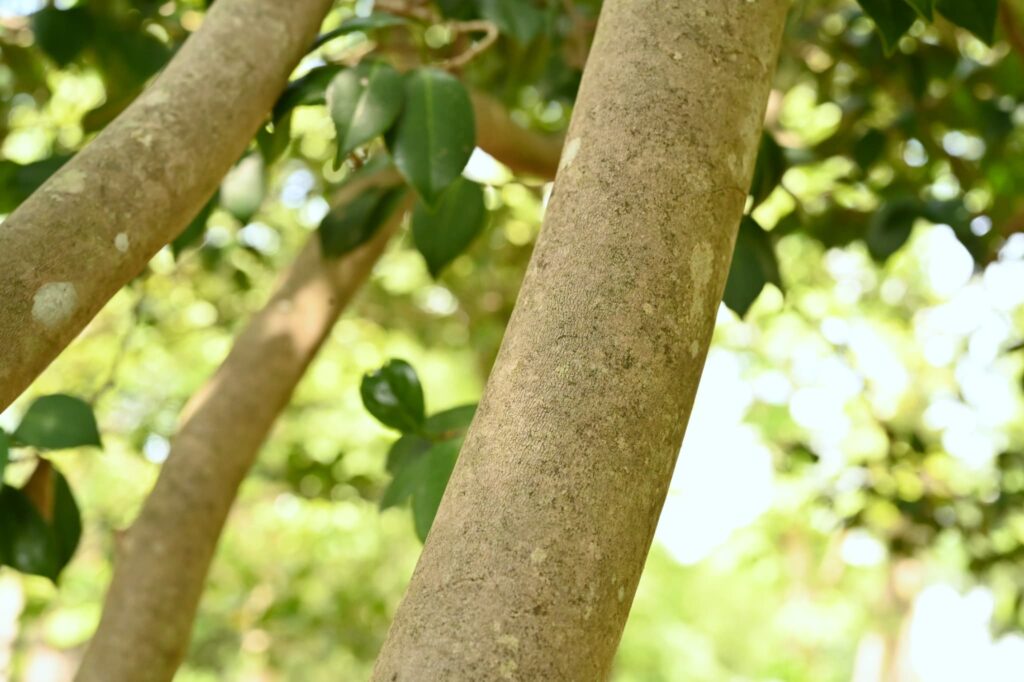
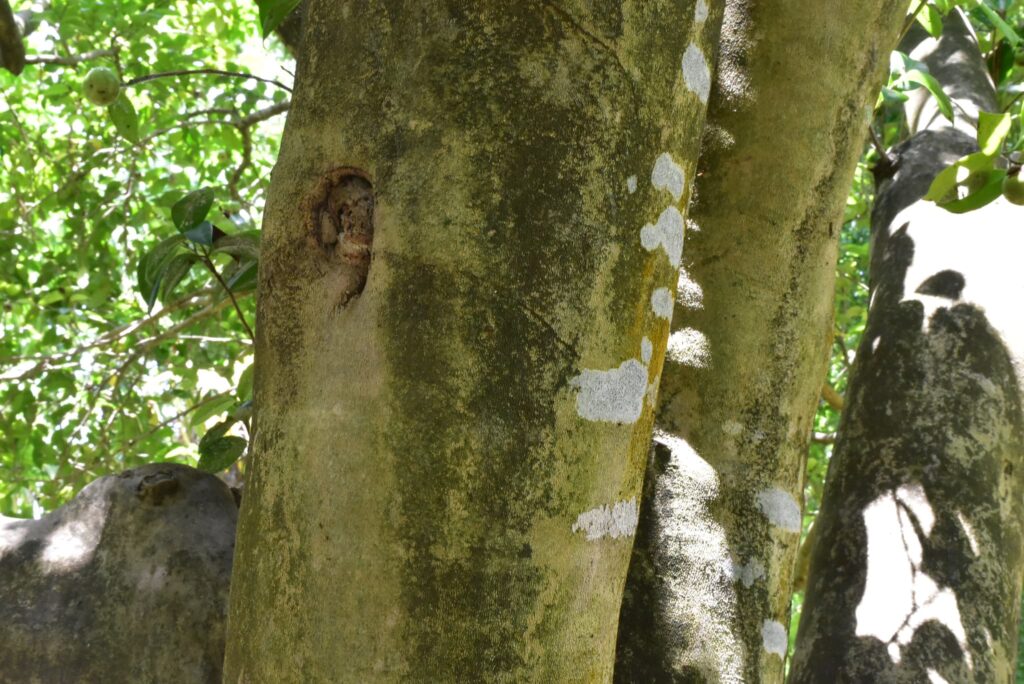
| Trunk | Smooth to the touch, sometimes finely patterned |
| Flowering Season | Late winter–spring in wild plants; autumn–spring in cultivated varieties |
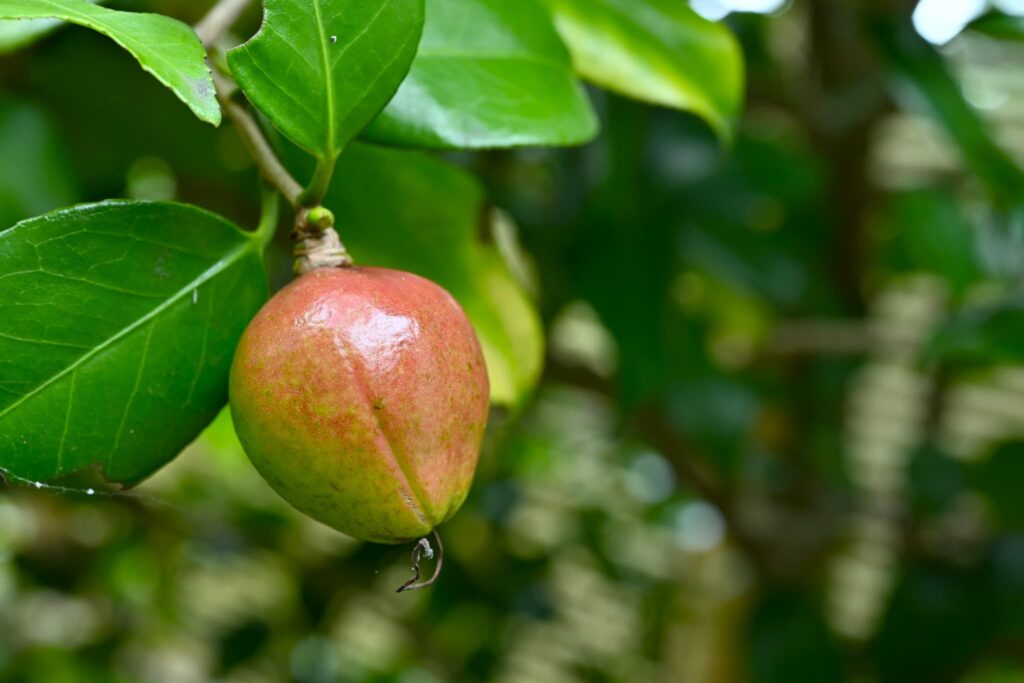
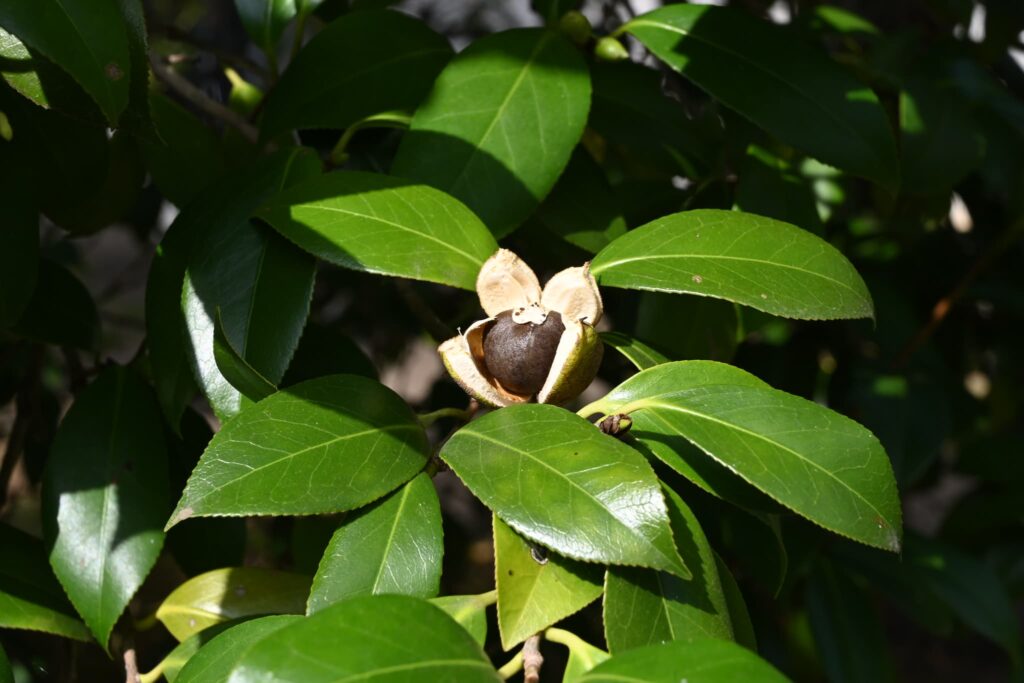
| Fruit Type | Round capsule, about 3 cm, ripening in autumn, containing 3–5 seeds |
| USDA Zones | Generally hardy in USDA zones 7–9, although cold tolerance varies among cultivars and local conditions. |
| Sun Exposure | Partial shade preferred; tolerates deeper shade |
Characteristics
| Feature | Description |
|---|---|
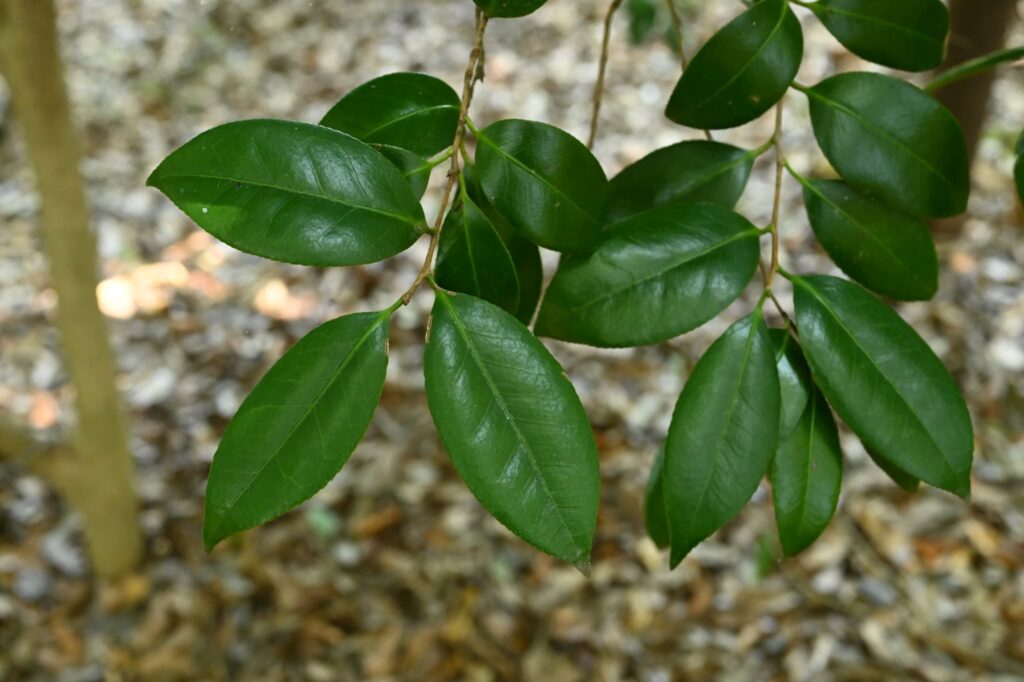
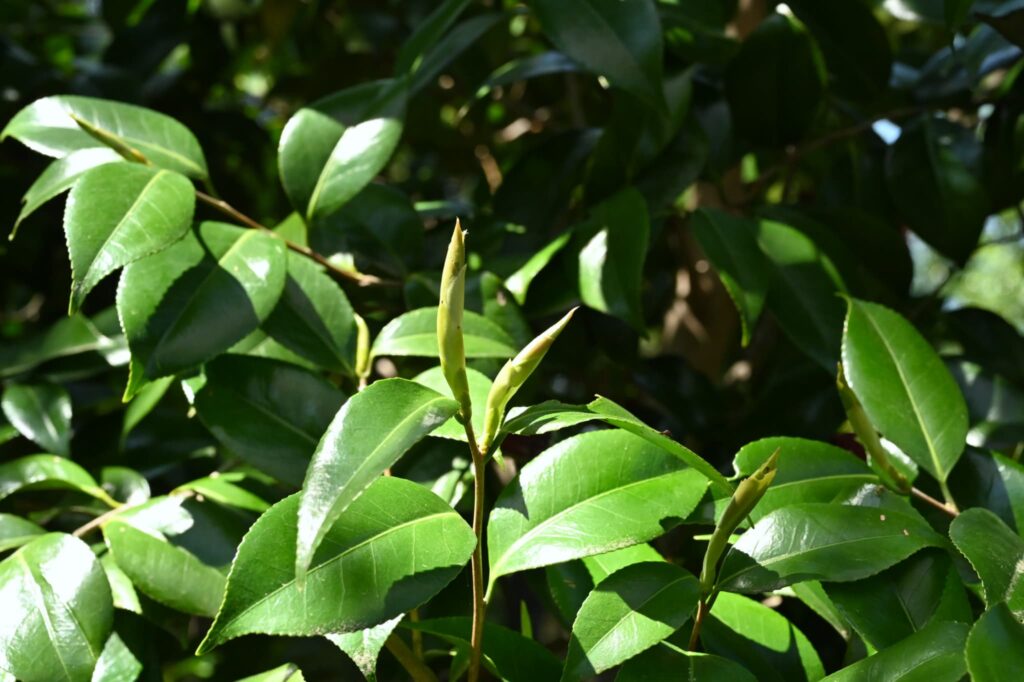
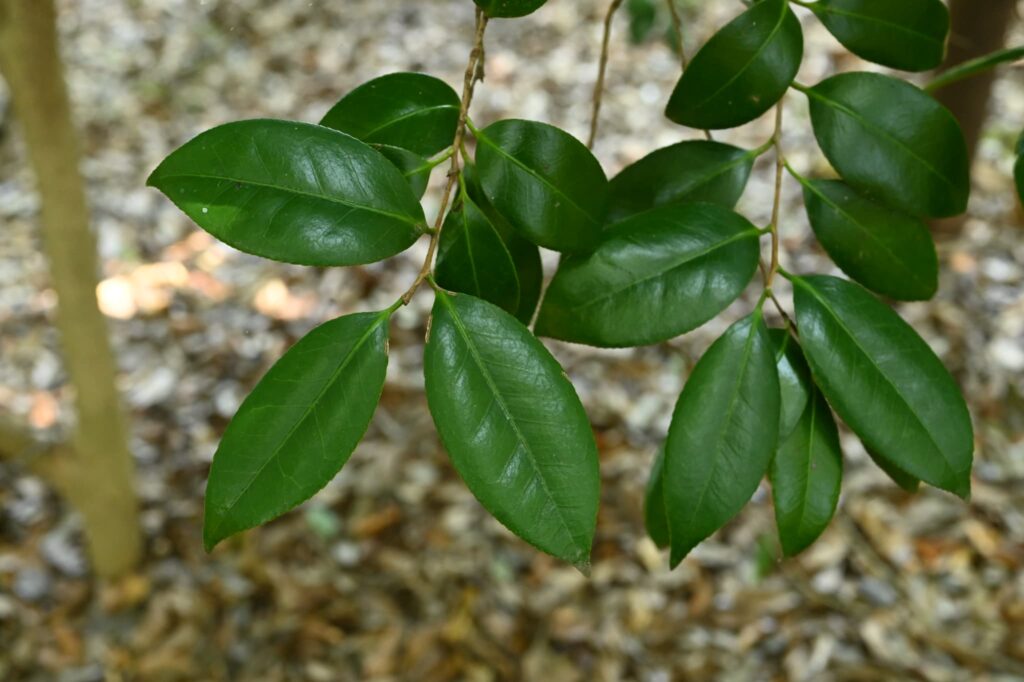
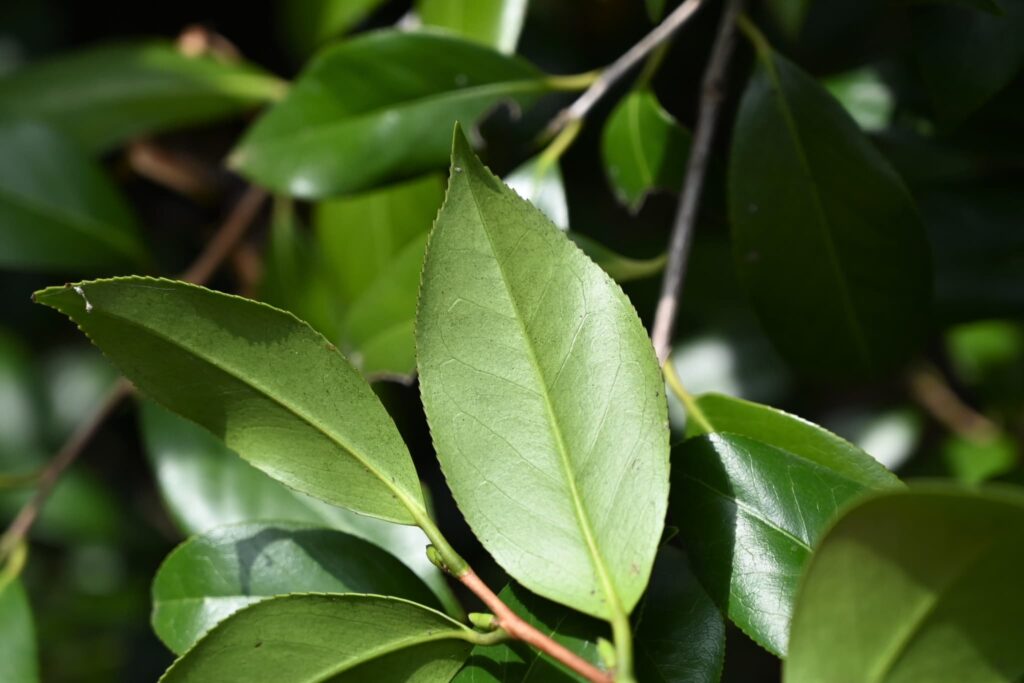
| Leaves | Alternate, oval, finely toothed, glossy year-round |
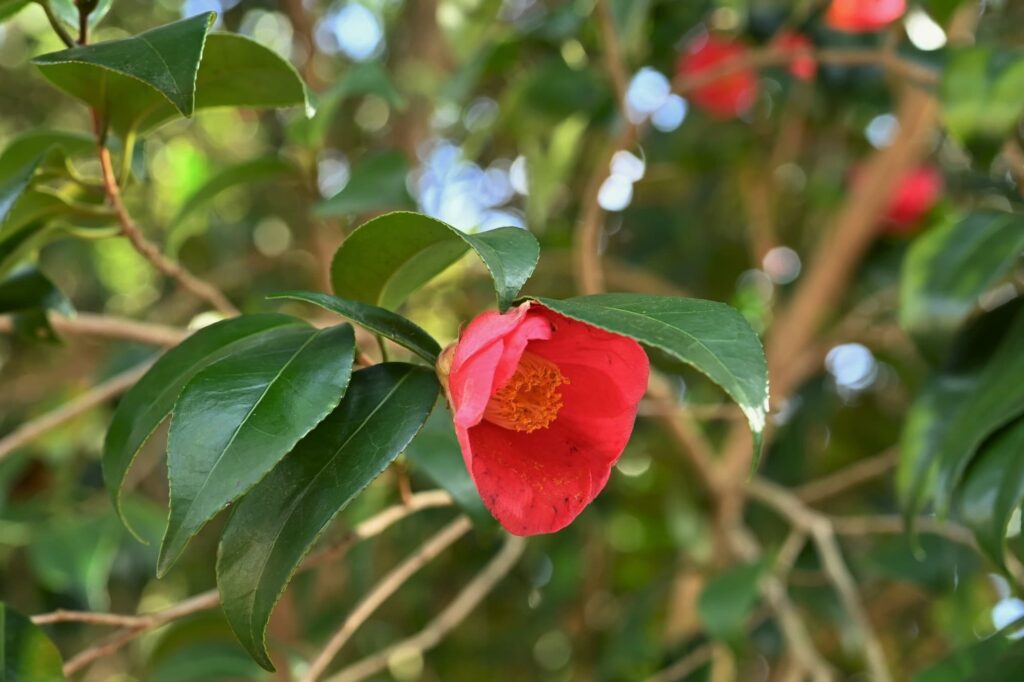
| Flowers | Typically red in the wild; cultivated forms vary widely, semi-tubular, falling whole rather than petal by petal |
| Fruit | Round capsule, source of camellia oil |
| Bark | Smooth to the touch, sometimes finely patterned |
Foliage
Leaves are oblong, tapering to a pointed tip, with fine serrations along the margin. They measure 5–11 cm long and 3–8 cm wide, growing alternately along the branch. Both surfaces are hairless, and the leaves keep their glossy shine year-round. Although the leaves themselves are not eaten, they have traditionally been used to wrap mochi and sushi for presentation and fragrance.
Flowers
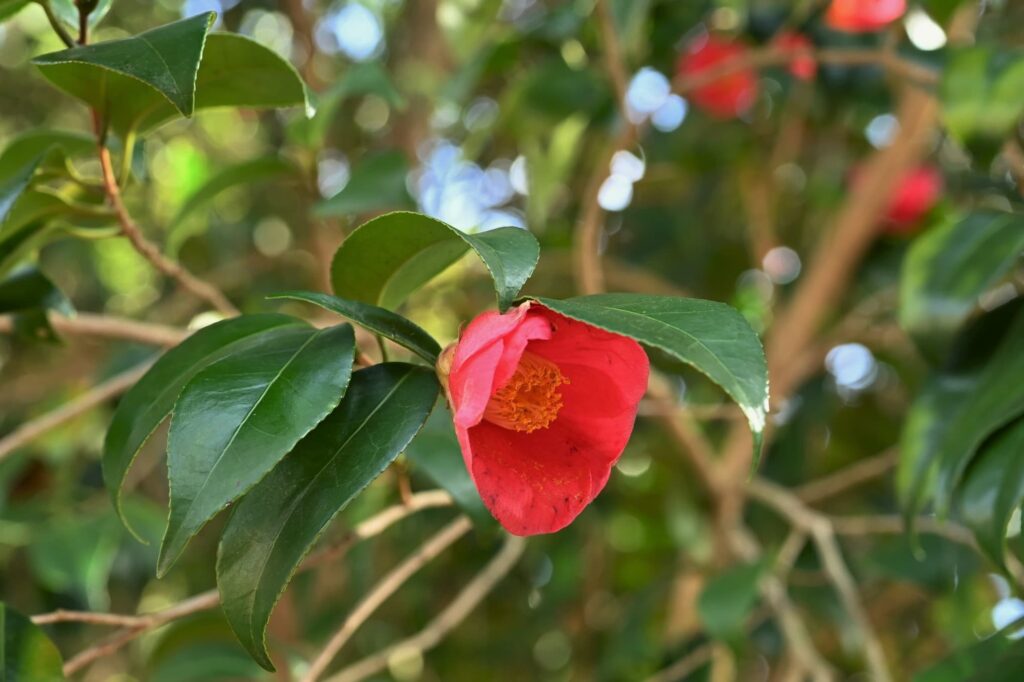
Wild Japanese Camellia generally flowers from late winter into spring, although cultivated varieties can extend the flowering season from autumn through spring. Wild flowers are typically red, while cultivated forms occur in white, pink, and many other variations. The flowers open at the leaf axils near the branch tips and are typically 5–7 cm across in wild plants.
The five petals open in a somewhat tubular or cup-shaped form rather than lying completely flat—a characteristic that helps distinguish Japanese Camellia from the closely related and often-confused Sasanqua Camellia or Tea Plant (Camellia sinensis), whose flowers generally open more fully. Its restrained, half-open form is one reason Japanese Camellia has long been valued as flower material in tea-ceremony settings.
The numerous stamens are fused at their base into a tube, which is further joined to the base of the petals. As a result, when the flower finishes blooming, it typically falls to the ground as a whole rather than shedding its petals individually—one of the most familiar differences between Japanese Camellia and Sasanqua. A well-known piece of folklore holds that samurai historically disliked the plant for this reason, since a whole flower dropping suddenly to the ground was seen as evoking a severed head.
Camellia flowers produce abundant nectar, attracting birds such as brown-eared bulbuls and Japanese white-eyes, which may help transfer pollen between flowers. The flowers are also eaten by monkeys, and the petals have traditionally been used in some parts of Japan as a seasonal ingredient, including in tempura. In earlier eras, fallen flowers were also gathered and used to produce natural dyes.
Fruits
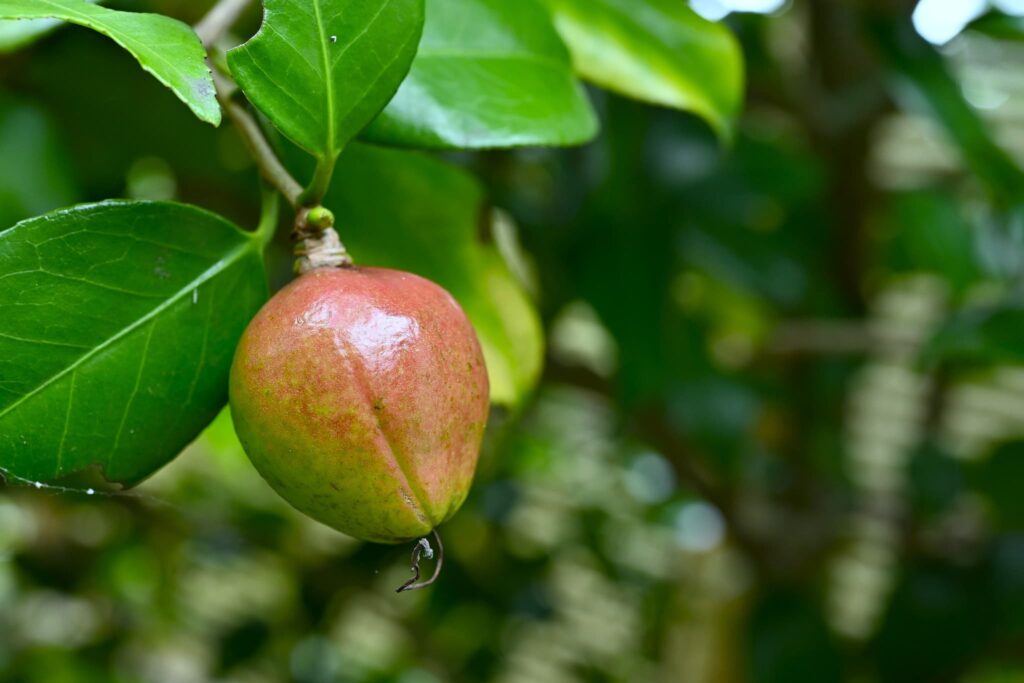
The fruit is a woody, rounded capsule about 3 cm across, ripening in autumn. When mature, it splits open to reveal several dark seeds. The seeds are rich in oil and have traditionally been pressed to produce camellia oil.
Bark & Timber
Japanese Camellia can reach over 15 m in height at maturity. The bark sometimes develops fine wrinkles or patterning, but remains smooth to the touch. The wood is dense and highly durable, historically known by the old name Katashi (“the hard one”). Jomon-period people made tool handles from camellia wood, and a comb crafted from camellia wood has been excavated from the Torihama shell mound in Fukui Prefecture. The glossy finish of worked camellia wood resembles that of boxwood, though it isn’t generally regarded as being in quite the same high-end category. Today it’s still used for combs, shogi pieces, and seals.
At the species’ northern natural limit, the Natsudomari Peninsula in Aomori Prefecture is home to a wild colony of over 10,000 Japanese Camellia trees, designated a national natural monument.
Size & Growth
Japanese Camellia can reach over 15 m in height at maturity, with modest resprouting vigor. Because it doesn’t resprout especially vigorously after cutting, shaping and size control call for a more patient, naturalistic approach rather than aggressive pruning.
Uses & Cultural Significance
Naming: Tsubaki, Camellia, and Their Kanji
Several theories exist for the origin of the word “Tsubaki.” One holds that it comes from tsuba-no-ki (“glossy tree”), built on the old word tsuba, meaning luster or shine. Others point to written meanings like “lustrous-leaf tree,” “glossy-leaf tree,” or “thick-leaf tree,” while another theory traces the name to the Korean word dongbaek (“winter cypress”). Despite being native to warm regions, the tree’s remarkable resilience even in cold climates has occasionally led to it being regarded as a sacred tree.
The kanji used to write Tsubaki include 椿, 海石榴, and 山茶. The most familiar of these, 椿, is actually a character invented in Japan (a kokuji)—in Chinese, the same character instead refers to an entirely different tree, the Chinese toon (Toona sinensis), and Chinese writers instead use 山茶 (“mountain tea”) for what Japanese speakers call Tsubaki. The English name Camellia honors the Jesuit missionary Georg Joseph Kamel, after whom Carl Linnaeus named the genus.
Fruit, Oil & Timber in Daily Life
Camellia oil pressed from the seeds has a long history as cooking oil, a hair-care product, a traditional remedy for skin conditions, and even as a purported elixir of longevity in earlier centuries. The dense, durable wood has been worked since the Jomon period into tool handles, and continues to be used today for combs, shogi pieces, and seals. Fallen flowers and fruit husks have also historically been used to produce natural dyes.
Growing Guide
| Item | Description |
|---|---|
| Sun | Partial shade preferred; tolerates deeper shade |
| Soil | Moist, well-drained; prefers slightly acidic to neutral conditions |
| Climate | Prefers warmth; sensitive to cold winter wind and dryness |
| Pruning | Modest resprouting vigor; hard to hold a clipped shape |
| Pests | Tea Tussock Moth — regular monitoring essential |
| Garden Use | Screening, windbreak; can feel heavy/dark if left unpruned |
Light & Soil
Japanese Camellia prefers partial shade and tolerates deeper shade well, though leaf color suffers in very strong sun. Prefers moist, well-drained soil; generally performs best in slightly acidic to neutral conditions.
Wind & Snow Tolerance
The tree keeps its glossy, deep green foliage year-round, making it useful for screening and as a windbreak. Because the foliage is so dark, though, an unpruned specimen can make a garden feel heavy or closed-in over time.
Cold Hardiness
Hardy to USDA zones 7–9. Japanese Camellia prefers warm regions and is sensitive to cold winter wind and dry conditions.
Pruning
Japanese Camellia responds less vigorously to hard cutting than many common hedge plants, so severe pruning should generally be avoided. Gradual thinning and selective shortening are better suited to maintaining a natural form.
Suitability for Home Gardens
Japanese Camellia works well as a specimen tree, for screening, as a windbreak, and as flower material for the tea ceremony. It doesn’t lend itself easily to a formal, tightly clipped hedge, so it suits gardens where a more naturalistic shape is welcome.
Pests
Japanese Camellia is one of the plants commonly attacked by Tea Tussock Moth (Euproctis pseudoconspersa), whose caterpillars feed on the leaves of camellias and related plants. Infestations are more likely to become noticeable when caterpillars emerge and feed in groups, sometimes stripping leaves from affected branches.
The caterpillars are covered with urticating hairs that can cause severe skin irritation. Detached hairs may also remain on leaves and surrounding surfaces, so avoid direct handling and take particular care when pruning or cleaning around an infested plant. Regular inspection—especially during periods of active caterpillar growth—helps detect infestations before they become widespread.
Cultivars
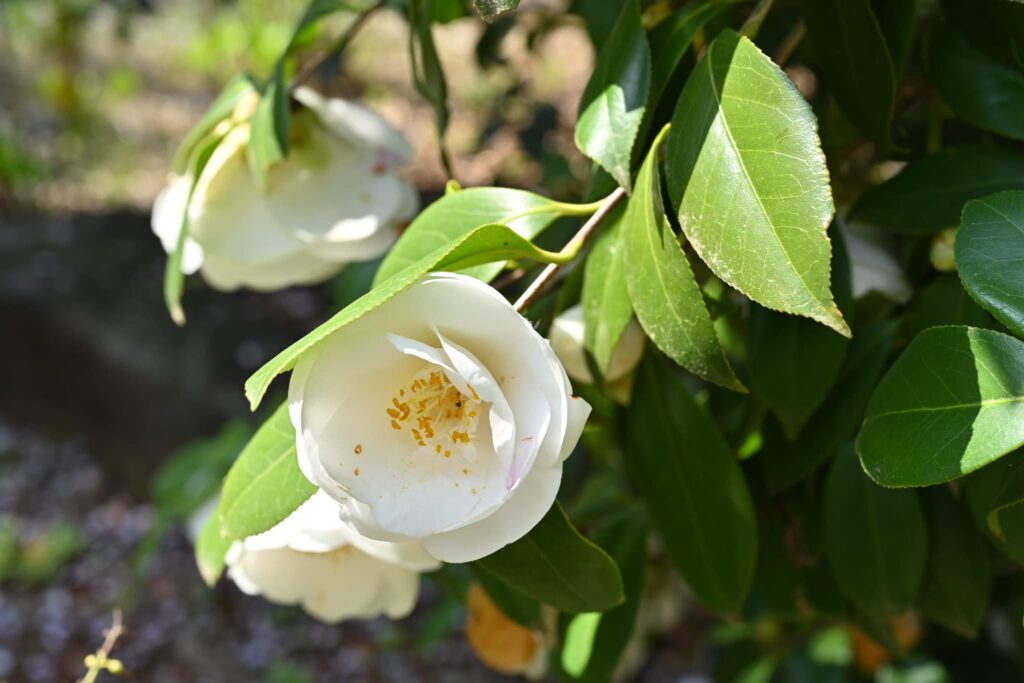
Shiro-Wabisuke — a white-flowered cultivar within the Wabisuke group, valued for its small, restrained blooms suited to tea-ceremony use.
Similar Species
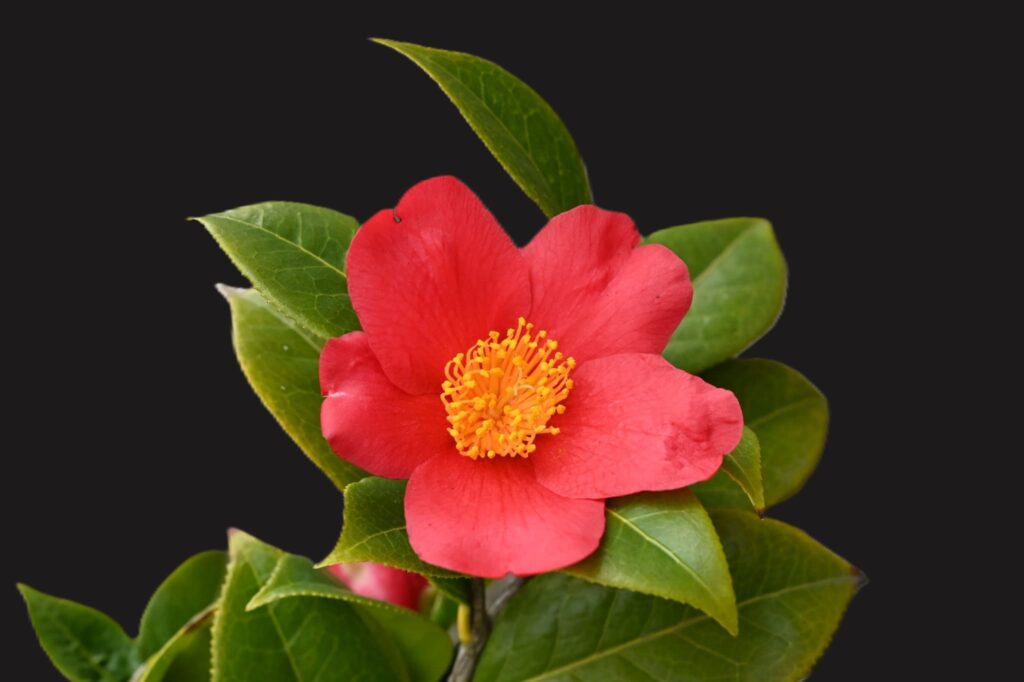
Snow Camellia (Camellia rusticana) — found mainly along the Sea of Japan side of central and northern Honshu. Its branches often grow low and spread horizontally, an adaptation to regions with heavy snowfall. Compared with Japanese Camellia, its leaves are generally thinner and have more sharply serrated margins. Taxonomic treatment varies, with some authorities treating Snow Camellia as a distinct species and others placing it within Camellia japonica. Snow Camellia has played an important role in the breeding history of many cultivated camellias, particularly through its relationship and hybridization with Japanese Camellia.
Yakushima Camellia (Camellia japonica var. macrocarpa) — a form of Japanese Camellia associated with Yakushima and parts of the Ryukyu Islands, distinguished by its unusually large fruit. The capsules may reach 5–10 cm across, giving rise to the Japanese name Ringo-tsubaki, or “apple camellia.” The flowers and seeds are otherwise broadly similar to those of typical Japanese Camellia. Its taxonomic status has also been treated differently by different authorities.
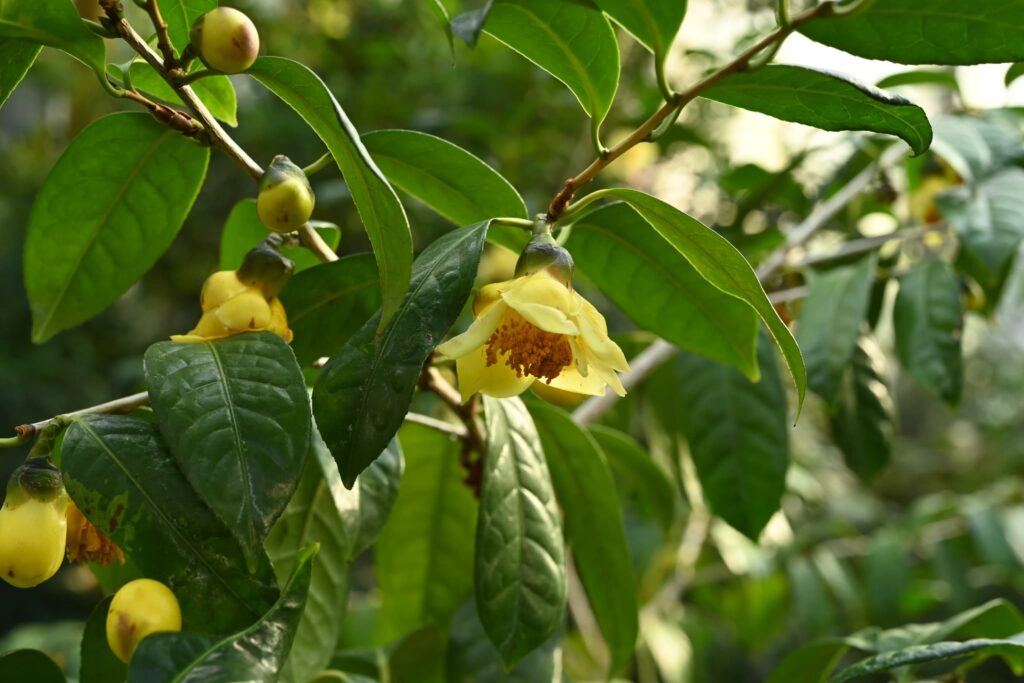
Golden Camellia (Camellia petelotii, syn. C. chrysantha) — native to southern China and Vietnam and immediately distinguished from Japanese Camellia by its yellow flowers. Japanese Camellia normally has red flowers in wild populations, while cultivated forms occur in a much wider range of colors, including white and pink.
Sasanqua Camellia (Camellia sasanqua) — one of the species most easily confused with Japanese Camellia in gardens. Its young twigs are hairy, whereas those of Japanese Camellia are smooth. Sasanqua also generally flowers earlier, from autumn into winter, and its petals usually fall individually rather than dropping as a whole flower. Held up to the light, the leaf veins of Japanese Camellia are more readily visible, while those of Sasanqua are less conspicuous.
Tea Plant (Camellia sinensis) — another close relative, grown primarily for the leaves used to make tea. Its flowers are generally smaller and open more fully than those of Japanese Camellia. Tea Plant also differs in having smaller leaves and a more finely branched growth habit.
Frequently Asked Questions
What’s the easiest way to tell Japanese Camellia apart from Sasanqua?
Flower drop is the most reliable clue: Japanese Camellia’s flowers fall to the ground whole, while Sasanqua sheds its petals individually. Bloom timing also differs, with Sasanqua flowering in autumn and winter and wild Japanese Camellia generally flowering from late winter to spring, while cultivated varieties may bloom anytime from autumn through spring.
Why is camellia associated with the tea ceremony?
Japanese Camellia has long been valued as chabana—flowers used in tea-ceremony settings—because its simple, restrained form suits the aesthetic of wabi-cha. Unlike flowers with elaborate or showy blooms, a single camellia flower can create a quiet seasonal accent without overwhelming the tea room.
Its association with the tea ceremony is also closely connected to its flowering season. Many camellias bloom from winter into early spring, when relatively few other garden flowers are available, making them especially valuable as seasonal flowers for tea gatherings. Over time, particular cultivars, including members of the Wabisuke group, came to be especially prized for their small, understated blooms.
What is camellia oil used for?
Pressed from the tree’s seeds, camellia oil is rich in oleic acid and has a long history of use as cooking oil, a hair-care product, a traditional remedy for skin conditions like atopic dermatitis, and in industrial applications. It was historically prized enough to draw international attention as a purported elixir of longevity.
Why does my Japanese Camellia keep getting caterpillars?
Japanese Camellia is a host plant for Tea Tussock Moth (Euproctis pseudoconspersa), so caterpillars can reappear when adult moths lay eggs on the leaves. The larvae feed on the foliage and may occur in groups, sometimes causing noticeable defoliation.
Because the caterpillars are covered with urticating hairs that can cause severe skin irritation, avoid touching them or brushing against infested branches. Regular inspection can help detect infestations while the caterpillars are still small and localized.
Can Japanese Camellia be shaped into a formal hedge?
Not easily. It doesn’t resprout as vigorously as many hedge plants, so keeping a tightly clipped shape requires real skill, and a heavily geometric form tends to look unnatural on this particular tree. It’s generally better suited to a more naturalistic form than to formal topiary.
Conclusion
Few flowering trees are as deeply rooted in Japanese aesthetics and daily life as Japanese Camellia—prized for centuries as tea-ceremony flower material, pressed into oil valued as both food and medicine, and carved into everything from Jomon-era tool handles to modern shogi pieces. From the ancient wild colony at Natsudomari Peninsula to countless garden cultivars bred from crosses with Yuki-tsubaki, Japanese Camellia remains, by most accounts, one of Japan’s oldest and most enduring ornamental flowering trees.