Japanese Black Pine (Pinus thunbergii): Identification, Care and Uses
Japanese Black Pine is one of Japan’s most famous ornamental trees, celebrated for its rugged dark bark, dense needles, and remarkable tolerance of harsh coastal conditions. This guide covers identification, bark, flowers, cones, and cultivation, based on observations of the tree as grown in Japan.
What Is the Japanese Black Pine?
Japanese Black Pine is an evergreen conifer in the family Pinaceae, native to coastal regions of Japan and parts of Korea. In Japan, it occurs naturally along the Pacific and Sea of Japan coasts of Honshu, Shikoku, Kyushu, and the Tokara Islands, where it is well adapted to strong winds, salt spray, and poor sandy soils.
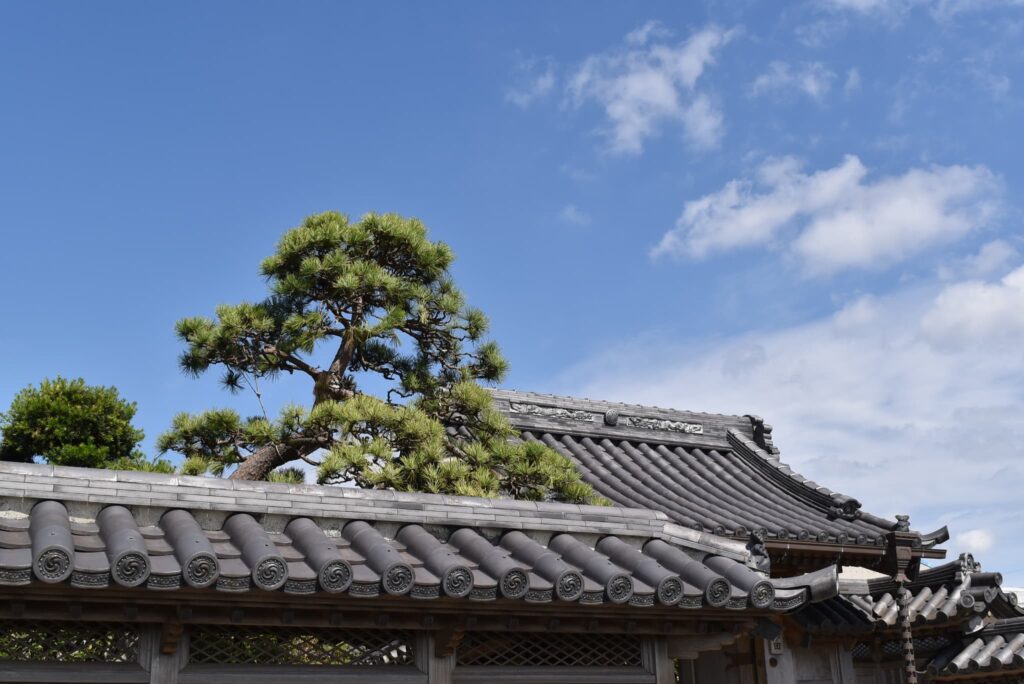
Its dark, rugged bark and long, stiff needles make it one of Japan’s most distinctive pines. Because of its exceptional tolerance of coastal conditions, Japanese Black Pine has long been planted in seaside forests as a windbreak and for coastal protection, while its dramatic form has also made it an important tree in Japanese gardens and bonsai.
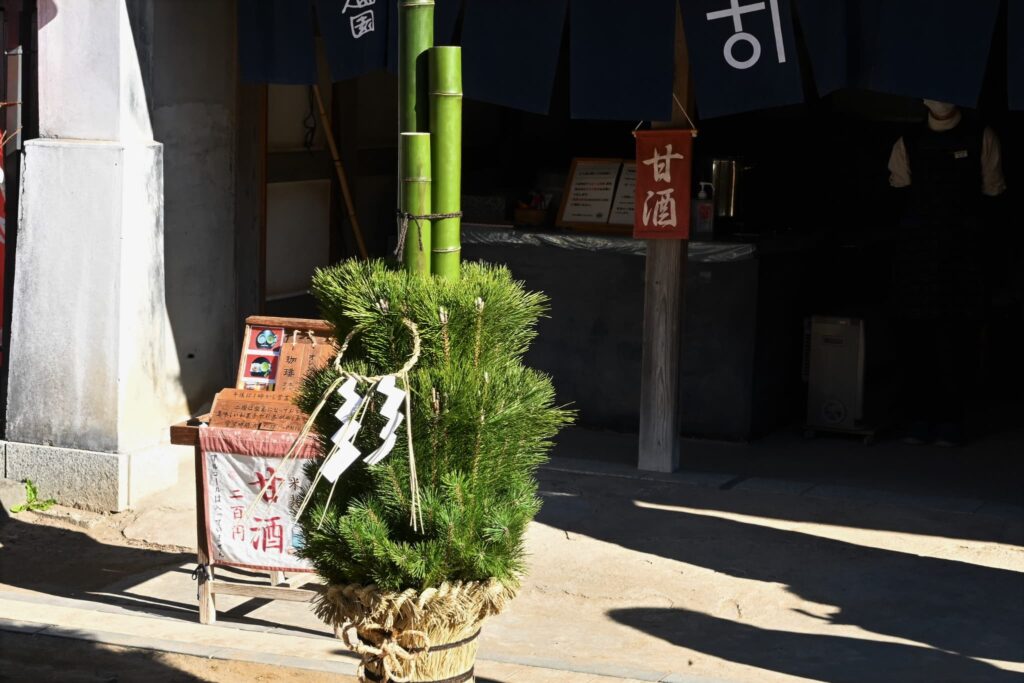
The species has deep cultural associations with longevity, prosperity, and the changing seasons. Japanese Black Pine is commonly planted at shrines and temples and is one of the principal trees used in kadomatsu, the traditional New Year decoration placed at entrances to welcome the deities of the New Year.
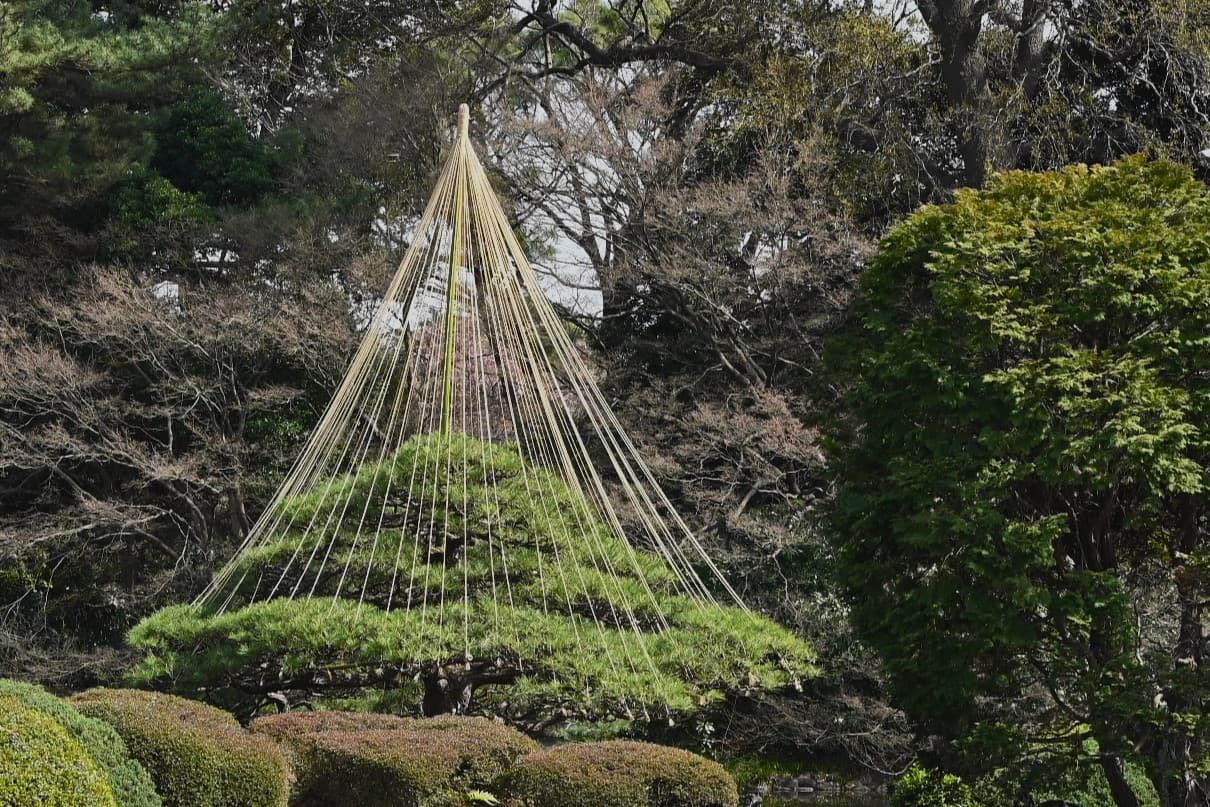
In regions with heavy snowfall, cultivated specimens may also be protected with traditional snow supports, known as yukitsuri, to reduce the risk of branches breaking under accumulated snow.
Overview
| Item | Description |
|---|---|
| Scientific Name | Pinus thunbergii |
| Common Name | Japanese Black Pine |
| Japanese Name | Kuromatsu (クロマツ) |
| Family | Pinaceae |
| Native Range | Japan and Korea |
| Plant Type | Evergreen Coniferous Tree |
| Height | 20–40 m (65–130 ft) |
| Trunk | Gnarled, up to 1.5 m in diameter |
| Flowering Season | April–May |
| Fruit Type | Cone |
| USDA Zones | 5–8 |
| Sun Exposure | Full Sun |
Characteristics
| Feature | Description |
|---|---|
| Needles | Paired, 10–15 cm long, 1–2 mm wide, stiff and sharply pointed |
| Flowers | Monoecious; yellow male flowers, purplish-brown female flowers, April–May |
| Cones | Oval, 5–7 cm long, ripening in autumn the year after flowering |
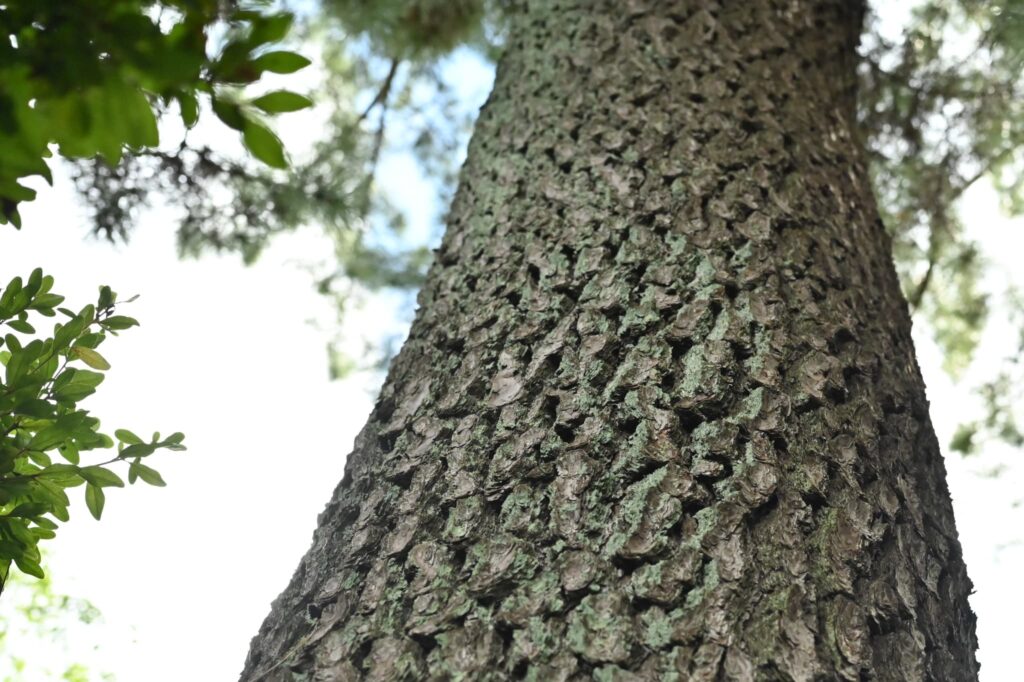
| Bark | Dark, deeply furrowed in a tortoiseshell pattern with age |
Foliage (Needles)
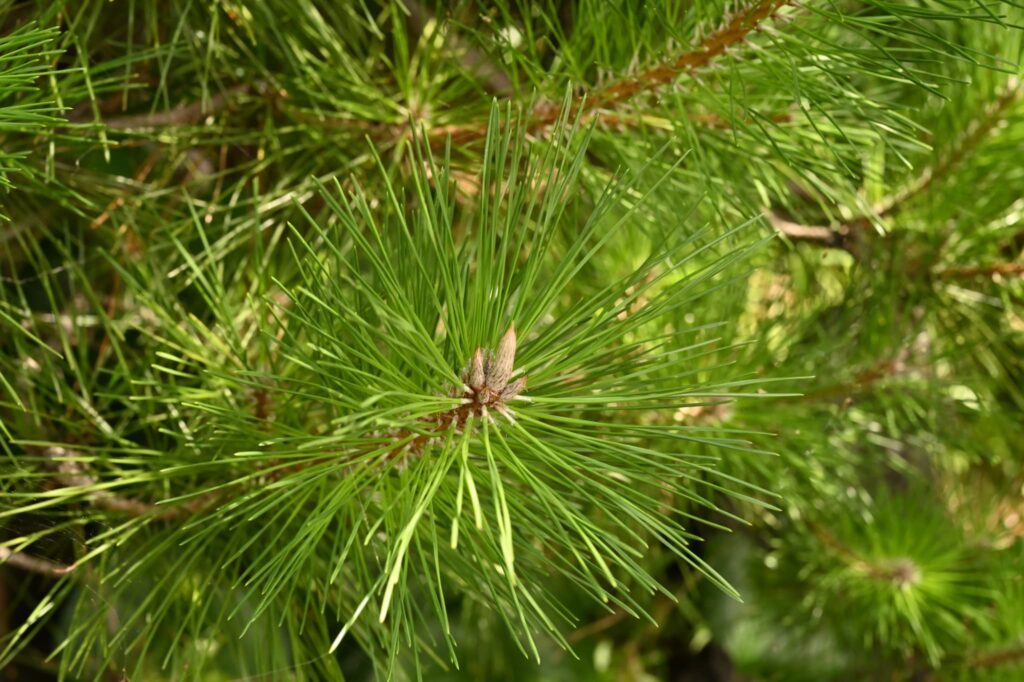
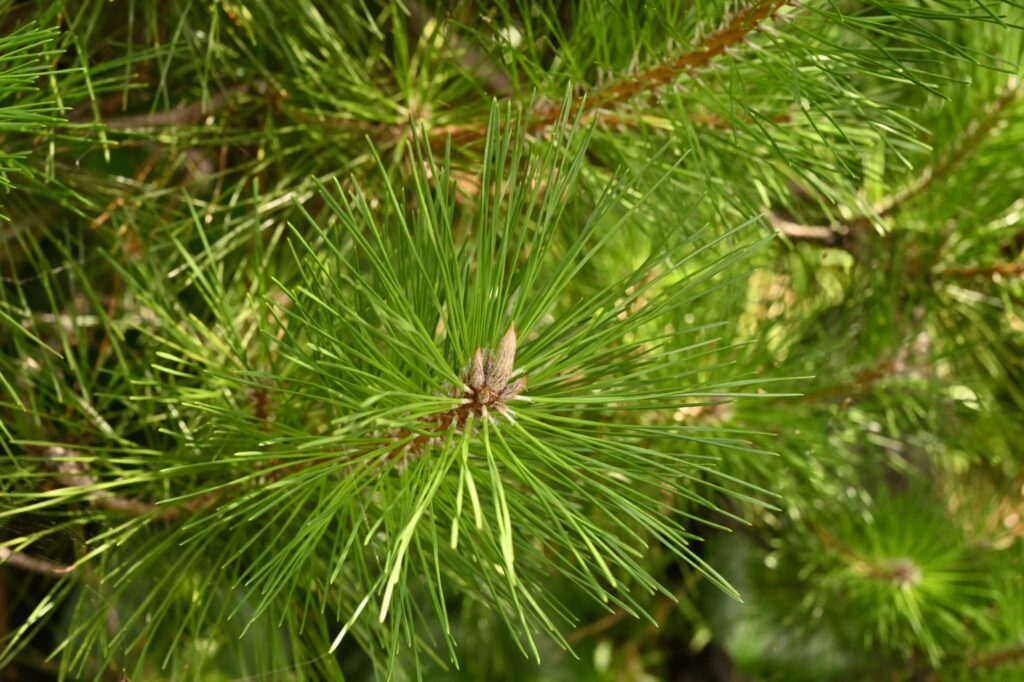
The needles grow in pairs and measure 10–15 cm in length and 1–2 mm in width. Compared to Japanese Red Pine(sometimes called Mematsu, or “female pine”), Japanese Black Pine is known as Omatsu (“male pine”) due to its thicker, longer, and more robust needles. The needle tips are sharply pointed, and the cross-section is semicircular. Small, scaly, brownish leaves—vestigial and scale-like—can be found at the base of new shoots in early spring.
Flowers
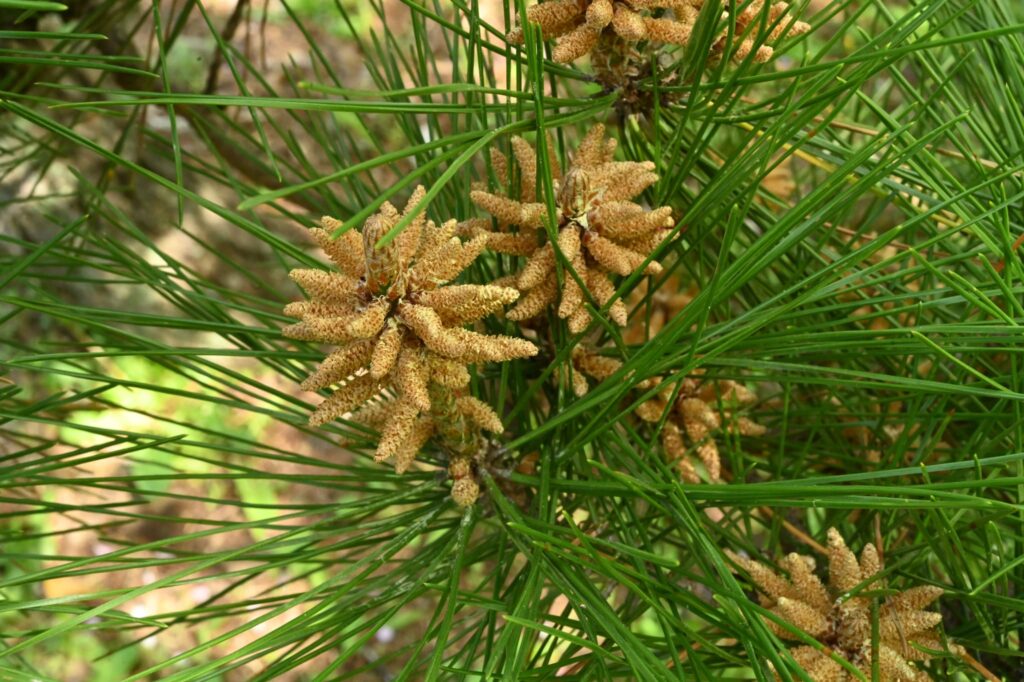
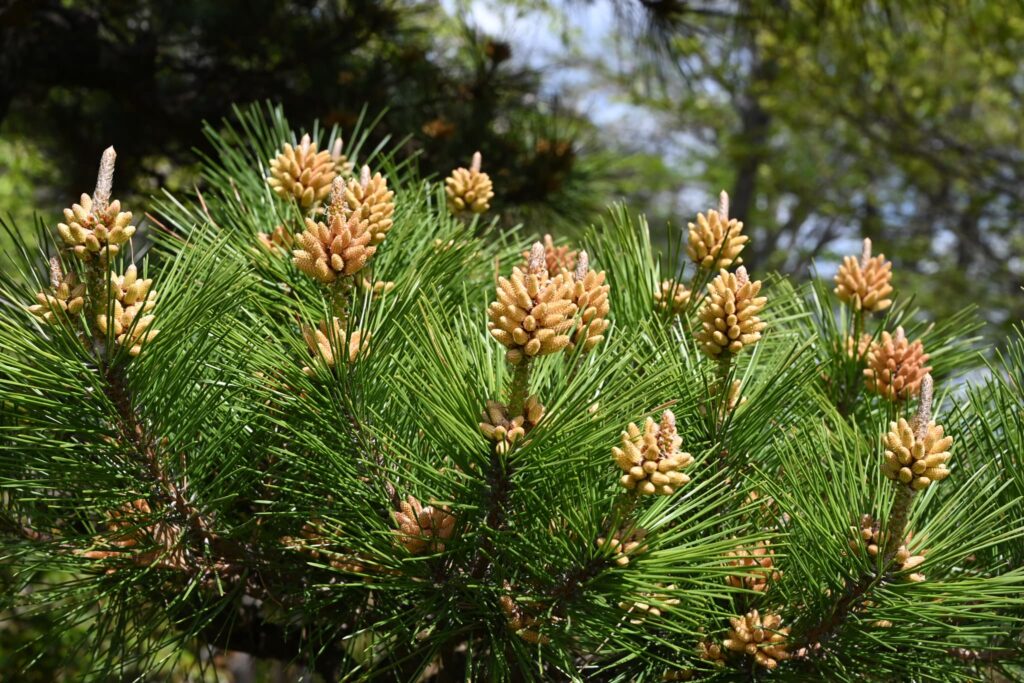
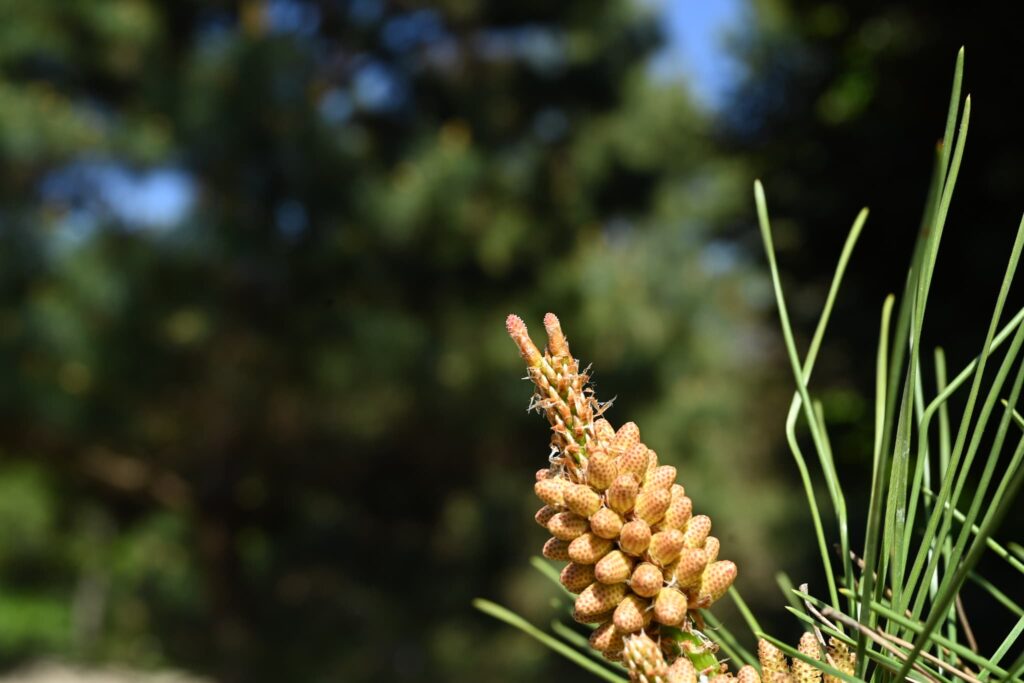
Japanese Black Pine is monoecious, producing both male and female flowers on the same tree from April to May. Male flowers are yellow and far more abundant; female flowers are purplish-brown and harder to spot. Pollination is wind-driven (anemophily). This separation in timing and position may help reduce self-pollination and promote pollen exchange between different trees.
Fruits (Cones)
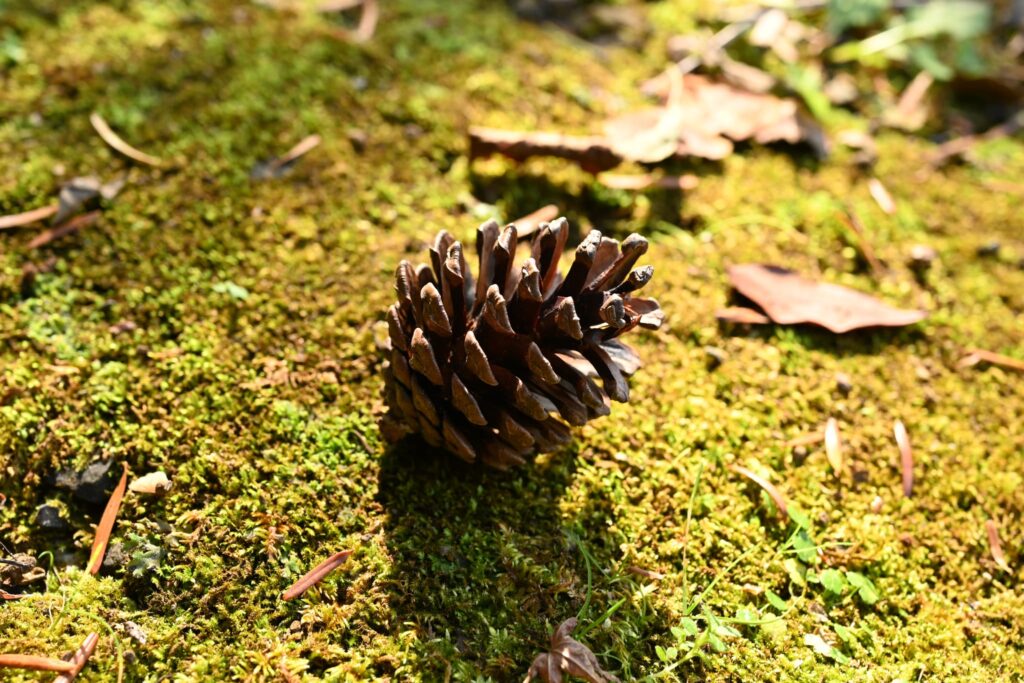
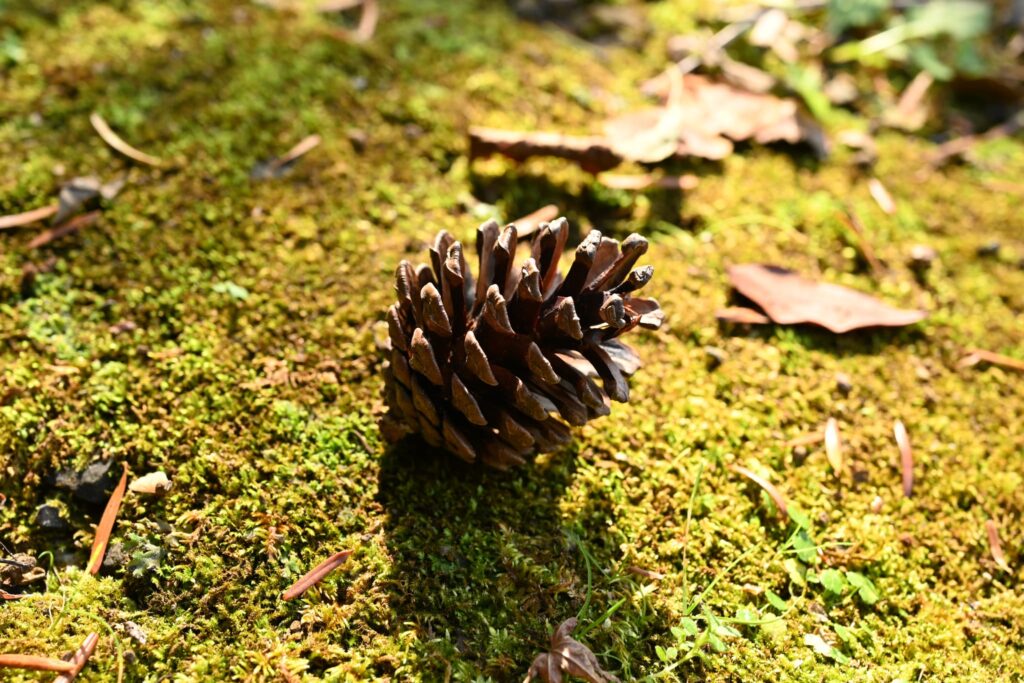
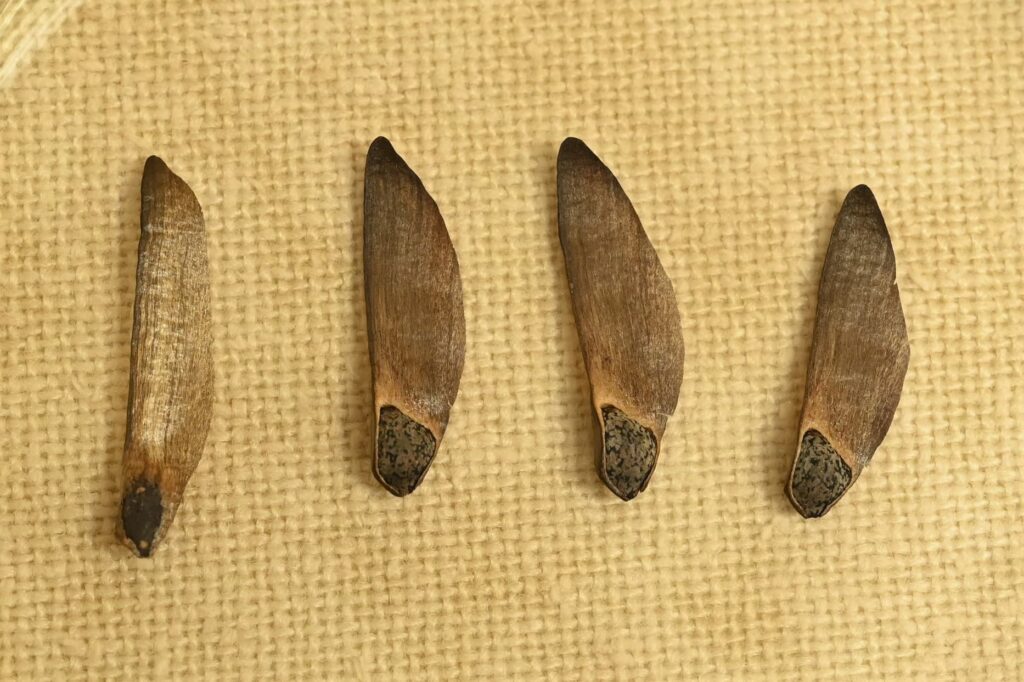
The cones of Japanese Black Pine are oval, 5–7 cm long, and generally larger than those of Japanese Red Pine. They develop from the female flowers and take about a year and a half to mature, ripening in autumn of the year following flowering. Mature cones are woody and brown, with a pointed tip.
Each cone contains winged seeds that are released when the scales open. The seeds are dispersed primarily by wind and may also be eaten or moved by wildlife.
In Japan, immature green cones are sometimes known as ao-matsukasa (“green pine cone”) or shinchijiri. Although the mature cones are not edible, they are a familiar feature of Japanese Black Pine and often remain on the branches after the seeds have been released.
Bark & Timber
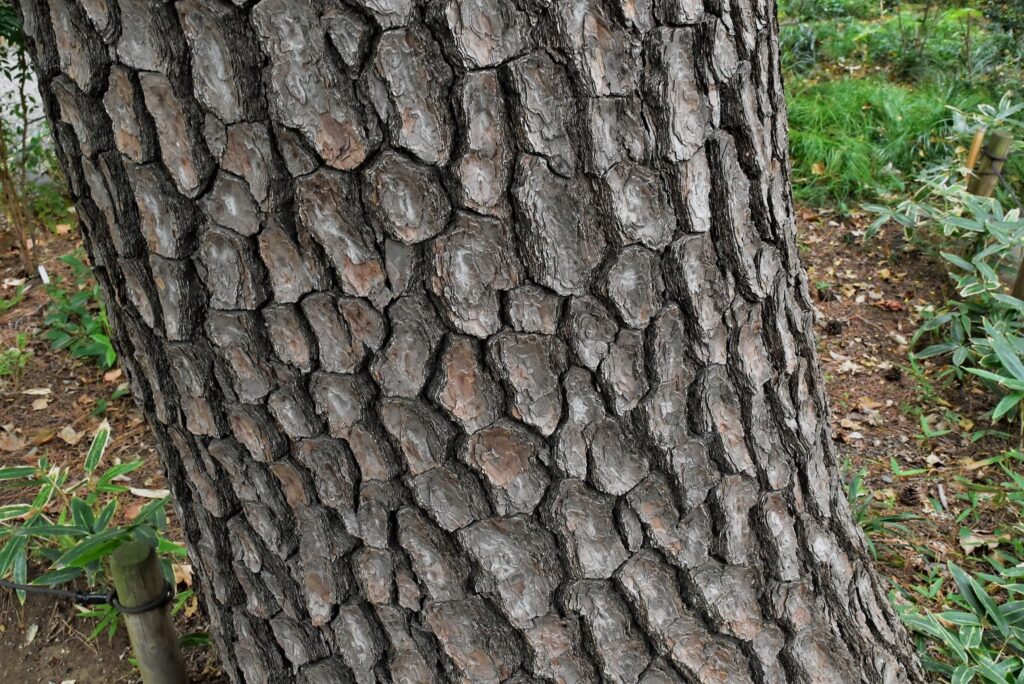
True to its name, the bark of Japanese Black Pine is dark and becomes deeply furrowed in a tortoiseshell pattern with age. While the trunk tends to be gnarled, it can reach up to 1.5 m in diameter. The wood quality is comparable to Japanese Red Pine and is used as construction timber. It is notably resinous with a strong pine fragrance. Specimens with an exceptionally high resin content and attractive coloration are prized as koeomatsu (“fat pine”) and used for ornamental pillars, entryway step boards (agari-kamachi), and traditional crafts.
Size & Growth
Japanese Black Pine reaches 20–40 m (65–130 ft) at maturity, though cultivated garden specimens are typically kept much smaller through pruning. It has a moderate to fast growth rate, and under favorable conditions young trees can grow 30–60 cm (12–24 inches) per year. Some historic specimens in Japan are believed to be over 500 years old.
Uses & Cultural Significance
Japanese Black Pine is commonly found on the grounds of Shinto shrines and Buddhist temples, reflecting a long-held belief that the tree serves as a yorishiro—a sacred object through which deities descend to the earthly realm. It has also been regarded as a sakaiki (boundary tree), planted at the threshold between this world and the next. Most Japanese Black Pines used for New Year’s kadomatsu decorations, displayed at entrances to welcome the deities of the New Year and pray for good fortune, are cultivated in Ibaraki Prefecture.
Name Origin
The word matsu is thought to derive from several possible origins: matsu (待つ, “to wait” for the gods), or tamotsu (保つ, “to preserve” its evergreen color).
Famous Scenic Groves
Many of Japan’s iconic coastal pine groves feature Japanese Black Pine, including:
- Amanohashidate – Miyazu City, Kyoto Prefecture
- Miho no Matsubara – Shizuoka City, Shizuoka Prefecture
- Kehi no Matsubara – Tsuruga City, Fukui Prefecture
- Niji no Matsubara – Karatsu City, Saga Prefecture
Miho, Kehi, and Niji no Matsubara are collectively known in Japan as one of the traditional “Three Great Pine Groves”
Growing Guide
| Condition | Guidance |
|---|---|
| Light | Full sun |
| Soil | Well-drained sandy, loamy, or rocky soil |
| Watering | Low to moderate; drought tolerant once established |
| USDA Zones | 5–8 |
| Salt Tolerance | Excellent |
| Wind Tolerance | Very high |
Light & Soil
Japanese Black Pine thrives in sunny locations with well-drained soil. Avoid planting in poorly drained soils, as excessive moisture may lead to root problems—one of the most common causes of decline is waterlogged soil, which reduces oxygen available to the roots and can lead to root suffocation and decay. Early symptoms include yellowing needles, reduced growth, and thinning foliage. Trees in heavy clay soils or low-lying areas are particularly vulnerable; raised beds, sandy soil amendments, and careful irrigation help prevent excess moisture around the roots.
Watering & Fertilizer
Young trees benefit from regular watering during establishment, but mature specimens are highly drought tolerant, and minimal fertilization is required in most landscapes. For bonsai cultivation, regular pruning and candle pinching are commonly practiced to maintain compact growth and enhance branch structure.
Wind & Snow Tolerance
Japanese Black Pine is particularly well adapted to coastal environments exposed to strong winds and salt spray, and is one of the most salt-tolerant trees in Japan. Its natural habitat includes coastal dunes, rocky shorelines, and seaside forests where trees are regularly exposed to salt-laden winds and sea spray, and its strong root system helps stabilize sandy soils. In areas with heavy snowfall, snow barriers (yuitsuri) are used to prevent branches from breaking under snow load.
Cold Hardiness
Japanese Black Pine is hardy in USDA zones 5–8, with some cultivars surviving in Zone 6 with protection. Mature trees tolerate cold weather well, though the roots of container-grown specimens are more exposed to freezing temperatures and may require winter protection in colder climates.
Pruning
Japanese Black Pine responds well to pruning, which is one reason it is so widely used in Japanese gardens and bonsai. In landscape trees, pruning is usually used to maintain the tree’s natural form, improve branch structure, and control excessive growth rather than to create a densely clipped shape.
In Japan, candle pruning is commonly used on cultivated Japanese Black Pines to control the length of new shoots and encourage shorter needles and denser branching. The timing and intensity of this technique depend on the tree’s age, vigor, and the desired result. Removing all candles indiscriminately can weaken the tree, so ordinary garden specimens generally require a more selective approach.
For large established trees, pruning should focus on removing dead, damaged, crossing, or poorly positioned branches. Because Japanese Black Pine can eventually become a large tree, it is better to choose a suitable planting site than to rely on repeated heavy pruning to control its size.
Suitability for Home Gardens
Japanese Black Pine can make an excellent garden tree, but its eventual size should be considered carefully. In its natural form, the species can grow into a large tree, reaching 20–40 m in height, although garden specimens are often kept much smaller through selective pruning and training.
Its exceptional tolerance of wind, salt spray, drought, and poor sandy soils makes it particularly well suited to coastal gardens and other exposed sites where many ornamental trees struggle. It performs best in full sun and well-drained soil and is generally a poor choice for permanently wet or heavily shaded locations.
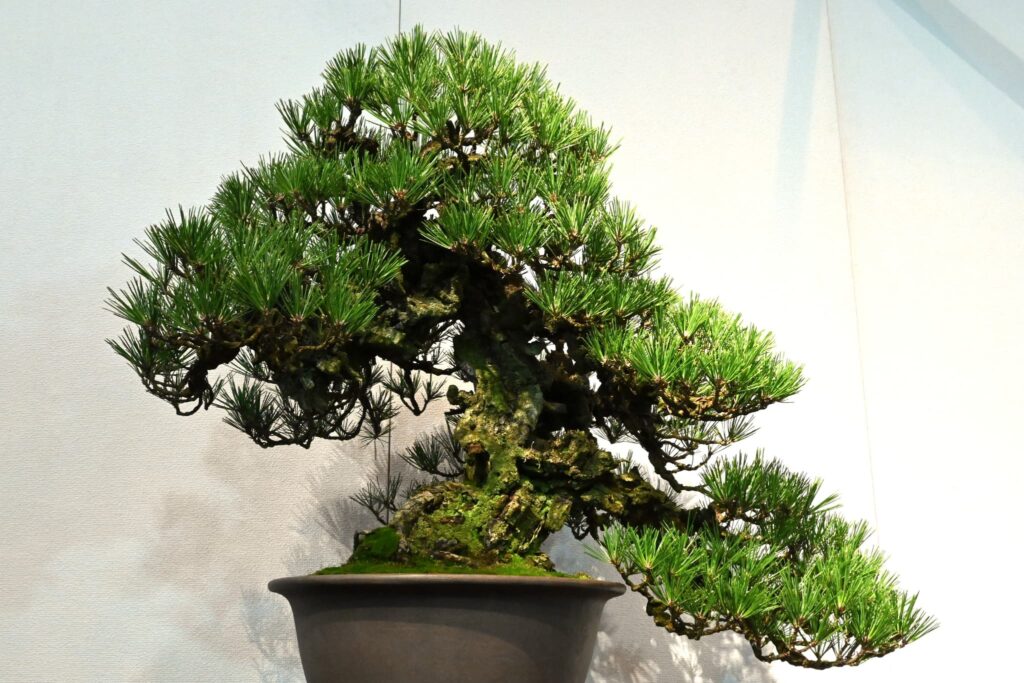
For smaller gardens, however, a full-sized Japanese Black Pine may eventually require more space than is available. In such situations, container cultivation or bonsai training can be more practical options. Japanese Black Pine is one of the world’s most widely used bonsai species, valued for its rugged bark, strong branch structure, and ability to develop character with age.
Container-grown plants require a freely draining soil mix and a pot with adequate drainage. Because the root system is more exposed than it would be in the ground, regular watering is necessary during hot or dry weather, although the soil should not remain constantly wet. With appropriate pruning and root management, a Japanese Black Pine can be maintained in a container for many years.
Pests
Pine wilt disease is one of the most serious threats to Japanese Black Pine. It is associated with the pine wood nematode, which is transmitted from tree to tree by pine sawyer beetles. Once infected, a tree may decline rapidly as its water transport system becomes disrupted, often dying within a single growing season.
Early symptoms can include needles turning pale green or yellow before becoming reddish-brown. Unlike the normal shedding of older needles, which occurs mainly on the inner parts of the branches, pine wilt often causes browning to spread more widely through the canopy, while dead needles may remain attached to the tree.
Once obvious symptoms appear, recovery is often difficult. If pine wilt disease is suspected, prompt identification and removal or treatment of affected trees may be necessary to reduce the risk of further spread. Management methods vary by region and may involve local forestry or plant health authorities, so consulting a qualified arborist, forestry specialist, or relevant local authority is advisable.
Not all browning needles indicate disease, however. Like other pines, Japanese Black Pine naturally sheds older needles as part of its normal growth cycle, most noticeably in autumn. In this case, the newest needles near the branch tips remain green and healthy while the older inner needles gradually yellow, brown, and fall.
Cultivars
| Cultivar | Feature |
|---|---|
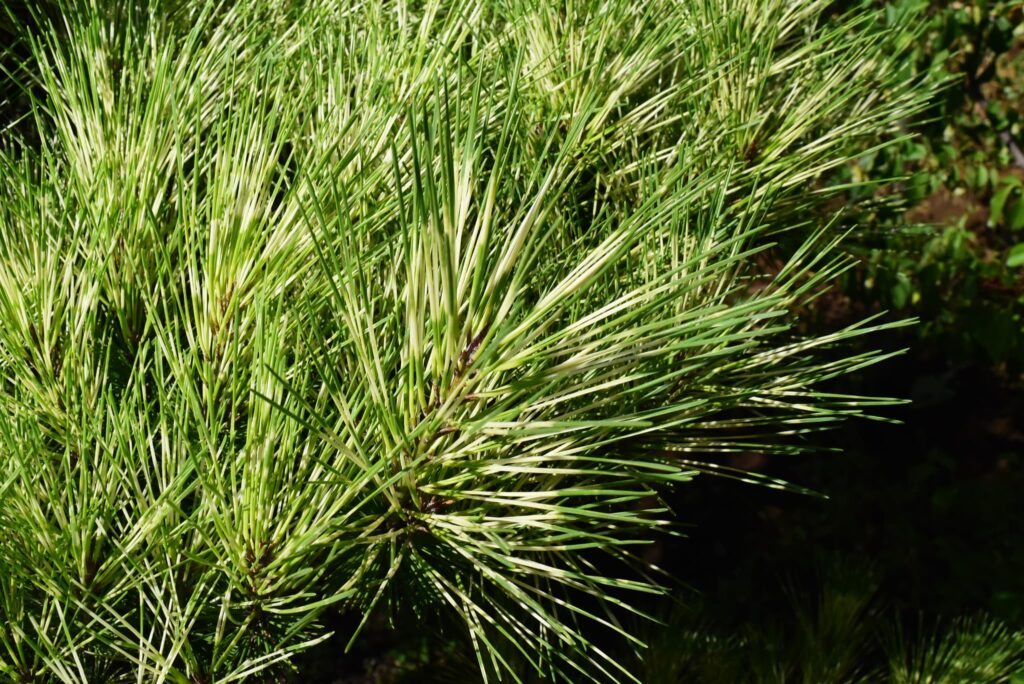
| Janome-matsu (“Snakeeye Pine”) | White-patterned needles |
| Nishiki-matsu | Bark resembling rugged rock or brocade |
| Ougi-matsu (“Fan Pine”) | Fan-shaped needle bases |
| Ougon Kuromatsu (“Golden Black Pine”) | New needles emerge entirely yellow |
| Shidare-matsu (“Weeping Pine”) | Gracefully drooping branches |
Similar Species
More than 100 species of pine occur throughout the Northern Hemisphere. The following are often confused with Japanese Black Pine or share similar characteristics.
- Japanese Red Pine(Pinus densiflora) — the species most often confused with Japanese Black Pine. Distinguished by reddish-orange bark, softer and more slender needles, and a preference for inland habitats; less adapted to seaside conditions than Japanese Black Pine.
- Japanese White Pine(Pinus parviflora) — shorter, bluish-green needles grouped in bundles of five, versus Japanese Black Pine’s dark green needles in pairs. Widely cultivated in ornamental gardens and bonsai collections.
- Chinese Black Pine (Pinus tabuliformis) — a somewhat similar silhouette and bark texture, but typically shorter needles and a broader native range across northern China.
- Aleppo Pine (Pinus halepensis) — also tolerates dry and windy environments, but has a lighter canopy, thinner needles, and a distinctly Mediterranean distribution.
Frequently Asked Questions
How can I tell Japanese Black Pine from Japanese Red Pine?
Japanese Black Pine generally has darker, more deeply fissured bark and longer, stiffer, darker green needles. Japanese Red Pine typically has reddish-orange bark and softer, more slender needles. Japanese Black Pine is also generally better adapted to coastal environments exposed to salt spray.
Is Japanese Black Pine native to Japan?
Yes. Japanese Black Pine is native to Japan and also occurs naturally in parts of Korea. In Japan, it is commonly found along coastal areas where it withstands strong winds and salt spray.
How fast does Japanese Black Pine grow?
Japanese Black Pine has a moderate to fast growth rate. Under favorable conditions, young trees can grow 30–60 cm (12–24 inches) per year.
Can Japanese Black Pine grow near the ocean?
Yes. It is one of the most salt-tolerant trees in Japan and is widely planted as a windbreak and coastal protection tree along seashores.
How tall does Japanese Black Pine get?
Mature trees typically reach 20–40 meters (65–130 feet) in height, although cultivated specimens in gardens are often kept smaller through pruning.
Is Japanese Black Pine suitable for bonsai?
Yes. Japanese Black Pine is one of the most popular bonsai species in the world. Its rugged bark, flexible branches, and ability to respond well to pruning make it highly valued by bonsai enthusiasts.
Why are the needles on my Japanese Black Pine turning brown?
Browning needles may result from natural aging, drought stress, poor drainage, transplant shock, or diseases and pests. Older inner needles often turn yellow or brown and fall naturally as part of the tree’s growth cycle, while browning of the newest needles or entire branches may point to disease, drought, or root damage instead.
How long does Japanese Black Pine live?
Japanese Black Pine can live for several hundred years. Some historic specimens in Japan are believed to be over 500 years old.
Conclusion
From windswept coastal forests to carefully trained garden specimens, Japanese Black Pine occupies a distinctive place in Japan’s landscape. Its long, stiff needles, deeply fissured bark, and exceptional tolerance of wind and salt spray make it both a defining tree of the Japanese coast and one of the country’s most important ornamental pines.
Although capable of growing into a large tree in the wild, Japanese Black Pine can also be shaped and maintained for gardens, containers, and bonsai. Its ability to withstand harsh conditions, combined with its dramatic appearance and responsiveness to careful training, has made it valuable in landscapes ranging from seaside shelterbelts to traditional Japanese gardens.
Whether growing naturally along the coast, protecting shorelines from wind and sand, or developing character over decades as a bonsai, Japanese Black Pine remains one of the most recognizable and enduring trees in Japan’s natural and horticultural landscape.