Japanese Andromeda (Pieris japonica): Identification, Care, Toxicity & Uses
Japanese Andromeda (Pieris japonica) is one of the classic shrubs of Japanese gardens, admired for its cascading spring flowers, colorful new foliage, and centuries of use in traditional landscapes. This guide covers identification features, flowers, fruit, bark, cultivars, and care, based on observations of the plant as grown in Japan.
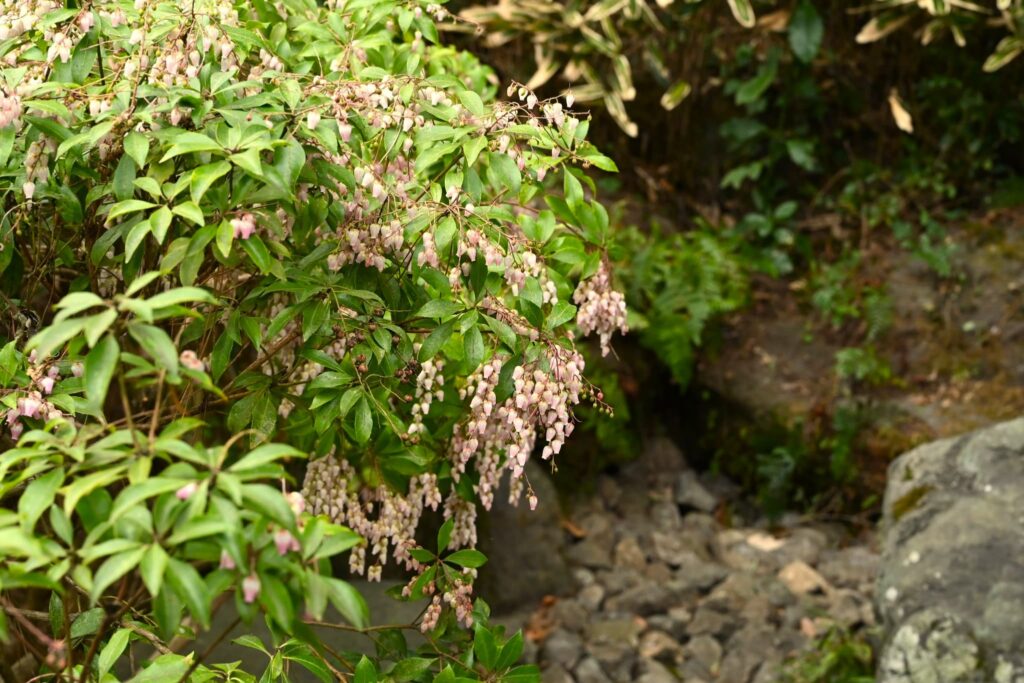
What Is Japanese Andromeda?
Japanese Andromeda is an evergreen shrub in the family Ericaceae (the heath family), distributed across Honshu (from Yamagata and Miyagi Prefectures southward), Shikoku, and Kyushu. It is a species endemic to Japan, often found growing in colonies in somewhat dry woodlands, gravelly terrain, and along mountain ridges.
Although the entire plant is toxic, it has long been cultivated as an ornamental shrub throughout Japan. Its toxicity discourages deer and many other animals from browsing it, often resulting in landscapes where Japanese Andromeda becomes especially abundant. Locations such as Kasuga Taisha Shrine and Nara Park, Hakone, and Mount Amagi are well known as scenic spots for the plant — though in many cases, this striking abundance is really the result of deer and other browsing animals avoiding the toxic shrub while eating everything around it.
Japanese Andromeda has been cherished since ancient times — it is even mentioned by name in the Man’yōshū, Japan’s oldest major poetry anthology — and its small, spring-blooming, lily-of-the-valley-like flowers have made it a popular choice for gardens and bonsai. It is one of the oldest plants used in traditional Japanese gardens, traditionally planted near stone lanterns and garden rocks, though its bright flowers and foliage also allow it to fit comfortably into Western-style gardens.
Overview
| Item | Description |
|---|---|
| Scientific Name | Pieris japonica |
| Common Name | Japanese Andromeda / Lily-of-the-Valley Shrub |
| Japanese Name | Asebi (アセビ), also Asebo, Ashibi, Ashimi, Asemi, Ashibu, or Asebu |
| Family | Ericaceae |
| Native Range | Japan (endemic); Honshu from Yamagata/Miyagi southward, Shikoku, Kyushu |
| Plant Type | Evergreen Shrub |
| Height | Around 3 m in the wild |
| Trunk | Multi-stemmed, twisted with age; reddish bark with vertical striations |
| Flowering Season | February–April |
| Fruit Type | Small capsule, ripening brown September–October, splitting into five sections |
| USDA Zones | 6–8 |
| Sun Exposure | Partial shade preferred; roughly 3–4 hours of sun a day is ideal |
Characteristics
| Feature | Description |
|---|---|
| Leaves | Alternate, leathery, glossy, finely toothed near the tip |
| Flowers | Small white (rarely pink) urn-shaped flowers in drooping clusters |
| Fruit | Small capsule on a curved stalk, splitting into five sections when ripe |
| Bark | Reddish, with vertical striations; trunk often twisted with age |
| Habit | Multi-stemmed, naturally rounded evergreen shrub |
Foliage
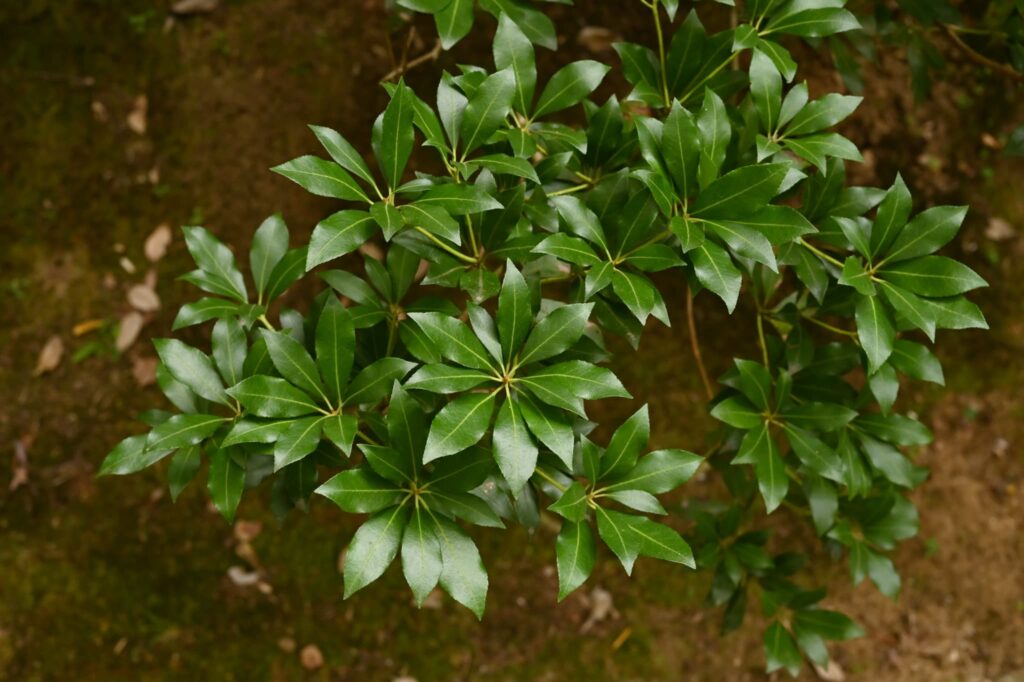
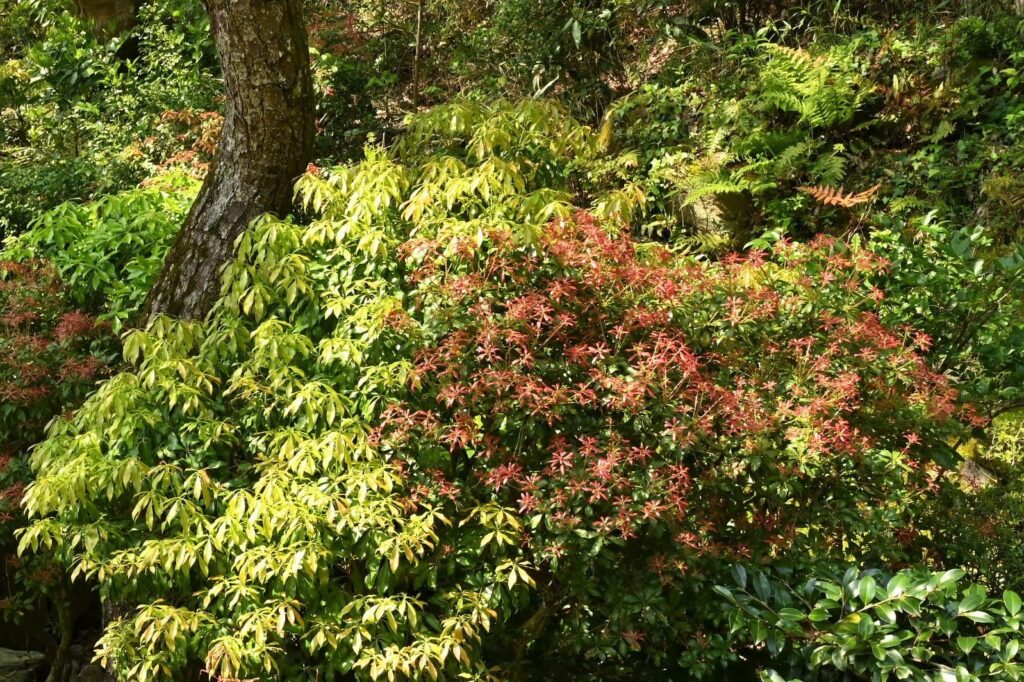
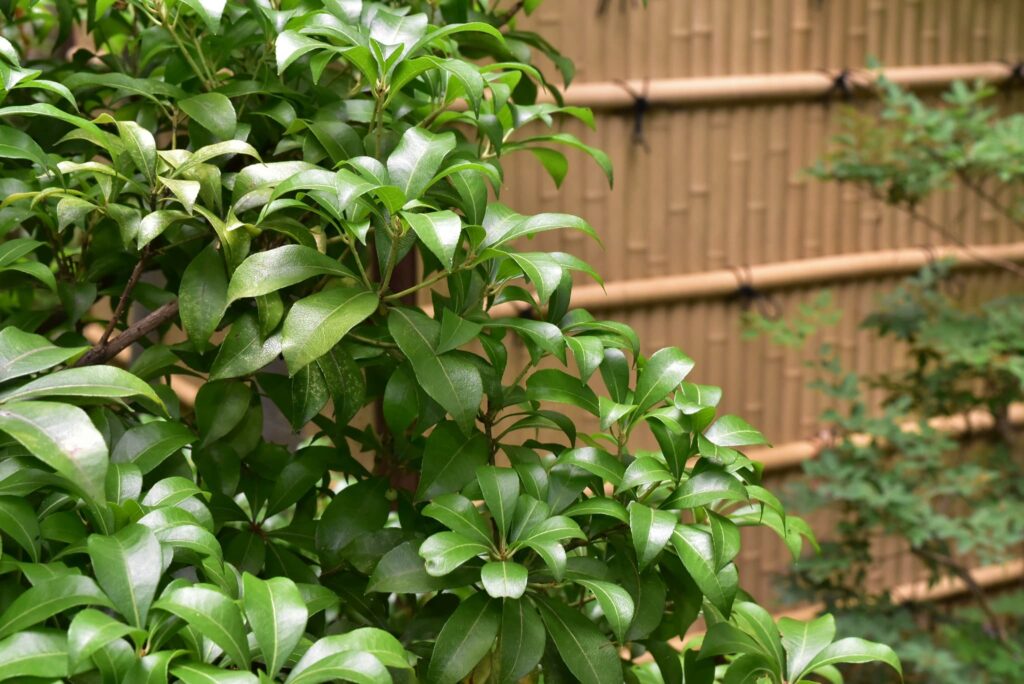
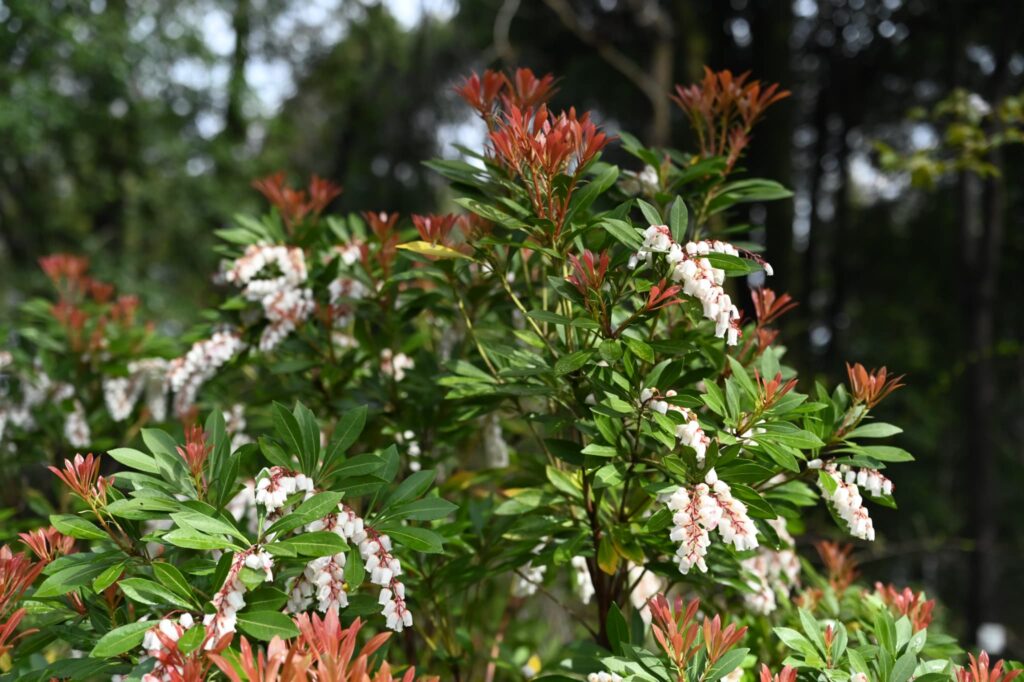
Young Japanese Andromeda leaves emerge tinged with red, giving them a striking beauty reminiscent of autumn color. The leaves appear to cluster at the branch tips, though they are actually arranged alternately along the stem.
Leaves are 3–9 cm long and 2–3 cm wide, whitish on the underside, and hairless on both surfaces. They have a leathery, glossy texture, with faint, shallow serrations visible along the leaf tip’s edge on closer inspection. The base is wedge-shaped, and the upper surface is slightly sunken along the midrib.
Flowers
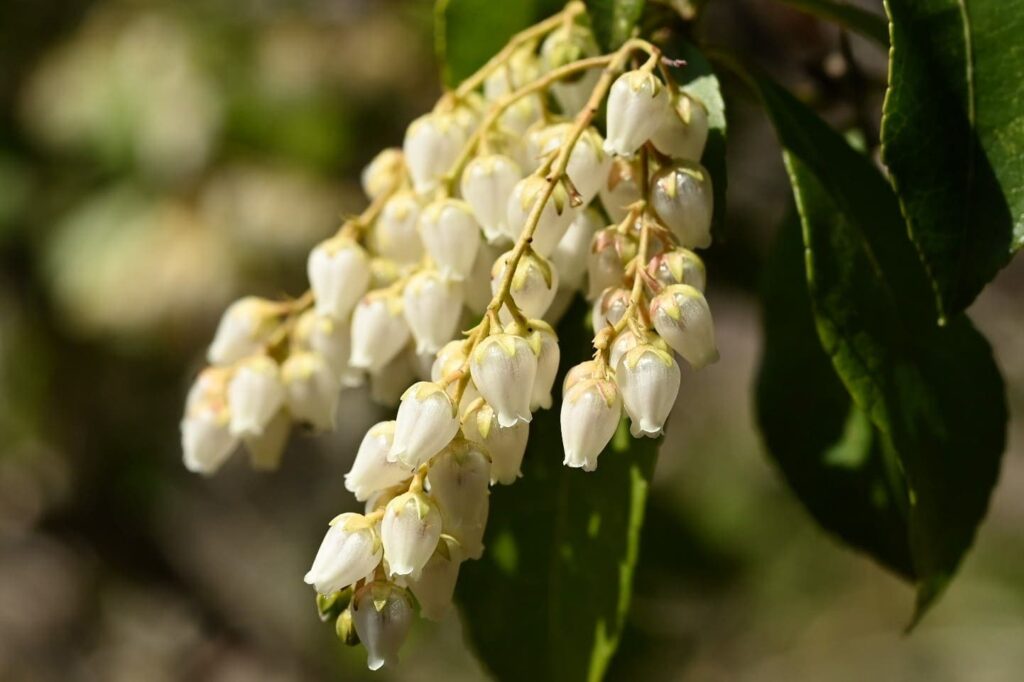
Japanese Andromeda flowers between February and April. Small, urn-shaped blooms similar to those of Enkianthus (Doudan-tsutsuji) hang in profusion from the branch tips, together forming a cone-shaped cluster. Each flower is about 6–8 mm across, with a shallowly five-lobed mouth, containing ten stamens and a single pistil. The species bears perfect (bisexual) flowers.
Nectar glistens deep within each flower, but the flowers themselves are toxic — there are recorded cases of poisoning from honey made by bees foraging on Japanese Andromeda.
The flower cluster (raceme) is typically 10–15 cm long and carries around 20–30 individual blooms, though the length of the cluster and the number of flowers vary by cultivar.
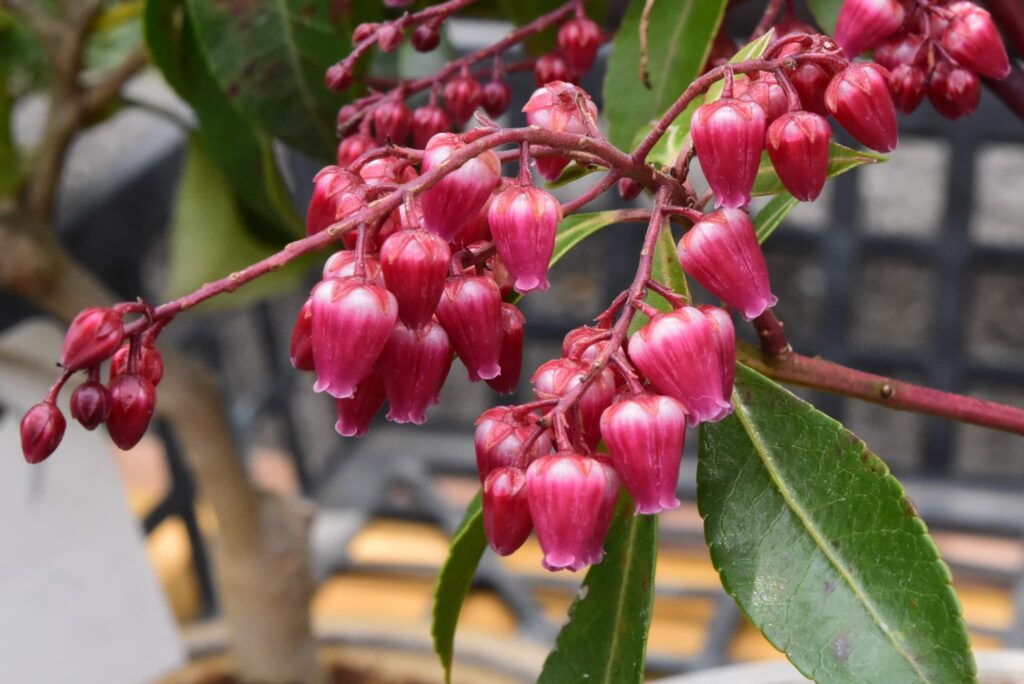
Wild Japanese Andromeda typically bears white flowers, though a pale pink form occurs rarely in nature and is especially popular in cultivation. The calyx at the base of each flower can also vary in color from individual to individual, appearing either pale pink or yellowish-green.
Fruits
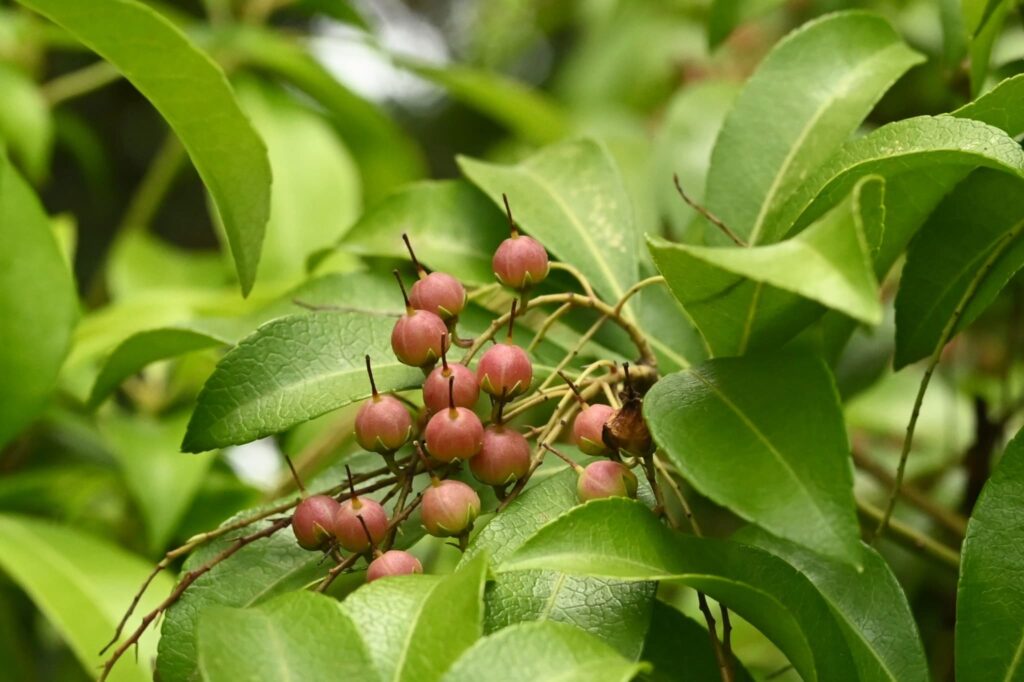
The fruit that follows flowering is about 5 mm across, carried on a short, curved stalk. Though it appears to hang downward from the branch, the tip of the fruit actually points upward. It ripens to brown around September or October, splitting into five sections; when shaken by the wind, the seeds fall out from within.
By the time the fruit ripens, buds for the following spring’s flowers have already formed, and to an unfamiliar eye, the fruit and the developing flower buds can be difficult to tell apart.
Bark & Timber
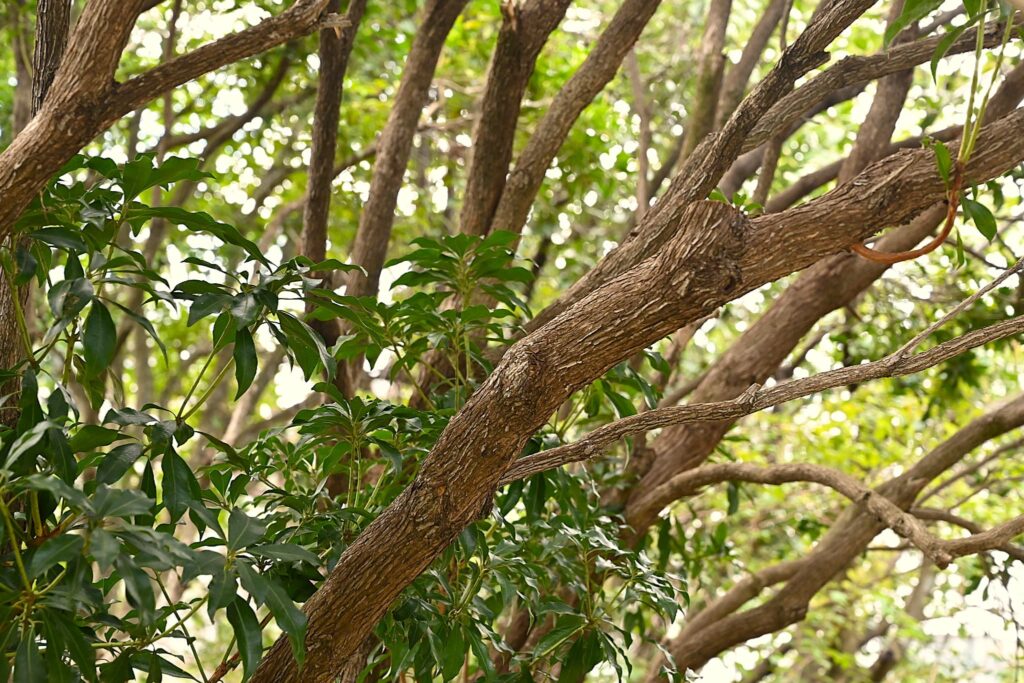
Japanese Andromeda usually grows as a multi-stemmed clump, and with age the trunk develops a twisted character similar to that of Lyonia ovalifolia (Nejiki). The bark is reddish and marked with vertical striations. In the wild, the plant typically reaches around 3 m in height. Its wood is only rarely used, occasionally for decorative alcove posts (tokobashira) or firewood.
Size & Growth
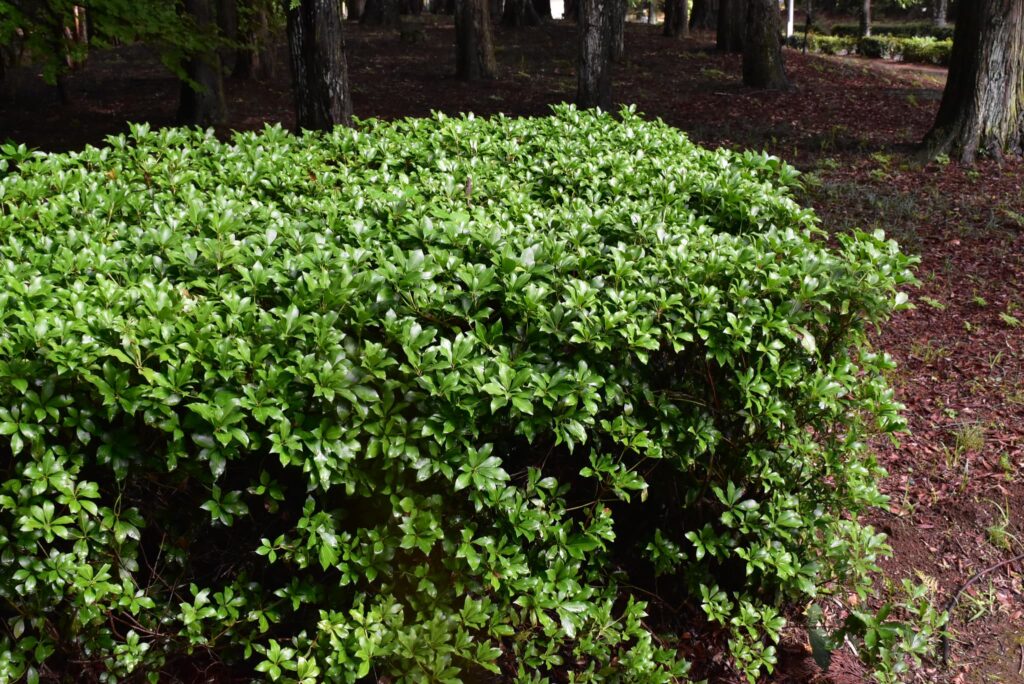
In the wild, Japanese Andromeda typically reaches around 3 m in height. Growth is naturally slow, and the plant branches freely, developing a pleasing rounded form on its own without much intervention.
Uses & Cultural Significance
Japanese Andromeda has been cherished since ancient times — it is even mentioned by name in the Man’yōshū, Japan’s oldest major poetry anthology. It is one of the oldest plants used in traditional Japanese gardens, traditionally planted near stone lanterns and garden rocks, and it is also a long-favored subject for bonsai.
Because the plant is toxic, deer and many other browsing animals avoid it, which over time has produced landscapes — such as those at Kasuga Taisha Shrine and Nara Park, Hakone, and Mount Amagi — that appear dominated by Japanese Andromeda. The effect is really a byproduct of selective grazing on surrounding vegetation rather than any special vigor of the plant itself.
Name Origin
Because it has been so widely known for so long, its Japanese name varies by region and speaker — Asebi, Asebo, Ashibi, Ashimi, Asemi, Ashibu, Asebu, and more — which can cause confusion, though the standard Japanese name is Asebi. As its Japanese kanji name suggests, horses and cattle that eat the branches and leaves of Japanese Andromeda can suffer damage to their respiratory control centers, causing an unsteady, drunken-looking gait — giving rise to the alternate name Ashibi (“numb legs”). One theory also traces the name Asebi to ashimi (“bad fruit”), an origin story similar to that proposed for Illicium anisatum (Shikimi), another toxic Japanese shrub.
The “Andromeda” in its English name refers to an entirely different flower native to the West; the name was borrowed for this Japanese species simply because of a resemblance between the two.
Toxicity
As its Japanese name suggests, Japanese Andromeda has long been associated with the effects of poisoning in animals. Horses and cattle that eat its leaves or branches may develop an unsteady, drunken-looking gait, which is thought to be one of the origins of the alternate name Ashibi, meaning “numb legs.” Another theory traces the name Asebi to ashimi (“bad fruit”), an origin story similar to that proposed for Illicium anisatum (Shikimi), another toxic Japanese shrub.
All parts of Japanese Andromeda contain toxic compounds, including grayanotoxins. Accidental ingestion can cause symptoms such as abdominal pain, vomiting, diarrhea, weakness, and breathing difficulties. Severe poisoning can be dangerous, particularly for livestock and pets, so the leaves, flowers, branches, and other plant parts should never be eaten.
Its toxicity has also shaped the way the plant interacts with its environment. Deer and many other browsing animals tend to avoid Japanese Andromeda, allowing it to remain abundant in places where surrounding vegetation is heavily grazed. This is one reason why the shrub can form especially striking colonies in areas such as Nara Park, Hakone, and Mount Amagi.
Japanese Andromeda also has a history of practical use despite its toxicity. In the past, water in which the leaves had been soaked, or a decoction made from the leaves, was used as an insect repellent and as a folk treatment for lice and scabies. However, because the plant is poisonous, it should not be used as a home remedy or consumed in any form.
Growing Guide
| Item | Description |
|---|---|
| Light | Partial shade; morning sun with afternoon shade is often ideal |
| Soil | Fertile, well-drained soil preferred, but tolerant of poor conditions |
| Wind & Salt Tolerance | Tolerates air pollution and salt-laden coastal wind well |
| Cold Hardiness | USDA Zones 6–8; can be grown north of its natural range, into Aomori and southern Hokkaido |
| Pruning Time | Immediately after flowering |
| Pests | Generally pest-resistant; occasional issues in poorly ventilated sites |
Light & Soil
The plant prefers fertile soil but is otherwise a remarkably tough garden plant; nursery-grown plants are adaptable, but they perform best in fertile, well-drained soil. Japanese Andromeda has a natural preference for shade and dislikes direct sun and intense afternoon western exposure — moderate shade produces the best flowers and foliage. Morning sun with afternoon shade is often ideal. In typical Japanese garden conditions, around three to four hours of sunlight a day often provides a good balance.
Wind & Snow Tolerance
The plant tolerates air pollution, salt-laden coastal wind, and dry conditions well, allowing it to be planted in fairly harsh environments.
Cold Hardiness
For an evergreen shrub, Japanese Andromeda is notably cold-hardy, and it can be grown even north of its natural range, in areas such as Aomori and southern Hokkaido.
Pruning
Japanese Andromeda branches freely and naturally develops a pleasing shape on its own, so it generally requires little hands-on care. That said, without any attention at all, the overall form can become top-heavy or irregular.
The plant buds vigorously and tolerates shearing, but its growth is slow, so it isn’t well suited to being clipped into crisp, formal shapes. Maintenance is usually best limited to removing overly long protruding branches, root suckers (“hikobae”), and any dead interior branches.
Because pruned branches and leaves are toxic, they need to be disposed of carefully. Flowers form on the previous year’s branch tips, so pruning after autumn will reduce the following spring’s flower count. Prune immediately after flowering if shaping is necessary.
Suitability for Home Gardens
Japanese Andromeda is a low-maintenance, deer-resistant shrub well suited to home gardens, particularly shaded or partly shaded beds near paths, stone lanterns, or garden rocks. Because every part of the plant is toxic, it is not a good choice for gardens frequented by small children or pets prone to chewing on foliage.
Pests
Japanese Andromeda is generally resistant to pests and disease. Because of its toxicity, most insects avoid it, with the exception of certain moth species (such as the geometer moth Alcis angulifera, known in Japanese as Hyōmon-edashaku), and a few insects that deliberately feed on it in order to sequester its toxins for their own defense.
In poorly ventilated locations, damage from wood-boring beetle larvae, leafroller caterpillars, carpenter moths, lace bugs, and leaf miners can sometimes occur from early summer through autumn.
Propagation
Japanese Andromeda can be propagated from seed, by layering, by division, or from cuttings. Seeds germinate readily, but young seedlings grow slowly, so buying nursery stock is usually faster if a larger number of plants is wanted. Most Japanese Andromeda sold commercially is propagated from cuttings.
Cultivars & Natural Forms
Cultivars
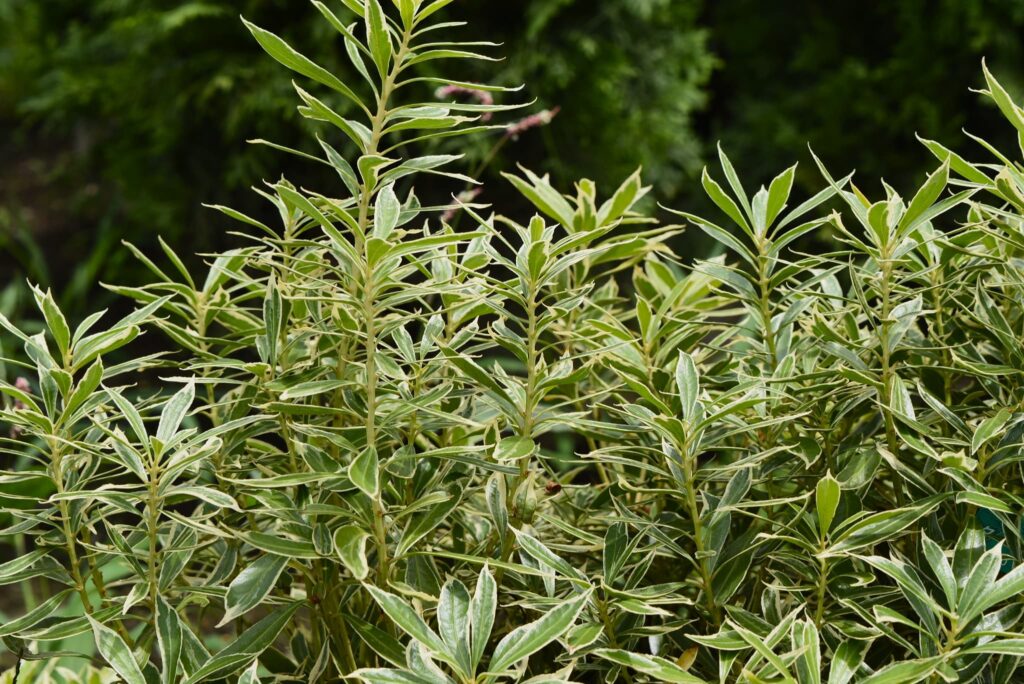
- Variegated Asebi — cultivars with patterned foliage, including Fukurin Asebi, which has a white leaf margin; plants of this type are usually smaller than the standard species.
- Hime Asebi (“dwarf Asebi”) — a dwarf cultivar reaching only about 60 cm, flowering later than the standard form, in April, with thread-like leaves.
- Kouzan Asebi — a form of Chinese origin, notable for even more vividly red new growth.
- Benibana Asebi — a deeper-pink form of Akebono Asebi; a paler pink counterpart is known as Usubeni Asebi. Other pink-flowered cultivars include ‘Daisen’ and ‘Christmas Cheer’, though individual variation in flower color makes precise cultivar identification difficult.
Natural & Regional Forms
- Ryukyu Asebi (Okinawa Asebi) — a cultivar with finely branched, densely packed foliage and comparatively large flowers, native to the mountains of Okinawa and Amami Ōshima. It grows even more slowly than the wild species.
- Amami Asebi — a form endemic to the Amami Islands, similar to Ryukyu Asebi but with subtly different flower structure.
- Honaga Asebi (“long-spike Asebi”) — bears longer flower clusters than the standard form, drooping to nearly 30 cm; considered a naturally occurring wild form rather than a cultivated variety.
- Ukezaki Asebi — a rare form in which every flower faces upward, found growing wild only in a limited area of Kyoto.
- Akebono Asebi — a rarely occurring wild form with pink flowers.
Similar Plants
Several other shrubs produce flowers similar to those of Japanese Andromeda or belong to closely related groups:
- Himalayan Andromeda (Pieris formosa) — a closely related species that generally grows larger and produces longer flower clusters.
- Mountain Andromeda (Pieris floribunda) — a North American species with similar evergreen foliage and clusters of small, urn-shaped white flowers.
- Nejiki (Lyonia ovalifolia) — another member of the heath family native to Japan. Its flowers are also small and urn-shaped, although its leaves and overall growth habit differ considerably from those of Japanese Andromeda.
- Bog Rosemary (Andromeda polifolia) — a low-growing shrub with small, urn-shaped flowers, but it has narrow bluish-green leaves and is typically found in cool, wet habitats.
- Strawberry Tree (Arbutus unedo) — an evergreen shrub or small tree with similarly shaped urn-like flowers, but it can easily be distinguished by its strawberry-like red fruits.
Frequently Asked Questions
Is Japanese Andromeda poisonous?
Yes — the entire plant is toxic, including the leaves, branches, and flowers. Accidental ingestion can cause abdominal pain, vomiting, diarrhea, convulsions, and breathing difficulty, and can be fatal depending on the amount consumed. Even honey made from its flowers has caused poisoning in rare cases, so the plant should never be treated as edible in any form.
Why do certain famous spots in Japan have so much Japanese Andromeda growing wild?
Because the plant is toxic, deer and other browsing animals tend to avoid it while eating the surrounding vegetation. Over time, this creates landscapes — such as those at Nara Park or Hakone — that appear dominated by Japanese Andromeda, though the effect is really a byproduct of selective grazing rather than the plant’s own aggressive spread.
Does Japanese Andromeda need full sun?
No — it actually prefers moderate shade and can be damaged by intense direct sun or afternoon western exposure. That said, deep shade will reduce flowering, so about three to four hours of sunlight a day tends to give the best results for both flowers and foliage.
Can Japanese Andromeda be trimmed into a tidy, clipped shape?
Not easily. While it tolerates shearing and buds back readily, its growth is slow, so it doesn’t respond well to being maintained as a crisply clipped hedge. It’s generally better to let the plant keep its naturally rounded form, removing only stray branches, root suckers, and dead wood as needed.
Why do the wild flowers vary between white and pink?
Wild Japanese Andromeda is predominantly white-flowered, but a pale pink form occurs occasionally in nature and has become especially popular in cultivation. Numerous pink-flowered cultivars, ranging from very pale to deep crimson, have since been selected and named, though individual variation makes it genuinely difficult to tell some of these cultivars apart by color alone.
Is Japanese Andromeda deer resistant?
Deer usually avoid it because of its toxicity, although no plant can be considered completely deer-proof under all conditions.
Is Japanese Andromeda safe for dogs and cats?
No. All parts of the plant are poisonous to dogs, cats, horses, and many other animals.
Conclusion
Few shrubs are as deeply woven into the history of Japanese gardening as Japanese Andromeda. Its cascading, lily-of-the-valley-like flowers have been celebrated in Japanese poetry for well over a thousand years, and its combination of toxicity, resilience, and understated beauty has shaped both cultivated gardens and, indirectly, some of Japan’s most famous natural landscapes. From the pure white blooms of the wild species to the deep crimson flowers of cultivars such as ‘Gokubeni’, Japanese Andromeda offers remarkable diversity while retaining its timeless elegance. Whether planted in a traditional Japanese garden or a modern landscape, it rewards gardeners with year-round beauty and remarkably little maintenance.