Japanese Aralia (Fatsia japonica): Identification, Care & Uses
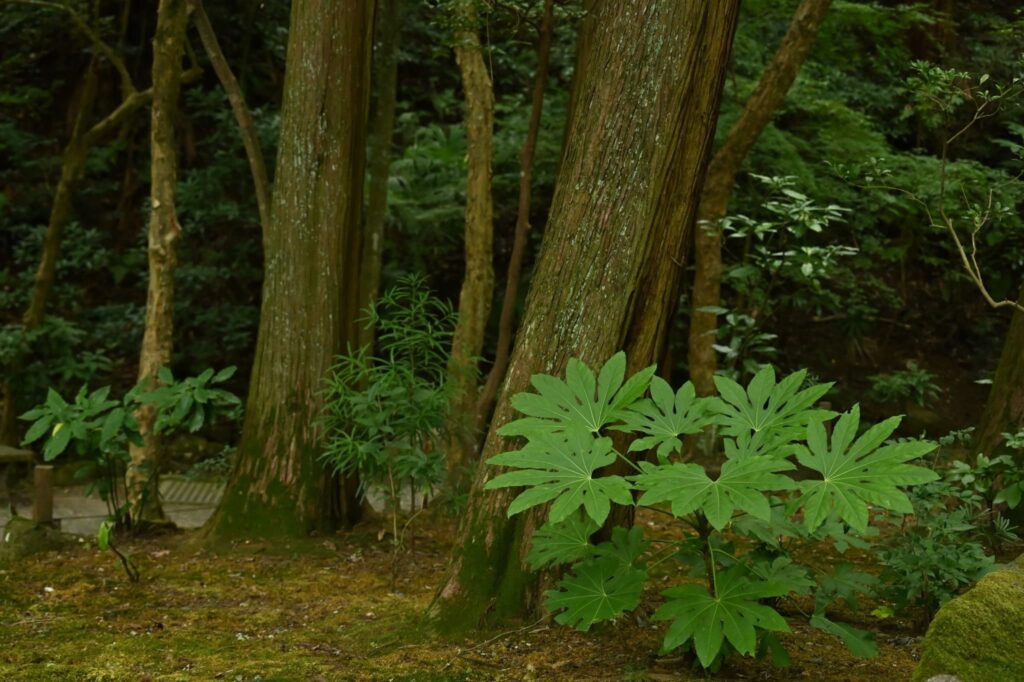
Japanese Aralia is one of Japan’s classic shade-loving shrubs, instantly recognizable by its huge, glossy, hand-shaped leaves. This guide covers its identification, flowers, fruit, cultivation, and traditional uses, based on observations of the plant as grown in Japan.
What Is the Japanese Aralia?
Japanese Aralia is an evergreen shrub in the family Araliaceae (ginseng family), native to the Pacific coast of Honshu south of Fukushima Prefecture, as well as Shikoku, Kyushu, and Okinawa. It is a species endemic to Japan, growing wild in hillside woodlands near the coast. Thanks to its tolerance for shade and air pollution, it has been planted as an ornamental garden shrub since the late Edo period, and it was introduced to Europe in the mid-19th century by Philipp Franz von Siebold, who helped popularize its bold, glossy foliage across Western gardens.
Overview
| Item | Description |
|---|---|
| Scientific Name | Fatsia japonica |
| Common Name | Japanese Aralia / Fatsia / Paper Plant |
| Japanese Name | Yatsude (ヤツデ) |
| Family | Araliaceae |
| Native Range | Pacific coast of Honshu (south of Fukushima), Shikoku, Kyushu, Okinawa |
| Plant Type | Evergreen Shrub |
| Height | Typically 1–3 m, occasionally taller |
| Trunk | Usually single-stemmed, occasionally clump-forming (2–3 stems) |
| Flowering Season | October–December |
| Fruit Type | Small round berry, ripening the following spring (April–May) |
| Sun Exposure | Shade to Partial Shade |
Characteristics
| Feature | Description |
|---|---|
| Leaves | Large, hand-shaped, 20–40 cm across, 7–9 lobes (occasionally 5 or 11–13) |
| Flowers | Small white, ball-shaped clusters, October–December |
| Fruit | Round berry, green → purplish brown → black, ripens April–May |
| Stem | Single or clump-forming, green when young, pale gray from year two |
Foliage
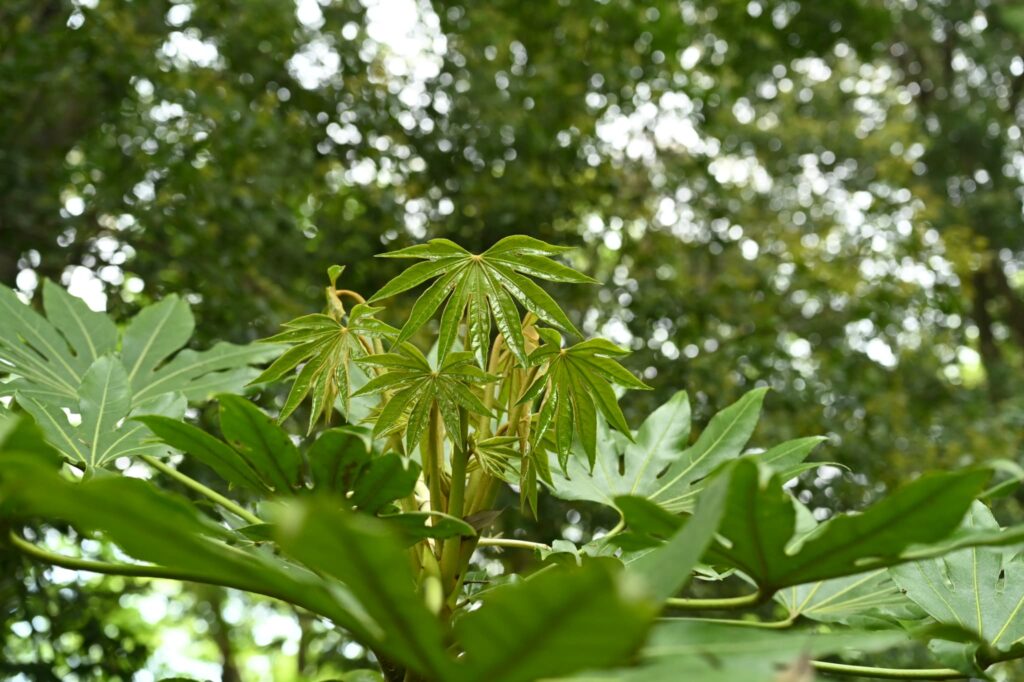
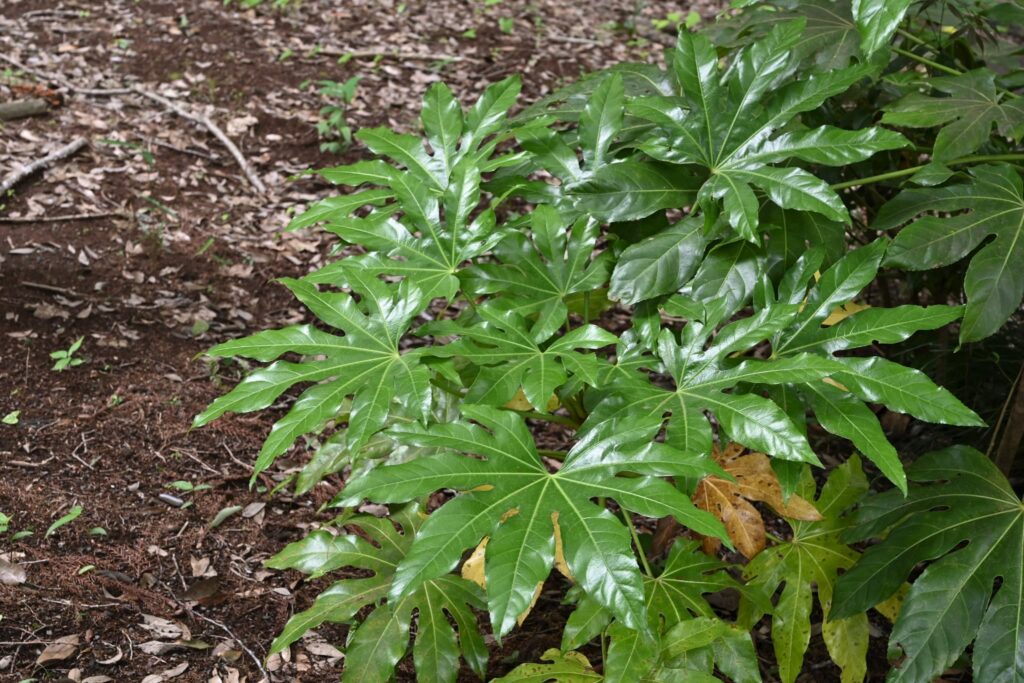
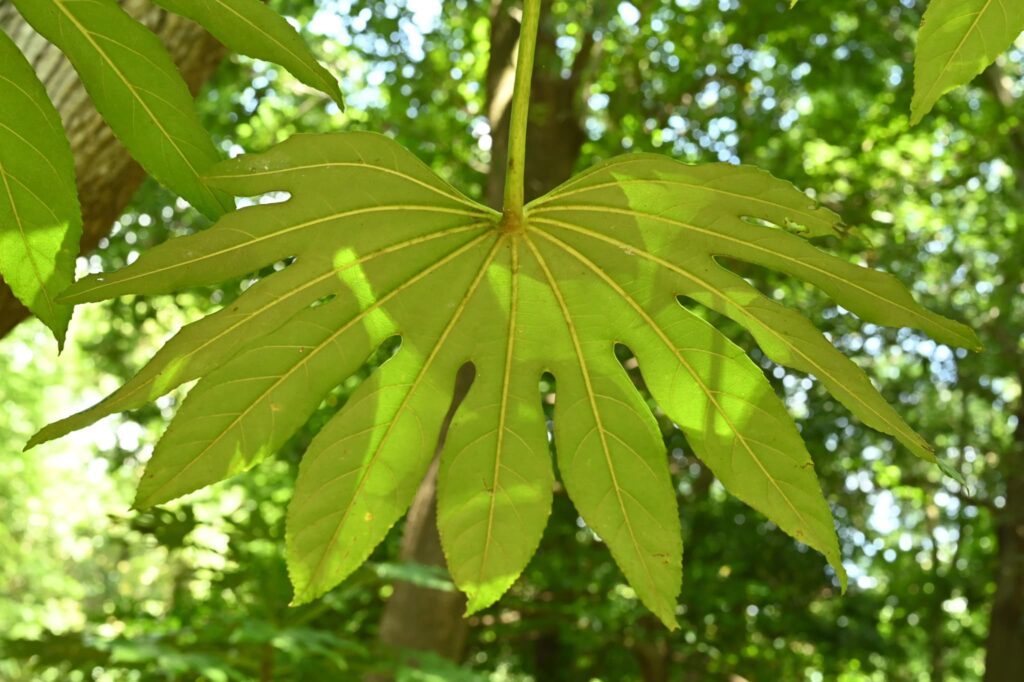
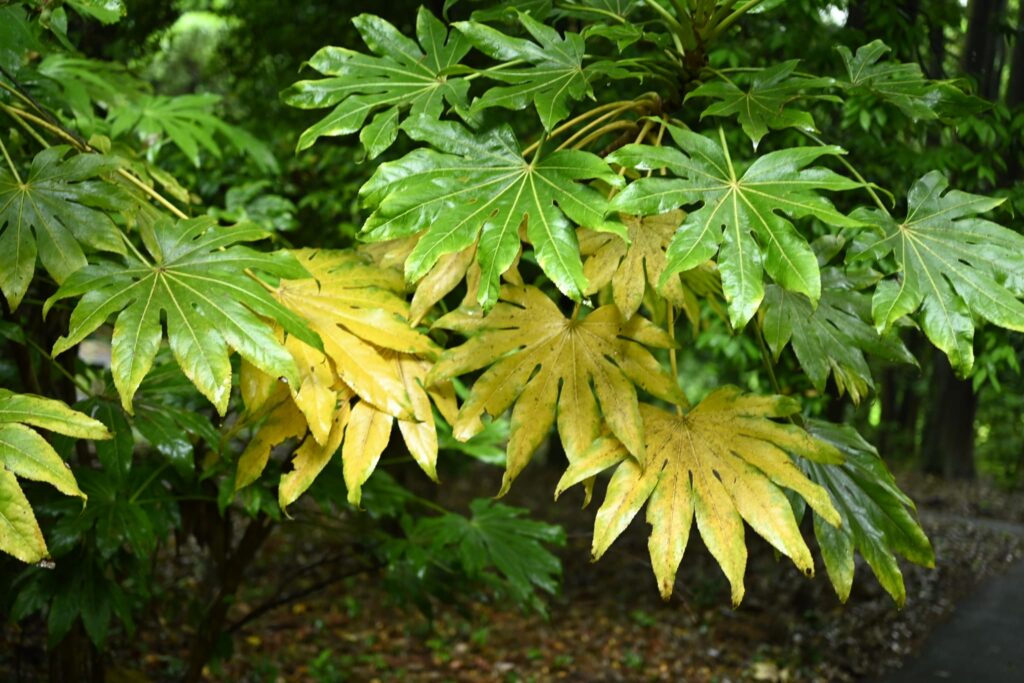
Japanese Aralia leaves are large, 20–40 cm across, carried on long stalks 15–45 cm in length—a scale that has earned the plant the nickname “tengu’s fan” (a reference to the giant fan carried by the long-nosed goblin of Japanese folklore). Young plants produce leaves with fewer lobes, sometimes divided into only three sections, giving rise to another nickname, “demon’s fingers.”
Despite the name yatsude, meaning “eight hands” or “eight-fingered,” the leaves are usually divided into seven or nine lobes rather than eight, occasionally as few as five, and under especially good growing conditions as many as eleven or thirteen. The lobe count is always an odd number. It is evergreen, but in cold weather the leaves turn yellow and fall.
Flowers
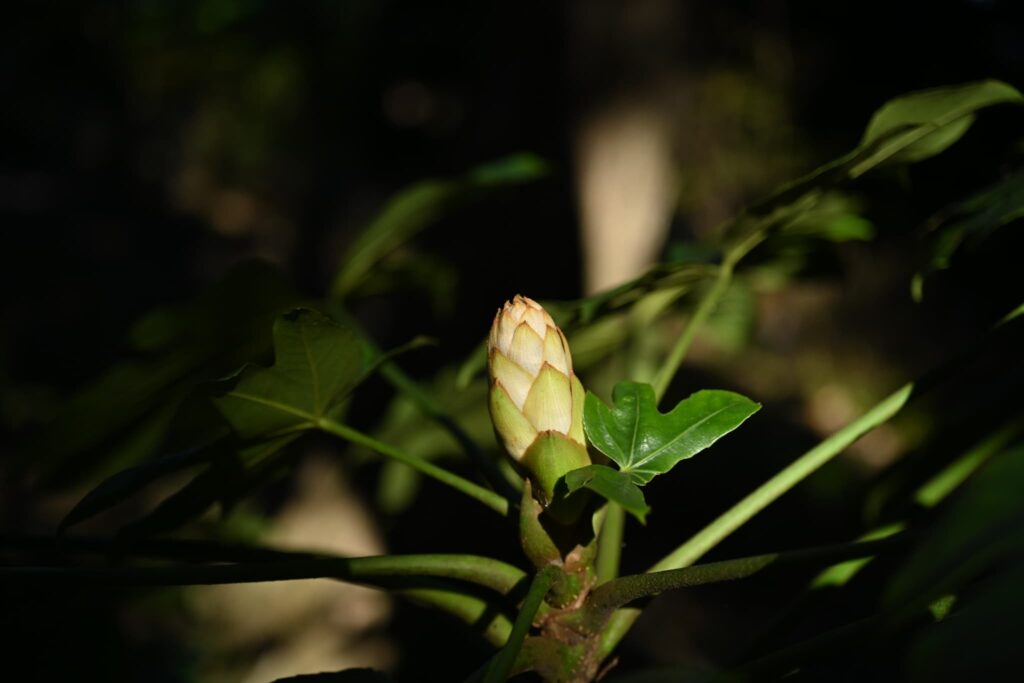
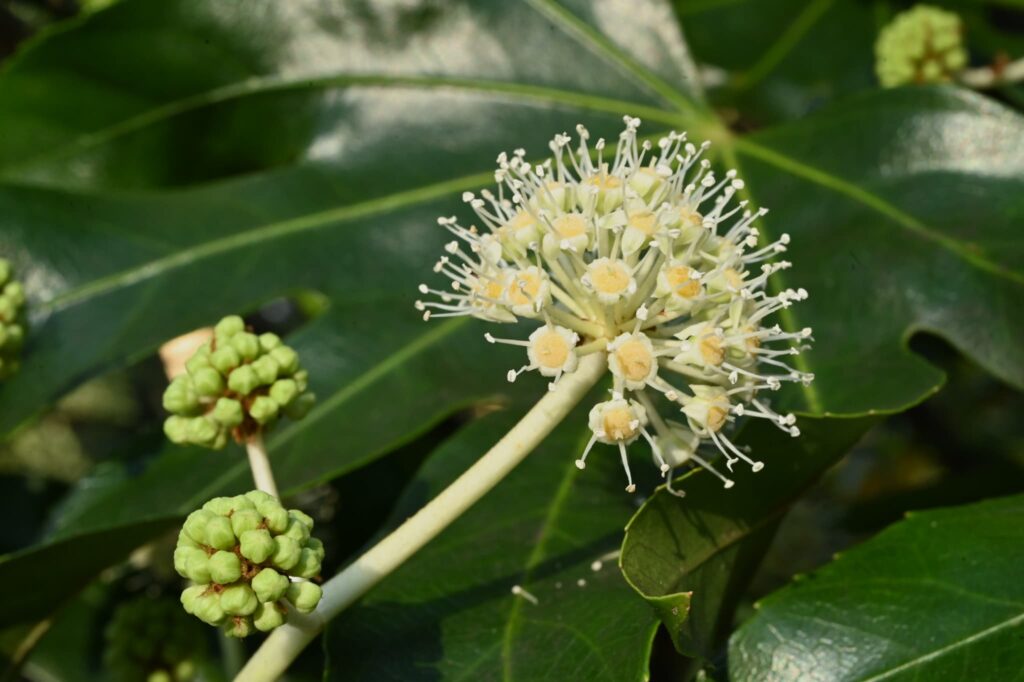
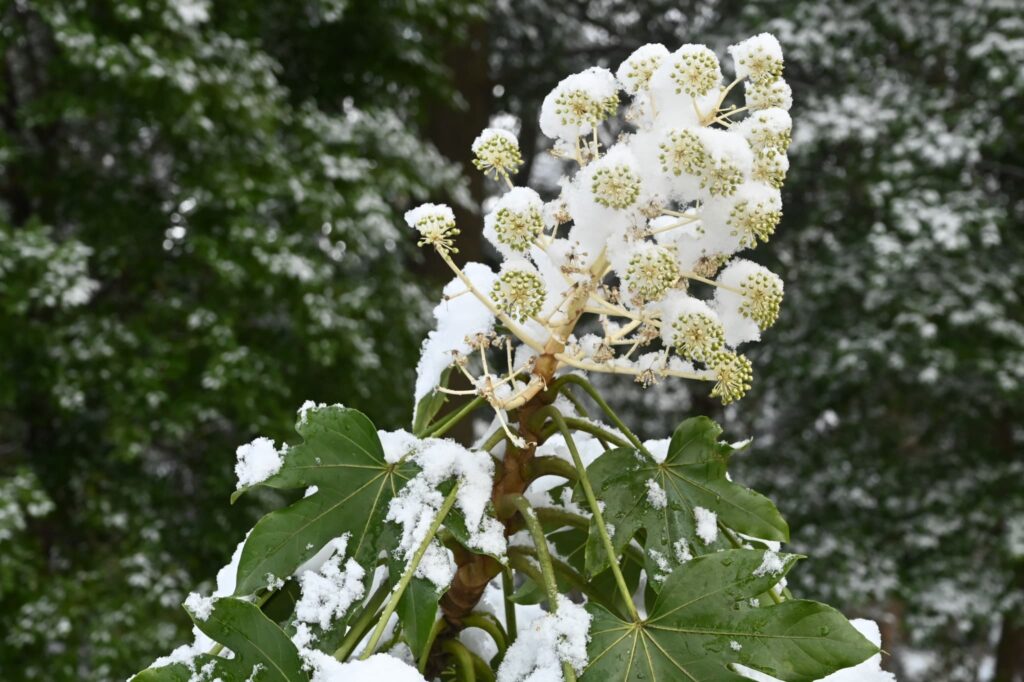
Japanese Aralia flowers from October through December. Small white flowers, each about 5 mm across, gather in ball-shaped clusters of around 25 blooms atop flower stalks rising from the branch tips. Each flower has five white petals and gives off a fragrance reminiscent of spring blossoms. Though modest in appearance, the flowers appear at a time of year when little else is in bloom, and their generous nectar draws large numbers of blowflies, hoverflies, and other insects preparing to overwinter.
Japanese Aralia has a complex flowering system in which flowers function first as male and later as female.
Fruits
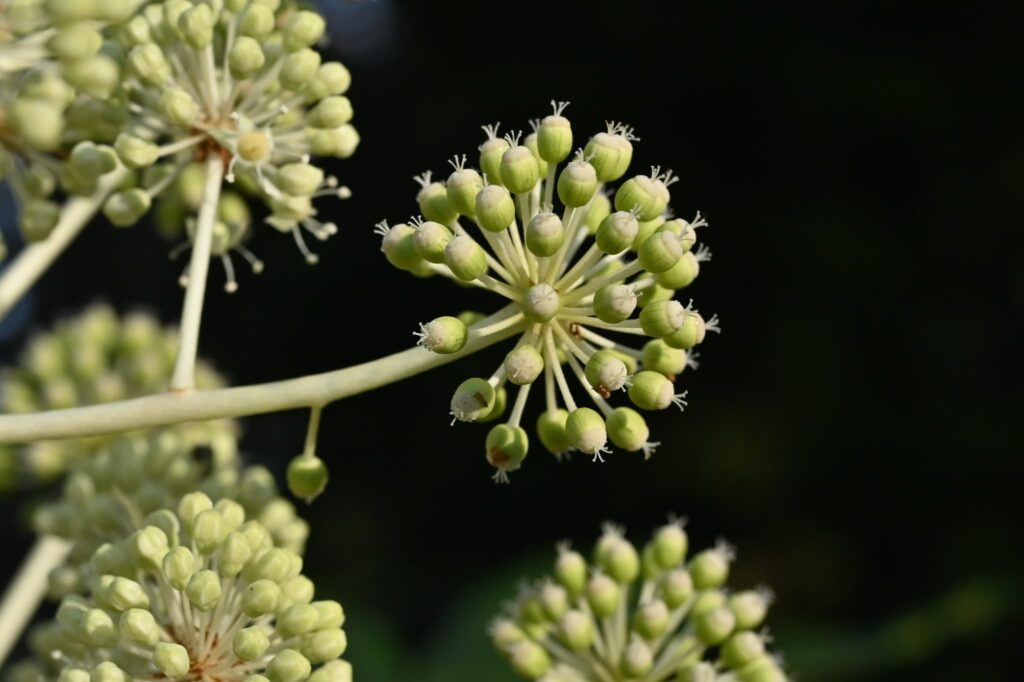
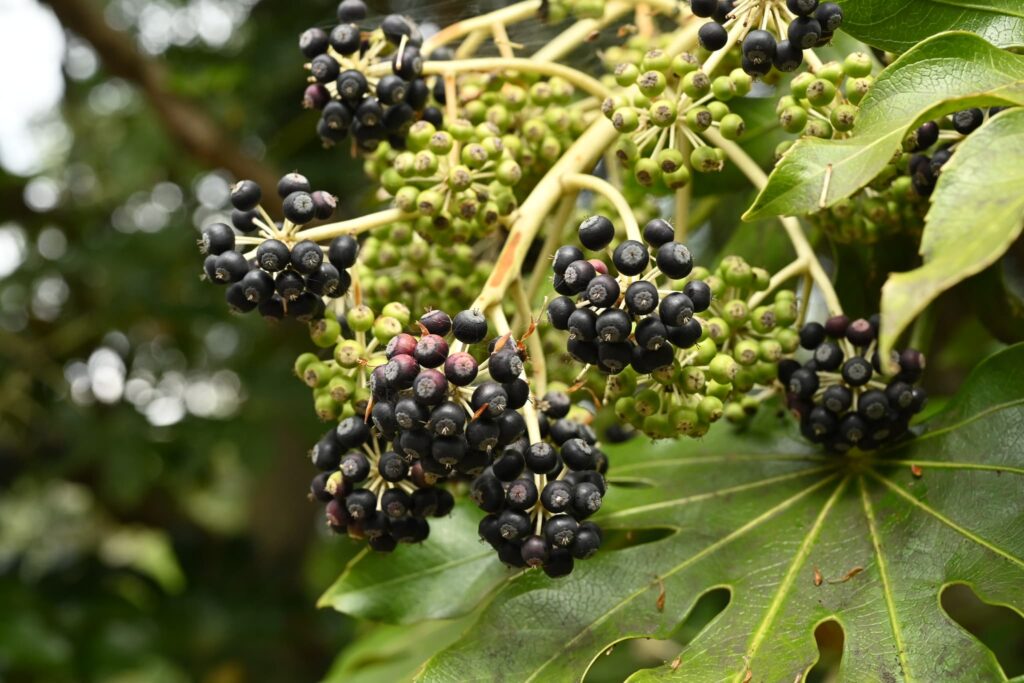
The fruit that follows is a small round berry about 5 mm in diameter, changing color from green to purplish brown and finally to black as it ripens the following spring (April–May). Each berry contains five seeds, which germinate readily when sown, making the plant easy to propagate from seed.
Stem & Bark
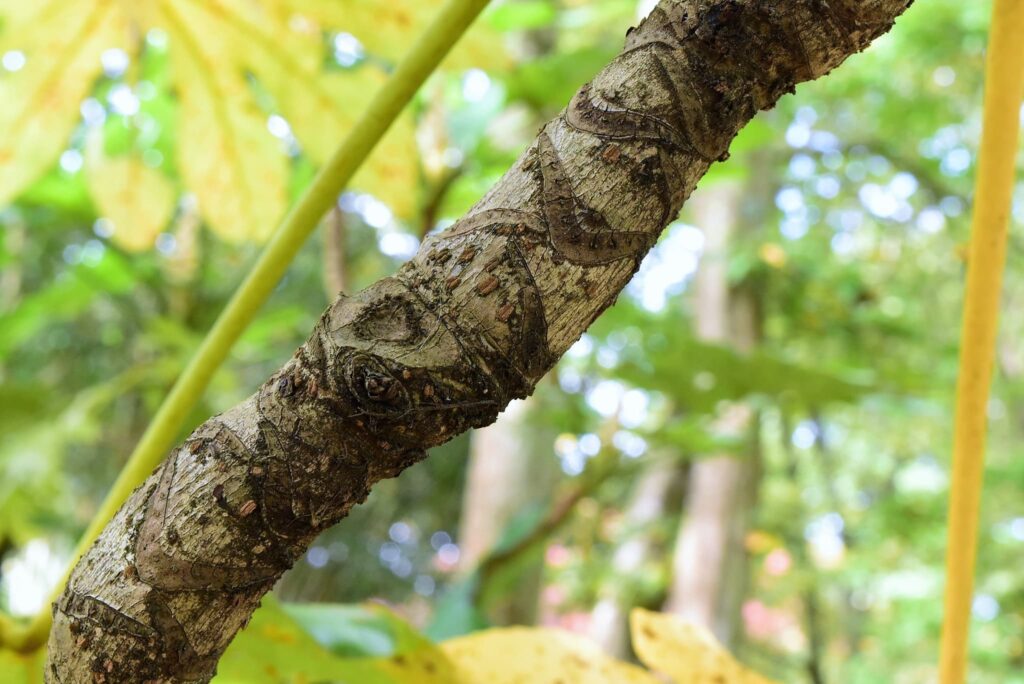
Japanese Aralia typically grows as a single stem with relatively little branching, though it occasionally produces two or three stems in a clump (“kabudachi”)—specimens with more stems fetch a higher price in cultivation. Young stems are green, turning pale gray from the second year onward, with crescent-shaped scars left behind on the upper stem where old leaves have dropped. The interior of the stem contains a thick, white pith that extends into the leaf stalks as well.
Size & Growth
Japanese Aralia generally reaches a height of a few meters, growing as a single stem with limited branching unless it forms a multi-stemmed clump. Growth is steady rather than fast, and the plant’s mature shape is shaped largely by how much light and space it receives in shaded garden corners.
Uses & Cultural Significance
Because its leaves resemble an open palm beckoning customers inside, Japanese Aralia is traditionally planted at the entrances of restaurants and homes for good luck, and many specimens thrive vigorously even amid the crowded conditions of city streets. Its dense evergreen foliage also made it useful as a traditional screening shrub around homes and gardens. Folk belief also holds that hanging its leaves at a gateway wards off evil.
Name Origin
The name Yatsude (“eight hands” or “eight-fingered”) is something of a mismatch with the plant itself, since its leaves are almost always divided into an odd number of lobes—seven or nine most commonly. The name is thought to be either an auspicious reference to the leaf’s ever-widening, fan-like (“suehirogari”) shape, or simply an old way of saying “many-lobed” rather than a literal count. The genus name Fatsia is thought to derive from a corruption of the Japanese word hachishu (“eight hands”), and the plant’s Chinese name, 八角金盤, translates to roughly “eight-cornered golden plate.”
Traditional Medicine
Japanese Aralia has a history of use in Japanese folk practices, although it is not regarded as an edible plant. Its leaves contain saponin compounds, and historical sources including the Edo-period herbal text Yamato Honzō warned of harmful effects from ingestion. Consuming the leaves or concentrated preparations made from them may cause symptoms such as vomiting, diarrhea, and abdominal discomfort.
Dried leaves were also traditionally added to bathwater as a folk remedy for conditions such as rheumatism. However, these traditional uses should not be taken as evidence of proven medicinal effectiveness, and Japanese Aralia should not be eaten or used as a home remedy without reliable medical guidance.
Growing Guide
| Condition | Guidance |
|---|---|
| Light | Shade to partial shade; tolerates 1–2 hours of morning sun |
| Soil | Not particular, prefers slightly moist soil |
| Cold Hardiness | Somewhat cold-sensitive; difficult in northern Tohoku |
| Pruning | Limited resprouting ability; avoid hard pruning in cold regions |
| Pests | Generally resistant; occasional longhorn beetle larvae |
Light & Soil
Japanese Aralia is not particular about soil type but prefers a slightly moist, partly shaded site, and is intolerant of strong direct sun or cold north winds.
Wind & Snow Tolerance
Japanese Aralia tolerates salt spray reasonably well, making it a workable choice for coastal plantings, though it dislikes cold, drying north winds.
Cold Hardiness
The plant is somewhat cold-sensitive, making it difficult to grow in the northern Tohoku region.
Pruning
Japanese Aralia’s ability to resprout from cut wood is generally limited, and this depends heavily on growing conditions—in cold regions, hard pruning can badly disfigure the plant’s shape or even kill it back. That said, as long as the root system survives, new stems will typically emerge from the base, and the plant can also be propagated by cuttings or by division.
Suitability for Home Gardens
Along with Japanese Aucuba (Aucuba japonica) and Dendropanax trifidus, Japanese Aralia is one of the classic shade-tolerant garden shrubs in Japan, and it can even be grown indoors if given one to two hours of morning sun. Its long tradition as an entryway planting also makes it a natural fit for cramped, shaded spots near a front door.
Pests
Japanese Aralia is generally resistant to pests and disease, aside from occasional longhorn beetle larvae at the base of the stem. However, because it flowers at a time of year when little else is blooming, its flowers attract large numbers of insects—so it may not be the best choice for anyone bothered by flies and hoverflies congregating nearby.
Cultivars
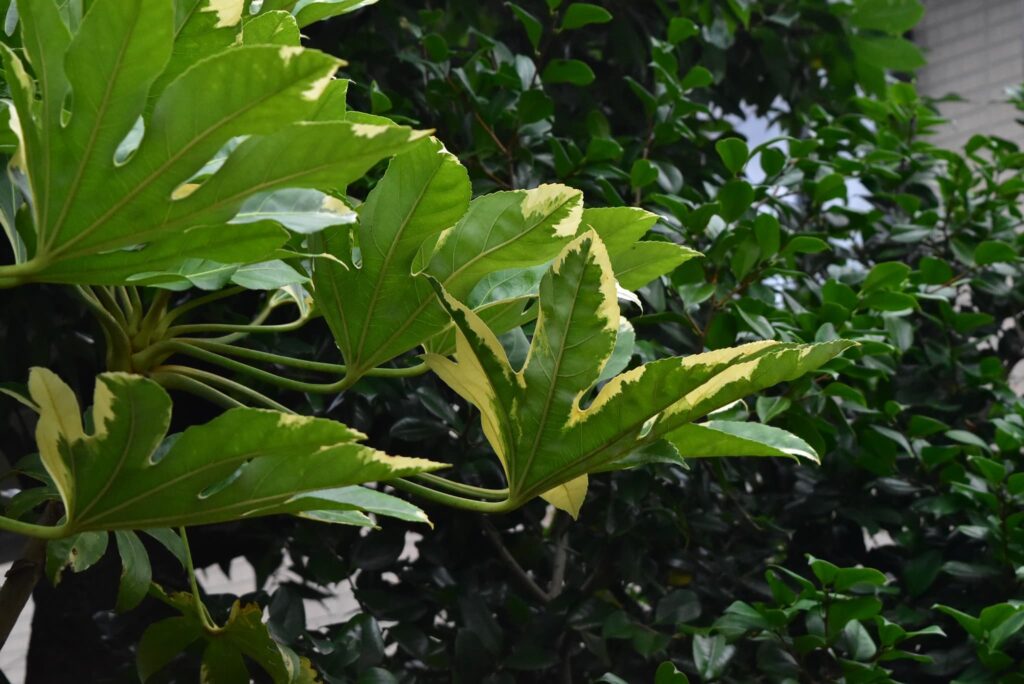
Because Japanese Aralia is so strongly associated with shade, it can carry a somewhat gloomy image in the garden. For this reason, variegated cultivars with white or yellow markings are popular, including forms sold under Japanese names such as Shirobuchi Yatsude, Shirofu Yatsude, Fukurin Yatsude, Kimon Yatsude, and Kiamigata Yatsude, as well as trade names like “Tsumugi Shibori” and “Spider’s Web.”
Similar Species
- Fatsia oligocarpella (Munin Yatsude / Habira) — an evergreen small tree in its own genus, endemic to the Ogasawara (Bonin) Islands. It branches more freely and grows taller than common Japanese Aralia, and tolerates salt spray even better. A variant known as Ryukyu Yatsude occurs from Ōshima southward.
- Taiwan Aralia — a form found in Taiwan, distinguished by having 8–10 styles per flower (compared to 4–6 in the Japanese species).
- Tetrapanax papyrifer (Kamiyatsude / Tsūdatsuboku) — an evergreen shrub native to southern mainland China and Taiwan, with leaves reaching about 70 cm across—considerably larger than Japanese Aralia’s—and white-downy young shoots and leaf undersides. Its thick, white pith is used to make “tsūsōshi” (rice paper).
- Castor Bean (Ricinus communis) — a tropical plant with large, palm-shaped leaves that resemble Japanese Aralia, but with poisonous ricin-containing seeds and a much faster growth rate.
- Kalopanax septemlobus (Harigiri) — a deciduous tree with similarly large palm-shaped leaves, but armed with stout prickles on the trunk and branches.
- Hedera rhombea (Kizuta) — a vine that produces flowers and fruit closely resembling those of Japanese Aralia.
- × Fatshedera lizei — a hybrid between Japanese Aralia and English ivy (Hedera helix), semi-vining in habit with leaves shallowly divided into three to five lobes; variegated forms are especially common in the trade.
- Eleutherococcus sciadophylloides (Yamaukogi) — a deciduous relative of Japanese Aralia in the same family, producing similar flowers and fruit; its young shoots are edible.
Frequently Asked Questions
Why is Japanese Aralia often planted by doorways and restaurant entrances?
Its broad, hand-shaped leaves are traditionally seen as resembling an open palm beckoning customers or visitors inside, making it a popular good-luck planting near entrances. It also tolerates shade and cramped urban conditions, making it practical for planting beside homes, shops, and restaurant doorways.
Is Japanese Aralia poisonous?
Japanese Aralia is not an edible plant and should not be eaten. Its leaves contain saponin compounds, and ingesting the leaves or concentrated preparations made from them may cause symptoms such as vomiting, diarrhea, and abdominal discomfort. Historical sources also warned against consuming the plant.
Why doesn’t Yatsude (“eight hands”) actually have eight-lobed leaves?
Despite its name, Japanese Aralia leaves are usually divided into seven or nine lobes rather than eight. They may occasionally have as few as five or as many as eleven or thirteen lobes, but the number is typically odd. The name is thought to refer either to the leaf’s broad, spreading shape or to an older expression meaning “many-lobed,” rather than to a literal count.
Can Japanese Aralia grow indoors or in deep shade?
Yes. Japanese Aralia is highly tolerant of shade and can grow in deeply shaded gardens where many shrubs struggle. It can also be grown indoors in a bright location, ideally with some gentle morning light. Avoid prolonged exposure to strong direct sun.
Why does Japanese Aralia attract so many flies and hoverflies?
Japanese Aralia flowers from autumn into early winter, when relatively few other plants are in bloom. Its nectar-rich flowers can therefore attract large numbers of flies, hoverflies, and other insects. This is useful for insects late in the season but may be undesirable if the plant is growing directly beside a doorway or patio.
Can Japanese Aralia be pruned hard if it becomes too large?
Not always. Japanese Aralia has a limited ability to resprout from old wood, particularly in cold climates. Hard pruning may leave the plant misshapen or cause the upper stem to die back. If severe pruning is necessary, it is generally safer to cut back gradually or allow new shoots to develop from the base.
Why are Japanese Aralia leaves so large?
Japanese Aralia naturally grows in shaded woodland environments, where large leaves help capture limited available light. Its long leaf stalks also help spread the leaves apart, reducing overlap and allowing more of the foliage to receive light.
Conclusion
Japanese Aralia’s outsized, hand-shaped leaves and quiet tolerance for shade have made it a dependable presence in Japanese gardens for well over a century, valued as much for practical screening and good-luck symbolism as for its late-autumn flowers, which offer a rare source of nectar just as the rest of the garden winds down for winter. From its introduction to Europe by Siebold to its enduring role by doorways and in shaded corners across Japan, Japanese Aralia remains a quietly useful, distinctively shaped plant with a character all its own. Its bold foliage, remarkable shade tolerance, and unique seasonal interest make it one of the finest evergreen shrubs for Japanese-style gardens around the world.