Asunaro / Hiba (Thujopsis dolabrata): Identification, Care & Uses
Asunaro, widely known as Hiba in the timber trade, is one of Japan’s most prized native conifers — valued for rot-resistant timber, a Hinoki-like fragrance, and a name built around a well-loved lesson in patience. This guide covers identification features, flowers, cones, bark, cultivars, and care, based on observations of the plant as grown in Japan.
What Is the Asunaro Tree?
Asunaro is an evergreen conifer in the family Cupressaceae, endemic to Japan, distributed from the Oshima Peninsula in Hokkaido to the Osumi Peninsula in Kyushu. It favors moist, fertile soil in deep mountain forests, and is especially well known in Aomori and Ishikawa Prefectures — Aomori has designated it the prefecture’s official tree.
Overview
| Item | Description |
|---|---|
| Scientific Name | Thujopsis dolabrata |
| Common Name | Asunaro / Hiba / Hiba Arborvitae |
| Japanese Name | Asunaro (アスナロ) |
| Family | Cupressaceae |
| Native Range | Japan (endemic); Hokkaido (Oshima Peninsula) to Kyushu (Osumi Peninsula) |
| Plant Type | Evergreen Coniferous Tree |
| Height | 20–30 m (65–100 ft) |
| Trunk | Straight, up to 1 m in diameter |
| Flowering Season | April–May |
| Fruit Type | Cone, oval, 1–1.5 cm, ripening October–November |
| USDA Zones | 5–7 |
| Sun Exposure | Partial Shade to Full Sun |
Characteristics
| Feature | Description |
|---|---|
| Foliage | Scale-like, 5–7 mm, blunt-tipped, larger and thicker than Hinoki‘s |
| Flowers | Inconspicuous; monoecious, April–May |
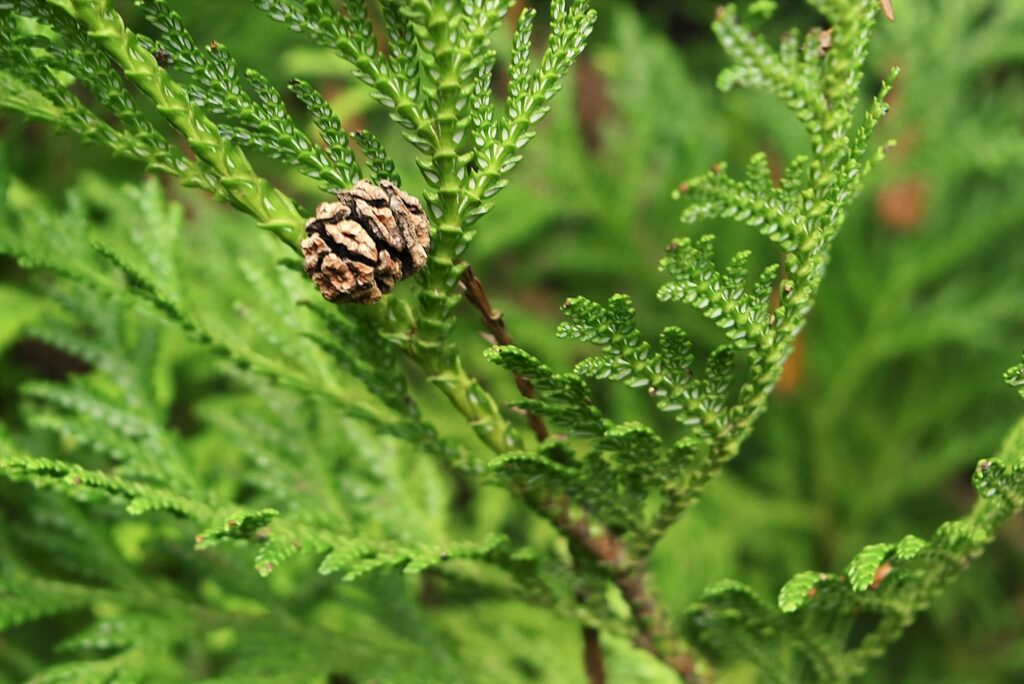
| Cones | Oval, 1–1.5 cm, with small horn-like projections |
| Bark & Timber | Reddish-brown, peeling in vertical strips; fragrant, rot-resistant wood |
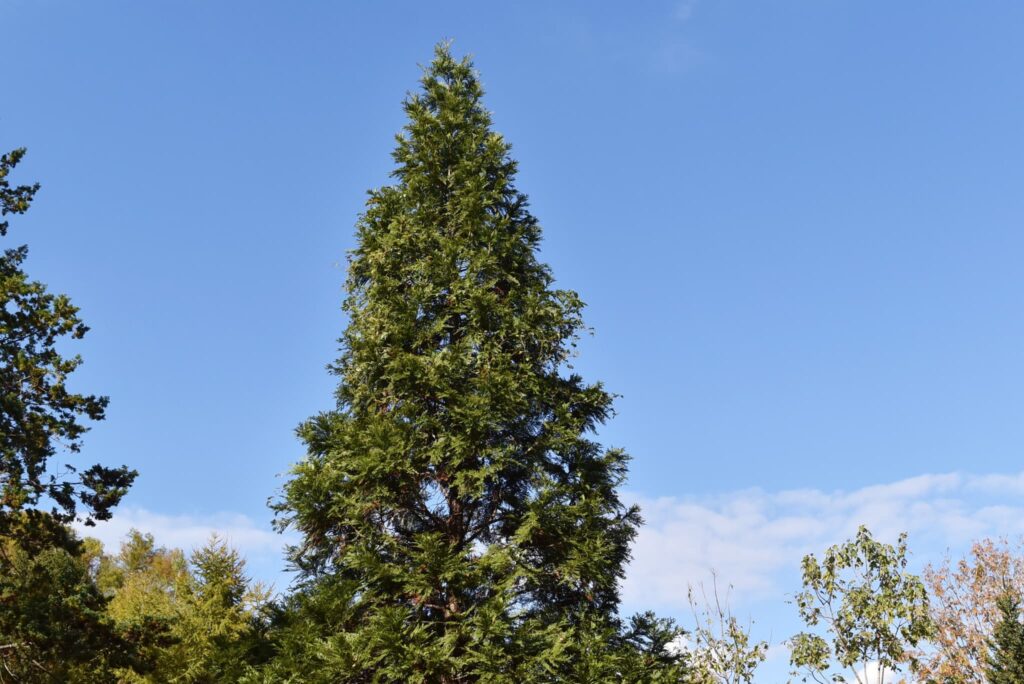
| Size & Growth | Slow-growing when young; naturally conical, tiered form |
Foliage
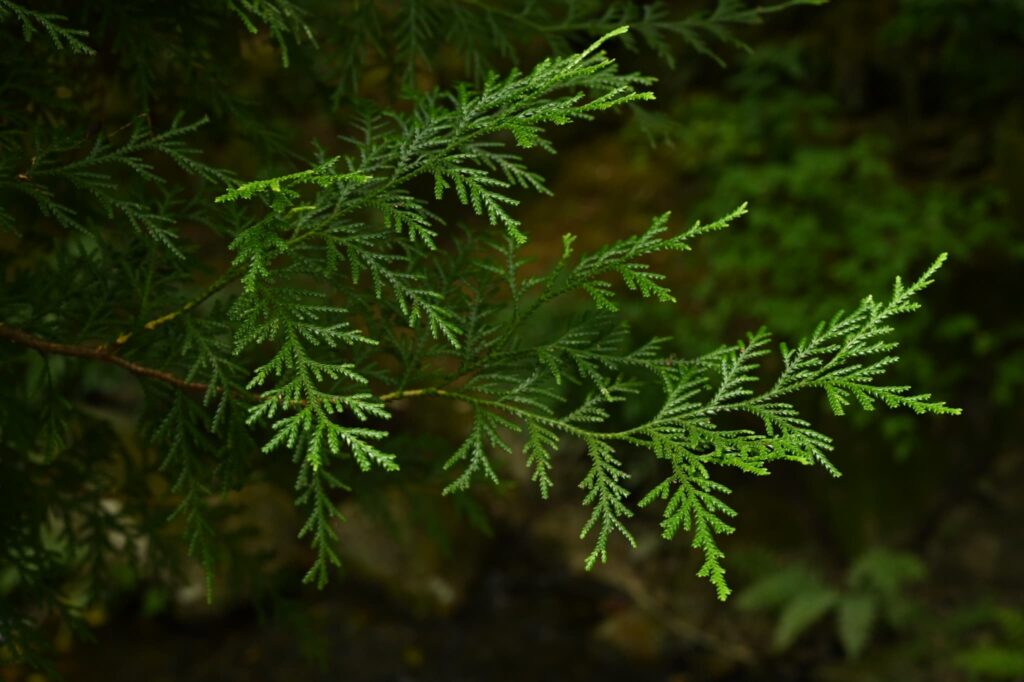
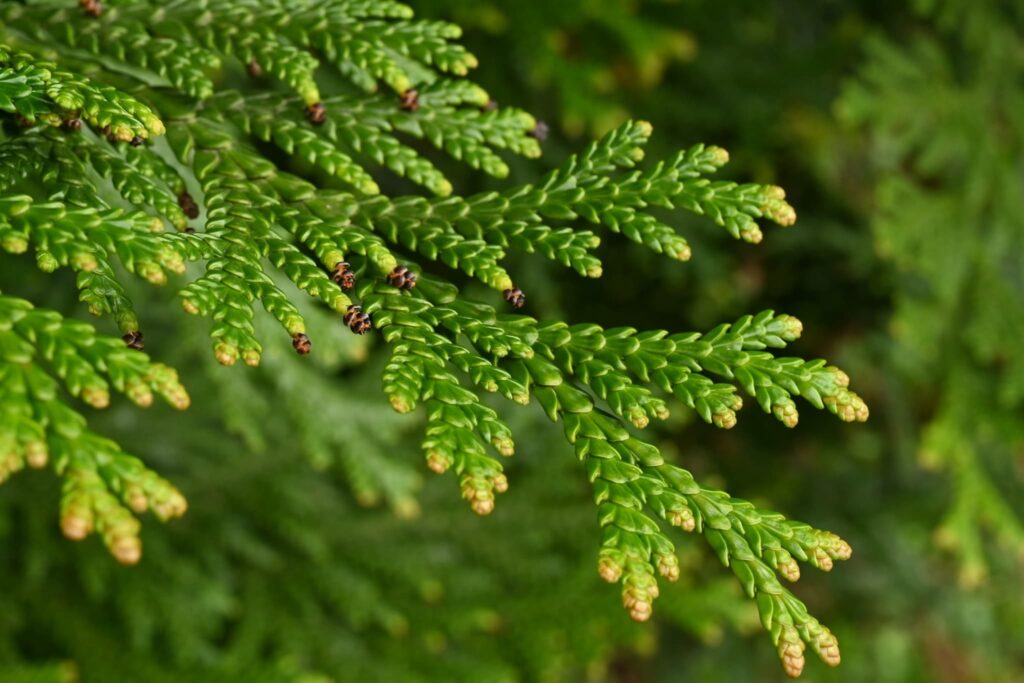
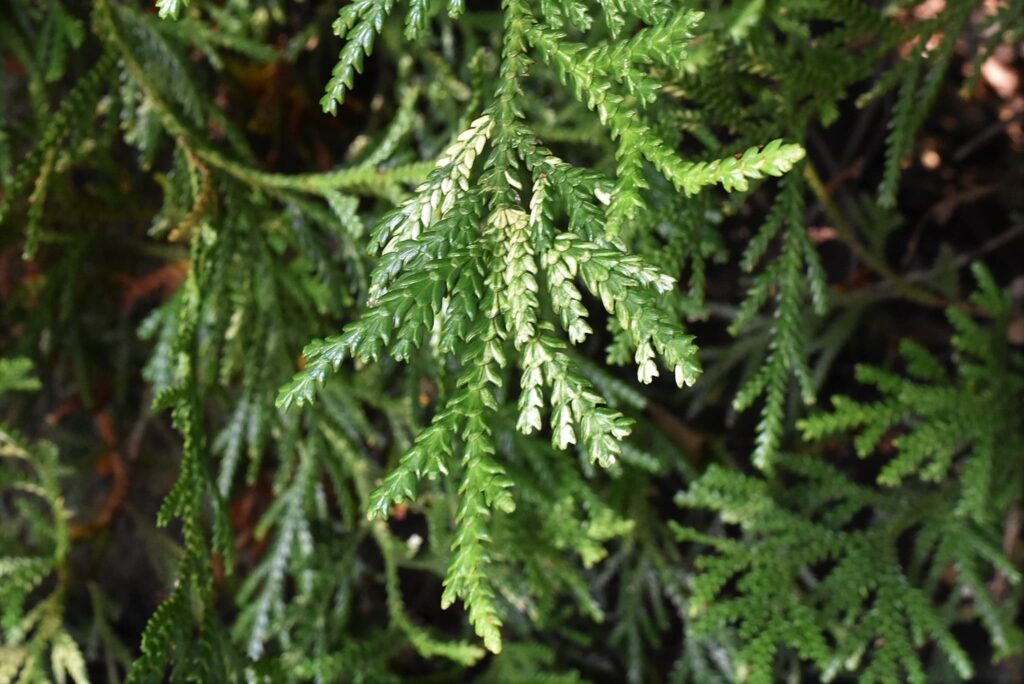
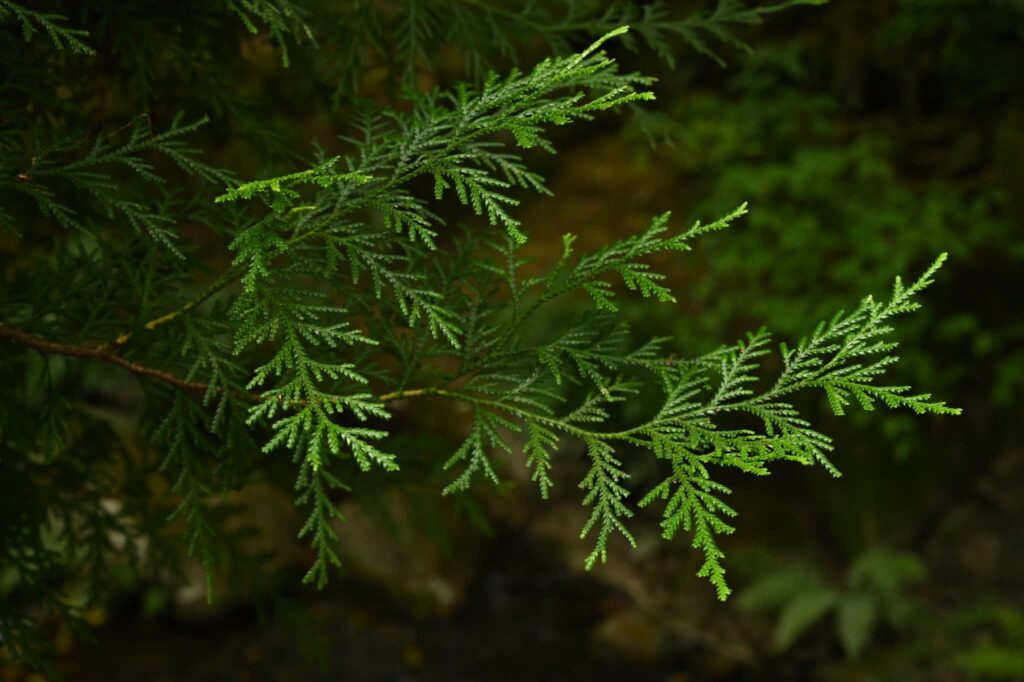
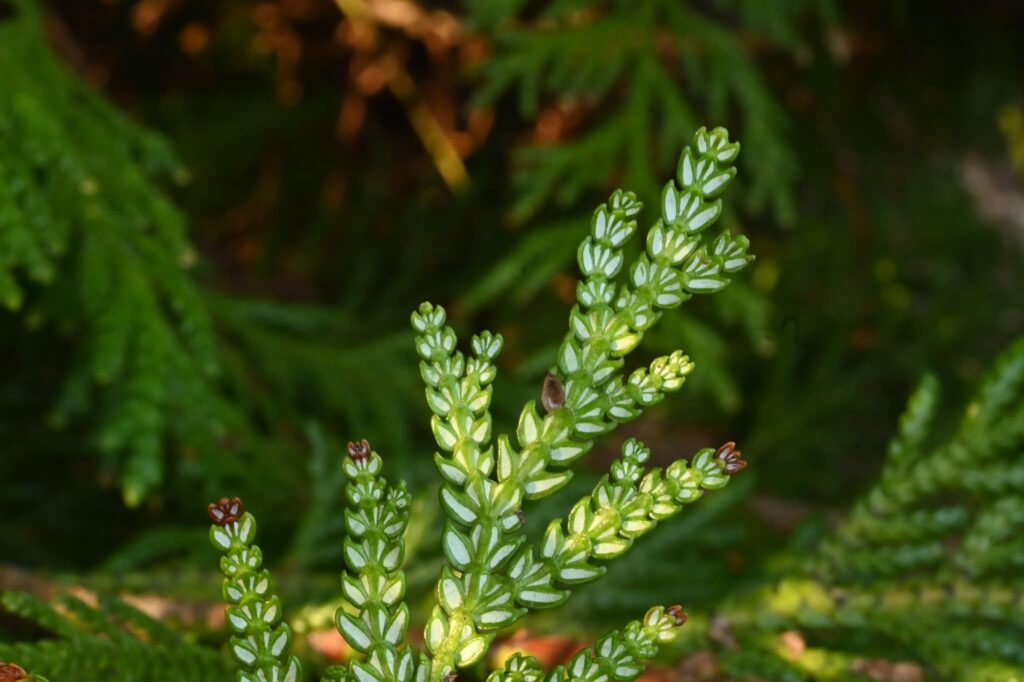
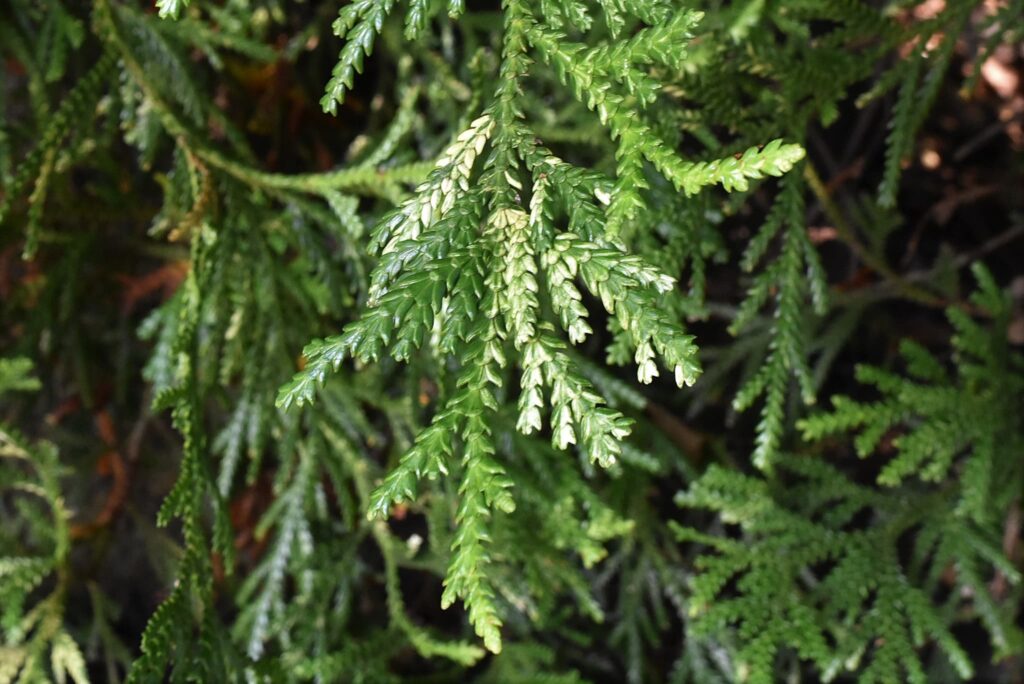
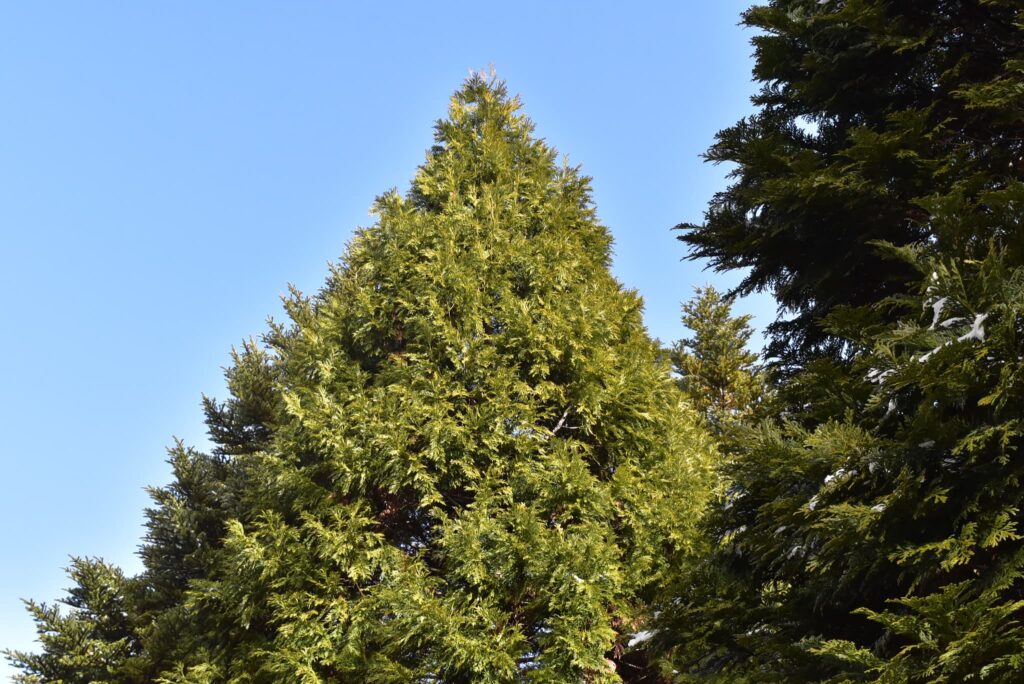
Asunaro’s leaves are scale-like rather than true needles, resembling those of Hinoki Cypress closely enough that the tree is sometimes called Hiba (桧葉, literally “Hinoki leaf”). Each leaf segment measures 5–7 mm — noticeably larger and thicker than Hinoki’s, with blunt rather than pointed tips. Among Japan’s scale-leaved conifers, Asunaro has the largest leaves of all, and individual leaves are notably long-lived, persisting for many years before shedding.
The white markings on the underside of the leaves (stomatal bands) are another distinguishing feature, making Asunaro relatively easy to tell apart from similar Hiba-type conifers. Numerous branches spread horizontally in layered tiers, giving the tree its overall pyramidal form.
Flowers
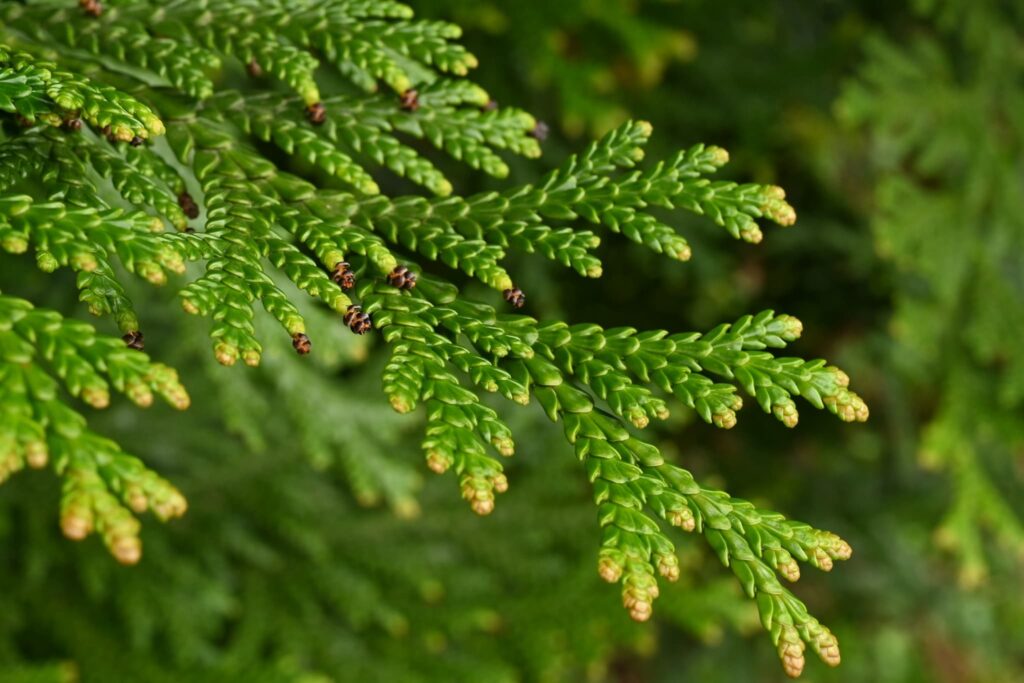
Asunaro is monoecious, producing inconspicuous flowers from April to May, much like Hinoki Cypress. Male flowers are slender and oval-shaped, while female flowers resemble small pinecones covered in thick scales.
Cones
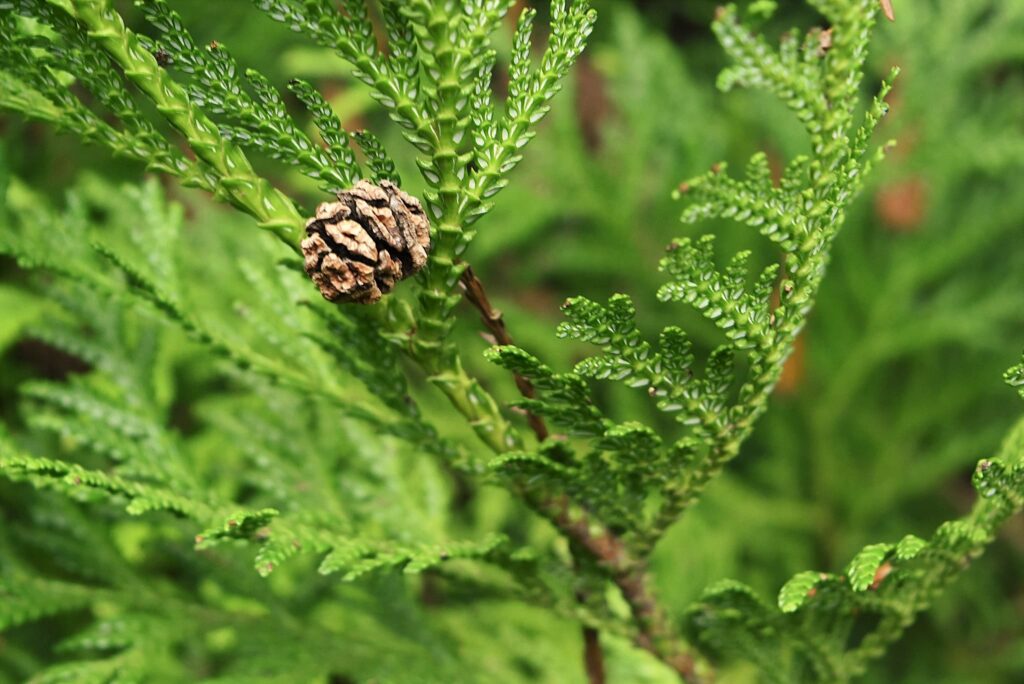
Cones are oval, measuring 1–1.5 cm in diameter — distinctly different from the nearly perfectly round cones of Hinoki Cypress. Asunaro cones feature small, horn-like projections on their scales and ripen around October to November.
Bark & Timber
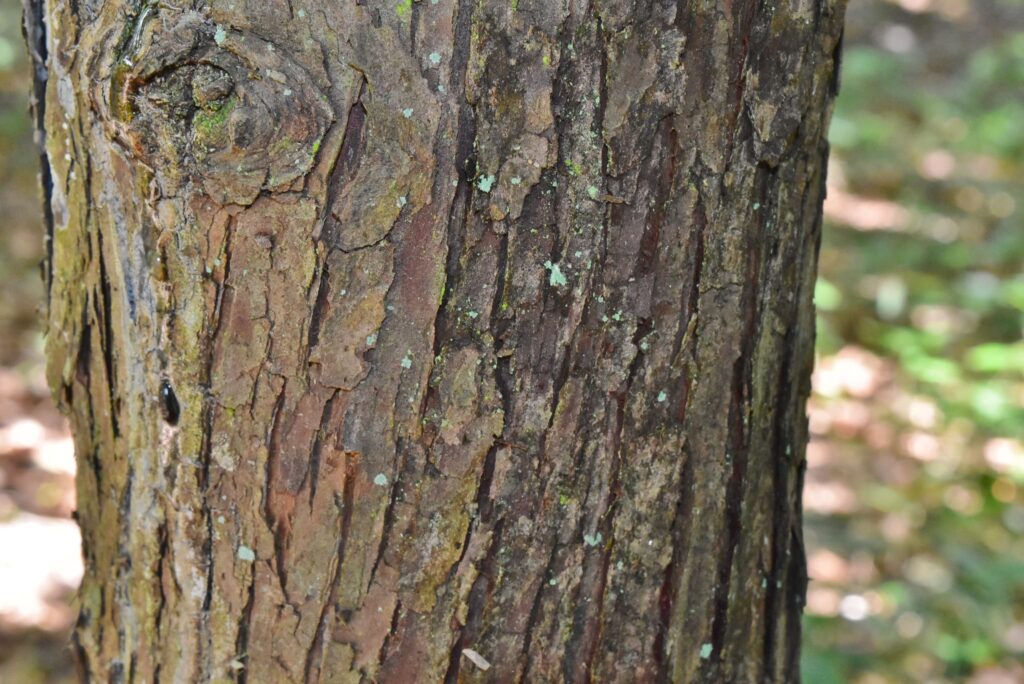
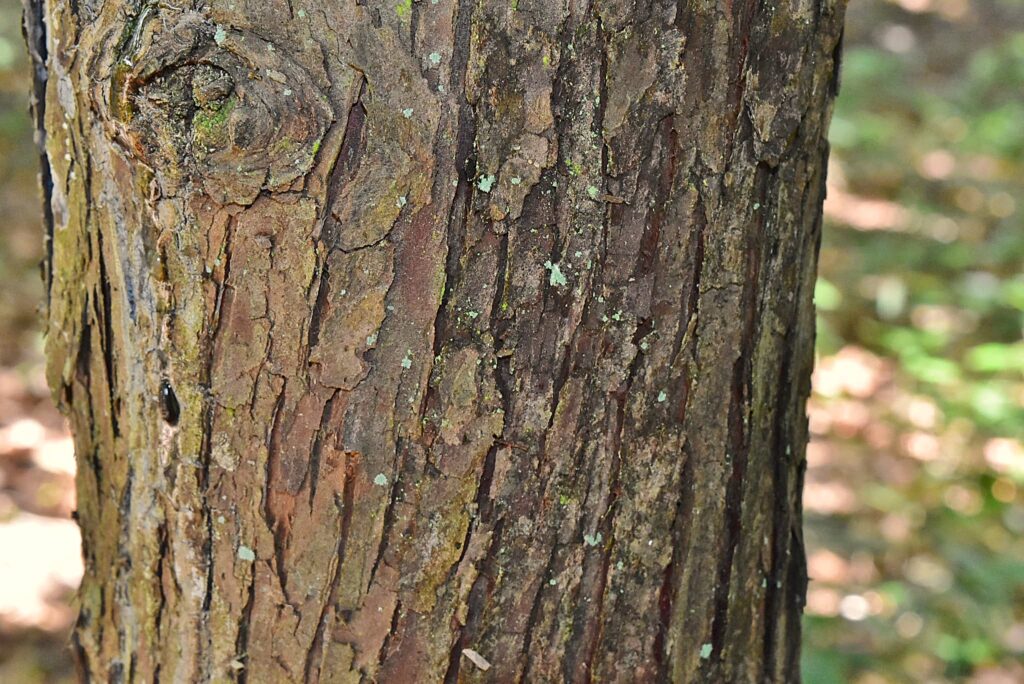
The trunk grows straight and can reach up to 1 m in diameter. The bark is reddish-brown to grayish-brown — similar to Hinoki Cypress but paler in color. With age, it splits and peels away in vertical strips, narrower than the strips seen on Hinoki. The bark has traditionally been used for roof thatching, and the timber itself carries a fragrance closely resembling Hinoki’s.
Size & Growth
Asunaro grows slowly, especially when young, and can reach 20–30 m at full maturity in favorable forest conditions. Its naturally conical form, built from horizontally tiered branches, generally holds its shape well without much intervention.
Uses & Cultural Significance
One of the “Five Precious Trees of Kiso”
Despite its name recognition, Asunaro is not commonly planted as an ornamental garden tree — it has historically been valued far more for its timber. During the Edo period, it was strictly protected by the Tokugawa Shogunate as one of the “Five Precious Trees of Kiso” (Kisogo Boku), alongside Hinoki Cypress, Sawara Cypress, Kurobe, and Japanese Umbrella Pine. In the commercial timber trade, the term “hiba” generally refers to both Asunaro and its variety, Hinoki-Asunaro.
Timber & Practical Uses
Asunaro timber is highly valued for its quality, moisture resistance, and natural resistance to termites. It is widely used in construction — particularly for structural foundations — as well as for bathtubs, interior elements such as decorative pillars and lintels, Buddhist statues, furniture, and lacquerware, including the famous Tsugaru-nuri lacquerware of Aomori Prefecture. Its fragrance closely resembles Hinoki’s, and in the Tohoku region, where Hinoki is scarce, Asunaro is often used as a direct substitute — a tradition reflected in the renown of “Aomori Hiba” as a prized timber brand in its own right.
Name Origin: “Tomorrow I’ll Be a Hinoki”
The name Asunaro carries the meaning “a tree with thick leaves like Hinoki” or “a noble tree like Hinoki.” It’s written in Japanese using the characters 明日檜 or 翌檜 — literally, “tomorrow’s Hinoki.”
The most popular interpretation traces the name to the phrase asu wa hinoki ni narou (“tomorrow, I will become a Hinoki”) — a poetic comparison likening the tree, historically valued less than Hinoki as timber, to a person who hasn’t yet succeeded but keeps striving to improve. The phrase is often invoked as a life lesson about perseverance and self-improvement. In reality, however, Asunaro never actually grows into Hinoki Cypress — the two remain entirely distinct species throughout their lives.
Growing Guide
| Factor | At a Glance |
|---|---|
| Light & Soil | Shade-tolerant; moist, fertile soil preferred |
| Wind & Snow Tolerance | Good; tolerates forest and mountain exposure well |
| Cold Hardiness | Cold-hardy; poor tolerance for dry conditions |
| Pruning | Light touch only; responds poorly to hard pruning |
| Suitability for Home Gardens | Limited for standard form; dwarf cultivars better suited |
| Pests | Rare; occasional witches’ broom disease |
Light & Soil
Asunaro is notably shade-tolerant and is known to form pure natural stands on shaded, north-facing slopes. Young trees in particular thrive in the dim understory of dense forests, and the species generally prefers moist, fertile soil over dry or poor ground.
Wind & Snow Tolerance
Growing naturally across a wide range of mountain terrain from Hokkaido to Kyushu, Asunaro tolerates the wind and heavy snowfall typical of Japan’s forested mountains reasonably well, particularly once established.
Cold Hardiness
Asunaro is cold-hardy but does not tolerate dry conditions well. Consistent soil moisture is important for healthy growth, regardless of climate.
Pruning
Branches and foliage grow densely, but young trees grow slowly, reducing the need for frequent pruning. The species also tends to respond poorly to heavy pruning, so a light touch is recommended.
Suitability for Home Gardens
Standard Asunaro is more commonly grown for timber than as an ornamental tree, and its eventual size makes it a poor fit for most residential gardens. Shade-tolerant dwarf cultivars, however — particularly Hime-Asunaro — are well suited to hedges and topiary in smaller garden settings.
Pests
Pest and disease problems are rare, though Asunaro can occasionally be affected by witches’ broom disease, which causes the foliage to develop a tangled, seaweed-like appearance.
Cultivars
- Fuiri Asunaro (Variegated Asunaro) — foliage marked with white variegation.
- Hinoki-Asunaro — a natural variety with slightly smaller leaves and cones than standard Asunaro; its cones are perfectly round rather than horned. Native from southern Hokkaido to central Honshu, its essential oil is extracted from branches and foliage for aromatherapy use.
- Hime-Asunaro — a dwarf cultivar of Hinoki-Asunaro, bred for garden use. Grows in a multi-stemmed, clumping form and is popular for shaded hedges and topiary. A variegated form also exists.

Similar Species
- Hinoki Cypress (Chamaecyparis obtusa) — Japan’s premier timber conifer, closely resembling Asunaro in fragrance and general appearance, but with thinner, pointed leaves and round rather than oval cones. Leaf thickness and the shape of the white stomatal markings on the leaf underside are the most reliable ways to tell the two apart.
- Sawara Cypress (Chamaecyparis pisifera) — one of the “Five Precious Trees of Kiso,” alongside Asunaro.
- Kurobe (Thuja standishii) — another of the “Five Precious Trees of Kiso”; also loosely referred to as “hiba” in some regions.
Frequently Asked Questions
Q: Is Asunaro the same as Hiba?
Not exactly. “Hiba” is a general term sometimes used for Asunaro, its variety Hinoki-Asunaro, or even other conifers like Kurobe, depending on the region. Commercially, “hiba wood” typically refers specifically to Asunaro and Hinoki-Asunaro.
Q: Does Asunaro really turn into Hinoki Cypress?
No. Despite the name’s literal meaning (“tomorrow’s Hinoki”), Asunaro and Hinoki Cypress are entirely distinct species. Asunaro never transforms into Hinoki — the name is symbolic, often used as a metaphor for personal growth and perseverance.
Q: How can I tell Asunaro and Hinoki Cypress apart?
The easiest way is by touch — Asunaro’s leaves are noticeably thicker. For certainty, check the white markings on the underside of the leaves; their shape differs distinctly between the two species.
Q: Is Asunaro a good choice for home gardens?
It can be, particularly shade-tolerant cultivars like Hime-Asunaro, which are well-suited for hedges and topiary in shaded areas. Standard Asunaro, however, is more commonly grown for timber than as an ornamental tree.
Q: Where does Asunaro grow naturally?
It is native to Japan, ranging from the Oshima Peninsula in Hokkaido to the Osumi Peninsula in Kyushu, with particularly notable populations in Aomori and Ishikawa Prefectures.
Q: Is Asunaro wood rot-resistant?
Yes. Asunaro wood is highly resistant to decay, moisture, and termites, making it valuable for construction and outdoor use.
Q: Why is Aomori Hiba famous?
Aomori Hiba is renowned for its durability, pleasant fragrance, and natural antibacterial properties. It has been widely used in traditional architecture and woodworking in northern Japan for centuries.
Q: Is Asunaro shade-tolerant?
Yes. Asunaro is one of the most shade-tolerant Japanese conifers and can grow successfully beneath a forest canopy, even forming pure natural stands on shaded, north-facing slopes.
Conclusion
Asunaro (Thujopsis dolabrata) is one of Japan’s most distinctive native conifers, valued for its durable timber, fragrant wood, and exceptional shade tolerance. Although often overshadowed by the more famous Hinoki Cypress, it has played an important role in Japanese forestry, architecture, and traditional craftsmanship for centuries. From the forests of Aomori to cultivated gardens across the country, Asunaro remains a symbol of resilience, patience, and quiet beauty — qualities reflected in the enduring meaning of its name.