Japanese Larch (Larix kaempferi): Identification, Care & Uses
Introduction
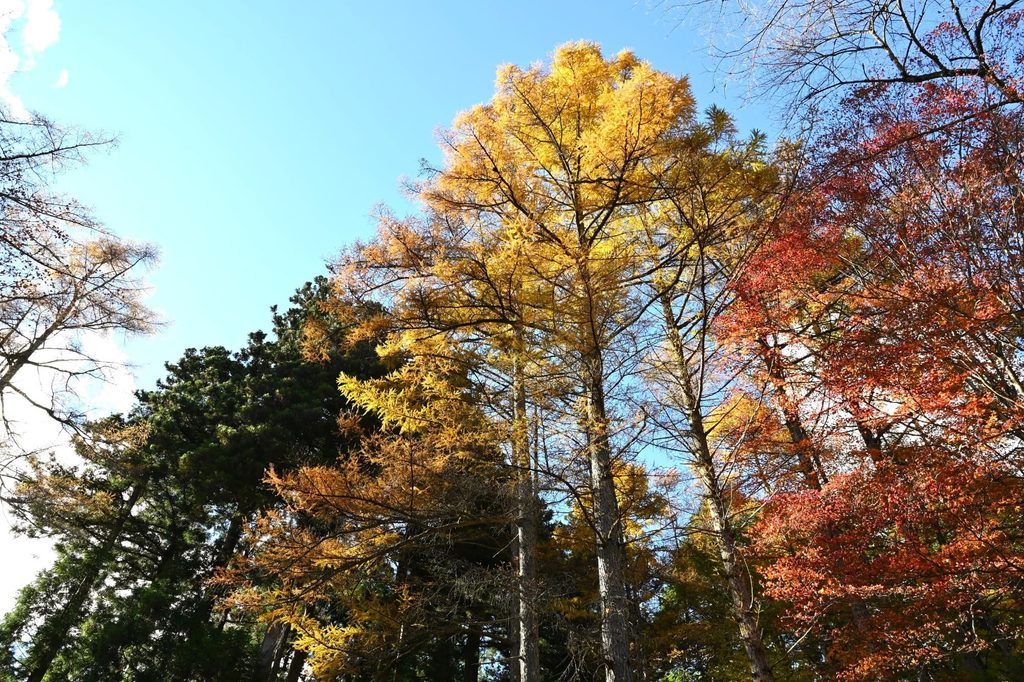
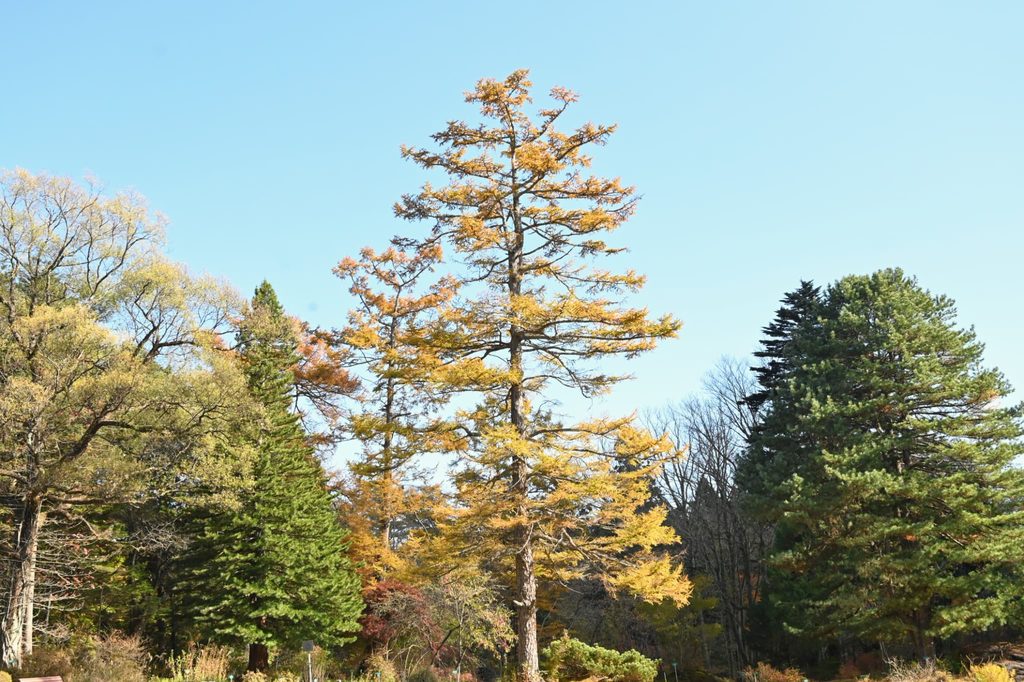
The Japanese larch, known in Japan as karamatsu, is Japan’s only native deciduous conifer in the pine family (Pinaceae). Its soft green needles emerge in spring, turn golden yellow in autumn, and fall before winter. Native to the mountains of central Japan, it is now also widely planted in colder parts of Japan, particularly Hokkaido, because of its rapid early growth and tolerance of cold conditions. This guide explains how to identify the Japanese larch, how it grows, how it is used, and what to consider when growing it as an ornamental tree.
What Is the Japanese Larch?
The Japanese larch is a deciduous conifer in the pine family (Pinaceae). Its native range is in the mountains of central Honshu, where it occurs mainly at higher elevations. It is a fast-growing, light-demanding tree that became an important forestry species because it can grow in cold regions and relatively poor soils.
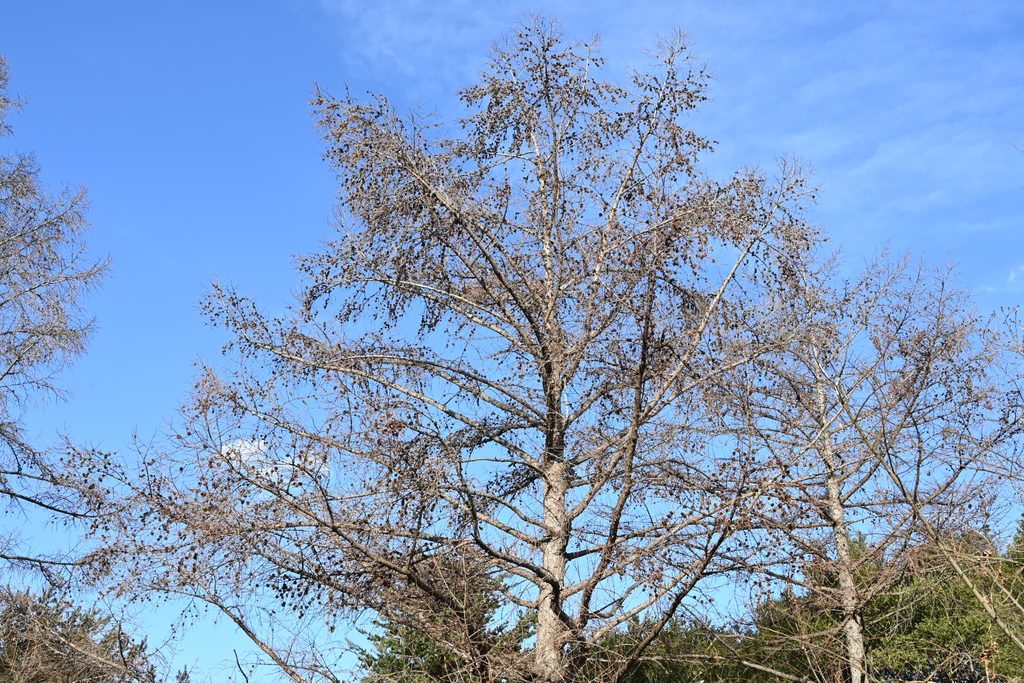
Unlike evergreen pines such as the Japanese black pine and Japanese red pine, the Japanese larch sheds all of its needles in autumn. Its fresh spring foliage, golden autumn color, and distinctive winter form also give it ornamental value, although its eventual size makes it unsuitable for most small gardens.
Overview
| Item | Details |
|---|---|
| Scientific Name | Larix kaempferi |
| Common Name | Japanese larch |
| Japanese Name | カラマツ (Karamatsu; 唐松 / 落葉松) |
| Family | Pinaceae |
| Genus | Larix |
| Native Range | Mountains of central Honshu, Japan |
| Plant Type | Deciduous coniferous tree |
| Typical Mature Height | About 20–30 m (66–98 ft) |
| Flowering Season | April–May |
| Fruit Type | Seed cone |
| USDA Zones | About 4–7 |
| Sun Exposure | Full sun |
Characteristics
| Feature | Details |
|---|---|
| Leaf Type | Soft, deciduous needles |
| Needle Length | About 2–4 cm |
| Flowers | Male and female cones occur on the same tree |
| Cone Size | About 2–4 cm |
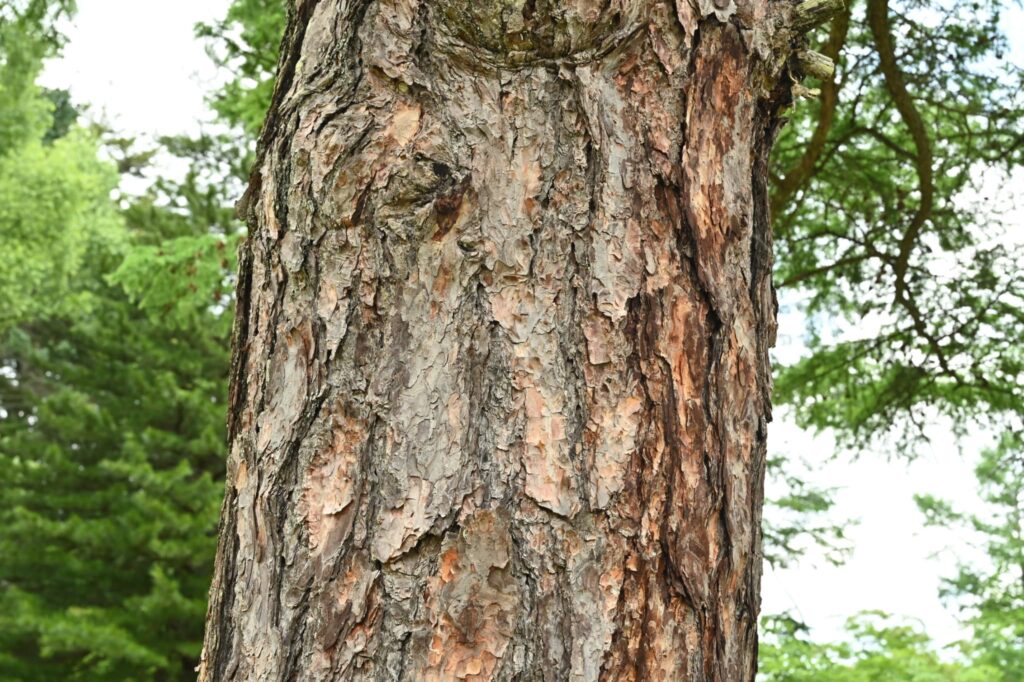
| Bark | Gray to reddish brown, becoming fissured and scaly with age |
| Growth Rate | Rapid, especially after establishment |
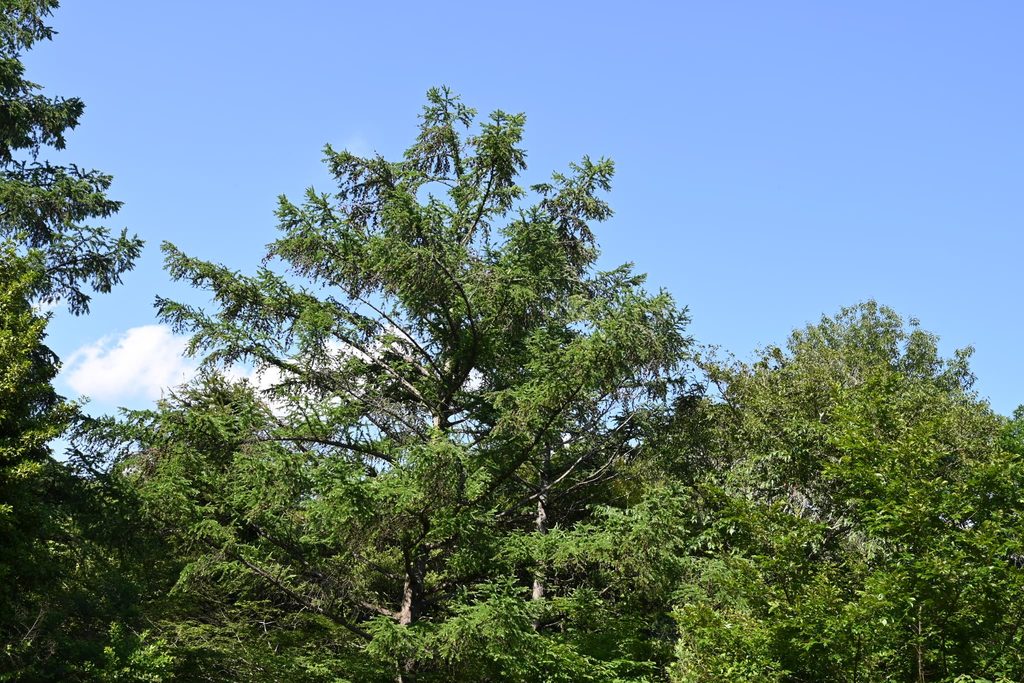
| Mature Form | Large, broadly conical tree with spreading or slightly drooping branches |
Foliage
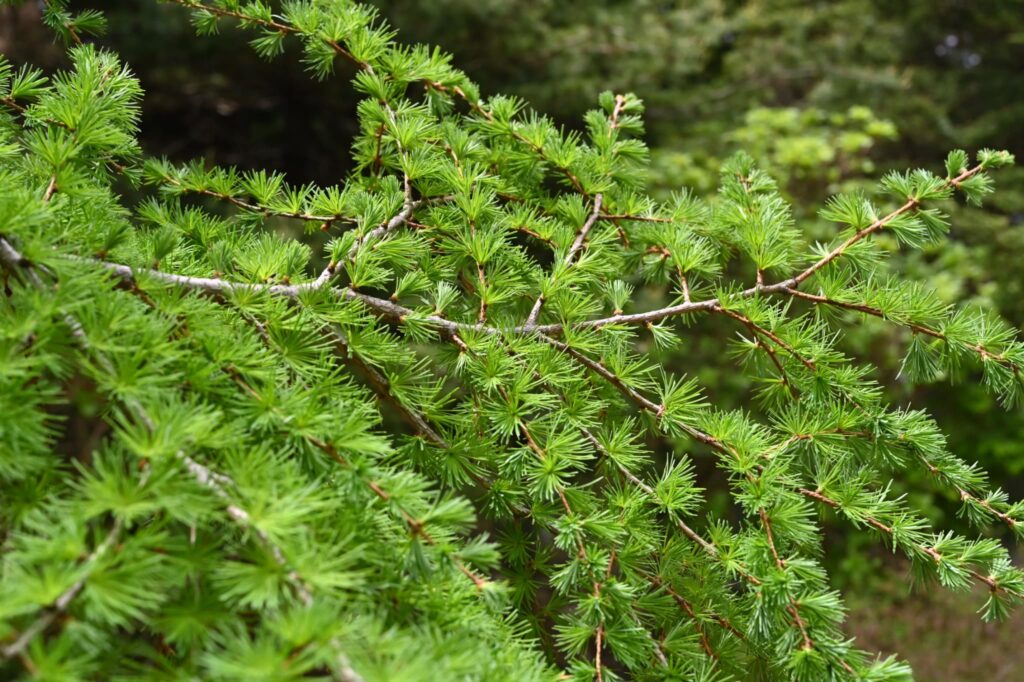
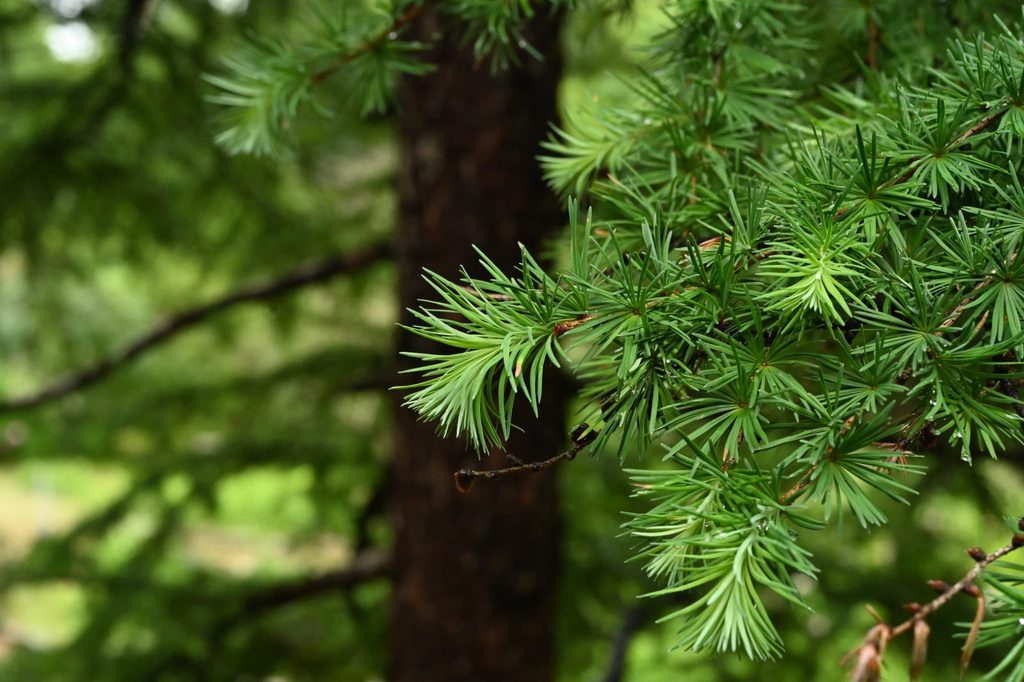
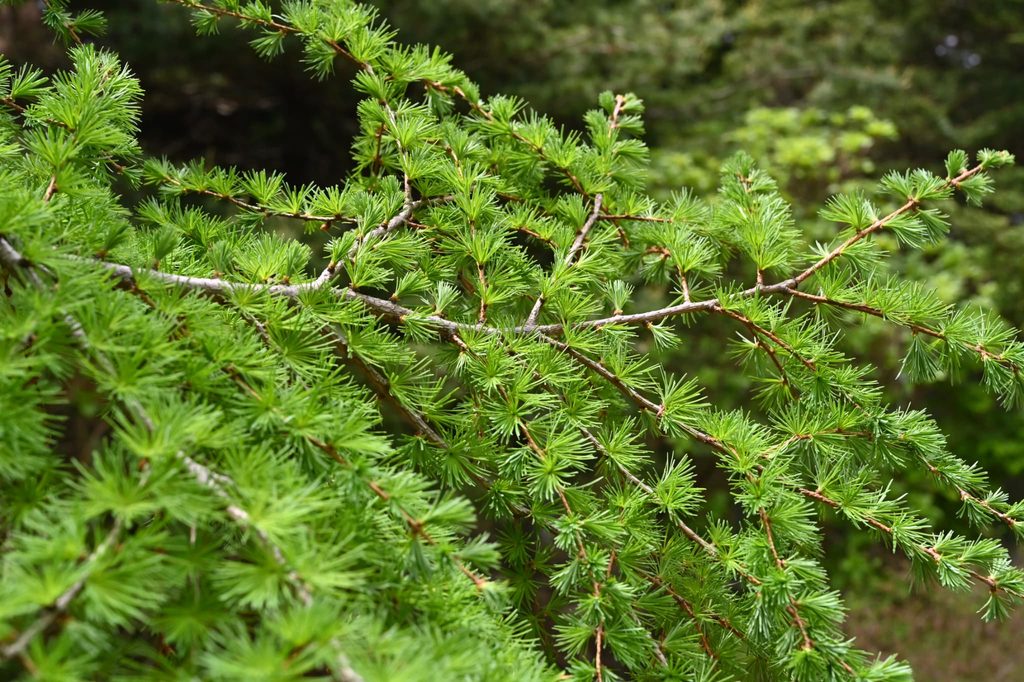
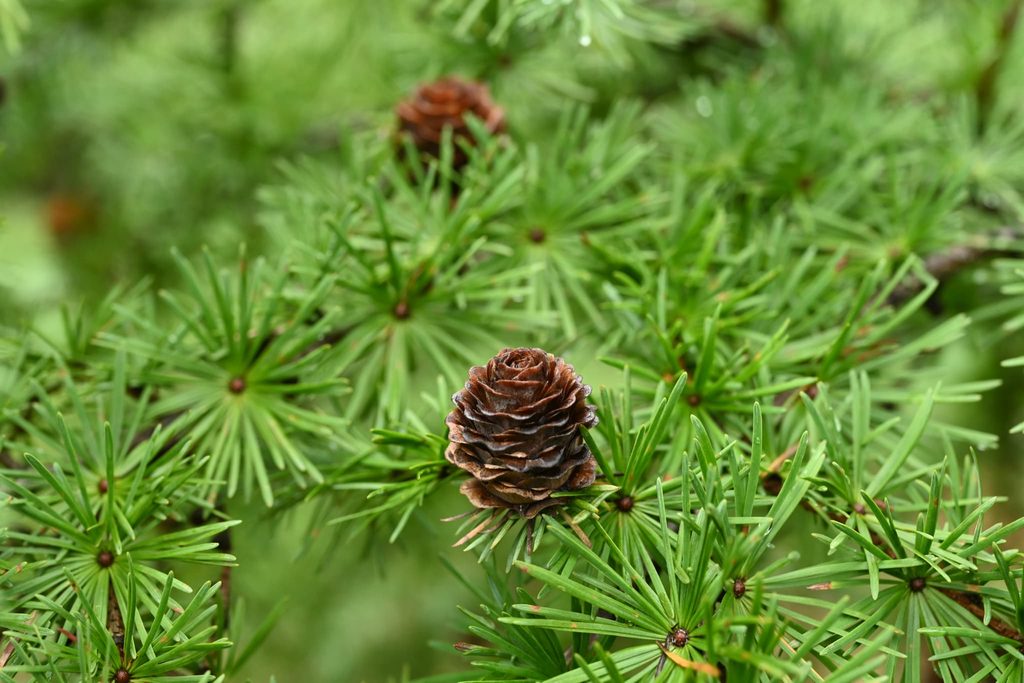
The needles are soft, linear, and generally about 2–4 cm long. They are arranged differently on long and short shoots. On long shoots, the needles are borne singly in a spiral arrangement, while on short spur shoots they form dense clusters.
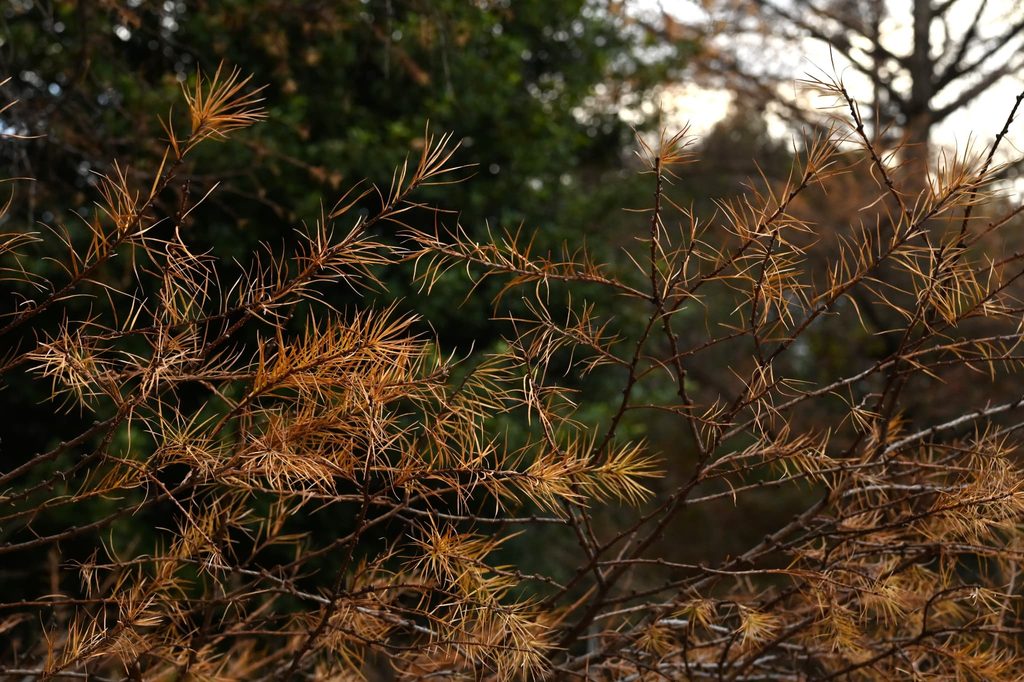
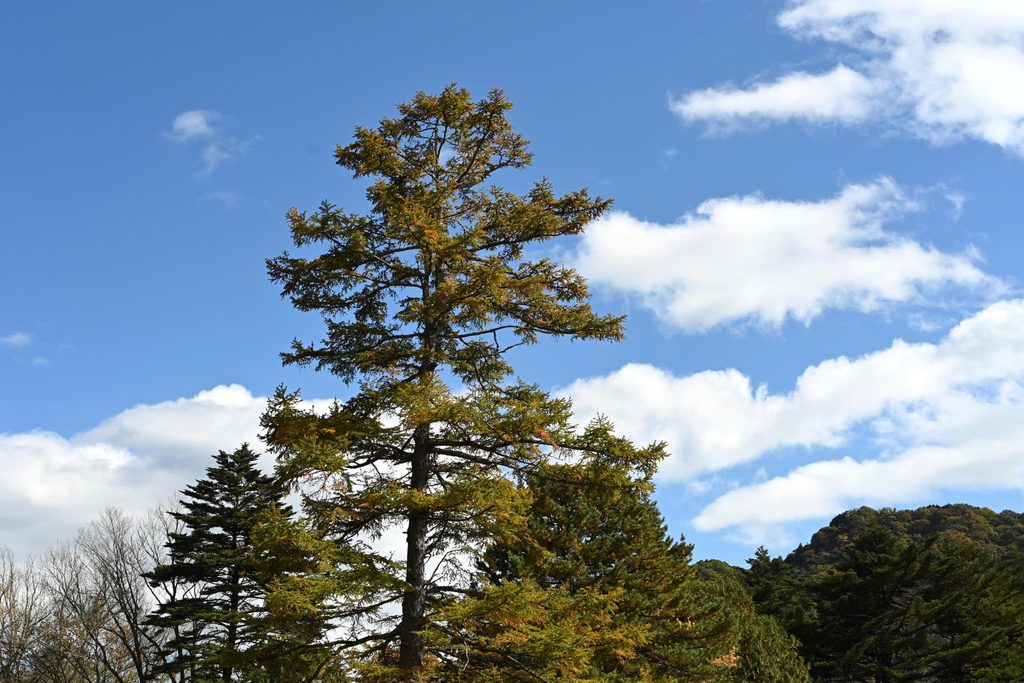
The young foliage is fresh green in spring and becomes deeper green during summer. In autumn, the needles turn yellow to golden yellow before falling. This seasonal change is one of the Japanese larch’s most distinctive features.
Flowers
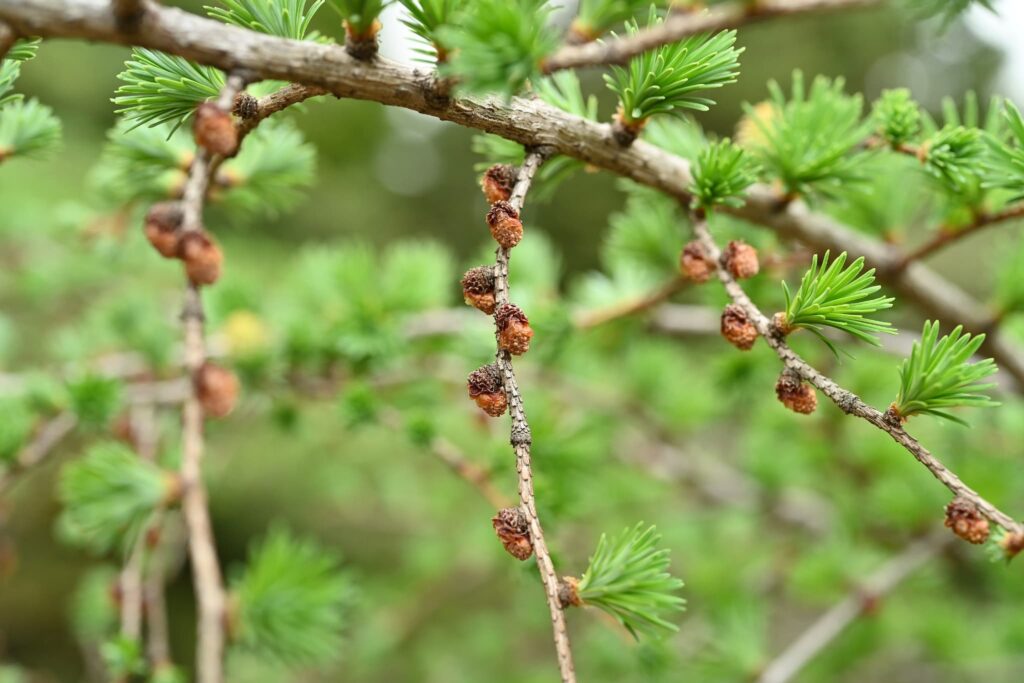
The Japanese larch is monoecious, meaning that male and female reproductive structures occur on the same tree. They appear in spring as the new needles emerge.
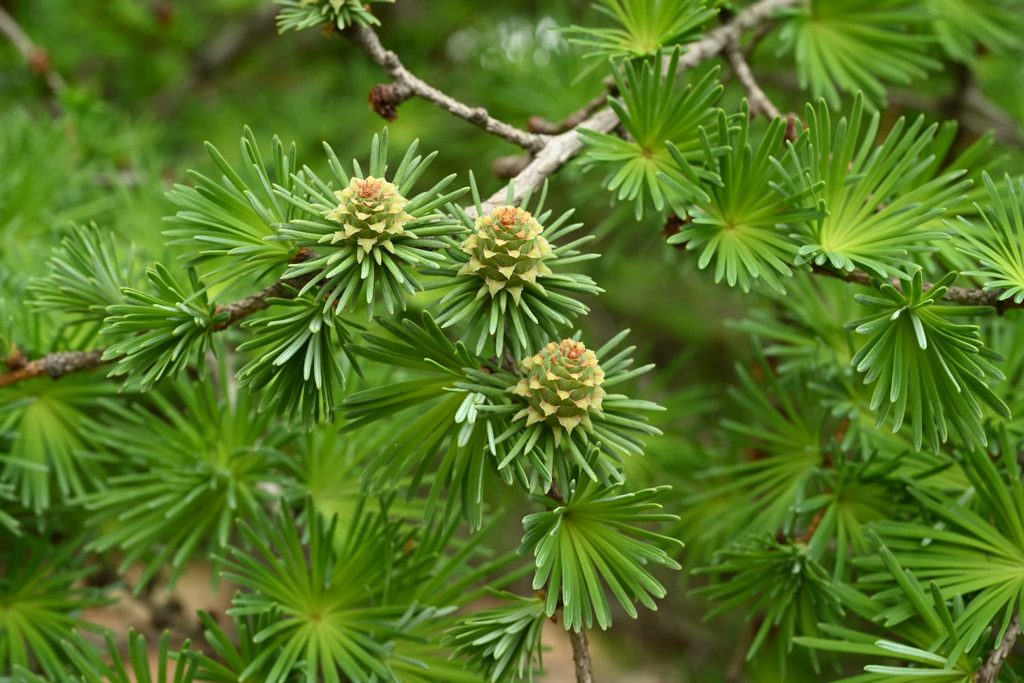
Male cones are small and yellowish and hang downward. Female cones are upright and often pinkish or reddish when young, making them particularly conspicuous against the fresh green foliage.
Cones
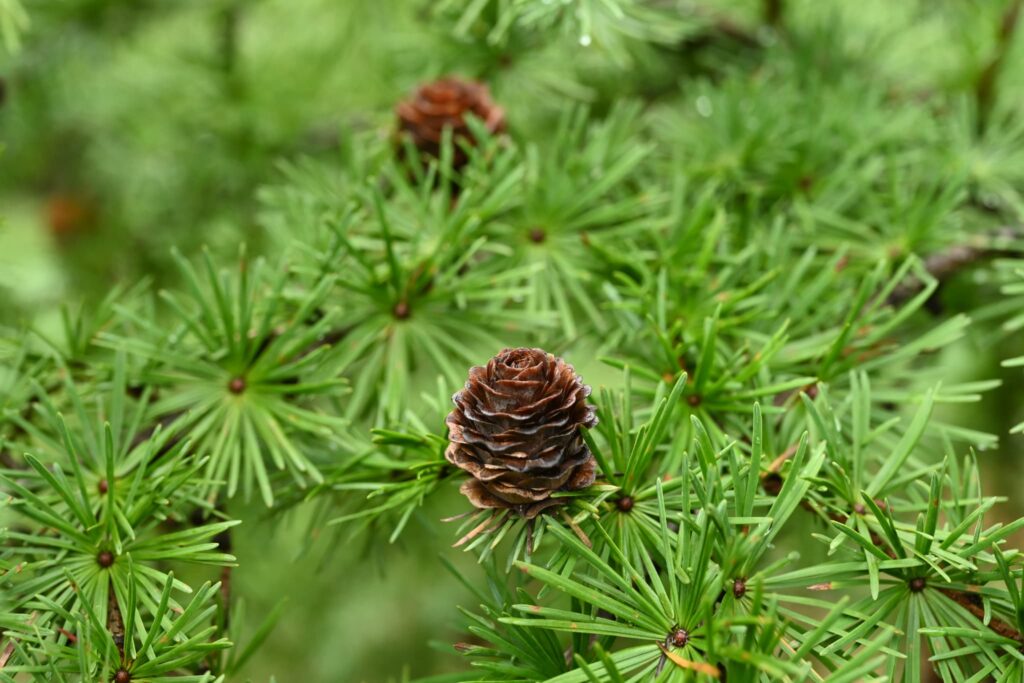
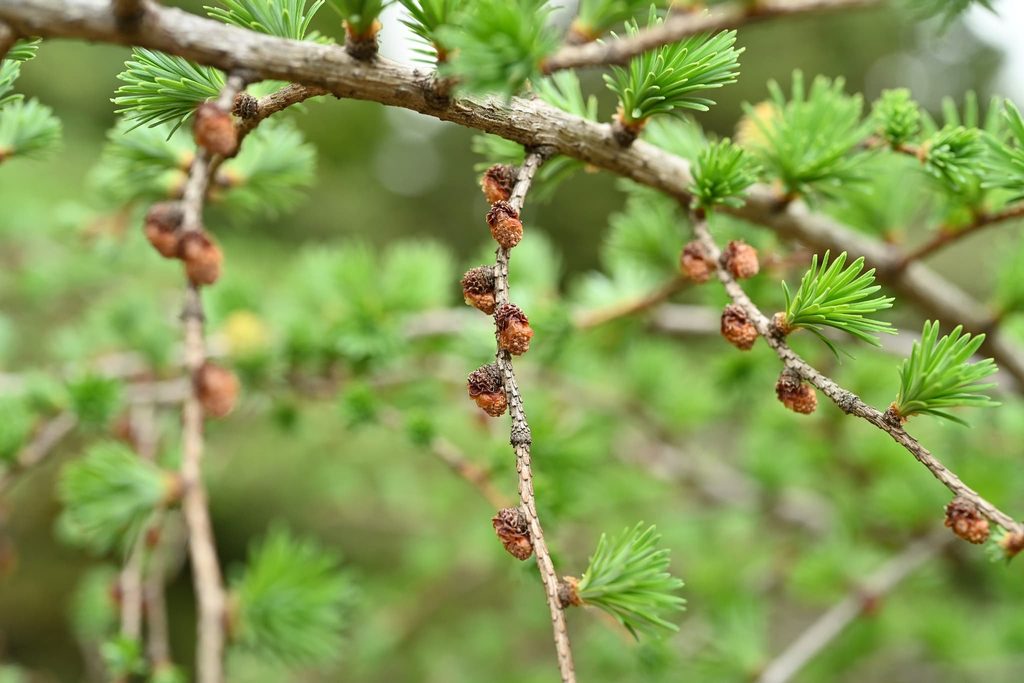
The seed cones are upright, broadly oval to nearly spherical, and generally about 2–4 cm long. They develop during the growing season and mature from green or purplish tones to brown. The scales have distinctive outward-curving margins.
Mature cones may remain attached to the branches after the seeds have been released, sometimes persisting into the following year.
Bark & Timber
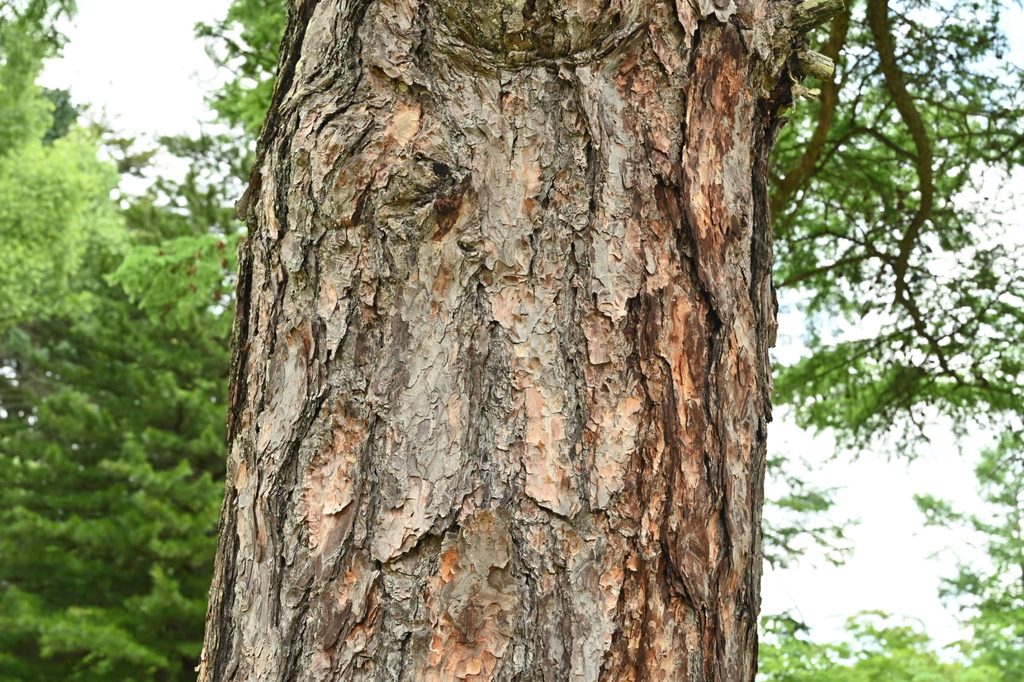
Young trunks have relatively smooth bark, but mature trees develop gray to reddish-brown bark that becomes deeply fissured and breaks into scales or plates.
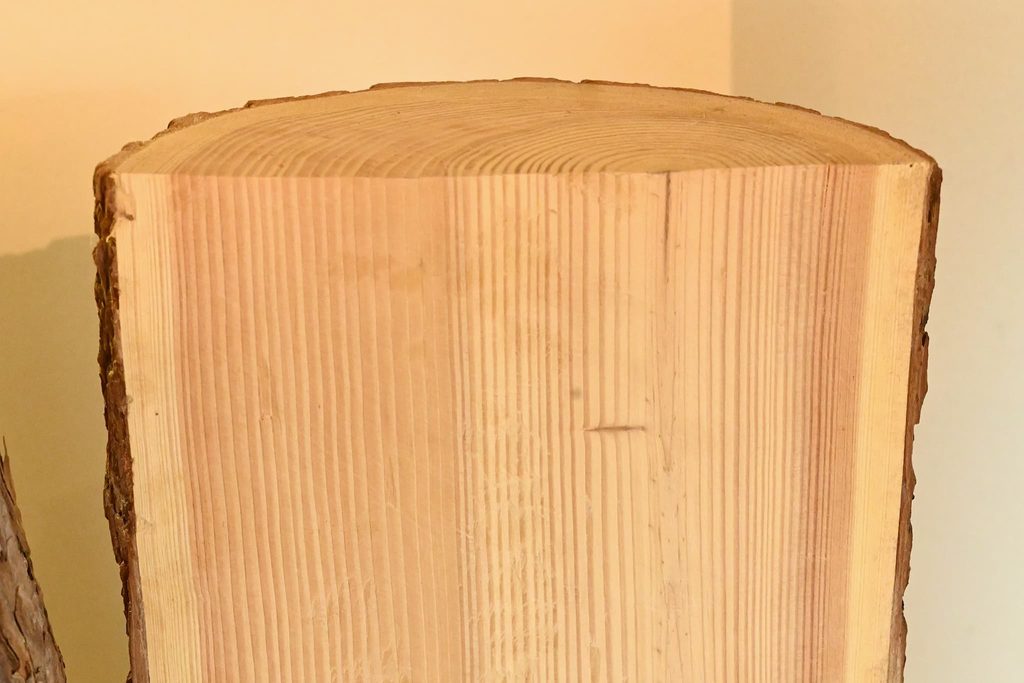
Japanese larch wood is relatively heavy and strong for a conifer and contains abundant resin. It has traditionally been used for construction, civil engineering, plywood, pulp, packaging, and other wood products. It is also valued for applications where resistance to moisture is useful. However, drying can cause cracking or warping, so the properties of the wood need to be considered according to its intended use.
Size & Growth
Japanese larch is a large tree, commonly reaching around 20–30 m in height under suitable conditions. It grows rapidly, particularly after the early establishment period, and develops a broad, conical crown.
It is a strongly light-demanding species and is well adapted to cold mountainous environments. It can also establish on relatively poor volcanic soils, which helps explain its occurrence on volcanic slopes and its importance as a forestry tree.
Uses & Cultural Significance
Origin of the Name
The Japanese name karamatsu has several proposed explanations. One relates to the tree’s deciduous nature and the idea of becoming bare (kara), while another connects the appearance of its forests with the pine forests depicted in Chinese landscapes. It has also been interpreted simply as a tree regarded as a kind of foreign pine.
The tree is also written as 落葉松 and can be read rakuyōshō, meaning roughly “the pine that sheds its leaves.”
Natural Range & Plantation History
The Japanese larch is native to central Honshu, especially mountainous areas of the Japanese Alps, Mt. Fuji, the Yatsugatake region, and other high-elevation areas. It is not native to Hokkaido, although it is now one of the most important planted trees there.
Because of its rapid early growth, cold tolerance, and ability to grow on relatively poor soils, Japanese larch became an important plantation species outside its natural range. It was introduced to Hokkaido during the Meiji period and subsequently planted extensively there. After World War II, it was also widely used in reforestation in cold regions of Japan.
Today, larch accounts for a substantial share of Japan’s planted forest area, particularly in northern and central regions.
Ornamental Value
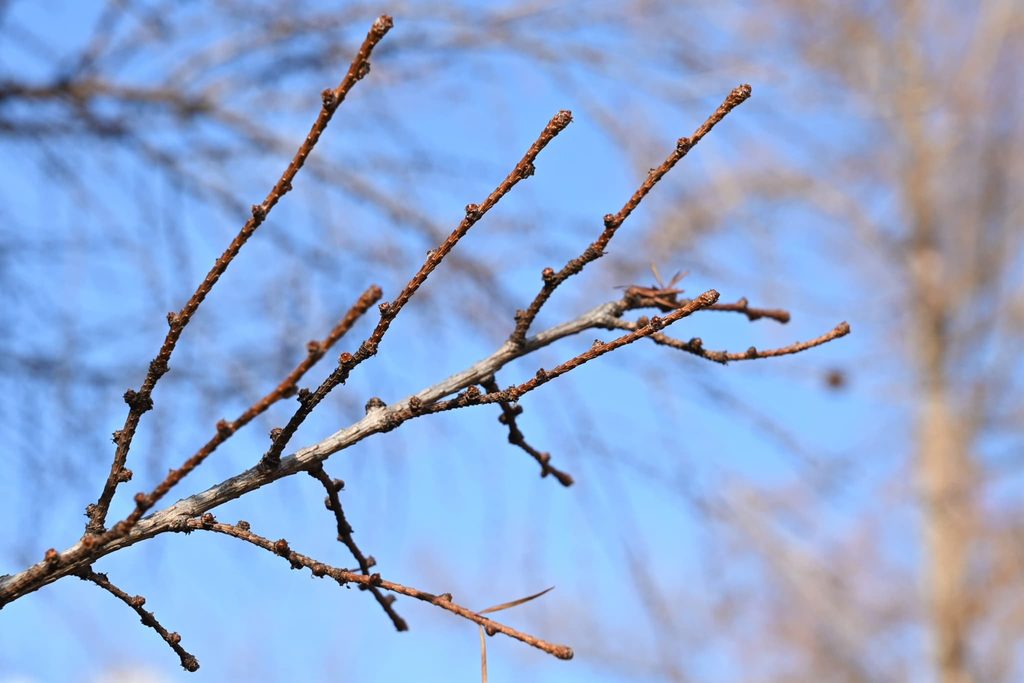
Japanese larch has considerable ornamental value because of its changing appearance through the seasons. The fresh green foliage of spring, golden-yellow autumn color, and bare winter branches provide strong seasonal contrast.
It is particularly effective in large parks, woodland settings, mountain landscapes, and other places where its eventual size can be accommodated. Smaller cultivars are available for more restricted spaces.
Growing Guide
| Growing Factor | Recommendation |
|---|---|
| Light | Full sun |
| Soil | Deep, well-drained soil; adaptable to different soil types |
| Moisture | Moderate and consistent moisture is preferable |
| Drought Tolerance | Moderate once established, but prolonged drought can reduce vigor |
| Cold Hardiness | Very high |
| Heat Tolerance | Limited in hot, humid climates |
| Pruning | Usually unnecessary; preserve the natural form |
| Home Garden | Generally suitable only for large gardens or spacious sites |
Light & Soil
Japanese larch is strongly adapted to sunny conditions and grows poorly in deep shade. Full sun is preferable.
It can tolerate a range of soil types, including clay, loam, and sandy soils, provided drainage is adequate. In cultivation, it generally performs best in deep, well-drained soil with adequate moisture. It is particularly well adapted to the volcanic and relatively poor soils found in parts of its natural range.
Wind & Snow Tolerance
Japanese larch is well adapted to cold, exposed environments and is widely grown in regions with heavy snowfall. Because it sheds its needles before winter, it avoids carrying a heavy canopy of foliage throughout the snowy season.
However, young trees and newly planted specimens may still benefit from protection in exceptionally exposed locations.
Cold Hardiness
Japanese larch is highly cold-hardy and is commonly grown in northern Japan, including Hokkaido. It is generally rated around USDA Zone 4 and can tolerate severe winter conditions.
Heat is a greater limitation. In regions with hot, humid summers, growth and foliage quality can decline, particularly when the tree is exposed to drought or other stress.
Pruning
Japanese larch usually needs little pruning when it has sufficient space. Its natural broad, conical form is one of its attractive features.
If pruning is necessary, it is preferable to remove poorly positioned, dead, damaged, or crossing branches rather than repeatedly reducing the crown. Young trees can be trained if a particular form is required.
Suitability for Home Gardens
The species is generally too large for an ordinary residential garden. A mature tree can reach around 20–30 m, and its spreading crown requires considerable space.
Its seasonal beauty is better suited to large gardens, parks, estates, golf courses, and woodland landscapes. Smaller cultivars can be considered where space is limited.
Pests & Diseases
Japanese larch can be affected by several insect pests and diseases. Reported problems include needle cast, needle rust, canker, larch sawfly, larch case-bearer, larch looper, and various aphids.
Healthy trees growing in suitable cool conditions are generally more resilient. Good site selection is particularly important because heat and drought stress can reduce overall vigor.
Cultivars
Garden Cultivars
Although the species itself becomes a large tree, several cultivars have been selected for ornamental use.
‘Diana’ is a contorted form that can remain much smaller than the species, while ‘Jacobsen’s Pyramid’ has a narrow, upright habit and can be useful where a columnar form is desired. Other dwarf and compact cultivars are also available.
Related Larch Species
- European larch (Larix decidua): Native to Europe. Its cones are generally more elongated than those of the Japanese larch.
- Dahurian larch (Larix gmelinii): Native to northeastern Asia and highly adapted to cold climates.
- American larch (Larix laricina): Native to northern North America and also known as tamarack.
- Western larch (Larix occidentalis): Native to western North America and an important forestry tree.
The Kuril larch (Larix gmelinii var. japonica in some classifications, depending on the taxonomic treatment) has also been associated with northern Japan and nearby regions. Its relationship to other northeastern Asian larches has been treated differently by different taxonomic sources.
Similar Species
- Himalayan cedar (Cedrus deodara): Both have soft-looking needle foliage and belong to the pine family. The key difference is that Himalayan cedar is evergreen, whereas Japanese larch loses its needles in autumn. Japanese larch needles are also notably soft to the touch.
- Chinese golden larch (Pseudolarix amabilis): Another deciduous conifer in the pine family, but it belongs to a different genus. Its needles are considerably longer, and its cones are much larger than those of Japanese larch.
- Bald cypress (Taxodium distichum): A deciduous conifer in the cypress family (Cupressaceae). Like Japanese larch, it loses its foliage in autumn, but its foliage, cones, bark, and overall form are quite different.
Frequently Asked Questions
Is the Japanese larch evergreen?
No. Japanese larch is deciduous. Its soft needles turn yellow in autumn and fall before winter.
Is the Japanese larch a true pine?
It belongs to the pine family (Pinaceae), but it is not a true pine in the genus Pinus. It belongs to the genus Larix.
Why do the needles turn yellow?
The needles naturally change color as the tree prepares for winter dormancy. They turn yellow to golden yellow before falling, producing the characteristic autumn appearance of Japanese larch forests.
How fast does it grow?
Japanese larch is a rapid-growing tree, particularly after it becomes established. Its fast early growth is one reason it has been widely used in forestry.
Can I grow Japanese larch in a home garden?
It can be grown as an ornamental tree, but the species becomes very large. It is generally better suited to large gardens, parks, and other spacious sites. Compact cultivars are available for smaller spaces.
Does Japanese larch tolerate heat?
Not particularly well. It is best adapted to regions with cool summers and cold winters. Hot, humid conditions, especially when combined with drought, can reduce growth and foliage quality.
How can I tell Japanese larch apart from Himalayan cedar?
The simplest difference is whether the needles are shed in autumn. Japanese larch is deciduous, while Himalayan cedar remains evergreen. Japanese larch also has softer needles that do not feel sharply prickly.
Conclusion
Japanese larch is a distinctive deciduous conifer native to the mountains of central Japan. Its rapid growth, strong cold tolerance, and ability to grow in challenging soils have made it an important forestry species far beyond its natural range, particularly in Hokkaido.
For gardeners, its soft spring foliage, golden autumn color, and attractive winter form make it an appealing ornamental tree, but its eventual size means that the species is best reserved for large sites. Where space is limited, compact cultivars provide a more practical alternative.