Kashiwa Oak (Quercus dentata): Identification, Leaves, Acorns & Care
Kashiwa Oak (Quercus dentata), also known as Daimyo Oak, is a deciduous oak native to Japan and neighboring parts of East Asia. It is best known in Japan for its large leaves, which are traditionally used to wrap kashiwa-mochi rice cakes eaten around the Boys’ Festival (Tango no Sekku).
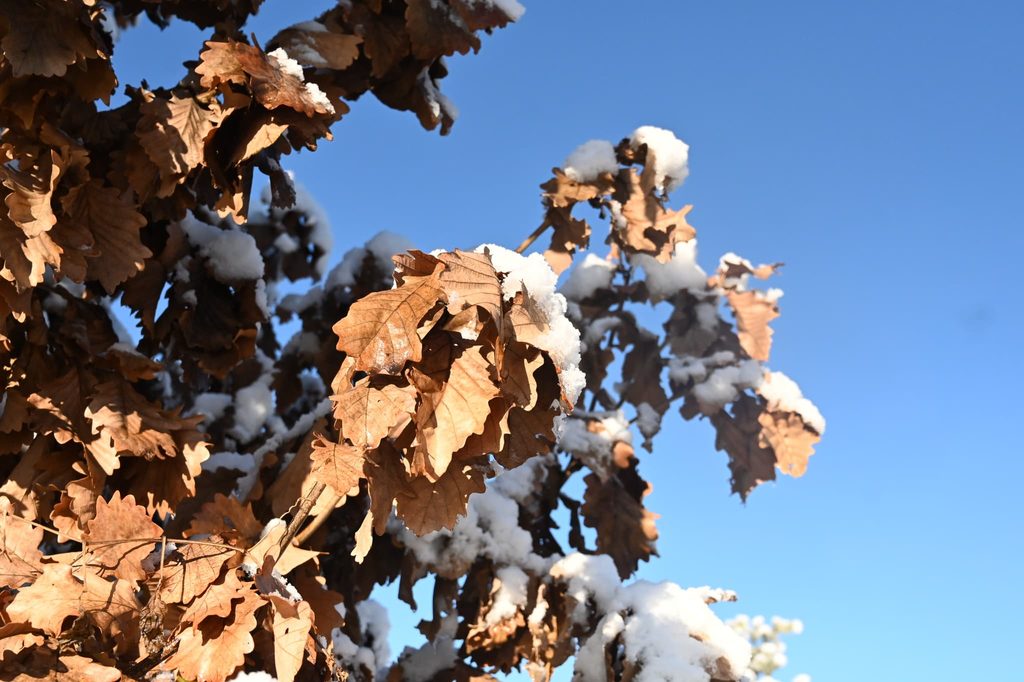
One of its most distinctive features is its marcescent foliage: many dead leaves remain attached to the branches through winter and are shed when new leaves emerge in spring. This unusual habit contributed to the tree’s traditional association with the continuity and prosperity of a family.
The photographs and observations on this page are based on Kashiwa Oak as grown in Japan.
What Is the Kashiwa Oak?
Kashiwa Oak is a deciduous broadleaf tree in the beech family (Fagaceae). In Japan, it occurs mainly from Hokkaido through Honshu, Shikoku, and Kyushu, with additional populations in Korea, China, southern Sakhalin, and the southern Kuril Islands.
It commonly grows in sunny, relatively dry habitats, including coastal areas, hillsides, and other open sites. In Hokkaido it is an important coastal oak, while in other parts of Japan it can occur on hills and ridges.
Unlike many deciduous trees, Kashiwa often retains its dead leaves through winter. The leaves are usually shed when the new shoots begin to expand in spring.
Overview
| Scientific Name | Quercus dentata Thunb. |
| Common Names | Kashiwa Oak, Daimyo Oak, Japanese Emperor Oak |
| Japanese Name | Kashiwa (カシワ) |
| Japanese Characters | 柏, 槲, 檞 |
| Family | Fagaceae (Beech family) |
| Native Range | Japan, Korea, China, southern Sakhalin, southern Kuril Islands |
| Plant Type | Deciduous broadleaf tree |
| Typical Height | About 15–20 m; larger trees can occur |
| Leaf Size | Usually about 15–30 cm long |
| Flowering Season | April–May, sometimes extending into June depending on region |
| Fruit | Acorn |
| Sun Exposure | Full sun |
| Hardiness | Very cold-hardy; suitable for much of Japan |
Characteristics
| Leaf Shape | Large, obovate to broadly obovate |
| Leaf Margin | Deeply wavy, bluntly toothed or lobed |
| Leaf Underside | Grayish and densely hairy |
| Leaf Petiole | Very short |
| Leaf Retention | Many dead leaves remain through winter |
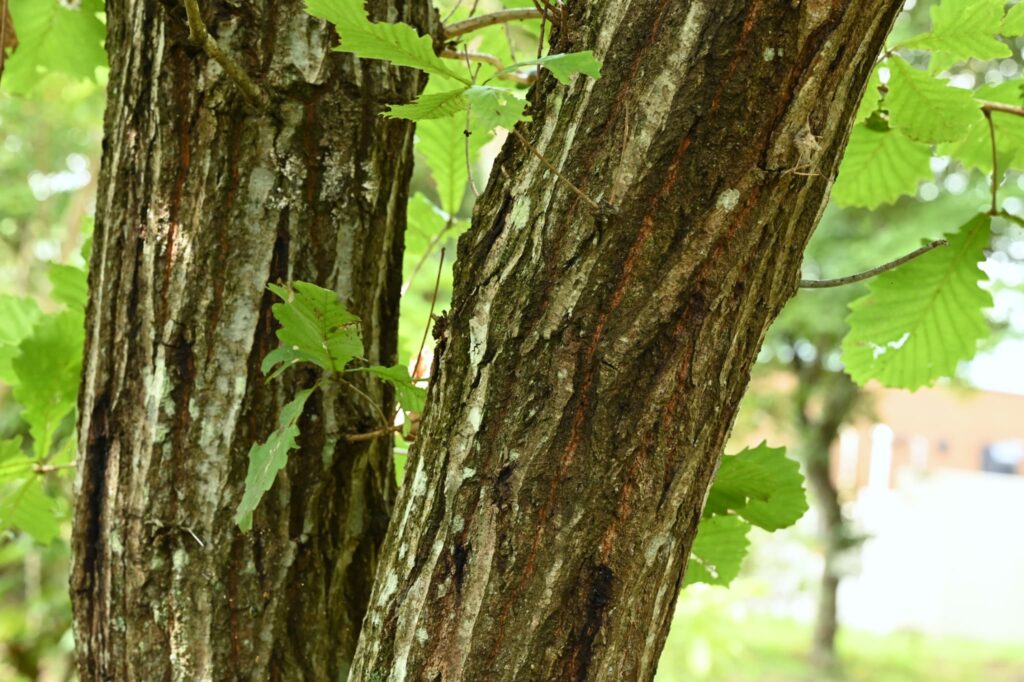
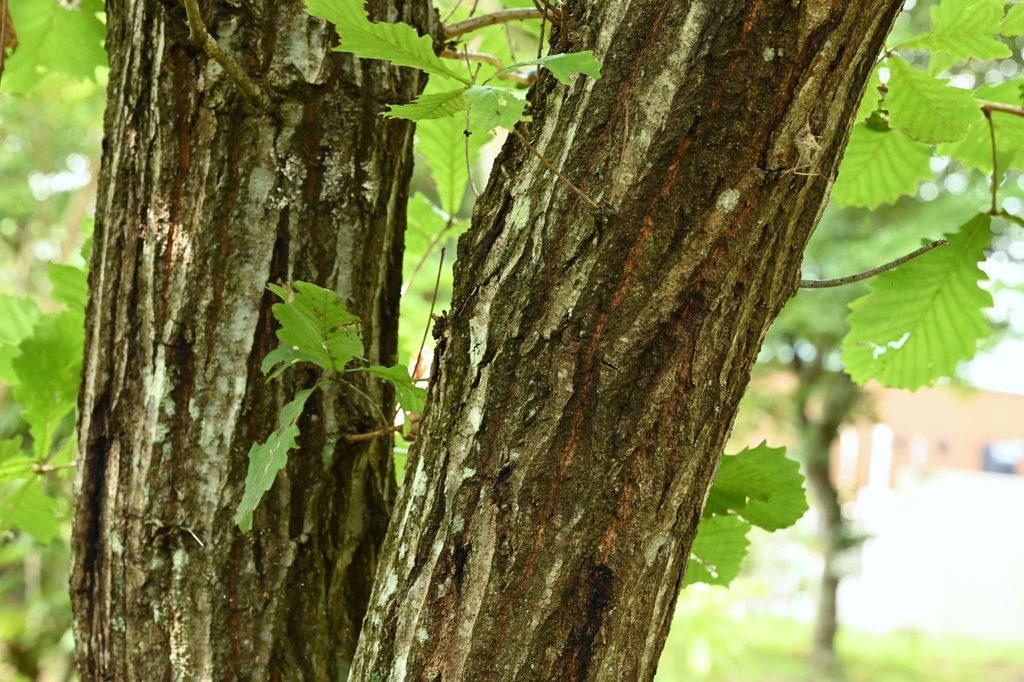
| Bark | Thick, deeply fissured and corky |
| Acorn | About 1.5–2 cm long, enclosed partly by a distinctive scaly cup |
Foliage
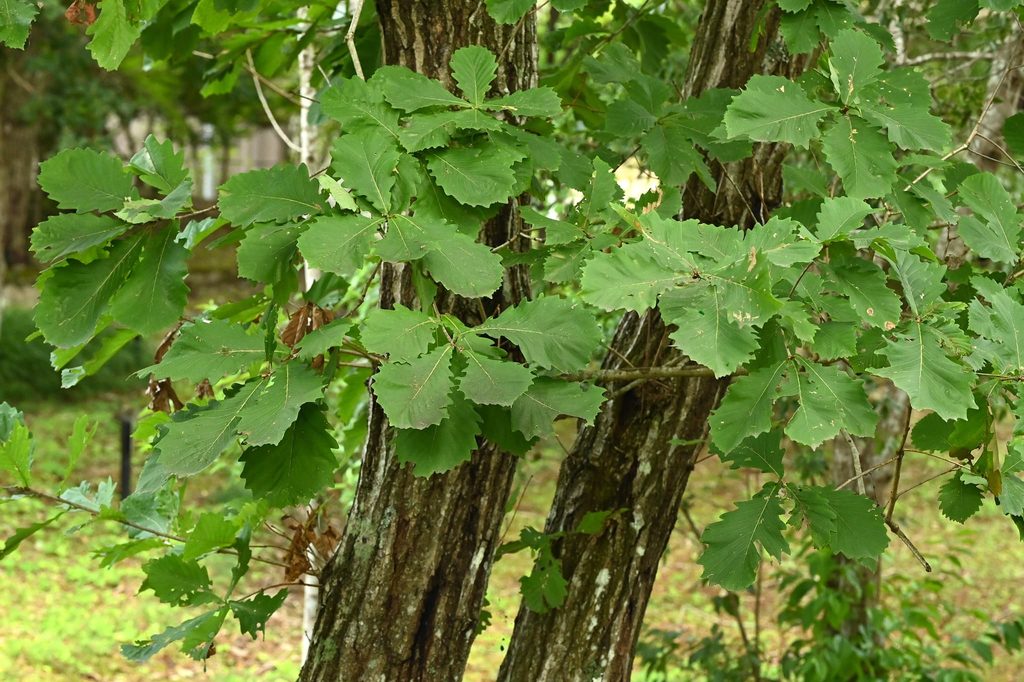
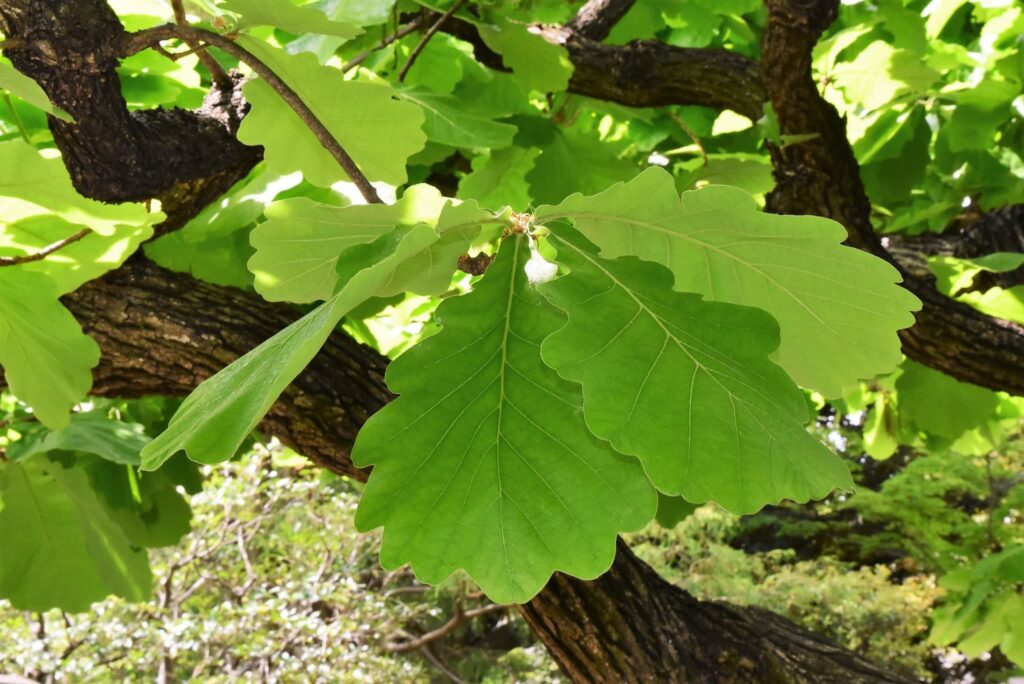
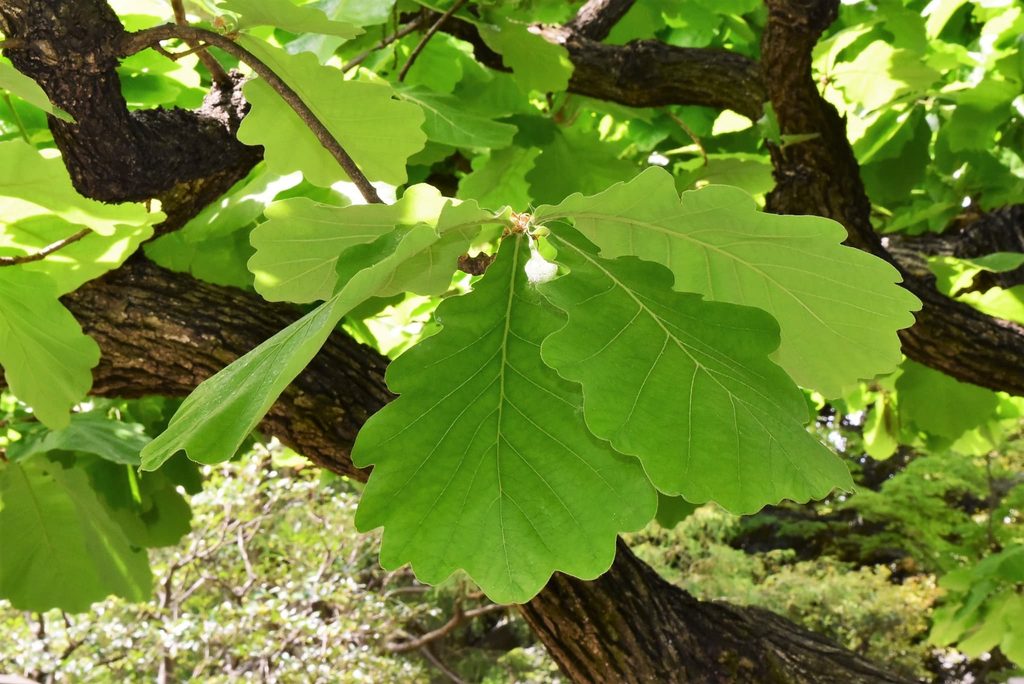
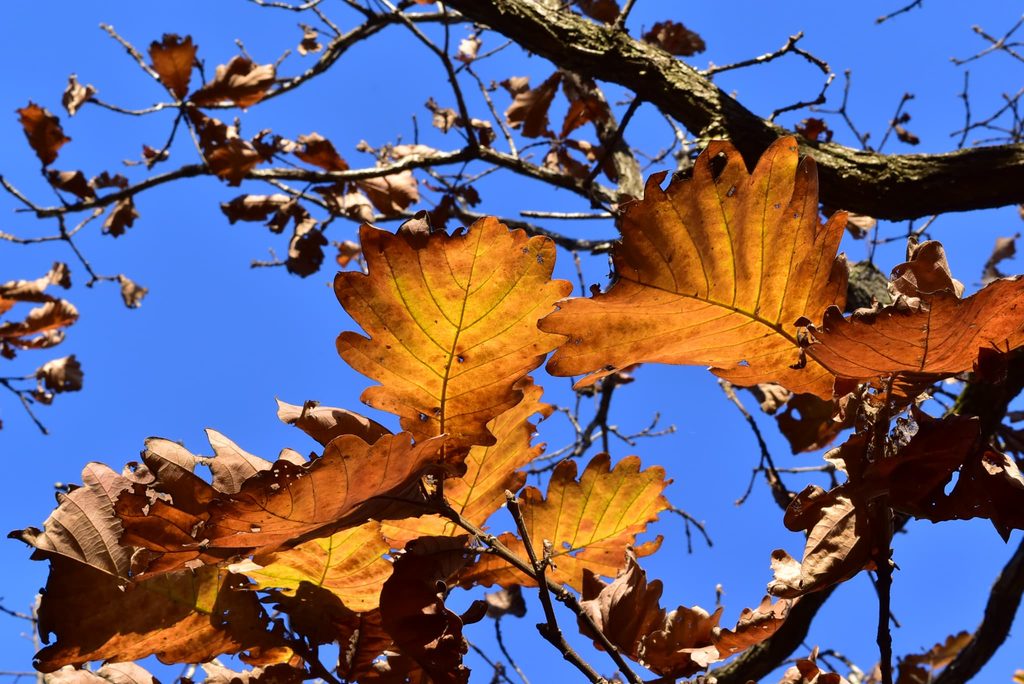
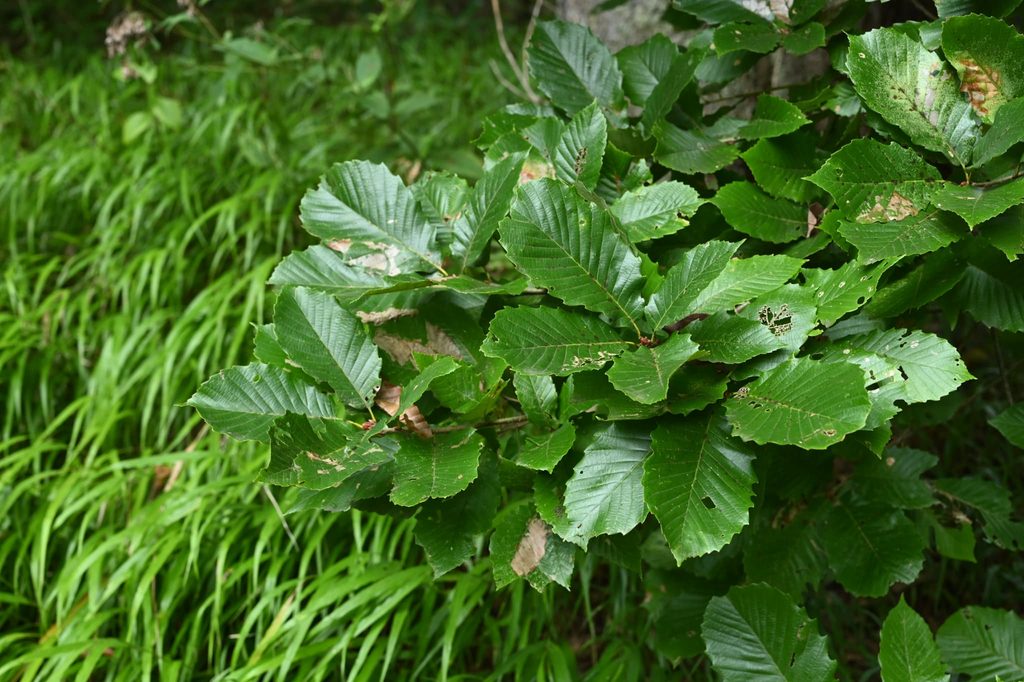
The leaves are one of the easiest ways to recognize Kashiwa Oak. They are large, thick, and broadly obovate, typically 15–30 cm long and 6–18 cm wide.
The margin has large, rounded waves or blunt teeth rather than the more regular teeth seen on some other Japanese oaks. The leaf base is narrowed and often slightly ear-shaped, while the petiole is extremely short.
The underside is grayish because it is densely covered with soft hairs. Leaves are concentrated toward the ends of the branches, giving mature trees a characteristic tufted appearance.
A particularly distinctive feature is marcescence. Many dead leaves remain attached throughout autumn and winter instead of falling immediately. They are gradually pushed off as the new leaves expand in spring.
Flowers
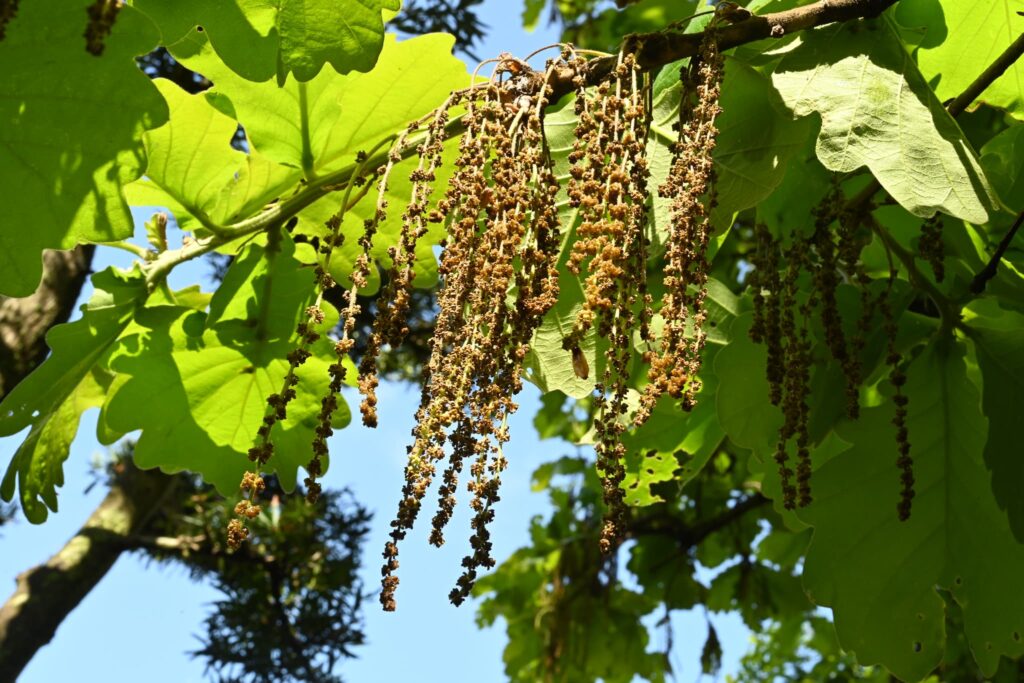
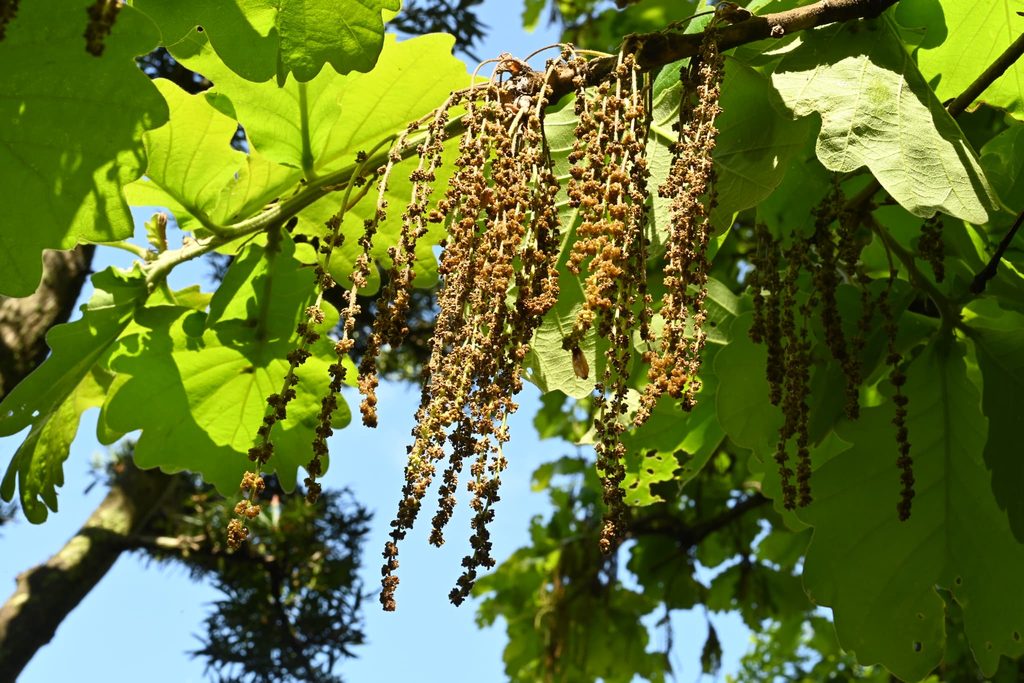
Kashiwa Oak flowers in spring as the new leaves emerge, generally from April to May in much of Japan.
The male flowers form long, hanging catkins about 8–15 cm long on the lower part of new shoots. The female flowers are much smaller and occur in clusters in the leaf axils toward the upper part of the new shoots.
Like other oaks, Kashiwa is wind-pollinated.
Fruits
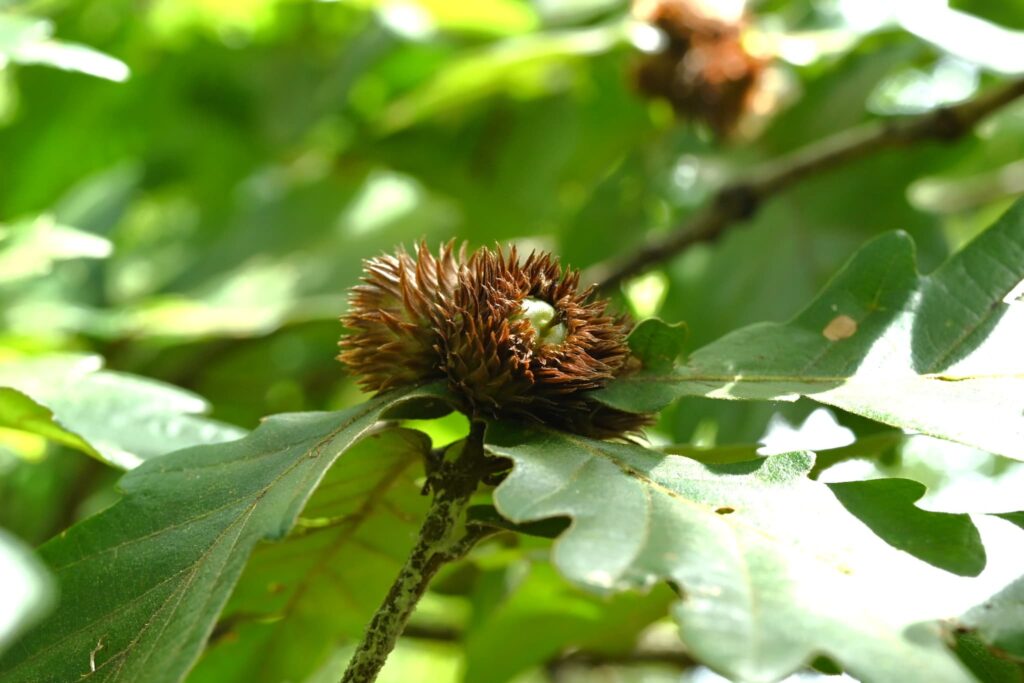
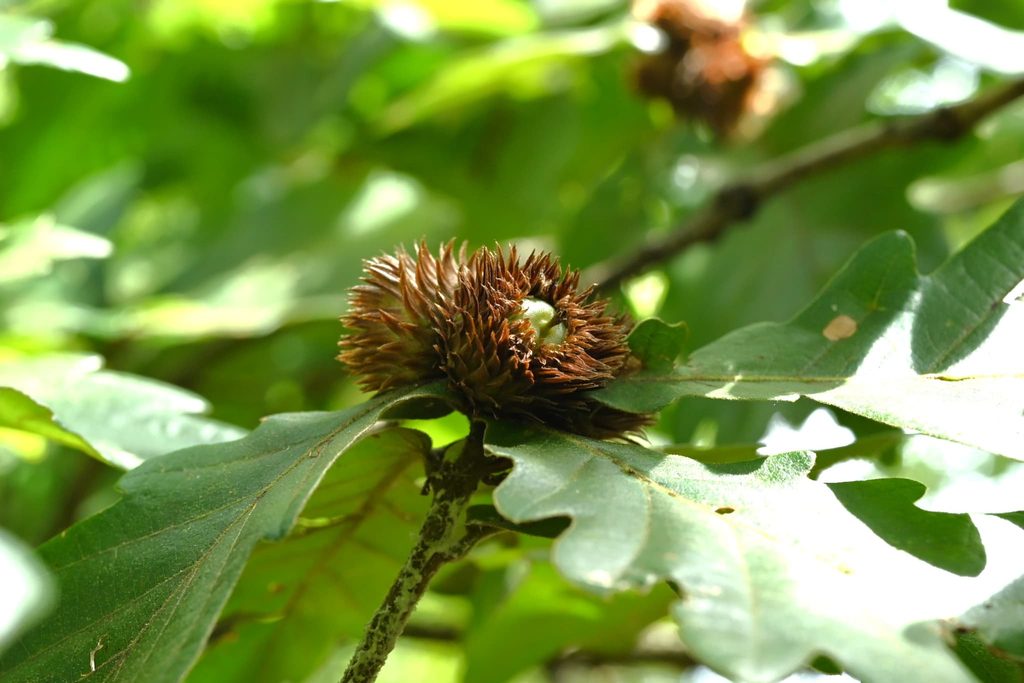
The fruit is an acorn that normally matures in the same year as flowering, ripening in autumn.
The acorns are about 1.5–2 cm long and are partly enclosed by a cup (cupule). The cup is covered with numerous narrow, overlapping scales whose tips project outward and often curve back.
The acorns can resemble those of Kunugi (Quercus acutissima), but the cup and leaf characteristics provide useful additional clues for identification.
Bark & Timber
The bark is thick, dark gray-brown, and deeply fissured with a corky texture. The thick bark contributes to the species’ ability to survive some fires, and Kashiwa can persist or regenerate in areas affected by wildfire.
The bark contains tannins and has historically been used for tanning and dyeing. The wood is hard and has been used for construction, fuel, and other practical purposes.
Size & Growth
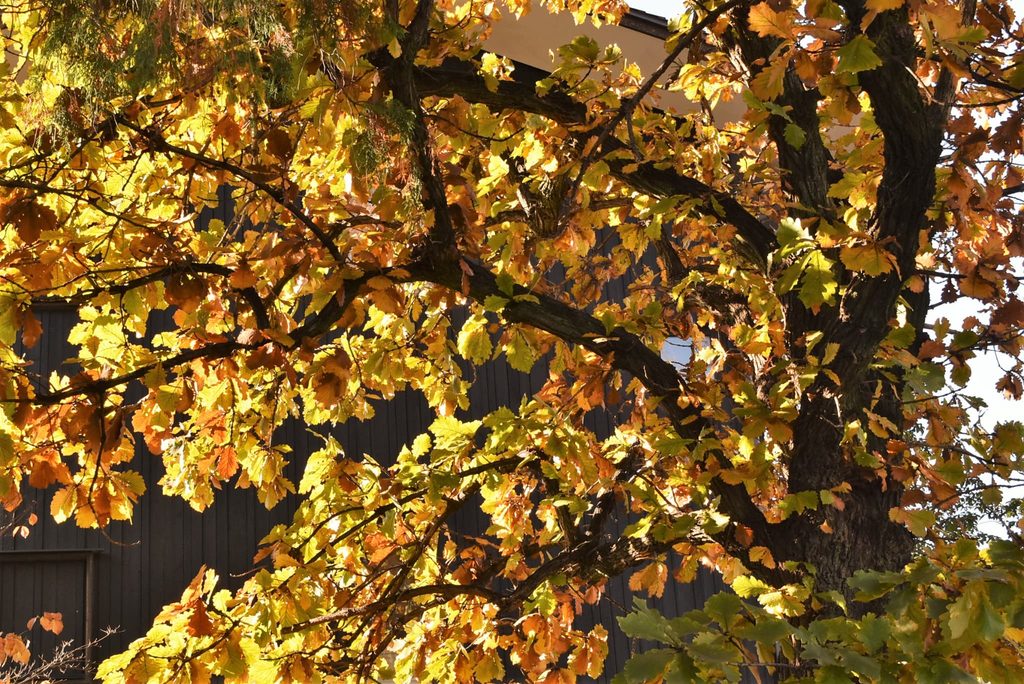
Kashiwa Oak can become a substantial tree, generally reaching around 15–20 m in height and developing a broad crown when given sufficient space.
Its natural form is therefore better suited to large gardens, open landscapes, parks, and shrine or temple grounds than to a small residential garden.
Young trees can grow relatively vigorously, but mature specimens develop a strongly branched, spreading form.
Uses & Cultural Significance
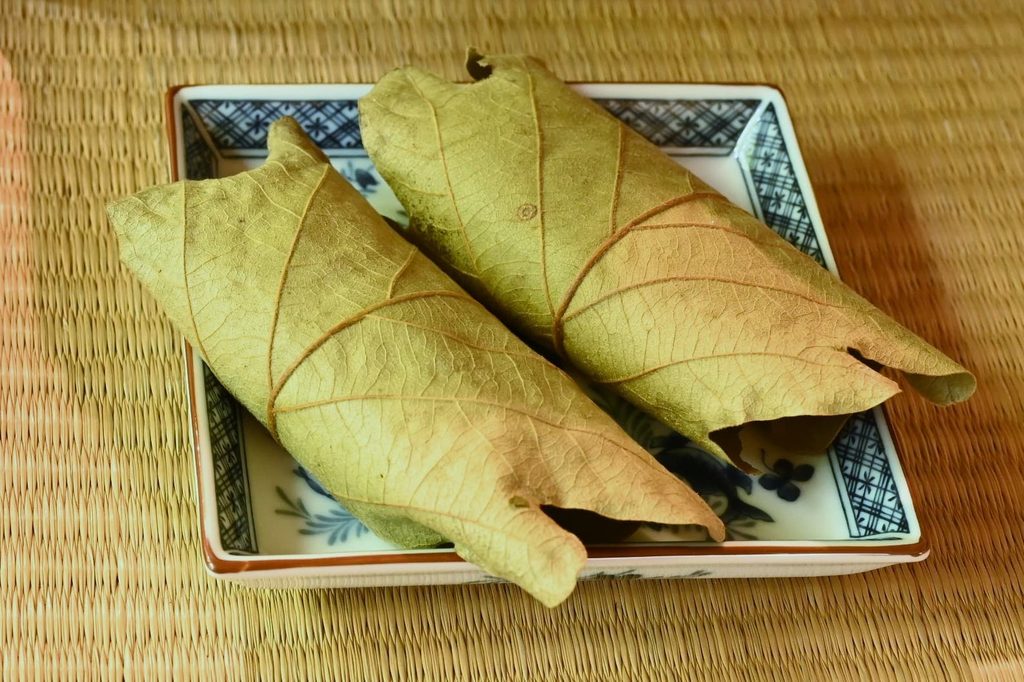
The most familiar use of Kashiwa leaves is kashiwa-mochi, a traditional Japanese rice cake associated with the Boys’ Festival on May 5.
The tree’s persistent dead leaves also have an important cultural meaning. Because the old leaves remain until the new leaves emerge, Kashiwa became associated with the continuation of a family line. The expression “葉守の神” (hamori-no-kami), or the guardian deity of leaves, is connected with this unusual characteristic.
This tradition appears in classical Japanese literature as well. The idea that a deity resides in the Kashiwa tree helped reinforce the tree’s auspicious symbolism.
Kashiwa leaves were also historically used more generally for wrapping or serving food. Other large leaves, including those of Magnolia (Magnolia obovata), Nara-gashiwa (Quercus aliena), and Oshima-zakura (Prunus speciosa), have been used for similar purposes in different regions.
Today, Kashiwa leaves used commercially for kashiwa-mochi may be dried, preserved, or imported, depending on the region and supply.
The Name “Kashiwa”
The traditional Japanese name is usually written 柏, 槲, or 檞.
The most widely cited explanation derives kashiwa from an old term associated with using leaves to hold, serve, or prepare food. The name therefore reflects one of the tree’s oldest practical uses.
There is an important botanical distinction concerning the character 柏. In classical Chinese botanical usage, 柏 is associated with conifers such as Platycladus orientalis. Nevertheless, 柏 has long been established in Japanese as a conventional written form of Kashiwa, including words such as 柏餅 (kashiwa-mochi) and 柏木 (kashiwagi). It is therefore better described as a traditional Japanese usage rather than simply as a “wrong” character.
Growing Guide
| Light | Full sun |
| Soil | Well-drained soil; tolerates relatively poor soils |
| Water | Moderate once established |
| Wind | Generally tolerant of exposed sites |
| Cold Hardiness | Very high |
| Salt Exposure | Avoid severe direct salt spray |
| Pruning | Tolerates substantial pruning, but natural form is broad and spreading |
| Space Required | Large |
Light & Soil
Kashiwa Oak grows best in full sun. It can tolerate relatively dry and poor soils and naturally occurs in open habitats, including coastal sites and hillsides.
Good drainage is preferable, particularly where the soil remains wet for long periods.
Wind & Coastal Conditions
The species is well adapted to exposed environments and is particularly characteristic of coastal habitats in northern Japan.
It can tolerate strong wind, but direct exposure to salt spray should still be avoided where possible.
Cold Hardiness
Kashiwa is one of the cold-hardy Japanese oaks. Its natural distribution extends through Hokkaido and into southern Sakhalin and the southern Kuril Islands.
This makes it suitable for cold regions of Japan, although local climate and planting conditions still affect growth.
Pruning
Kashiwa tolerates relatively hard pruning, and garden specimens are sometimes repeatedly cut back to control their size.
However, this is not its natural growth habit. An unpruned tree develops a broad, substantial crown, while repeated hard pruning produces a rougher, more angular form.
For a specimen tree, it is generally better to allow enough space for its natural shape.
Suitability for Home Gardens
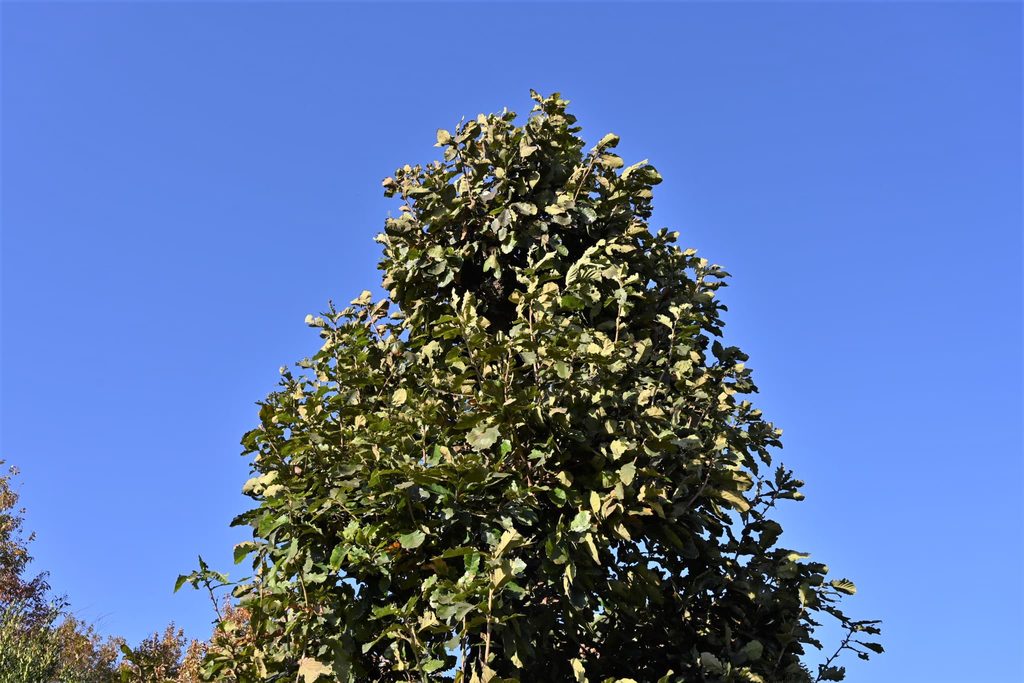
Kashiwa is best suited to large gardens and open sites rather than small urban plots.
Its large leaves, persistent winter foliage, substantial mature size, and cultural significance can make it an attractive specimen tree, but its eventual spread should be considered carefully before planting.
Pests & Diseases
Kashiwa can be affected by many of the same insects and diseases found on other oaks, including aphids, scale insects, caterpillars, gall-forming insects, and various fungal leaf diseases.
Problems are generally more likely when trees are stressed or poorly ventilated. Maintaining adequate growing space and monitoring the tree regularly are more useful than routine pesticide treatment.
Cultivars and Forms
Several horticultural forms of Kashiwa have been described, including selections with unusually shaped or deeply divided leaves.
One notable form is ‘Pinnatifida’, which has deeply dissected leaves with narrow, finger-like lobes.
Other Japanese names such as Hagoromo-gashiwa and Houou-gashiwa are also associated with distinctive horticultural forms.
Similar Species
Mizunara (Quercus mongolica var. crispula)
Mizunara is one of the most important species to compare with Kashiwa, especially in northern Japan.
Kashiwa generally has:
- Much larger leaves
- A more strongly wavy and bluntly toothed margin
- A very short petiole
- A densely hairy, grayish underside
- Hairier young shoots
Mizunara generally has smaller, more regularly toothed leaves and a less densely hairy appearance.
The distinction is not always clear, however. Kashiwa and Mizunara are closely related and can hybridize, producing fertile offspring. Natural hybrid zones occur where their ranges overlap.
Kashiwa × Mizunara Hybrids
The natural hybrid Kashiwa-mizunara, commonly treated as Quercus × angustilepidota, occurs in areas where Kashiwa and Mizunara meet.
Hybrid trees can show intermediate leaf and shoot characteristics, making identification difficult.
Genetic studies in northern Japan have also shown that some coastal trees traditionally referred to as “Mongorinara” are better understood as Mizunara with genetic introgression from Kashiwa, rather than simply as a separate stable hybrid species. This illustrates how complicated species boundaries can become among closely related Japanese oaks.
Other Look-alikes
Nara-gashiwa (Quercus aliena) can resemble Kashiwa because it also has large leaves, but its leaves are generally more regularly toothed and less strongly wavy.
Kunugi (Quercus acutissima) can be distinguished by its much more sharply toothed leaves and distinctive acorns.
Large leaves of Ho-no-ki (Magnolia obovata) can resemble Kashiwa at a glance, but Magnolia belongs to a completely different plant family and has very different flowers, fruits, and leaf arrangement.
Frequently Asked Questions
Why are Kashiwa leaves used to wrap kashiwa-mochi?
Kashiwa leaves have long been used for serving and wrapping food. Their large, tough leaves were particularly suitable for this purpose.
The tree’s habit of retaining dead leaves through winter also gave Kashiwa an auspicious association with family continuity, helping establish its connection with kashiwa-mochi and the Boys’ Festival.
Do Kashiwa trees lose their leaves in winter?
Yes. Kashiwa is a deciduous tree, but many dead leaves remain attached through winter. They are generally shed when new leaves develop in spring.
This is called marcescence.
How large are Kashiwa leaves?
Mature leaves are commonly about 15–30 cm long and 6–18 cm wide, although size varies with growing conditions and individual trees.
How can I distinguish Kashiwa from Mizunara?
Look at the combination of characters rather than a single feature. Kashiwa usually has much larger leaves, a strongly wavy margin, a very short petiole, and a densely hairy grayish underside.
Where Kashiwa and Mizunara grow together, however, hybridization can produce intermediate trees, so identification is not always straightforward.
Is 柏 the correct Japanese character for Kashiwa?
柏 is a traditional and widely established Japanese spelling of Kashiwa, although its original Chinese botanical meaning refers to conifers such as Platycladus orientalis. 槲 is the more specific Chinese character for the oak known as Kashiwa in Japan.
Thus, it is more accurate to call 柏 a traditional Japanese usage than simply an incorrect character.
Conclusion
Kashiwa Oak (Quercus dentata) is a distinctive Japanese oak recognized by its very large leaves, wavy margins, short petioles, hairy leaf undersides, and persistent dead foliage.
Its cultural importance is equally notable. The leaves have been used for food for centuries and remain closely associated with kashiwa-mochi, while the tree’s winter leaf retention gave it a lasting symbolic connection with family continuity.
For gardeners, Kashiwa is a hardy and adaptable tree, particularly suitable for sunny, spacious sites. Its eventual size and broad crown should be considered carefully before planting.
Its close relationship and hybridization with Mizunara also make Kashiwa an interesting species from a botanical perspective, especially in northern Japan where the two species meet.