Japanese Horse Chestnut (Aesculus turbinata): Identification, Care & Uses
Japanese Horse Chestnut is a stately deciduous tree endemic to Japan, valued for its naturally handsome form, fresh spring foliage, and a long history as an important traditional food resource, particularly during times of food shortage. This guide covers identification features, flowers, fruit, bark, cultivars, and care, based on observations of the tree as grown in Japan.
What Is Japanese Horse Chestnut?
Japanese Horse Chestnut is a deciduous tree found in mountainous areas from southwestern Hokkaido to north-central Kyushu, and is a species endemic to Japan. Tochigi Prefecture, whose name is written with the same character as the tree, has officially designated it the prefecture’s tree. Thanks to its naturally attractive form and the beauty of its fresh spring growth and yellow autumn foliage, it has long been used as a street and park tree throughout Japan, though its use has declined somewhat in recent years, since the fruit that drops in autumn can become a nuisance underfoot.
Overview
| Item | Description |
|---|---|
| Scientific Name | Aesculus turbinata |
| Common Name | Japanese Horse Chestnut |
| Japanese Name | Tochinoki (トチノキ) |
| Family | Sapindaceae |
| Native Range | Japan (endemic) |
| Plant Type | Deciduous Tree |
| Height | 20–30 m (occasionally taller) |
| Trunk | over 2 m in diameter |
| Flowering Season | May–June |
| Fruit Type | Round, glossy capsule, 3–5 cm, splitting into three at maturity |
| USDA Zones | 5–7 |
| Sun Exposure | Full Sun to Part Shade |
Characteristics
| Feature | Description |
|---|---|
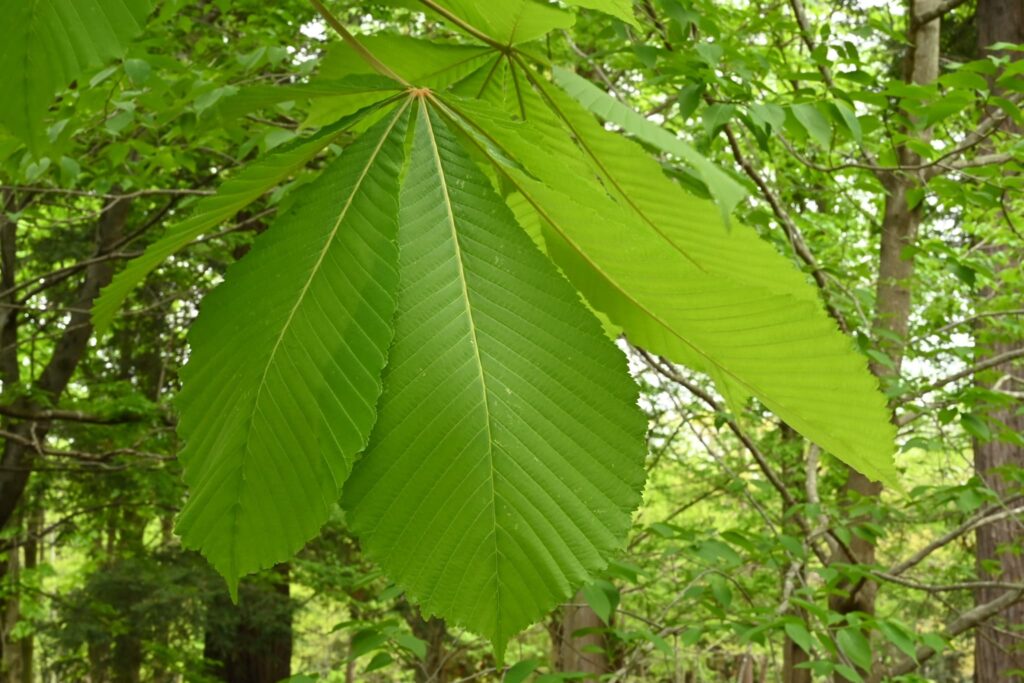
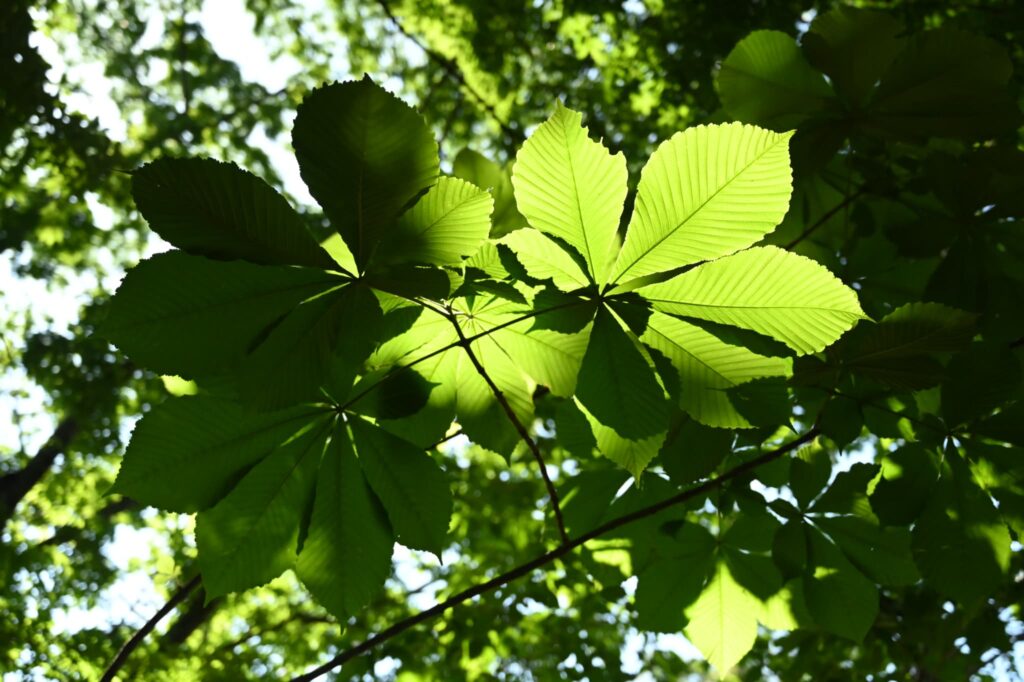
| Leaves | Palmately compound, 5–9 leaflets, up to 30 cm across |
| Flowers | Small, pale purple-centered, in tall conical clusters |
| Fruit | Glossy round capsule with chestnut-like seed inside |
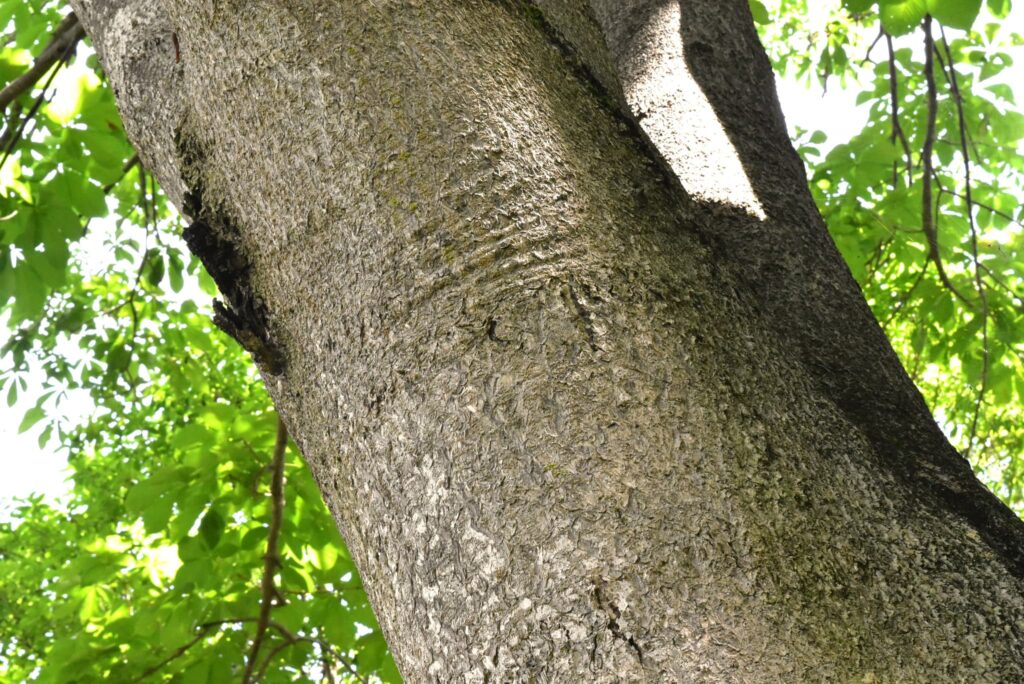
| Bark | Gray, vertically wrinkled, developing a patterned texture with age |
| Winter Buds | Large (about 1 cm), coated in glossy, sticky, dark resin |
Foliage
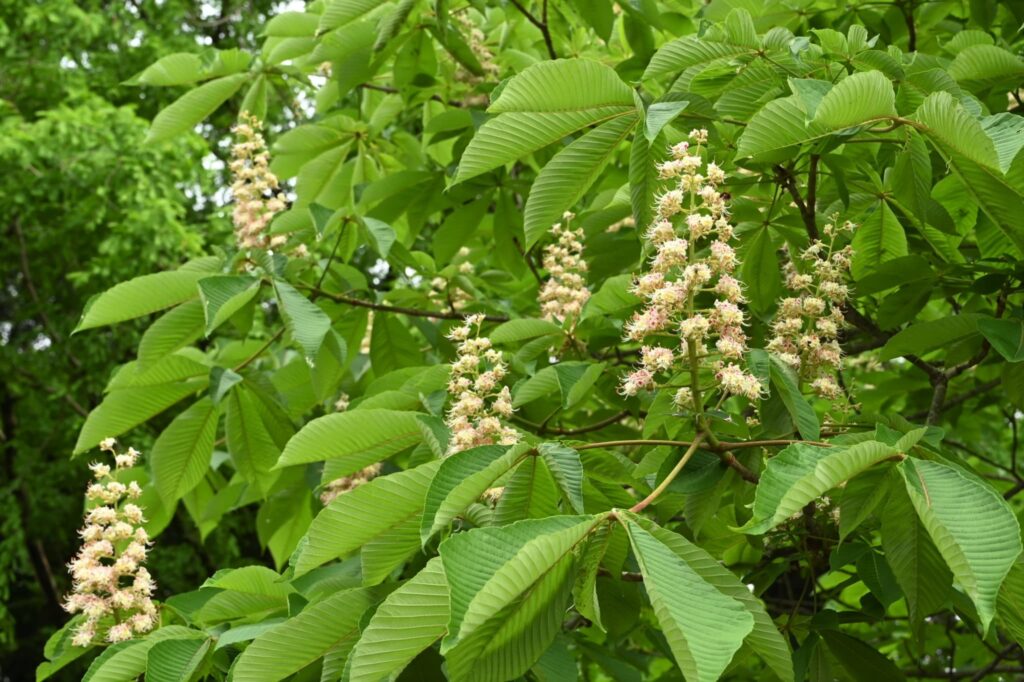
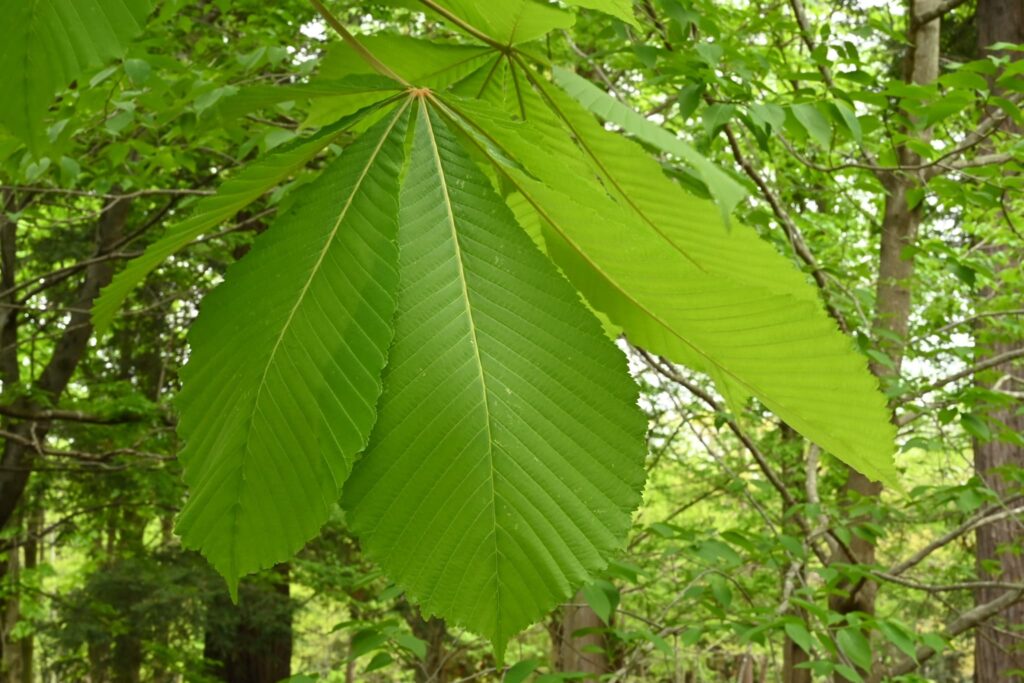
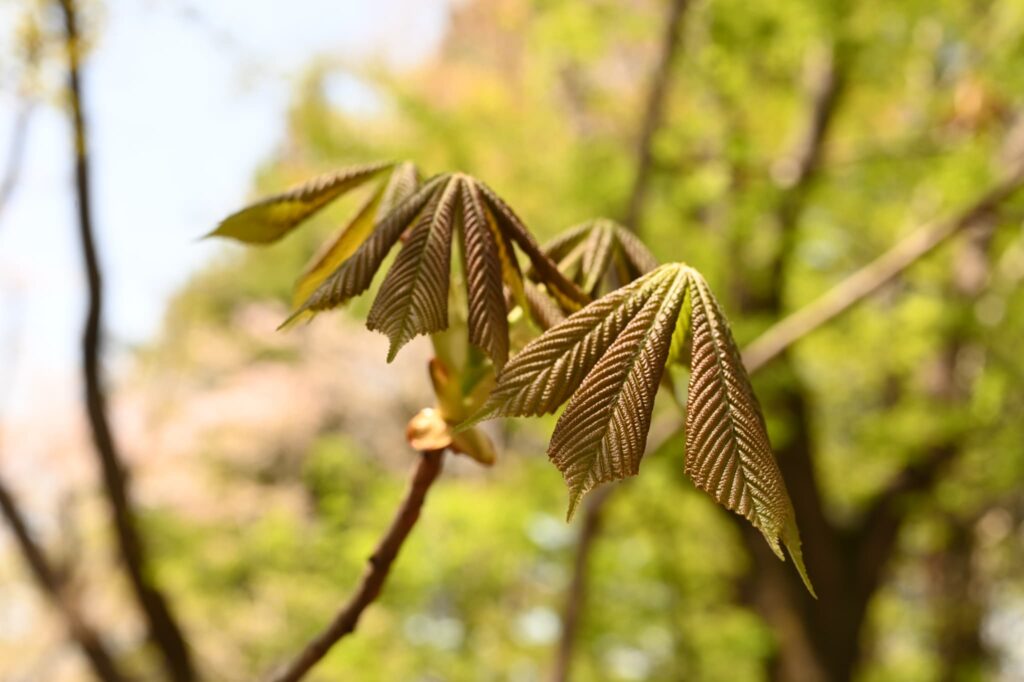
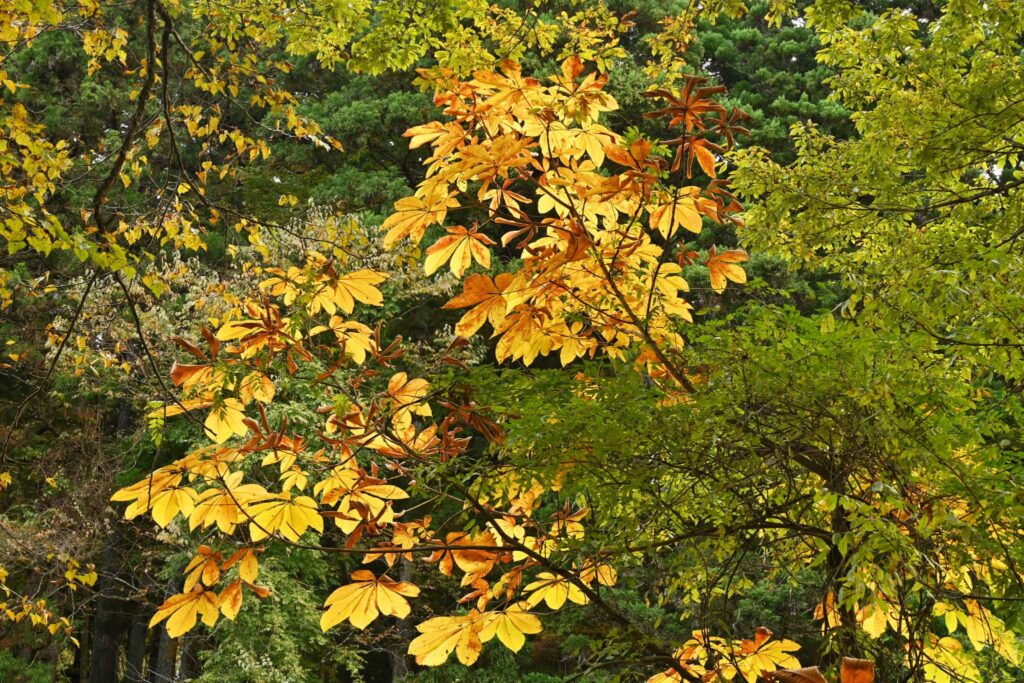
Japanese Horse Chestnut’s leaves resemble an oversized version of the houseplant Pachira, palmately compound with five to nine leaflets making up each leaf. This structure has also earned it the Japanese kanji name “seven-leaf tree” (shichiyouju)—though the tree genuinely called “seven-leaf tree” in China is actually a different, related species.
Individual leaves can reach about 30 cm across on the largest specimens, with leaves higher in the canopy generally smaller than those lower down, an arrangement that helps ensure the whole tree receives adequate light. The leaf margins bear gentle, rounded serrations—a useful clue for telling the tree apart from the similarly large-leaved Houba Magnolia. The leaves themselves aren’t edible, but in the Chichibu region of Saitama Prefecture, a traditional dish called tsutokko wraps sekihan (red rice) in Japanese Horse Chestnut leaves.
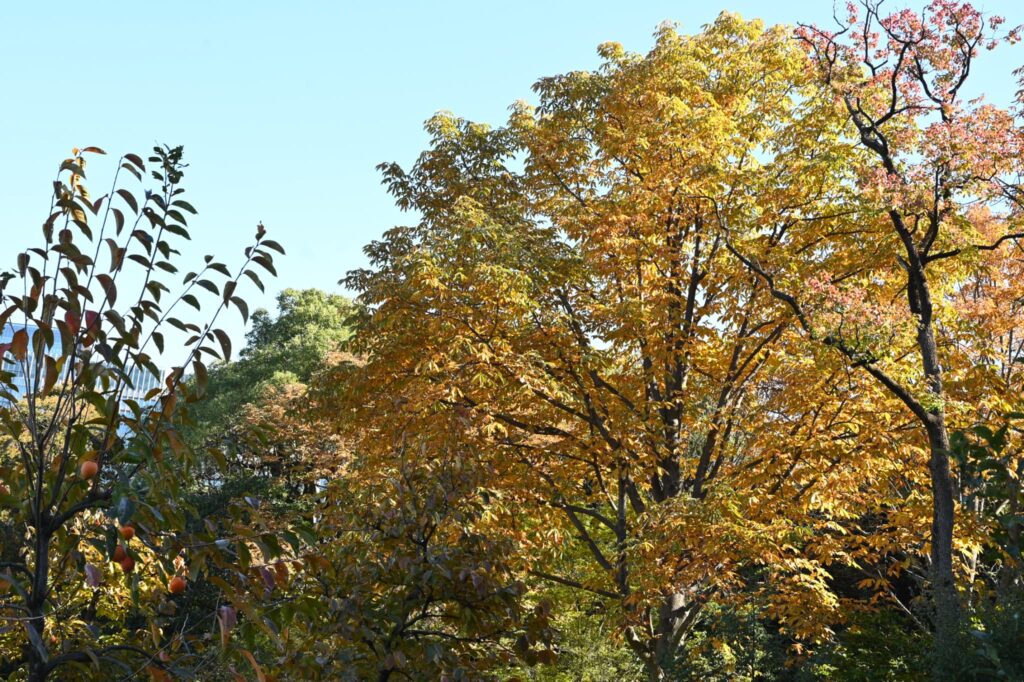
The large compound leaves turn bright yellow in autumn before falling all at once, often creating a striking carpet beneath mature trees.
Flowers
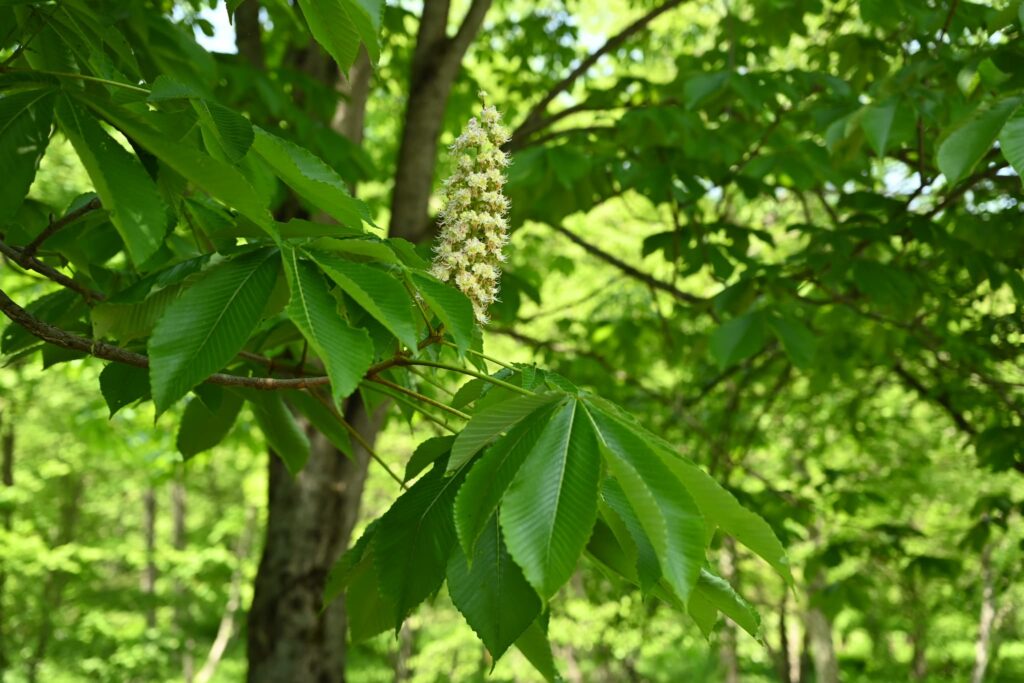
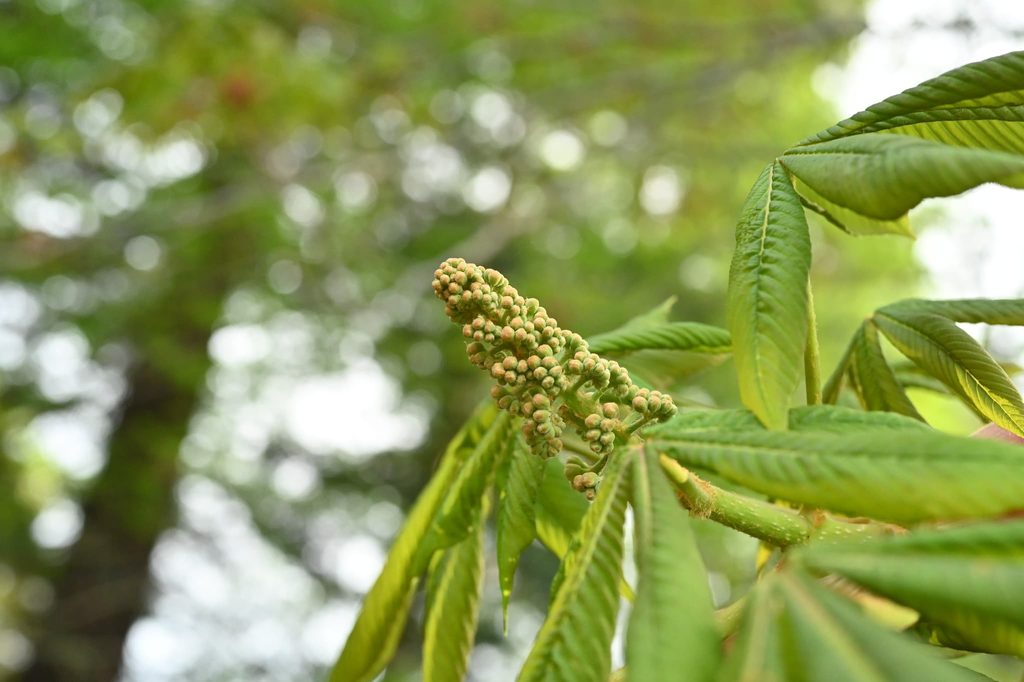
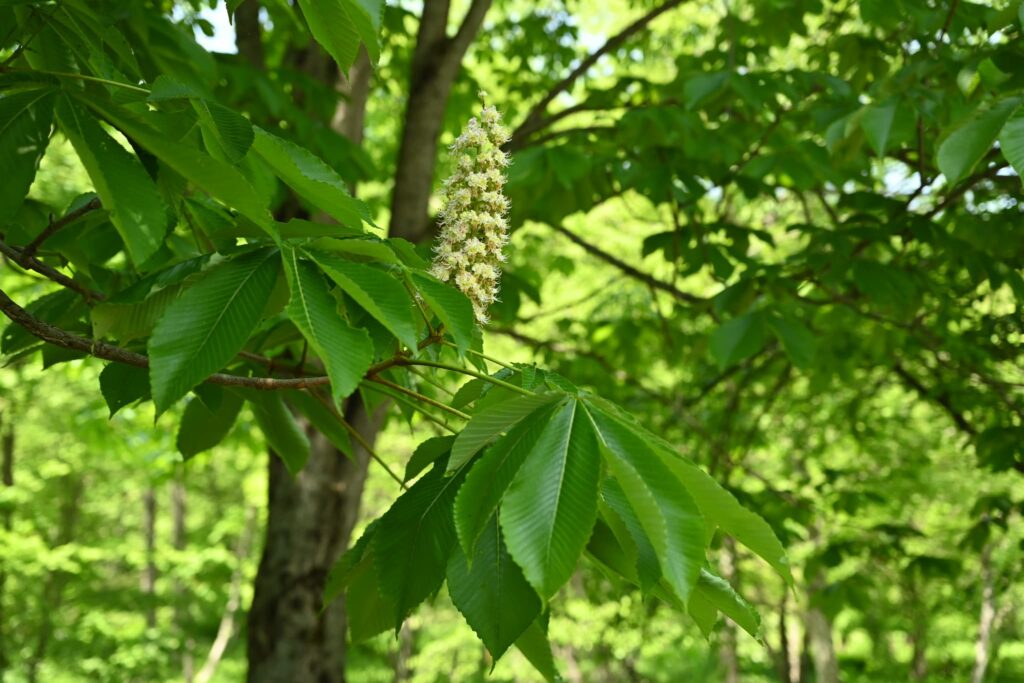
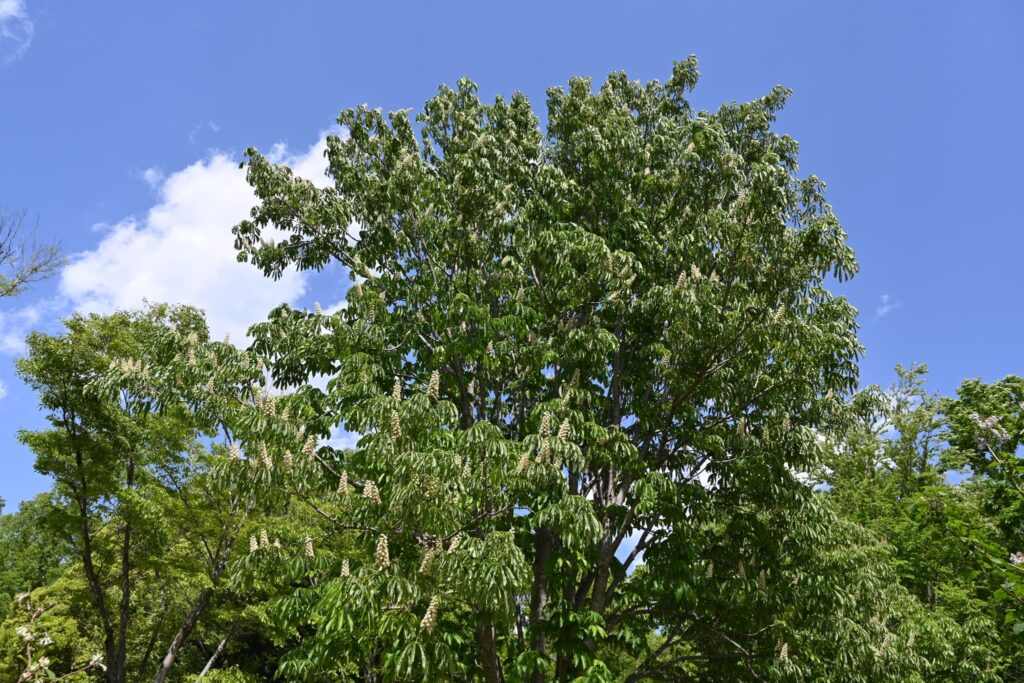
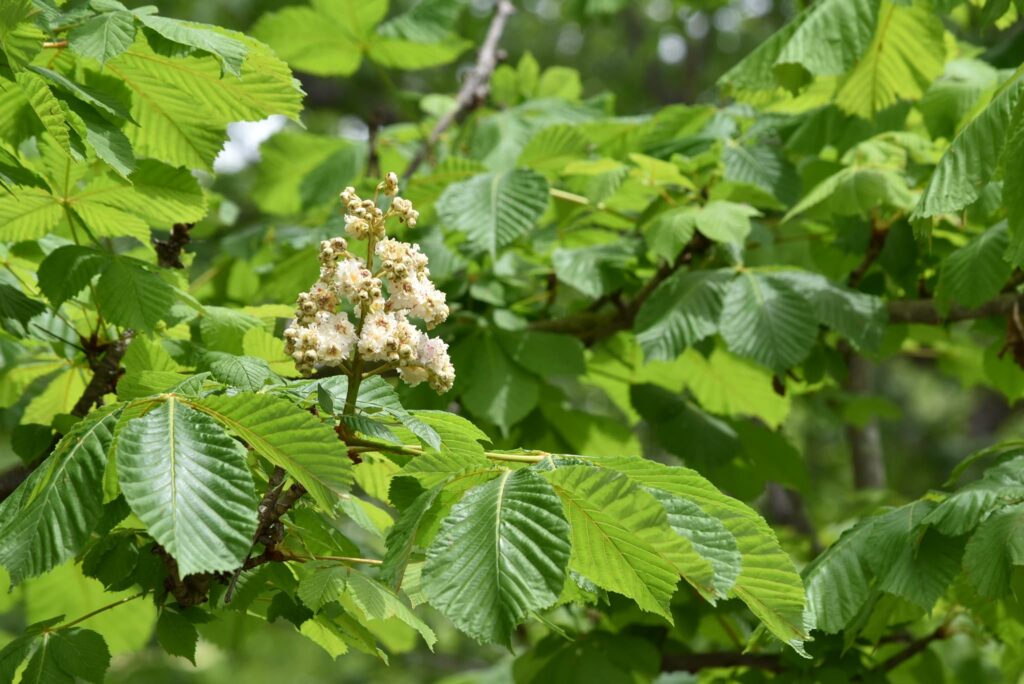
Japanese Horse Chestnut flowers in May and June, producing numerous small, fragrant flowers in tall, cone-shaped clusters at the ends of branches. The flowers are held upright, making the large clusters conspicuous from a distance, although they can be difficult to appreciate closely when they occur high in the canopy. Each flower cluster can reach about 25 cm in height, with individual flowers roughly 1.5 cm across.
The clusters contain both male and bisexual flowers, with male flowers concentrated toward the upper part of the cluster and bisexual flowers more common toward the lower part. The flowers have four petals, typically creamy white with pale pink to purple markings near the center. Male flowers are more numerous than bisexual flowers within a cluster.
The flowers produce abundant nectar and are visited by honeybees and other pollinators. In Japan, Japanese Horse Chestnut is also valued as a nectar source for beekeeping, and flowering trees can attract large numbers of bees.
Fruits
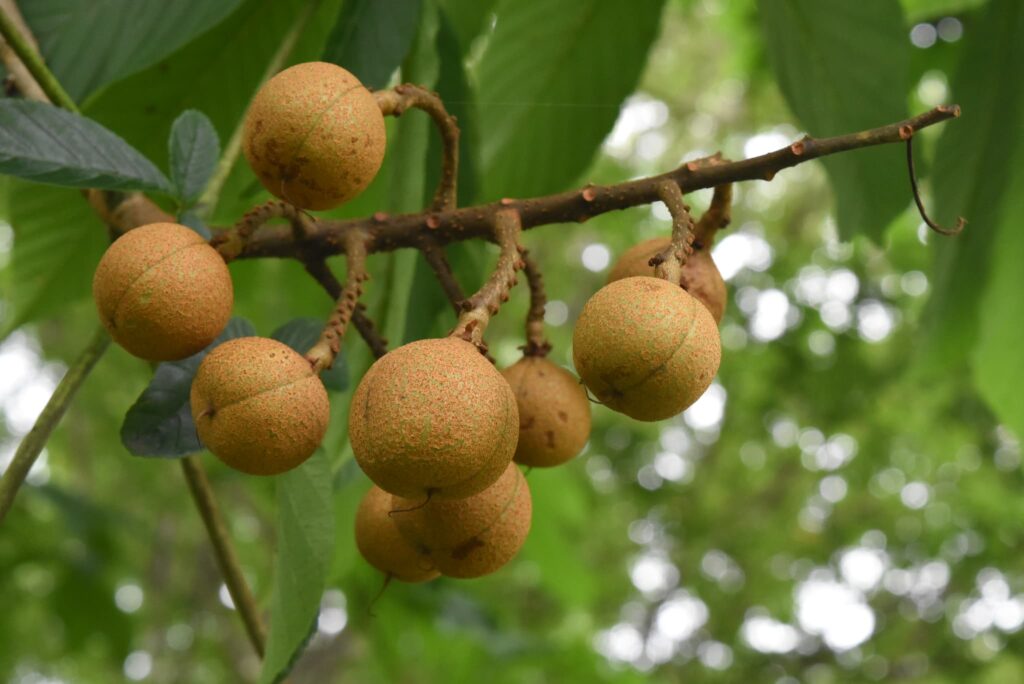
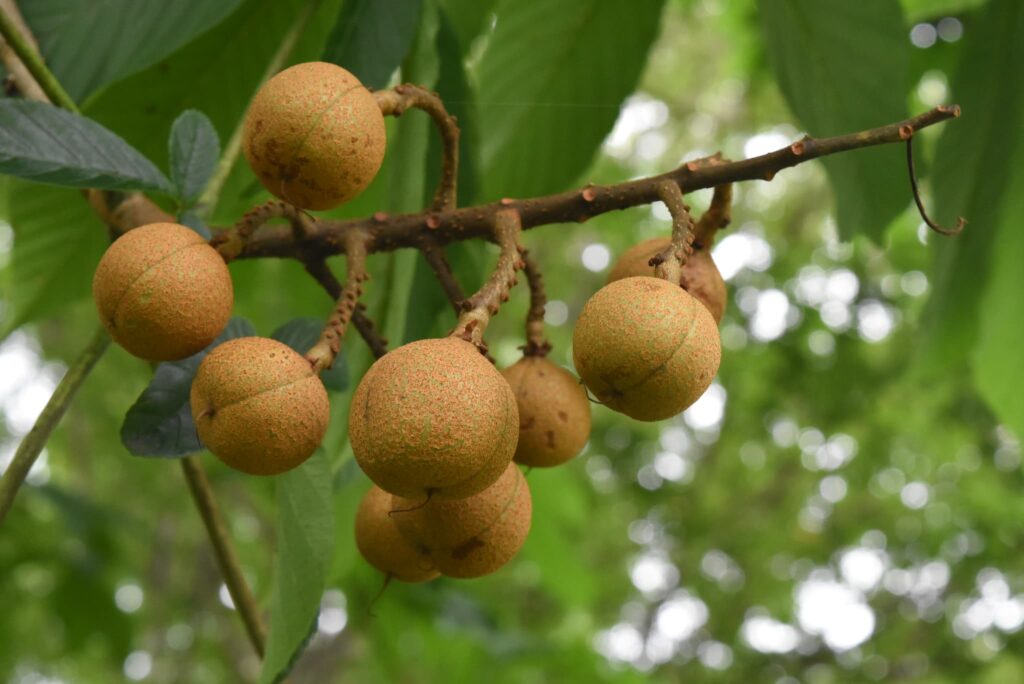
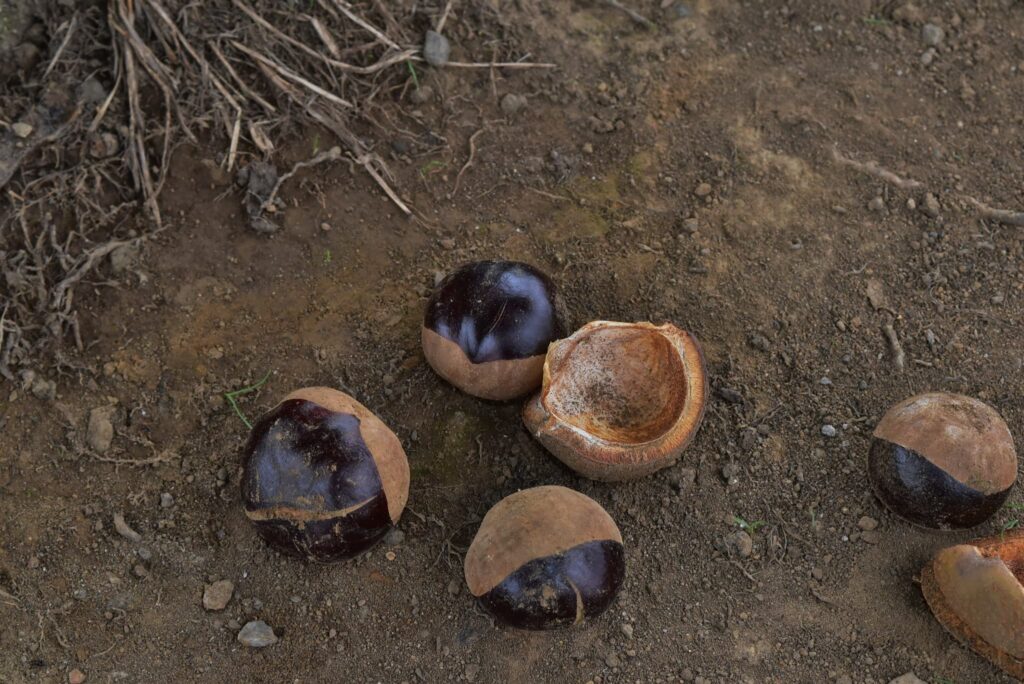
The fruit is a glossy, round to pear-shaped capsule about 3–5 cm long, with low, blunt bumps on the surface. At maturity, it splits into three sections, revealing one or two shiny, chestnut-like seeds. The seed is rich in starch and can be eaten after extensive processing to remove bitter and toxic compounds.
Bark & Timber
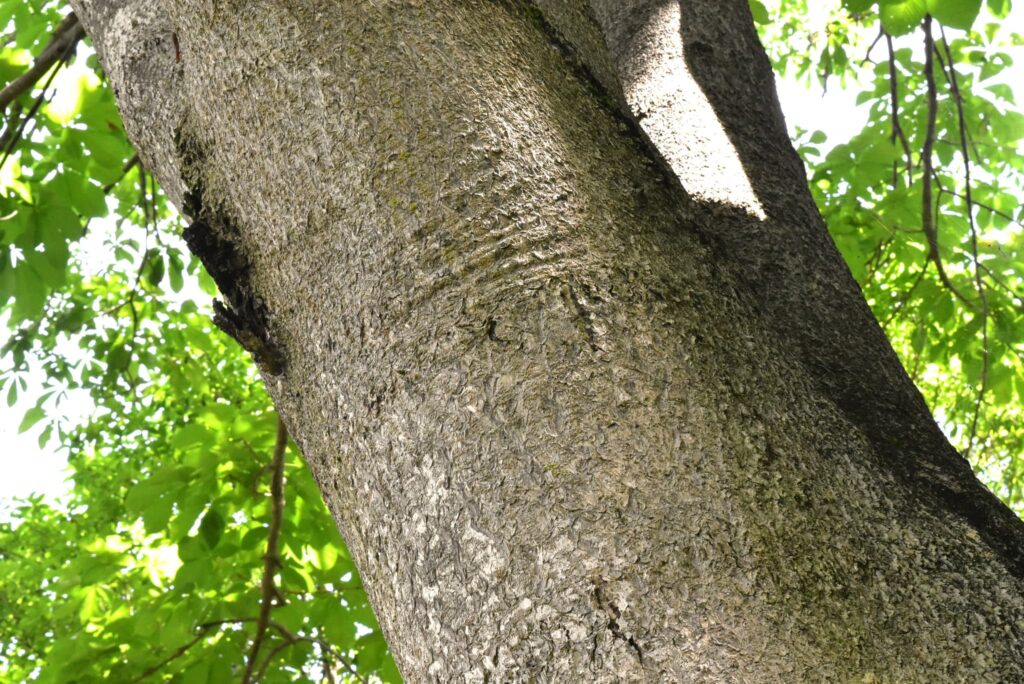
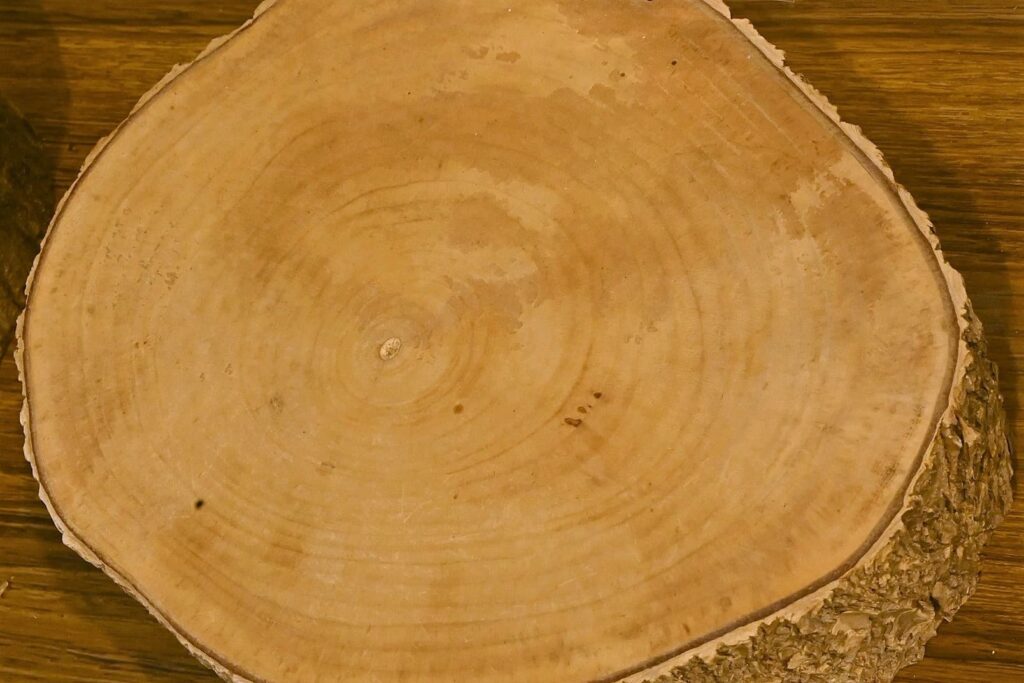
Japanese Horse Chestnut develops gray to grayish-brown bark that becomes increasingly irregular and fissured with age. Young trunks are relatively smooth, but older trees develop vertical cracks and a distinctive, rugged texture. The large, straight trunks of mature trees can produce substantial quantities of timber.
The wood is relatively light and soft for a broadleaf hardwood, making it easy to cut and work. It is pale yellowish-white to light yellow-brown, with little distinction between the sapwood and heartwood, and a fine texture that can take on a silky sheen when finished. The grain is sometimes irregular, and large trees may produce attractive figured patterns such as chijimi-moku (縮み杢, rippled or curly figure) and nami-moku (波杢, wavy figure). Particularly beautiful figured wood is valued for decorative and craft uses.
The wood is not highly durable and is prone to decay, so it is less suitable for exposed or structural applications than more durable Japanese hardwoods. Instead, it has traditionally been used for furniture, household utensils, bowls, trays, musical instruments, and other wooden crafts. Large pieces of figured timber are especially prized for furniture and traditional craftwork.
In Japan, Japanese Horse Chestnut wood is also associated with turned woodenware, including bowls and other vessels. Its combination of workable wood, fine texture, and attractive figure has made it a valued native timber despite its relatively low durability.
Size & Growth
Japanese Horse Chestnut grows into one of Japan’s largest deciduous trees, reaching 20–30 m in height (occasionally taller) with a trunk that can exceed 2 m in diameter. Growth is moderate to fast, and long-lived specimens beside mountain streams and shrines commonly live 200–500 years, with the oldest often designated as protected natural monuments.
The tree is slow to reach reproductive maturity, and in Japan its long juvenile period gave rise to the saying that it takes three generations to grow a Tochi tree for its fruit. Once mature, the tree can produce substantial crops of seeds, although strong winds can cause the fruits to fall before they are fully ripe.
Mature trees also play an ecological role along mountain streams, offering nesting sites and shade, and their fallen seeds are eaten by wildlife able to tolerate or break down the bitter saponins they contain.
Uses & Cultural Significance
Traditional Food Uses
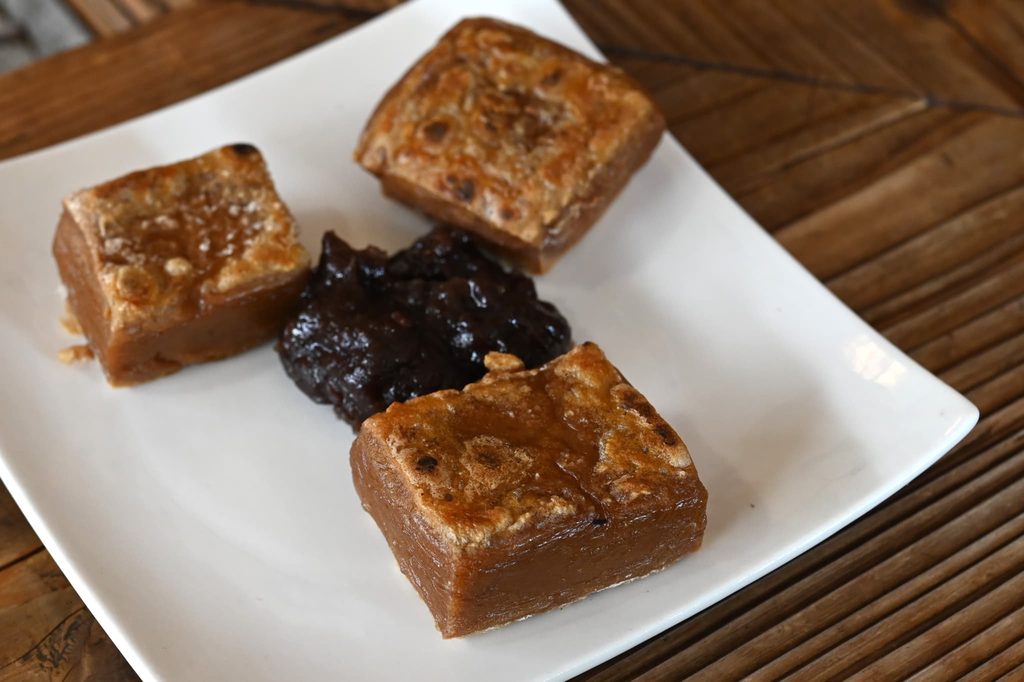
Because the seeds are rich in starch and can be eaten after extensive processing, Japanese Horse Chestnut has a long relationship with Japanese food culture—remains have even been found at Jomon-period archaeological sites. The seeds became a crucial nutritional resource for ordinary people during famines of the Edo period and again in the food shortages following World War II, and in some regions they were valuable enough to be included as part of a bride’s dowry. As a reminder of this history, many old, large specimens across Japan have been designated as natural monuments.
Today, the seeds are still eaten as tochi-mochi (pounded together with glutinous rice) or prepared as porridge. However, the seeds contain bitter saponins and other compounds that must be removed through thorough processing before they are eaten. Without thorough leaching to remove these bitter compounds, eating them can cause diarrhea, gastroenteritis, and dehydration. This relative inferiority to true chestnuts is reflected in the tree’s alternate Japanese name, “horse chestnut” (uma-guri)—and this same name is also the origin of the tree’s English common name.
Beyond food, the seeds have a range of other traditional applications: the saponins they contain have been used as a soap substitute, and preparations made by soaking the seeds in shochu or by roasting and kneading them with oil have been used as topical remedies. This long juvenile period is reflected in the Japanese proverb that it takes three generations to grow a Tochi tree for its fruit.
Naming: The Origin of “Tochinoki”
Several theories exist for the origin of the name Tochinoki, but the most widely cited interprets it as meaning roughly “a tree bearing many, many fruits”—with “to” representing the number ten and “chi” representing the number one thousand. (Notably, the tree was written with different characters, “止知,” during the Nara period.)
The tree is written in Japanese using several different kanji—”栃の木,” “杤,” and “橡”—though “栃” has been the most common choice since Tochigi Prefecture was established in the Meiji era. Notably, in Chinese, the character “橡” instead refers to Kunugi (Sawtooth Oak), an entirely different tree.
Growing Guide
| Item | Description |
|---|---|
| Growth Rate | Moderate to Fast |
| Longevity | 200–500 years |
| Salt Tolerance | Poor |
| Drought Tolerance | Moderate |
| Urban Tolerance | Moderate |
Light & Soil
Japanese Horse Chestnut grows best in full sun but tolerates partial shade. It prefers deep, fertile soil with good moisture retention and good drainage. In the wild, it is commonly found along moist mountain streams and in other areas with reliable soil moisture.
Watering
Japanese Horse Chestnut prefers consistently moist soil, especially while young. Water deeply during prolonged dry periods, particularly in summer, and do not allow newly planted trees to become severely dehydrated. Mature trees growing in suitable soil generally require little supplemental watering once established, but they can suffer from prolonged drought.
Wind Tolerance
Japanese Horse Chestnut is sensitive to strong wind. Its fruit, in particular, is easily knocked down in Japan’s typhoon-prone climate, which is a practical consideration for street and park plantings.
Cold Hardiness
Japanese Horse Chestnut is generally hardy in USDA Zones 5–7.
Pruning
Thanks to its naturally attractive form, formative pruning needs are generally light. In street and park settings, some canopy management may be considered given the tree’s ultimate size and the nuisance caused by dropping fruit in autumn.
Suitability for Home Gardens
Generally not well suited to small home gardens. The tree grows both tall and wide-canopied, and needs significant open space to develop its naturally attractive form—it’s much better suited to parks, wide streets, or large properties.
Pests
The species can be affected by leaf-mining moths and other pests and diseases, although serious problems are not necessarily common in all growing conditions.
Cultivars
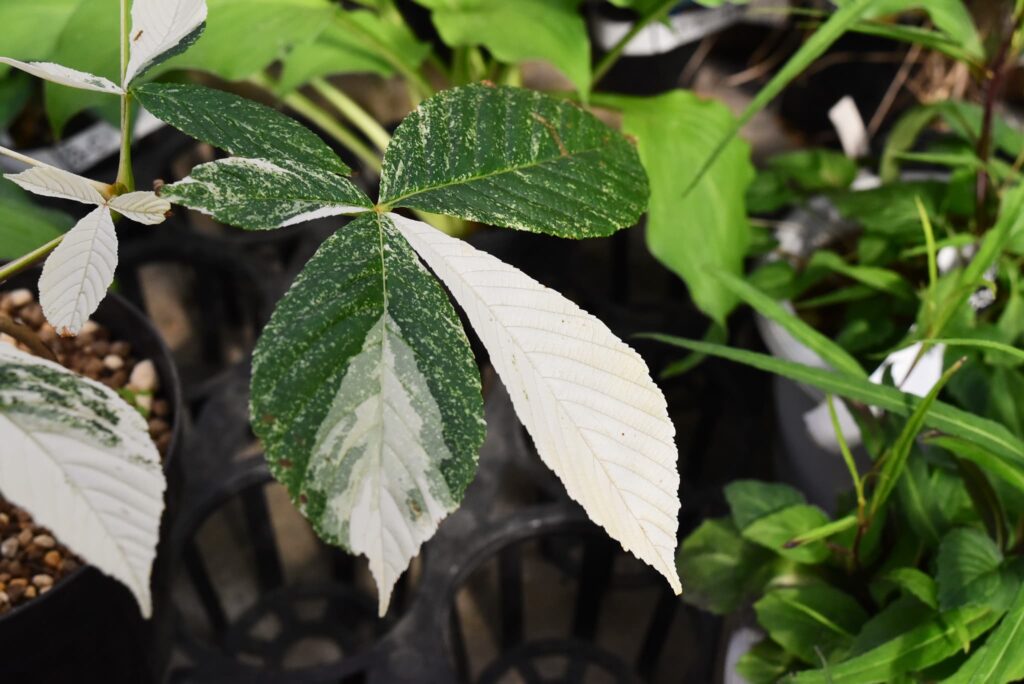
- Several cultivated selections of Japanese Horse Chestnut are known, including variegated forms such as ‘Marble Chip’ and ‘Morton Variegated’. ‘Morton Variegated’ has dark green, palmately compound leaves marked with conspicuous white blotches. These selections are primarily valued for their distinctive foliage rather than for differences in flowers or fruit.
Similar Species
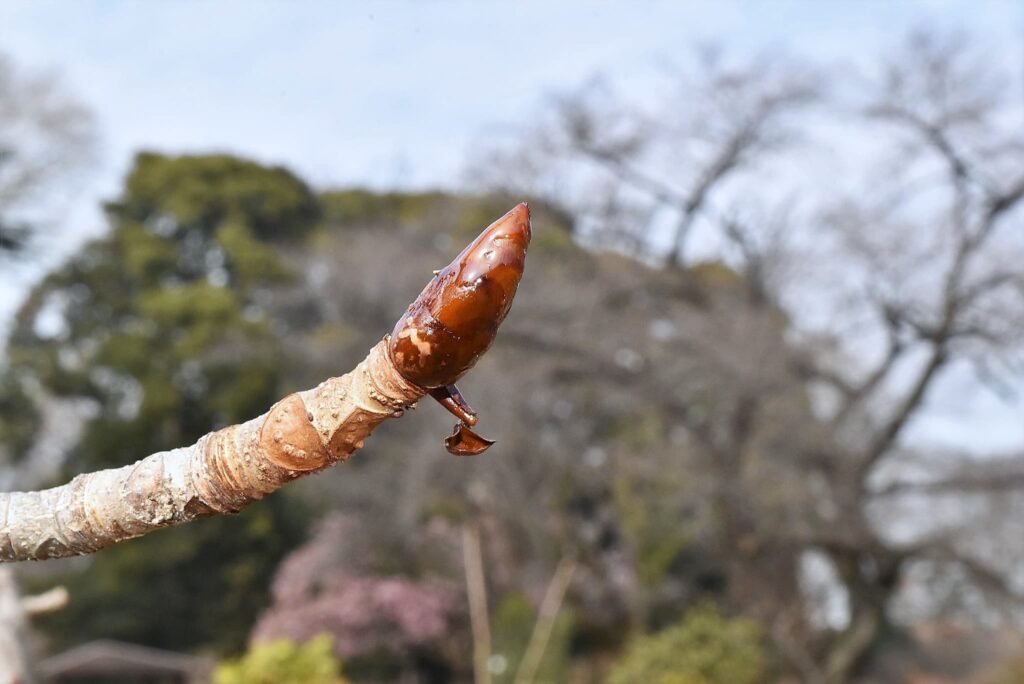
Common Horse Chestnut (Aesculus hippocastanum) , also known as European Horse Chestnut or Marronnier— a closely related European species, famous as a Paris street tree. Its leaves are smaller and more wrinkled than Japanese Horse Chestnut’s, with larger marginal serrations. Unlike Japanese Horse Chestnut’s sticky winter buds, Common Horse Chestnut’s buds are dry, and its fruit husk is spiny—a major visual difference from Japanese Horse Chestnut’s low-bumped, tuberculate capsule.
| Feature | Japanese Horse Chestnut (Aesculus turbinata) | Common Horse Chestnut (Aesculus hippocastanum) |
|---|---|---|
| Native Range | Japan | Southeastern Europe |
| Leaves | Larger, usually 5–9 leaflets, margins finely serrated | Smaller, usually 5–7 leaflets, margins more coarsely serrated |
| Flowers | Creamy white with pale pink to purple markings | White with conspicuous yellow to red markings |
| Flower Clusters | Tall, slender, and relatively open | Shorter, denser, and more compact |
| Winter Buds | Large, glossy, and sticky with resin | Large but dry and non-sticky |
| Fruit Husk | Covered with low bumps (tuberculate) | Densely covered with sharp spines |
| Seeds | Larger | Smaller |
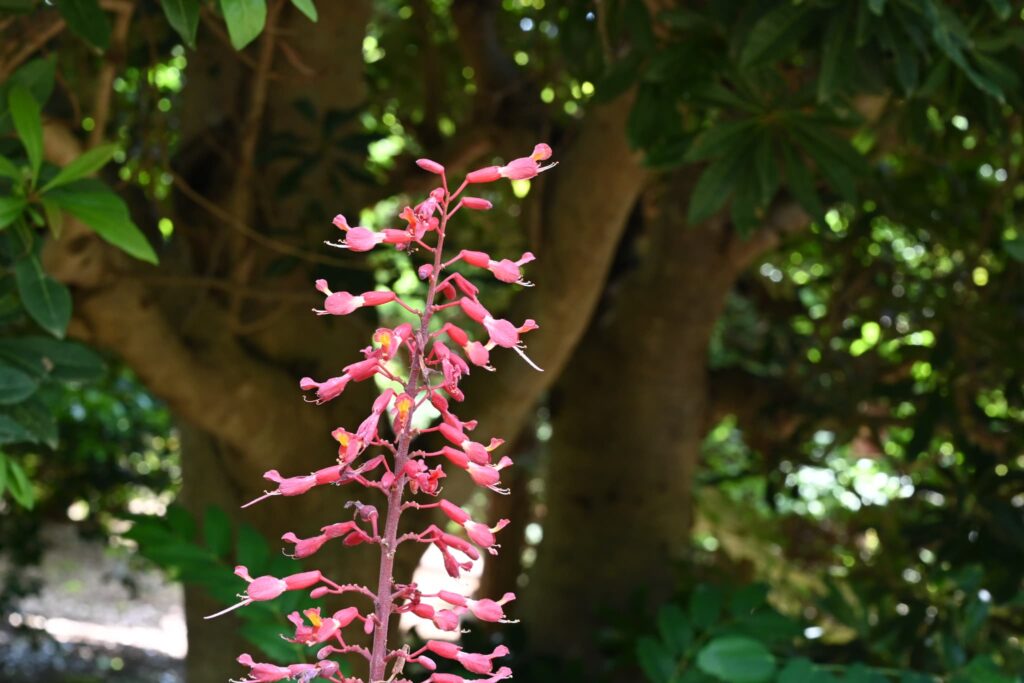
Red Horse Chestnut (Aesculus pavia) — native to the southern United States, with vividly crimson flowers.
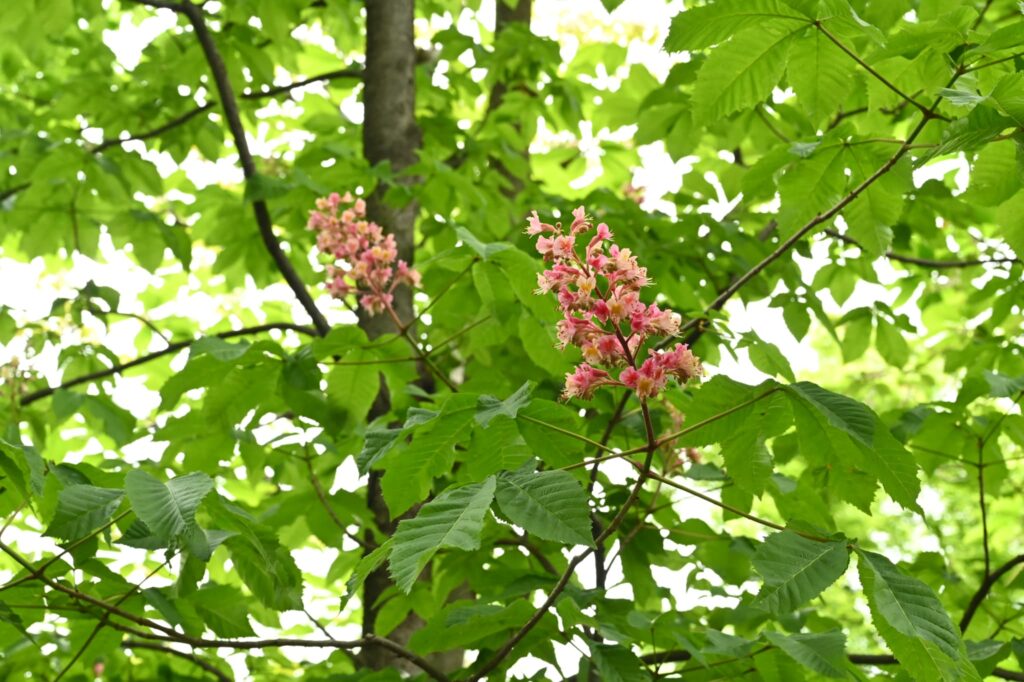
Aesculus × carnea (Ruby Horse Chestnut) — a hybrid between Common Horse Chestnut and Red Horse Chestnut, sharing Common Horse Chestnut’s spiny fruit husk. Its leaves show more surface wrinkling than Japanese Horse Chestnut’s, and its flower color is paler than Red Horse Chestnut’s.
Frequently Asked Questions
Are Japanese Horse Chestnut seeds safe to eat?
Only after proper processing. The seeds contain bitter saponins and other compounds that make them unsuitable to eat raw. Traditional processing involves extensive soaking and leaching to remove these compounds before the seeds are used as food.
Why has Japanese Horse Chestnut become less common as a street tree?
Its large, dropping fruit can become a nuisance and even a hazard underfoot along busy walkways, which has led many municipalities to favor other street tree species in more recent plantings. It remains valued for the shade of its large canopy and its attractive spring and autumn foliage, but its fruit drop is a genuine practical drawback in high-traffic areas.
How can I tell Japanese Horse Chestnut apart from Common Horse Chestnut?
Check the winter buds and fruit. Japanese Horse Chestnut’s winter buds are coated in a sticky, glossy resin, while Common Horse Chestnut’s are dry. Japanese Horse Chestnut’s fruit capsule has low, blunt bumps, while Common Horse Chestnut’s has a densely spiny husk. Common Horse Chestnut’s leaves are also smaller, more wrinkled, and more coarsely toothed than Japanese Horse Chestnut’s.
Why does Japanese Horse Chestnut take so long to produce fruit?
The tree is famously slow to mature, giving rise to the old proverb “a fool cuts down a Tochi tree; a fool plants one,” referring to the fact that it can take roughly three tree-generations before a planted tree bears fruit. This long timeline is part of why grafted or already-mature specimens, rather than young saplings, are often preferred when fruiting matters.
Is Japanese Horse Chestnut suitable for a small garden?
Generally not. It grows into a genuinely large tree, both tall and wide-canopied, and needs significant open space to develop its naturally attractive form. It’s much better suited to parks, wide streets, or large properties than to a typical residential garden.
Is Japanese Horse Chestnut the same as European Horse Chestnut?
No. Although both belong to the genus Aesculus, Japanese Horse Chestnut (Aesculus turbinata) is native to Japan, has larger leaves and seeds, and has long been used as a traditional food source after careful processing.
Conclusion
Few Japanese native trees combine practical history, cultural significance, and ornamental value as closely as Japanese Horse Chestnut. Its large palmate leaves, fragrant upright flower clusters, sticky winter buds, distinctive fruit, and yellow autumn foliage make it an impressive tree throughout the growing season.
For centuries, its starch-rich seeds served as an important traditional food resource, particularly during periods of famine and food shortage. The wood has also been valued for its light weight, workability, attractive grain, and use in furniture and traditional crafts. Today, the species is more commonly appreciated as a large landscape tree, particularly in parks, spacious gardens, and other sites where its substantial size and falling fruit are not a problem.
Whether encountered along a mountain stream, in an old shrine precinct, or as a mature landscape tree, Japanese Horse Chestnut remains one of Japan’s most distinctive native deciduous trees.