Japanese Yew (Taxus cuspidata): Identification, Care & Uses
Japanese Yew (Taxus cuspidata) is a slow-growing evergreen conifer valued for its dense foliage, attractive natural form, and bright red arils. Native to Japan and parts of northeastern Asia, it has long been important in Japanese gardens, traditional woodworking, and carving. This guide covers identification, flowers, fruit, bark, timber, cultivars, and cultivation.
What Is Japanese Yew?
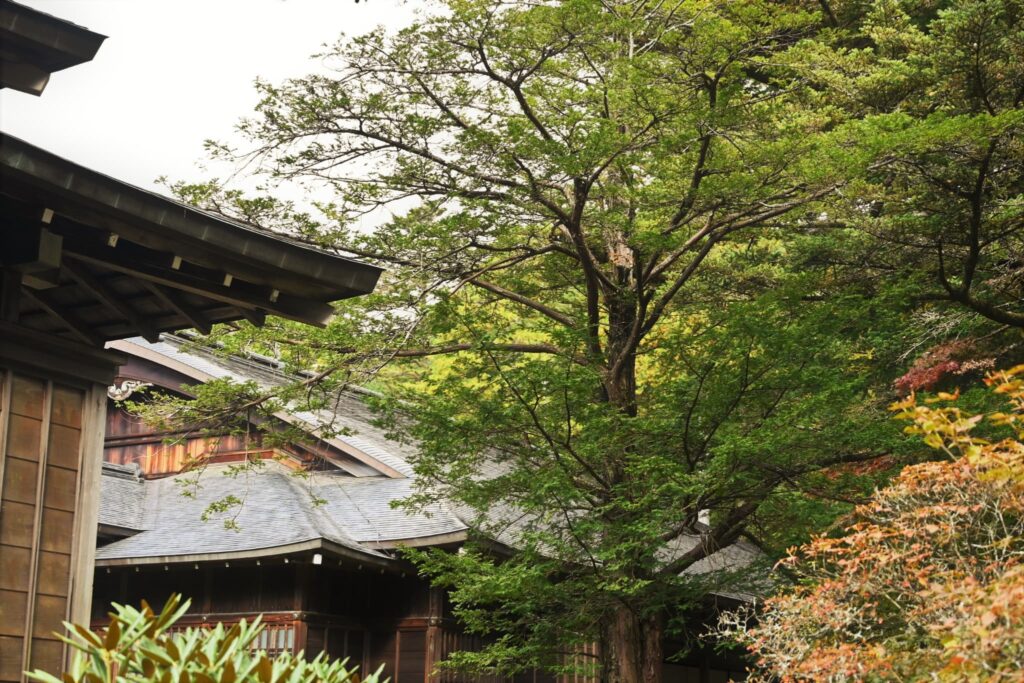
Japanese Yew is an evergreen conifer in the family Taxaceae. In Japan, it occurs from Hokkaido through Honshu, Shikoku, and Kyushu, particularly in cool mountain and subalpine environments. Its natural range also extends through the Korean Peninsula, northeastern China, the Russian Far East, Sakhalin, and the Kuril Islands.
The species is dioecious, meaning that male and female flowers occur on separate trees. Female trees produce the characteristic bright red arils surrounding a single seed.
In northern Japan, Japanese Yew is commonly known as Onko, while Araragi is another traditional name.
Overview
| Item | Description |
|---|---|
| Scientific Name | Taxus cuspidata |
| Common Name | Japanese Yew |
| Japanese Name | Ichii (イチイ), also Onko and Araragi |
| Family | Taxaceae |
| Native Range | Japan, Korea, northeastern China, Russian Far East, Sakhalin, and Kuril Islands |
| Plant Type | Evergreen conifer |
| Height | Usually 10–20 m (33–66 ft), occasionally taller |
| Habit | Evergreen tree, broadly pyramidal to columnar |
| Needles | Linear, 1.5–2.5 cm long, appearing in two rows |
| Flowers | Small, inconspicuous; March–April |
| Fruit | Red fleshy aril surrounding a single seed |
| USDA Zones | 4–7 |
| Light | Full sun to shade; highly shade-tolerant |
Characteristics
| Feature | Description |
|---|---|
| Needles | Soft, linear, 1.5–2.5 cm long, with a sharp tip |
| Foliage Arrangement | Appears two-ranked along most branches |
| Fruit | Red aril surrounding a poisonous seed |
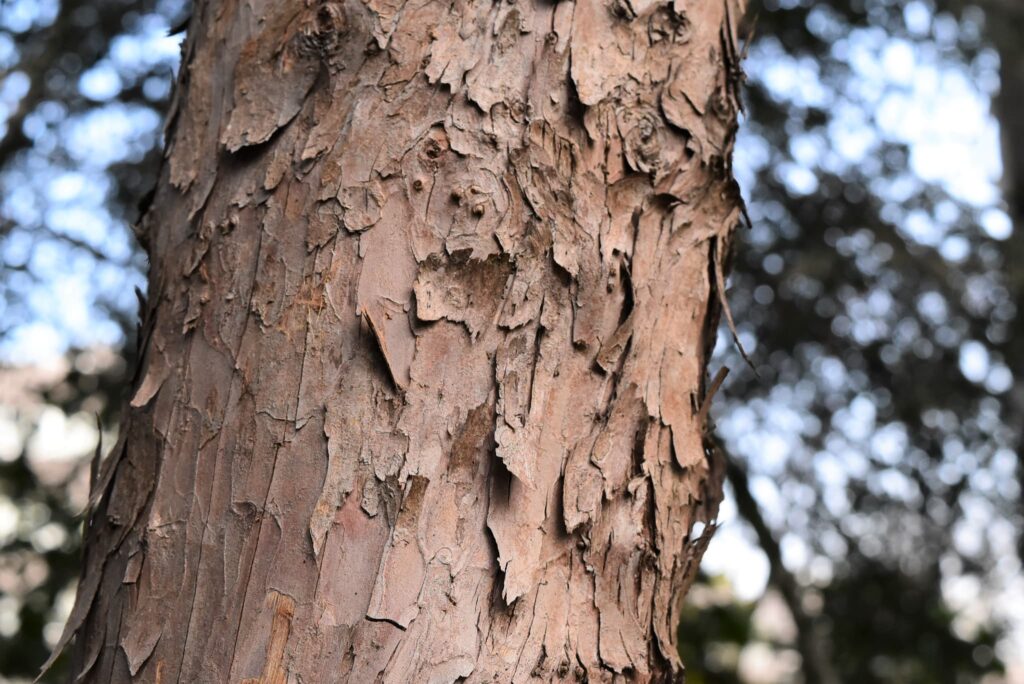
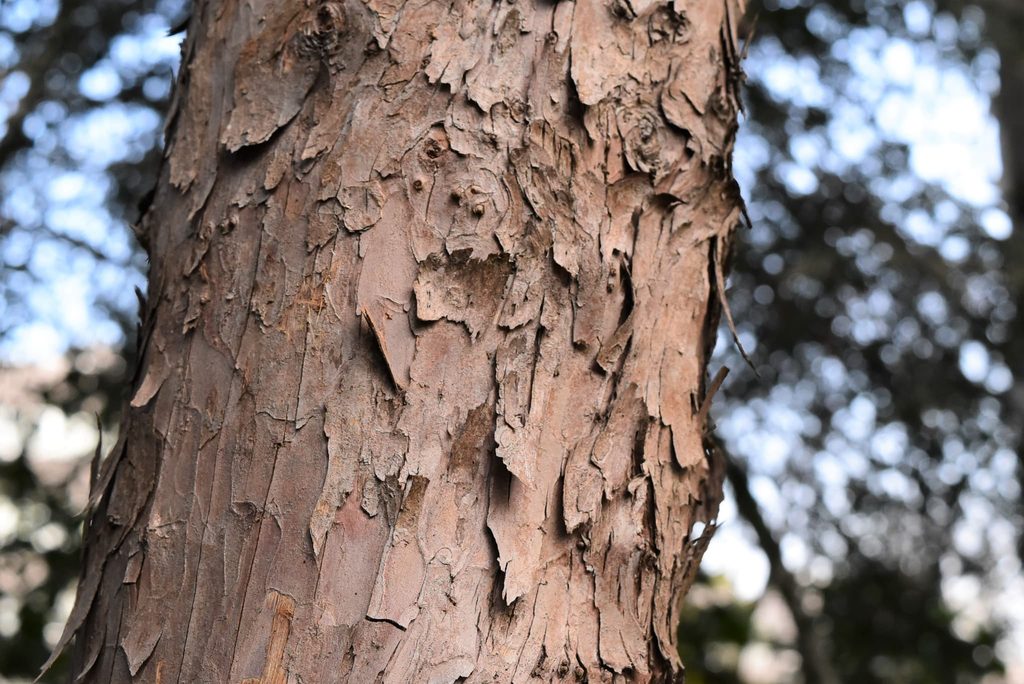
| Bark | Thin, reddish brown and flaky |
| Habit | Slow-growing, dense, pyramidal to columnar |
Foliage
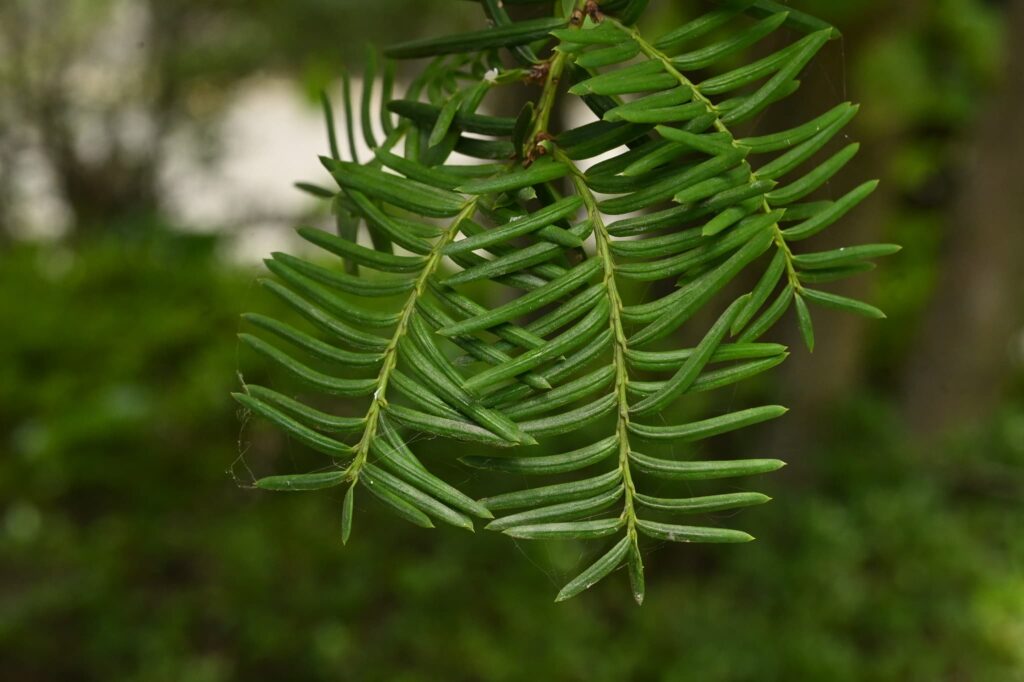
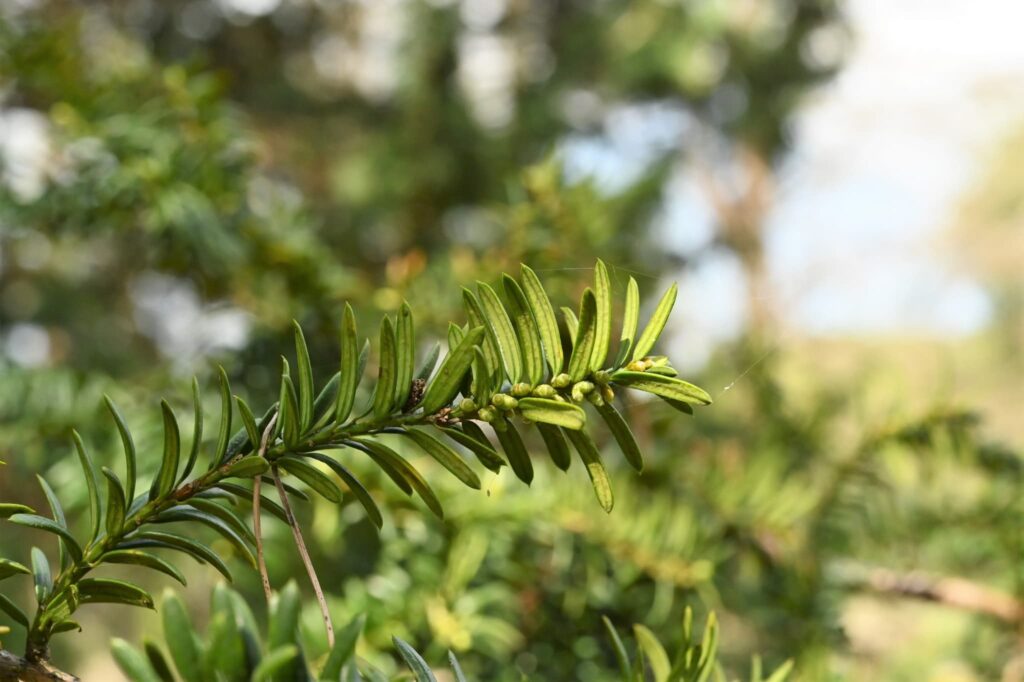
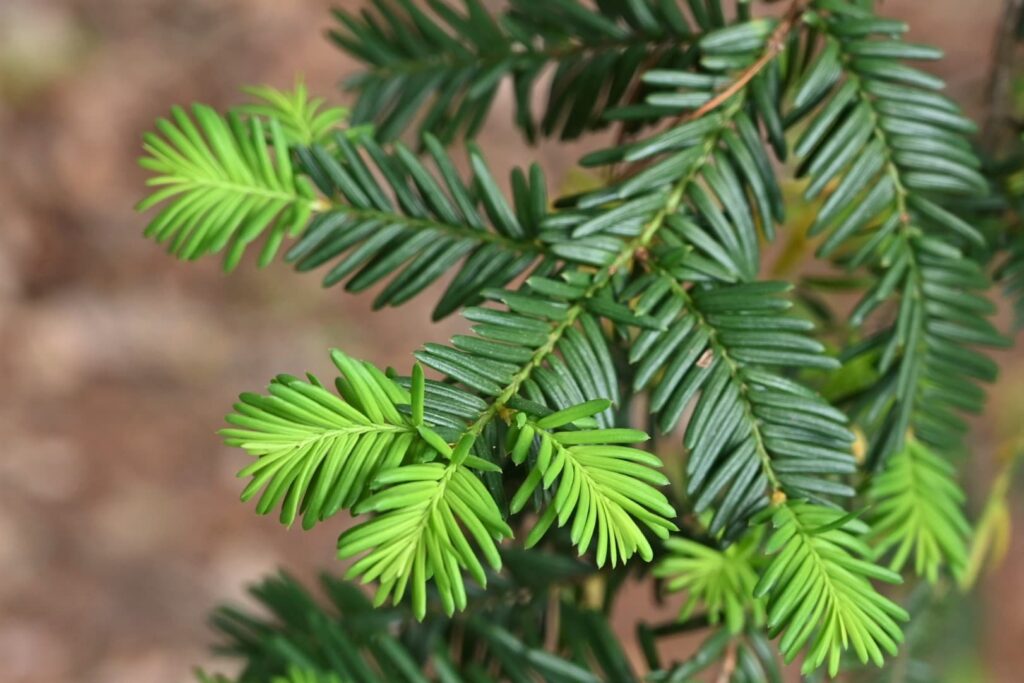
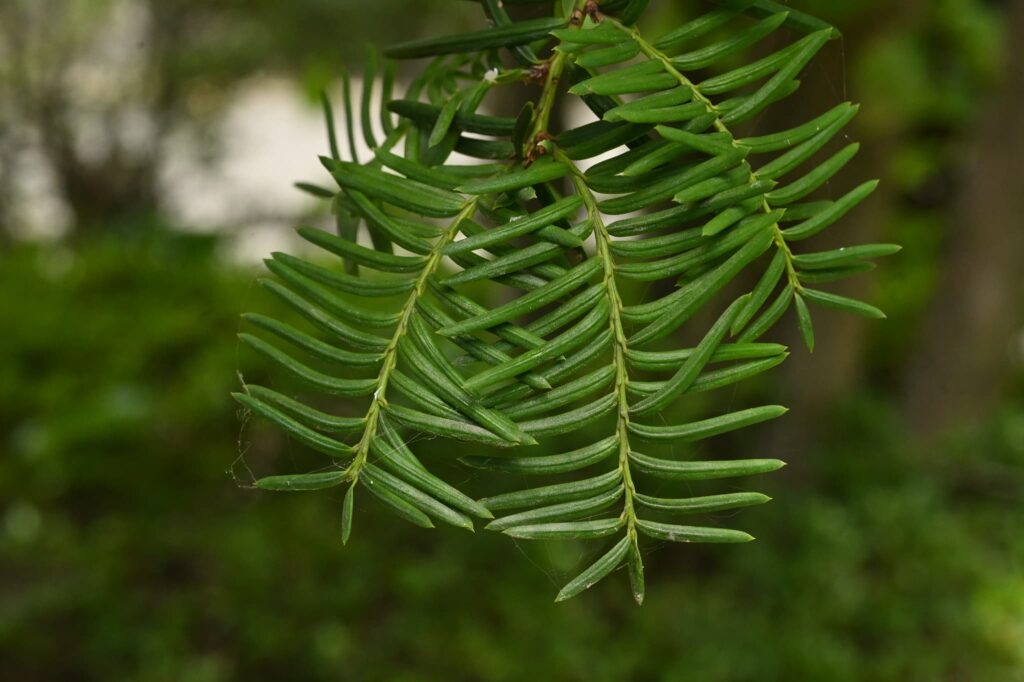
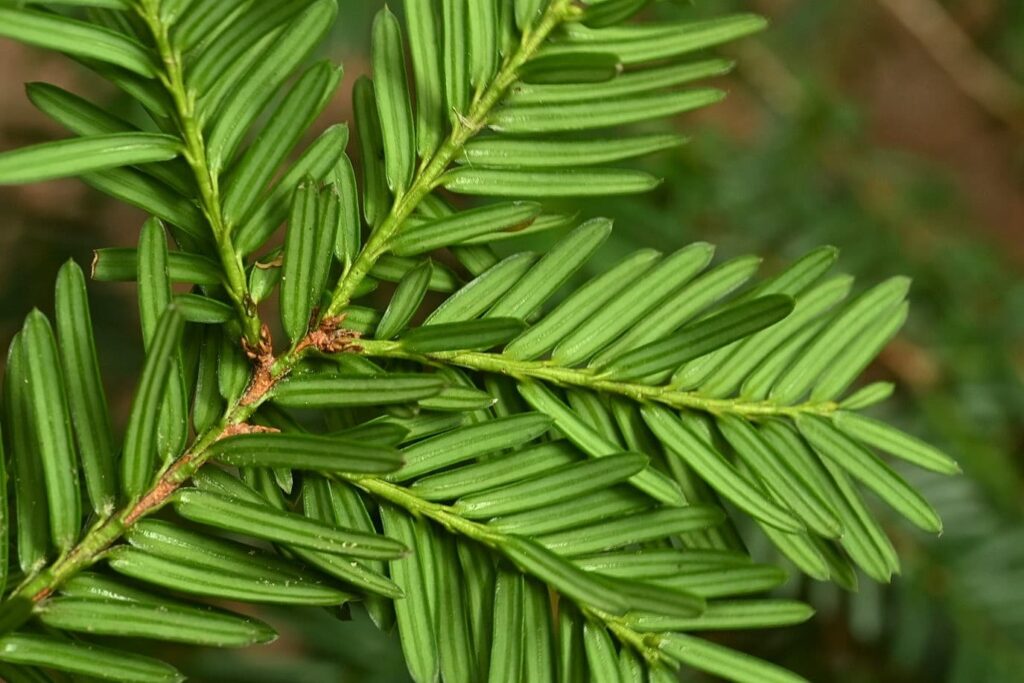
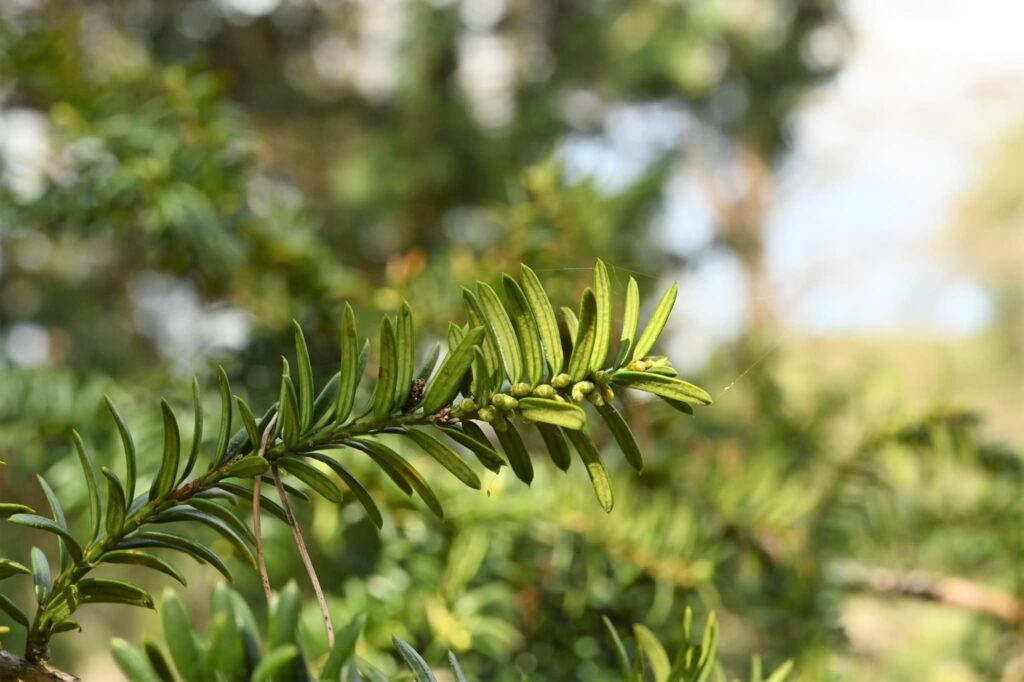
The needles of Japanese Yew are linear, dark green, and about 1.5–2.5 cm long and 2–3 mm wide. Although they are inserted spirally around the shoot, the bases of the needles twist so that they appear arranged in two flattened rows along most branches. At the shoot tips, the arrangement becomes more obviously spiral.
The underside has two conspicuous stomatal bands. The needle tip is sharply pointed but relatively soft to the touch compared with many prickly conifers.
Flowers
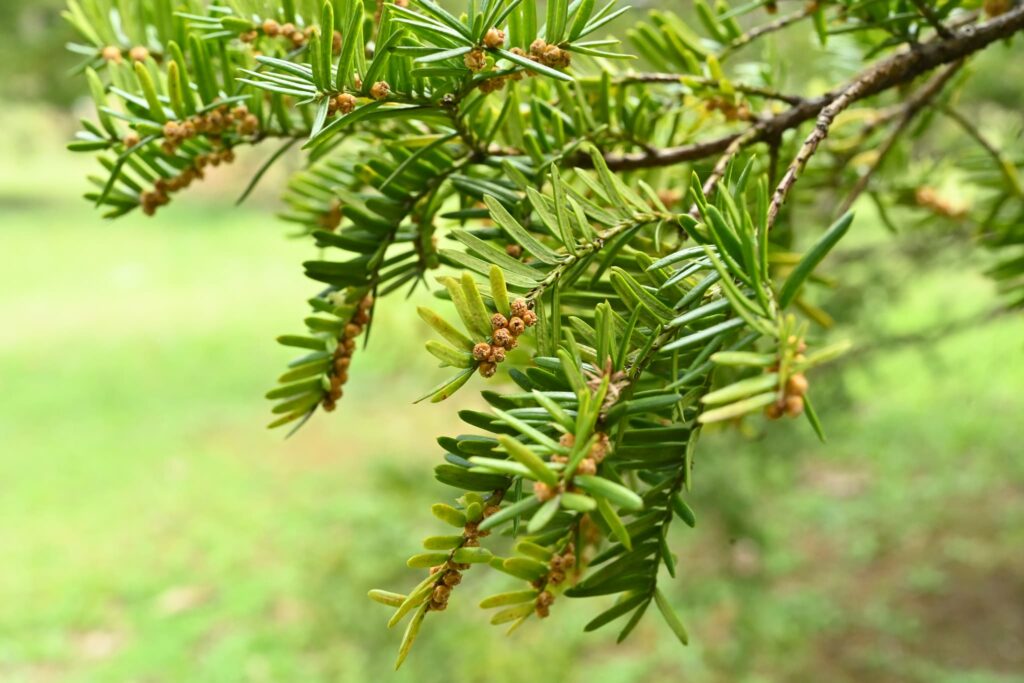
Japanese Yew flowers in March and April. The species is dioecious, with male and female flowers on separate trees.
Male flowers form small, rounded pollen cones in the axils of the needles. Female reproductive structures are much less conspicuous and develop singly on female plants.
Fruits
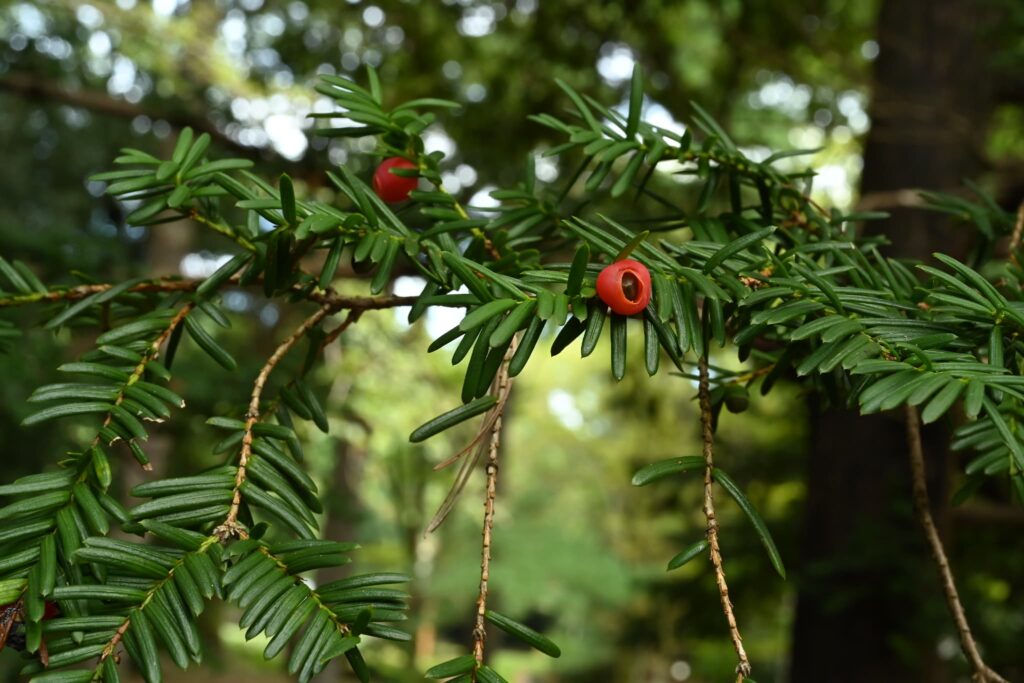
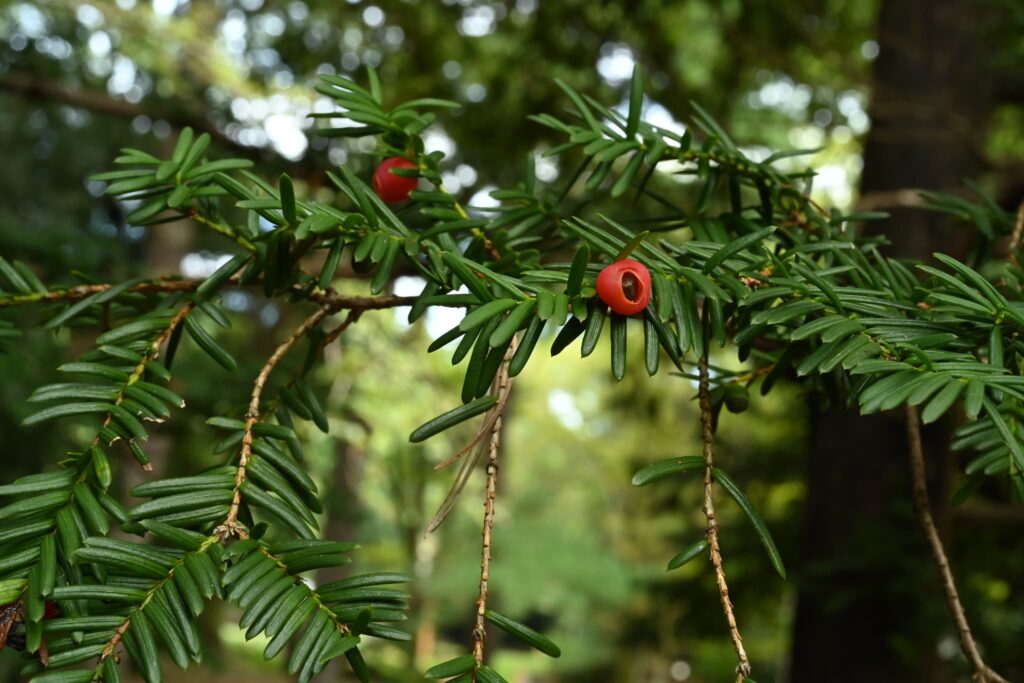
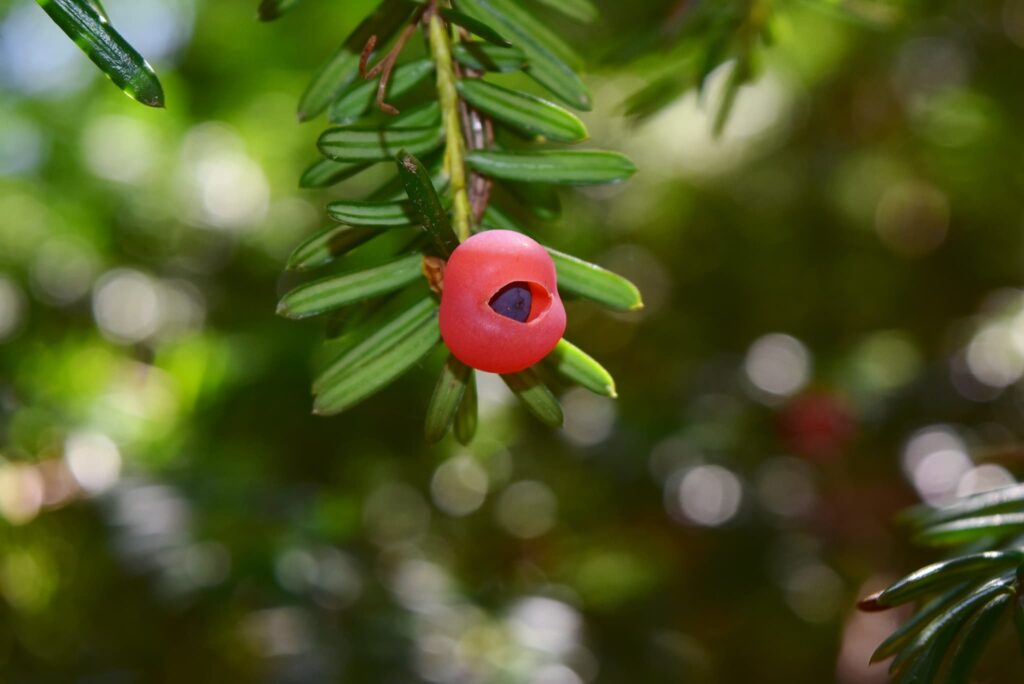
Female trees produce a fleshy, bright red aril surrounding a single seed. Botanically, this red structure is not a true fruit but a modified seed covering.
The aril itself lacks the toxic taxine compounds found in the seed, but the seed is highly poisonous. It should never be chewed or swallowed. Because seeds can be accidentally swallowed, the red aril should not be treated as a food crop, especially around children and pets.
A Note on Toxicity:
Most vegetative parts of Japanese Yew, including the needles and bark, contain toxic compounds. The seed is particularly dangerous because it contains taxine alkaloids. Traditional medicinal uses should not be attempted because of the plant’s toxicity.
Bark & Timber
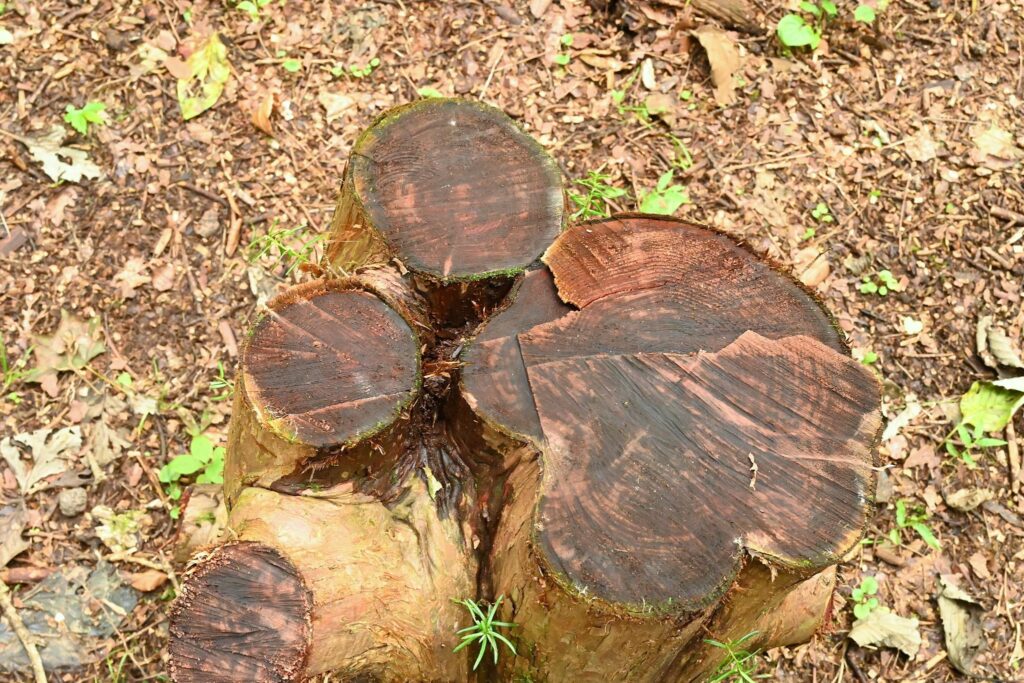
The bark is reddish brown and flakes into thin strips or scales with age. The wood is dense, fine-grained, and durable, with attractive reddish tones that deepen with age.
Japanese Yew has traditionally been valued for carving, decorative woodworking, and other fine applications. Its slow growth produces fine, even-textured wood that is particularly suitable for detailed carving.
Size & Growth
Japanese Yew is a slow-growing evergreen tree that commonly reaches around 10–20 m in height. It develops a dense crown and can survive for centuries under favorable conditions.
Its slow growth and shade tolerance allow it to persist beneath forest canopies, while its dense wood and flexible growth contribute to its durability.
Uses & Cultural Significance
Naming: The Origin of “Ichii”
The Japanese name Ichii (一位) is traditionally associated with the use of yew wood for shaku, the ceremonial tablets carried by officials at court.
A well-known tradition from Hida says that yew wood was used to make a shaku that was presented to the imperial court, after which the tree was associated with the rank Shoichii (正一位), the highest court rank. However, the historical details of this story are uncertain, and different traditions give different dates and circumstances. It is therefore best regarded as a traditional explanation for the name rather than an established historical fact.
Traditional Woodworking
Japanese Yew has been used for fine woodworking, carving, decorative architectural elements, and Buddhist sculpture. It is particularly associated with Ichii Ittobori, the distinctive single-blade carving tradition of Takayama, Gifu Prefecture. The craft developed into its present form in the late Edo period and remains one of the best-known traditional crafts associated with Hida.
Growing Guide
| Item | Description |
|---|---|
| Light | Full sun to shade; exceptionally shade-tolerant |
| Soil | Moist, fertile, well-drained soil |
| Drainage | Essential; avoid waterlogged soil |
| Cold Hardiness | USDA Zones 4–7 |
| Wind & Snow | Generally durable, but protect from exposed winter winds |
| Pruning | Responds well to regular pruning and shearing |
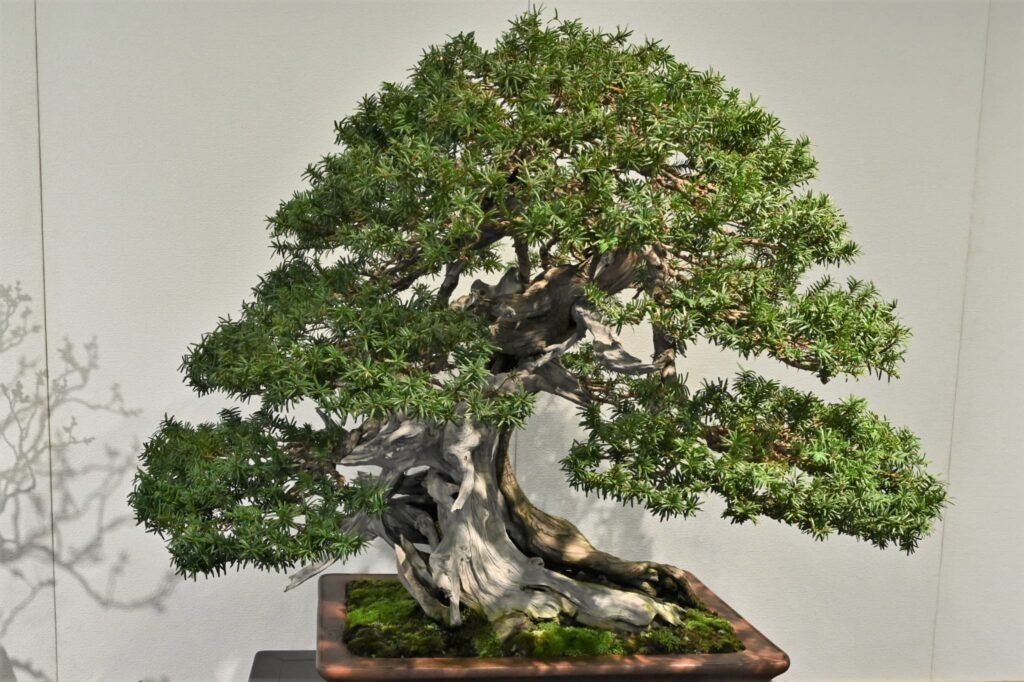
| Home Garden | Excellent for hedges, screens, specimen planting, and bonsai |
Light & Soil
Japanese Yew is one of the more shade-tolerant conifers and can grow successfully under relatively low light. It also grows well in full sun when adequate soil moisture is available.
It prefers moist, fertile, well-drained soil and does not tolerate prolonged waterlogging. Good drainage is particularly important because poorly drained soils can lead to root problems.
Wind & Snow Tolerance
Japanese Yew is generally durable, but exposed plants can suffer winter burn from cold, drying winds. A sheltered position is preferable in regions with severe winter weather.
Cold Hardiness
Japanese Yew is cold-hardy and is generally rated for USDA Zones 4–7. It is naturally associated with cool temperate and subalpine environments in Japan and northern East Asia.
Pruning
Japanese Yew responds well to pruning and shearing and is widely used for hedges and shaped evergreen specimens. Regular moderate pruning is preferable to repeatedly removing large amounts of old wood.
Its slow growth means that heavily neglected plants may take considerable time to regain a desired shape.
Suitability for Home Gardens
Japanese Yew is particularly useful where an evergreen plant is needed for a hedge, screen, specimen, or shaded garden.
It is generally better suited to cool climates than to hot, lowland conditions. Because Japanese Yew can be difficult to establish after major root disturbance, planting young specimens in their permanent position is preferable.
Pests & Diseases
Japanese Yew is generally resilient, although scale insects, mites, root rot in poorly drained soil, and occasional twig or needle diseases can occur. Winter burn is also possible in exposed sites.
Cultivars
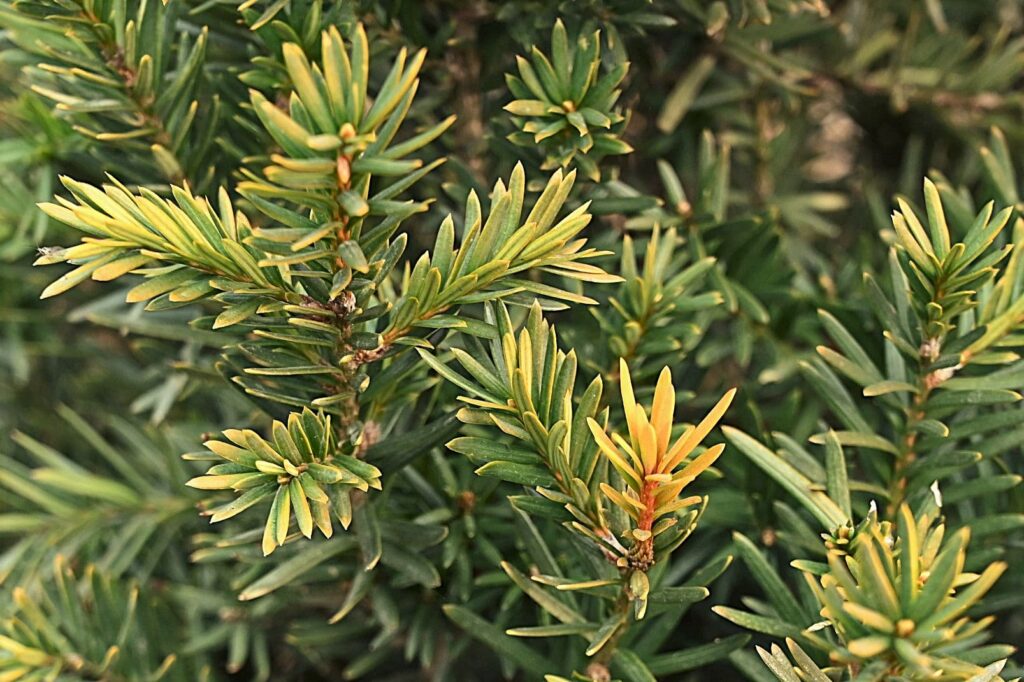
‘Bright Gold’
‘Bright Gold’ is a compact cultivar with yellow to golden foliage, particularly bright when grown in sufficient sunlight. It is suitable for specimen planting and smaller garden spaces.
Similar Species
Caraboku (Taxus cuspidata var. nana)
Caraboku is a recognized variety of Japanese Yew and is a low-growing evergreen shrub native mainly to the Sea of Japan side of Honshu.
The easiest field distinction is the arrangement of the needles. Japanese Yew usually has needles appearing in two flattened rows along its lateral shoots, whereas Caraboku has needles arranged spirally and does not show the same distinctly two-ranked appearance. Caraboku is also much smaller and more shrub-like.
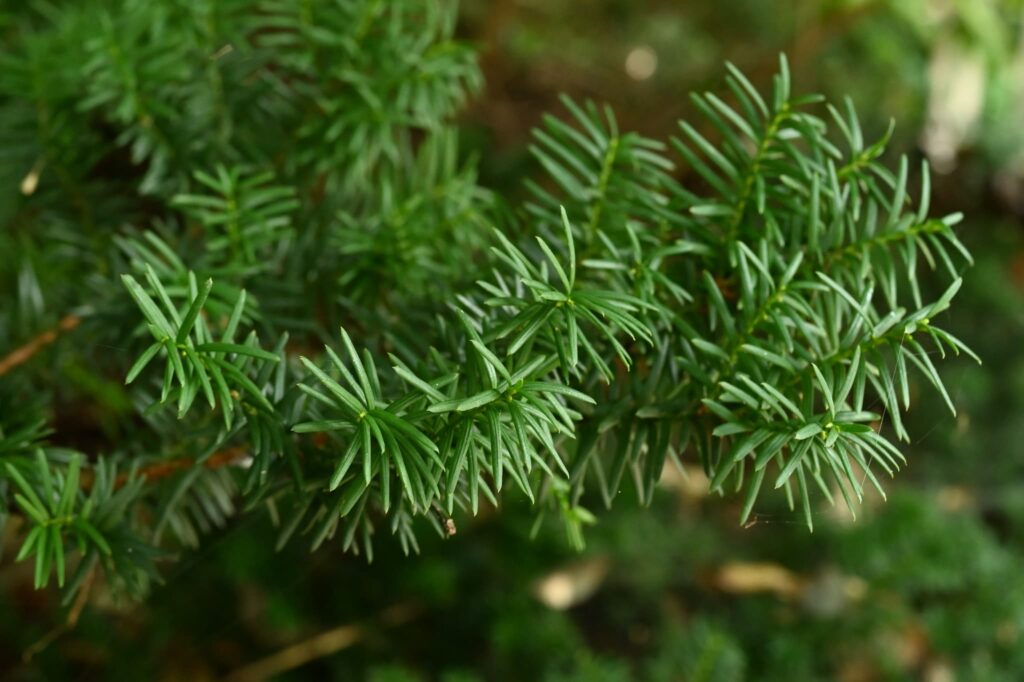 Caraboku (Taxus cuspidata var. nana) has spirally arranged needles.
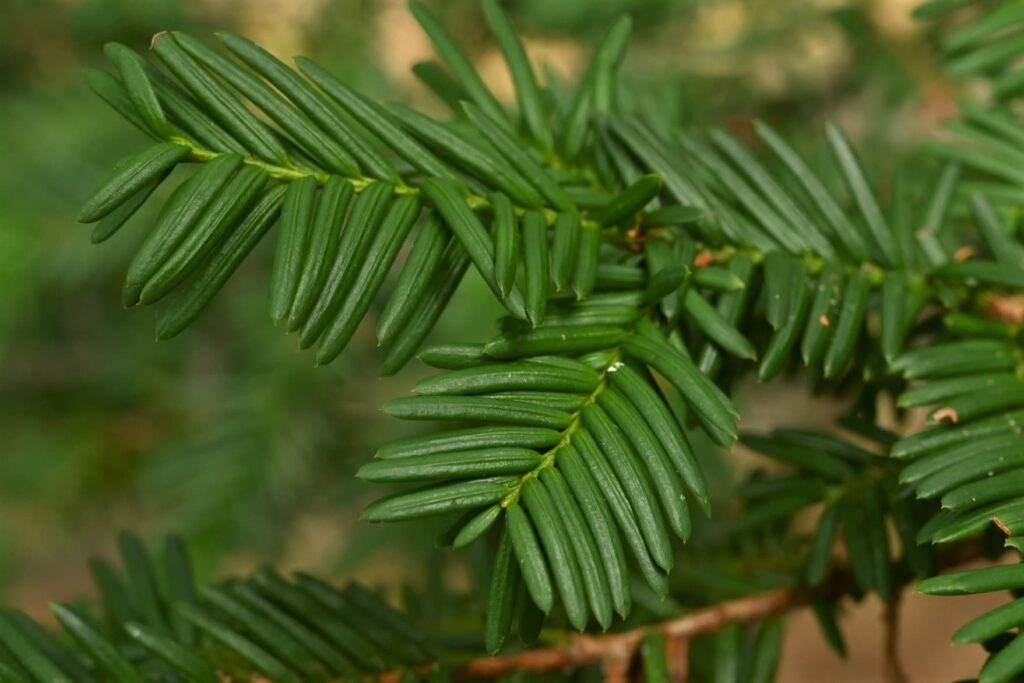 Japanese-Yew-Taxus-cuspidata Japanese Yew
English Yew / European Yew (Taxus baccata)
English Yew is a closely related species native to Europe and western Asia. It can resemble Japanese Yew closely, although differences in needle size, shoot form, and geographic origin can help distinguish them.
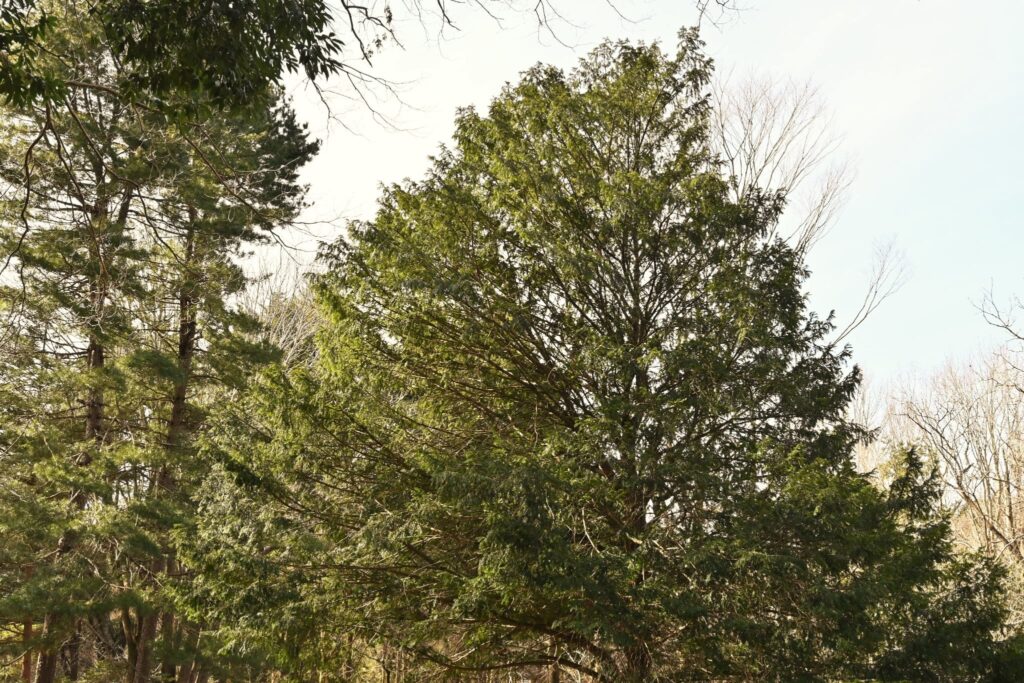
Pacific Yew (Taxus brevifolia)
Pacific Yew is native to western North America. It resembles Japanese Yew but generally has a more irregular growth habit. It is historically important as a source of paclitaxel, a compound used in cancer treatment.
Coast Redwood (Sequoia sempervirens)
Coast Redwood is unrelated to Japanese Yew and belongs to the cypress family, Cupressaceae. Its foliage can resemble yew foliage closely enough that it has been called Ichii-modoki in Japanese.
Frequently Asked Questions
Is Japanese Yew poisonous?
Yes. The seed, needles, bark, and other vegetative parts contain toxic compounds. The red fleshy aril surrounding the seed does not contain the same toxic compounds, but the seed itself is highly poisonous and should never be chewed or swallowed.
How can I tell Japanese Yew apart from Caraboku?
Japanese Yew usually has needles appearing in two flattened rows along lateral branches. Caraboku has needles arranged more spirally and lacks the distinctly two-ranked appearance. Caraboku is also a much smaller, shrub-like plant.
Can Japanese Yew be grown in a warm climate?
It can be grown in a range of climates, but it generally performs best in cool temperate conditions. In hot lowland areas, growth and establishment may be less satisfactory, particularly where summers are hot and soils remain wet.
Is Japanese Yew good for hedges or topiary?
Yes. It tolerates pruning and shearing well and develops dense evergreen foliage, making it useful for hedges, screens, and formal shapes.
Why does my Japanese Yew not produce any fruit?
Japanese Yew is dioecious. Male and female flowers occur on separate plants, and only female trees produce the red arils. A male tree will therefore never produce fruit.
Is the red fruit of Japanese Yew poisonous?
The red fleshy aril itself is not considered toxic like the seed, but the seed inside is highly poisonous. The safest practice is not to eat the aril because separating it from the seed carries a risk of accidental ingestion.
Why is Japanese Yew popular for bonsai?
It tolerates shade and pruning, develops dense evergreen foliage, and has attractive reddish bark and slow growth. These characteristics make it well suited to bonsai culture.
How fast does Japanese Yew grow?
It is a slow-growing tree. Growth varies considerably with climate, soil, light, and age, but its relatively slow growth contributes to its dense form and long-term durability.
Why is Japanese Yew long-lived?
Its slow growth, shade tolerance, durable wood, and ability to recover from moderate pruning all contribute to its ability to survive for many centuries under favorable conditions.
Conclusion
Japanese Yew (Taxus cuspidata) combines ornamental value with an unusually rich history in Japan. Its dense evergreen foliage, red arils, durable timber, and tolerance of shade and pruning make it useful as a specimen tree, hedge, and bonsai subject. Its association with the traditional name Ichii and with Hida’s Ichii Ittobori also gives the species an important place in Japanese woodworking culture.
At the same time, its poisonous seeds and foliage mean that it should be treated with care. For gardeners seeking a long-lived evergreen with a distinctly Japanese character, Japanese Yew remains one of the most useful native conifers.