Sweet Osmanthus (Osmanthus fragrans): Identification, Care & Uses
Sweet Osmanthus (Osmanthus fragrans) is an evergreen shrub or small tree prized for its intensely fragrant autumn flowers. Native to China and cultivated in Japan for centuries, it is one of East Asia’s best-known ornamental plants. This guide covers identification, flowers, fruit, bark, cultivars, and care based on observations of the plant as grown in Japan.
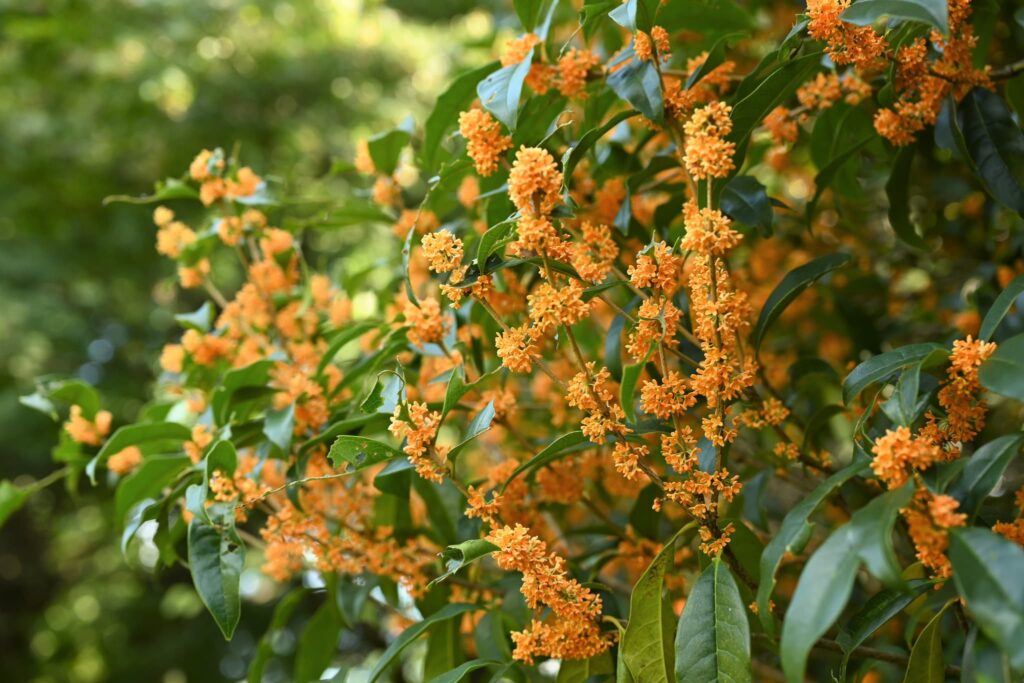
What Is Sweet Osmanthus?
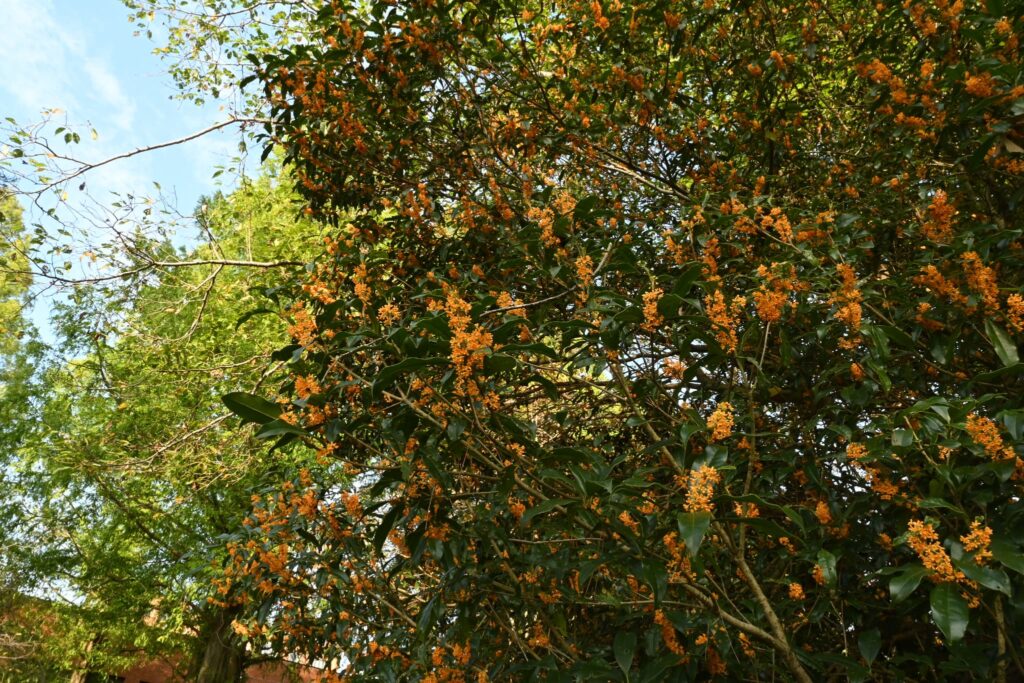
Sweet Osmanthus is an evergreen broadleaf shrub in the family Oleaceae, classified as a variety of Ginmokusei (Fragrant Osmanthus, the white-flowered form of the same species). It has long been planted in gardens and parks purely for ornamental purposes, but it originally came to Japan from China and does not grow wild in the country’s forests or mountains. It has been cultivated in Japan since ancient times and is now one of the country’s most familiar ornamental shrubs.
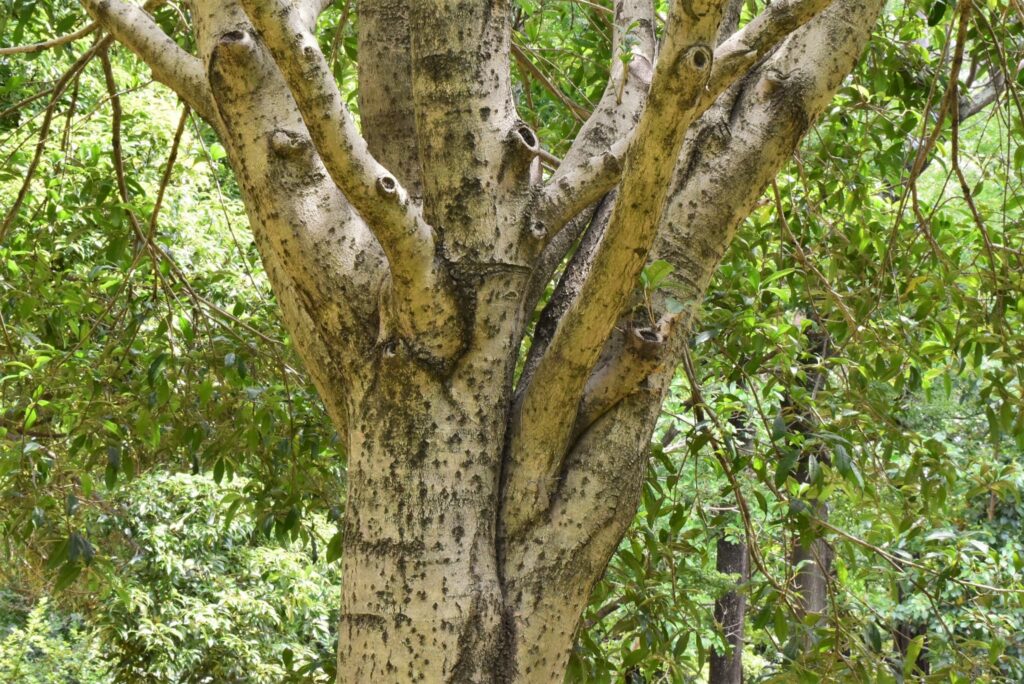
The “Kin” (gold) in its Japanese name, Kinmokusei, refers to its golden-orange flowers, while “Mokusei” (literally “wood rhinoceros”) describes the plant’s pale grayish-brown bark, said to resemble the texture of a rhinoceros’s hide—a resemblance that becomes more pronounced as the tree ages.
In China, the term corresponding to “Mokusei” traditionally refers to Ginmokusei itself, while Kinmokusei is written with characters meaning “cinnabar cassia,” combining a character for its orange-red color with one used generally for Osmanthus-type trees.
Sweet Osmanthus is believed to have originated as a cultivated form of Silver Osmanthus (Osmanthus fragrans var. fragrans), differing mainly in its orange flowers and stronger fragrance.
Overview
| Item | Description |
|---|---|
| Family | Oleaceae |
| Genus | Osmanthus |
| Species | O. fragrans var. aurantiacus |
| Scientific Name | Osmanthus fragrans var. aurantiacus (syn. Osmanthus fragrans) |
| Common Name | Sweet Osmanthus / Orange Osmanthus |
| Japanese Name | Kinmokusei (キンモクセイ) |
| Native Range | China (introduced to Japan; not found growing wild there) |
| USDA Hardiness | 8–10 |
| Plant Type | Evergreen Shrub |
| Growth Rate | Slow to moderate |
| Flowering Season | September–October |
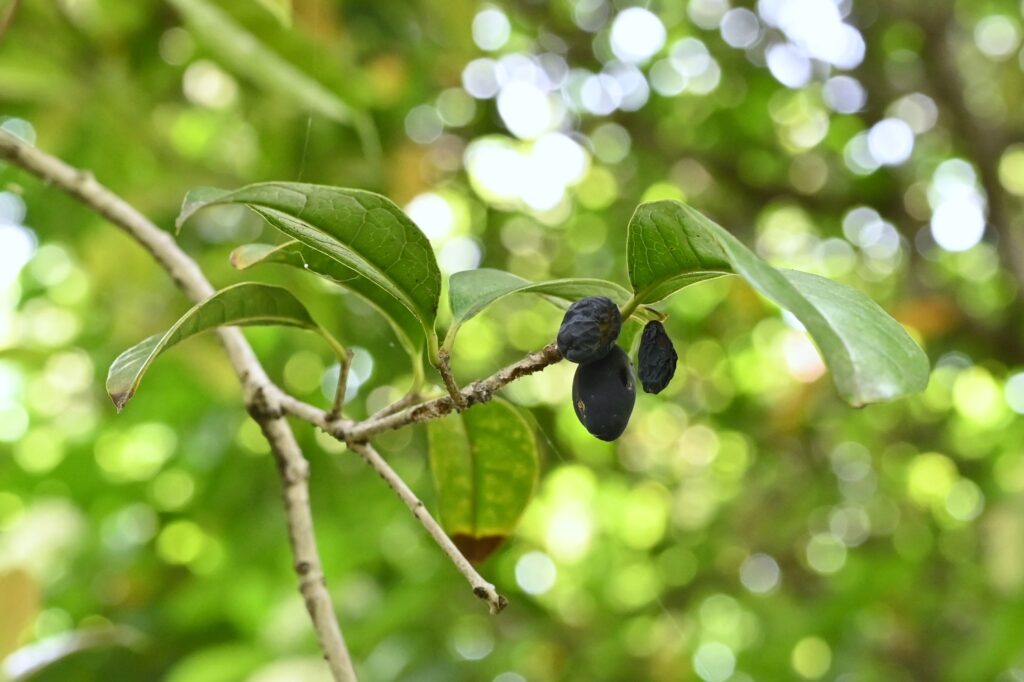
| Fruit Type | Oval drupe (rarely produced in Japan, due to absence of female trees) |
| Garden Use | Specimen shrub, hedge, fragrance planting |
Characteristics
| Feature | Description |
|---|---|
| Leaves | Opposite, leathery, deep green, mostly smooth-edged |
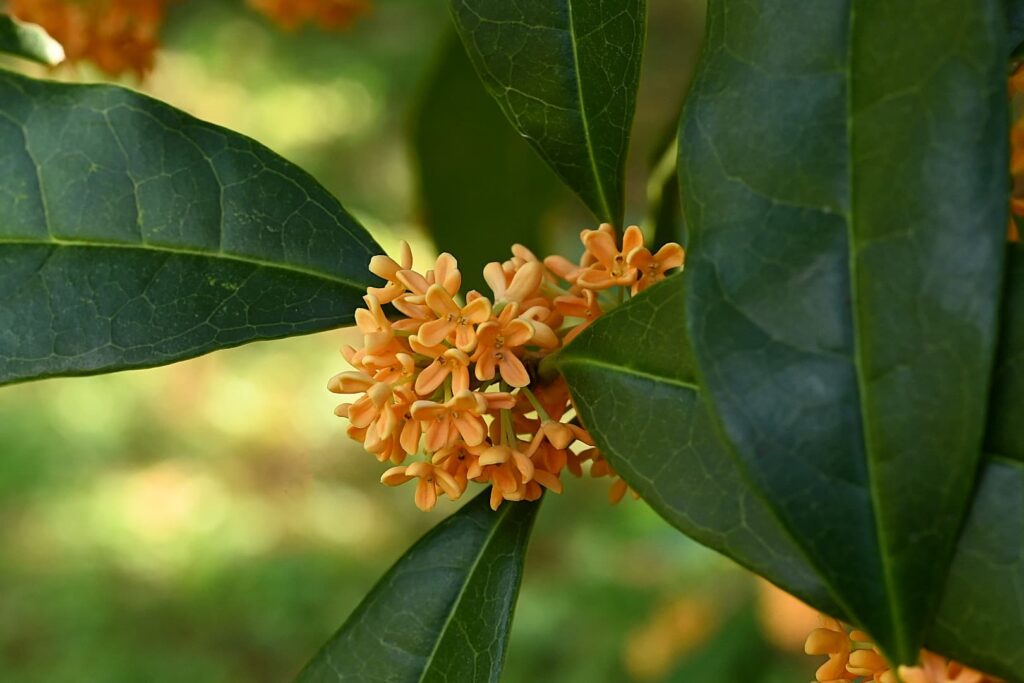
| Flowers | Small, deep orange, intensely fragrant |
| Bark | Pale grayish-brown, textured like rhinoceros hide with age |
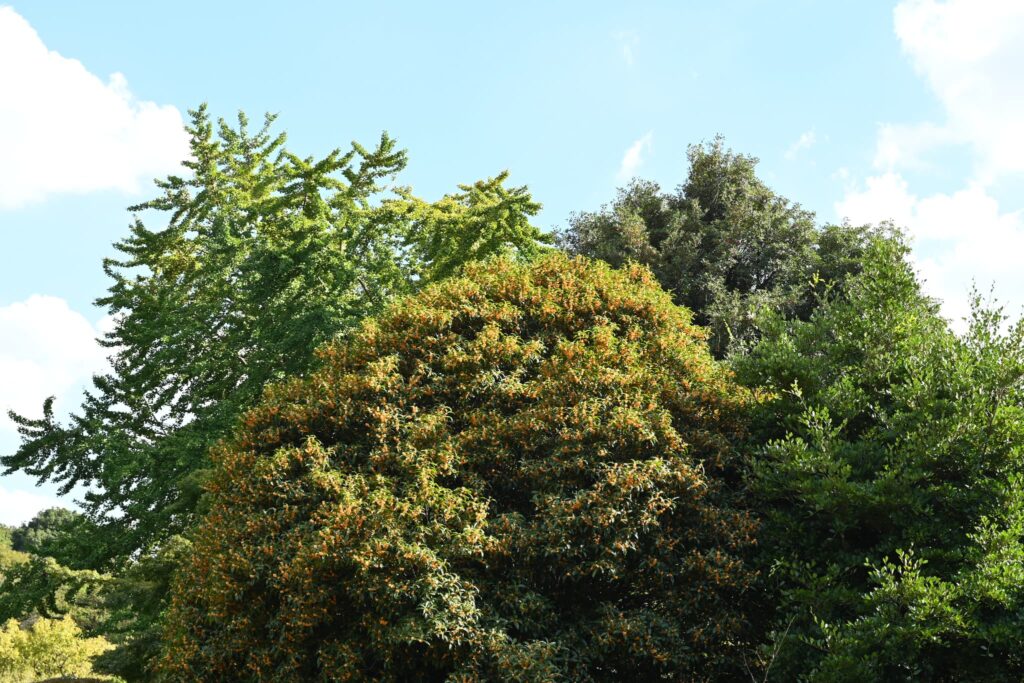
| Habit | Densely branched, well suited to hedges and specimen planting |
Foliage
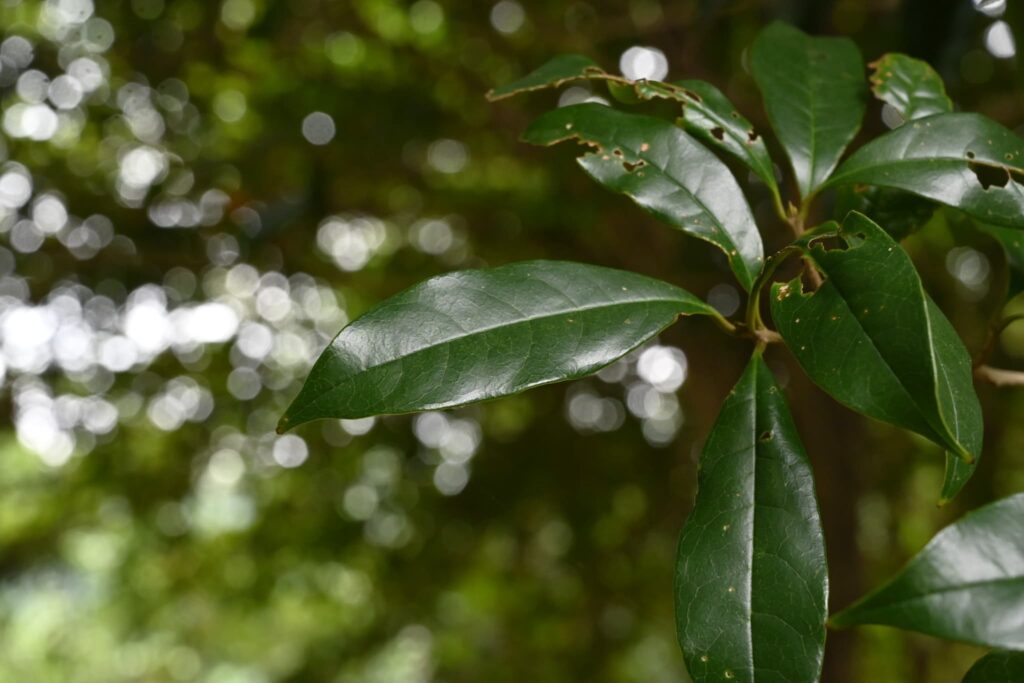
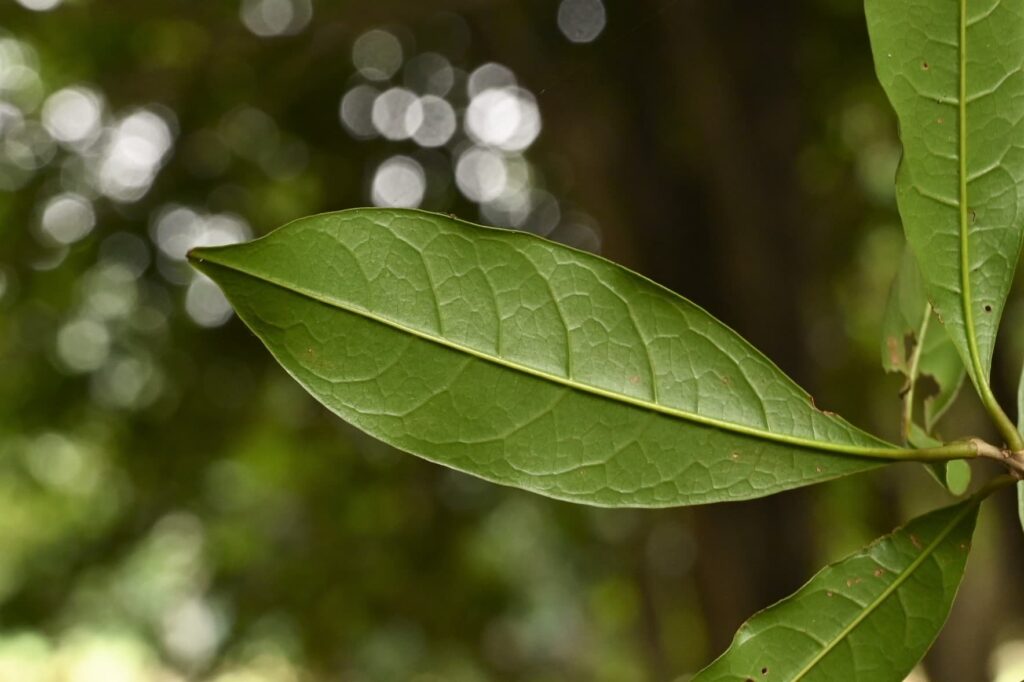
Sweet Osmanthus leaves are deep green and leathery, though somewhat thinner than those of Ginmokusei, with a slightly papery, rustling feel when touched. They are 6–12 cm long and narrower than Ginmokusei’s leaves, though individual variation makes the two genuinely difficult to tell apart outside of flowering season.
In most cases, the leaf margins are smooth, without teeth, though depending on the individual plant or growing conditions, fine serrations can sometimes appear near the leaf tip. Leaves grow in opposite pairs along the branch, and the plant tends to branch heavily, producing dense growth.
Flowers
Sweet Osmanthus flowers in September and October, producing small blooms about 4–5 mm across, densely clustered at the base of that year’s new leaves. Each flower is a fused, tubular type with a tip that splits into four lobes. Male flowers contain two stamens along with a single incomplete, pointed pistil. The calyx behind each flower is green and also splits into four sections.
Individual flowers are surprisingly short-lived, blooming for only about seven to ten days, though it has become increasingly common in recent years for a tree to bloom twice, once in September and again in October. After the flowers fade, fallen petals can carpet the ground in a striking orange—though because the flowers drop so readily, Sweet Osmanthus isn’t a practical choice as a cut flower for arrangements.
The flowers produce a rich, sweet fragrance often compared to ripe apricots or peaches. The genus name Osmanthus means “fragrant flower,” and in Japan the tree is considered one of the “three fragrant trees,” alongside Daphne odora and gardenia. Its fragrance is noticeably stronger than Ginmokusei’s—in China it’s sometimes described as carrying for “a thousand ri” (千里香)—and the flowers are traditionally steeped to make fragrant products such as osmanthus-infused wine (guihua chenjiu) and osmanthus tea (guihua cha).
Sweet Osmanthus is dioecious, with male flowers appearing on male trees and female flowers on female trees. However, only male trees—which bear a greater number of flowers—were originally brought to Japan, and female trees have remained extremely rare ever since, meaning ordinary observers essentially never get to see the plant’s fruit in Japan.
Fruit
Because fruit-bearing female trees are so rare in Japan, Sweet Osmanthus is propagated almost entirely by grafting onto False Holly (Hiiragi) rootstock, or from cuttings, rather than from seed. For reference, its fruit—on the rare occasion it does form—is an oval shape similar to that of False Holly; a similar-looking fruit can also be seen on the closely related Usugi Mokusei (pale-yellow Osmanthus), which does regularly bear fruit in Japan.
Trunk & Bark
The bark is a pale grayish-brown, and its texture is the source of the “Mokusei” (“wood rhinoceros”) half of the plant’s Japanese name—as the tree matures, the bark develops a rough, thickened quality said to resemble the hide of a rhinoceros. This resemblance becomes more pronounced with age, making bark texture a useful clue for judging roughly how old a specimen is.
Growing Guide
Soil & Sun
Sweet Osmanthus tolerates a wide range of soil types, but needs full sun to produce a good number of flowers.
Climate & Pollution Tolerance
The plant is generally resistant to pests and disease but is sensitive to dry conditions, salt-laden coastal wind, and in heavily polluted urban environments, flowering may be reduced.
Pruning & Maintenance
Growth is on the slower side, so even a modestly sized garden can accommodate Sweet Osmanthus as a hedge for around 20 years before it outgrows the space. As the tree ages, the lower branches tend to thin out and die back, so it helps to keep shearing the top of the plant to restrain its upward growth, while carefully training any thin new shoots from lower on the trunk—for instance, tying them in place with palm-fiber rope—to help fill the plant back in. That said, if the tree is planted along a walkway, it’s better to remove lower branches up to about head height to avoid blocking foot traffic.
The best time to prune is right after flowering, or in early spring. Because Sweet Osmanthus blooms on that year’s new growth, shearing between spring and late summer will reduce the number of flowers produced that autumn.

Related Species
- Silver Osmanthus (Osmanthus fragrans var. fragrans)— the wild-type parent of Sweet Osmanthus, bearing white flowers with a milder fragrance. The two are difficult to tell apart outside of bloom, but Ginmokusei’s leaf margins tend to show more pronounced fine serrations than Sweet Osmanthus’s.
- Usugi Mokusei (Osmanthus fragrans var. thunbergii) — a pale-yellow-flowered relative common in the Kansai region. Because female trees exist in Japan, it regularly sets fruit, ripening to a dark blue the following spring. Its fragrance is milder than Sweet Osmanthus’s.
- Hiiragimokusei (Osmanthus × fortunei) — a natural hybrid with False Holly, distinguished by even more pronounced serrations along the leaf margin than Ginmokusei.
- Four-Season Sweet Osmanthus — often sold as “Four-Season Sweet Olive,” a compact cultivar that flowers in all seasons except midsummer when young, though with age it tends to become difficult to distinguish from Usugi Mokusei.
- Osmanthus heterophyllus (False Holly) — A spiny-leaved relative traditionally used in Japan for warding off evil during Setsubun, with small white flowers in late autumn.
- Osmanthus delavayi (Delavay Osmanthus) — A smaller-leaved species native to China, valued for its abundant, jasmine-scented white flowers in spring rather than autumn.
Frequently Asked Questions
Q: Why doesn’t my Sweet Osmanthus ever produce fruit?
Sweet Osmanthus is dioecious, and only male trees were originally brought to Japan from China. Because female trees remain extremely rare in the country, the vast majority of Japanese Sweet Osmanthus specimens simply have no opportunity to set fruit, regardless of how well they’re cared for.
Q: Why isn’t my Sweet Osmanthus flowering well?
The most common cause is insufficient sunlight, since the plant needs full sun to bloom heavily. Poor air quality, salt-laden coastal wind, and dry conditions may also reduce flowering.
Q: When is the best time to prune Sweet Osmanthus?
Right after flowering finishes, or in early spring, is ideal. Because flowers form on that year’s new growth, pruning between spring and late summer will cut off the wood that would have flowered, reducing the display that autumn.
Q: What’s the difference between Sweet Osmanthus and Ginmokusei?
Sweet Osmanthus has deep orange flowers with a notably strong fragrance, while Ginmokusei’s flowers are white with a milder scent. Outside of bloom, the two can be hard to distinguish, though Ginmokusei’s leaves tend to show more noticeable fine serrations along the margin.
Q: Can Sweet Osmanthus be grown from seed?
In practice, no—not in Japan. Since female, fruit-bearing trees are essentially unavailable there, Japanese Sweet Osmanthus is propagated almost exclusively by grafting onto False Holly rootstock or by taking cuttings, rather than from seed.
Conclusion
Few plants announce the arrival of autumn in Japan as unmistakably as Sweet Osmanthus, whose apricot-sweet fragrance can carry through entire neighborhoods each September and October. Though it arrived from China centuries ago rather than growing wild in Japan, and though its lack of female trees means most people will never see its fruit, Sweet Osmanthus has nonetheless become one of the country’s most beloved fragrance plants—prized in gardens and parks for a scent that, however brief each individual bloom may be, reliably returns every year. Whether planted beside an entrance, trained as a hedge, or simply enjoyed for its unforgettable fragrance, Sweet Osmanthus remains one of Japan’s most beloved evergreen shrubs.