Yoshino Cherry (Prunus × yedoensis): Identification, Care & Uses
Yoshino Cherry (Prunus × yedoensis) is one of Japan’s most famous ornamental trees. This guide covers identification, flowers, bark, fruit, cultivation, history, and origin, with photographs taken throughout Japan.
What Is Yoshino Cherry?
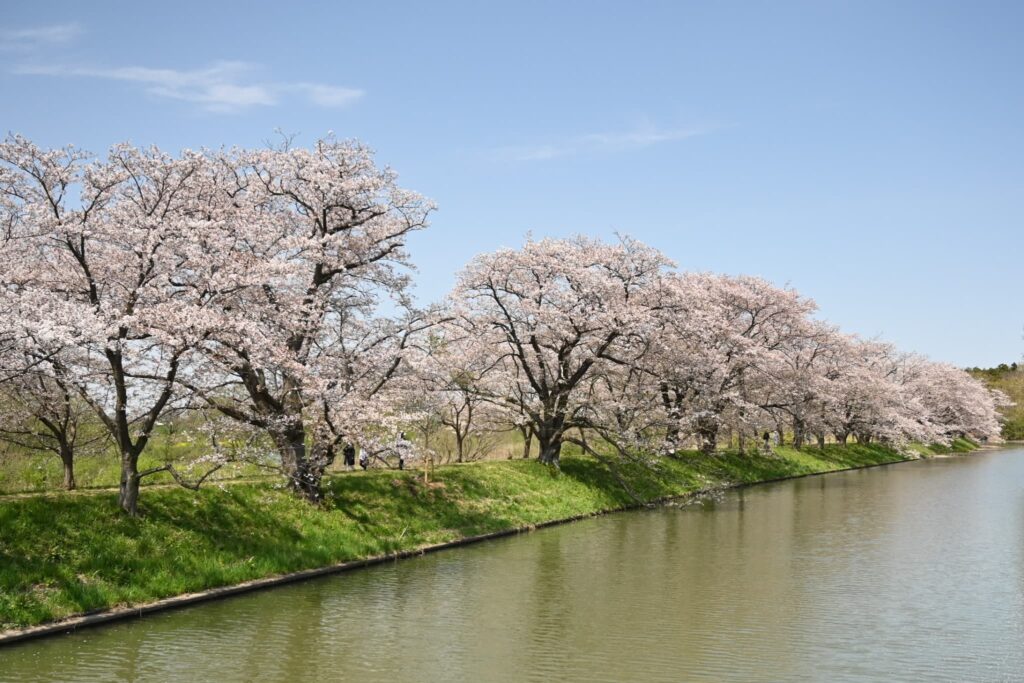
Yoshino Cherry is a deciduous tree in the genus Prunus, family Rosaceae, and the most iconic of Japan’s more than 300 cherry cultivars. Its flowers — which bloom before the leaves emerge — are strikingly beautiful and mark the arrival of spring for people across the country.
Planted from Hokkaido to Kyushu, Yoshino Cherry accounts for the vast majority of cherry trees in urban areas, particularly in the Kanto region. Though it feels like a timeless tradition, large-scale planting of this cultivar only began in the Meiji era. Most of the Yoshino Cherry trees seen today were mass-produced during Japan’s postwar reconstruction period.
Overview
| Item | Description |
| Scientific Name | Prunus × yedoensis |
| Common Name | Yoshino Cherry / Tokyo Cherry |
| Japanese Name | Somei Yoshino (ソメイヨシノ) |
| Family | Rosaceae |
| Native Range | Garden cultivar (Japan) |
| Plant Type | Deciduous Broadleaf Tree |
| Height | 10–15 m (33–50 ft) |
| Flowering Season | March–April |
| Fruit Type | Drupe (cherry) |
| USDA Zones | 5–8 |
| Sun Exposure | Full Sun |
Characteristics
Flowers
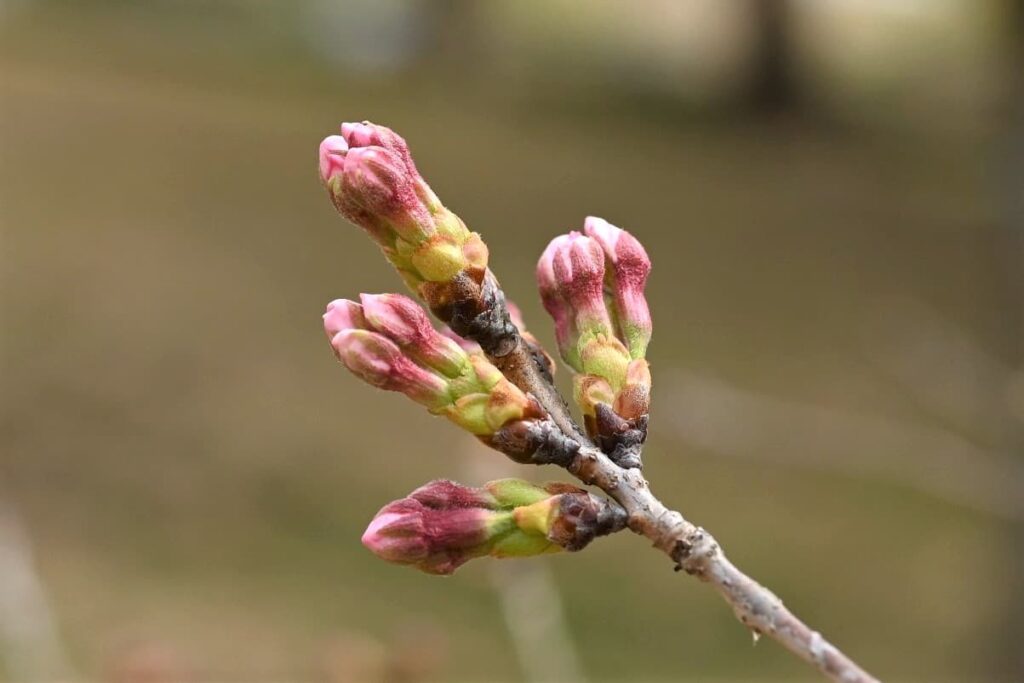
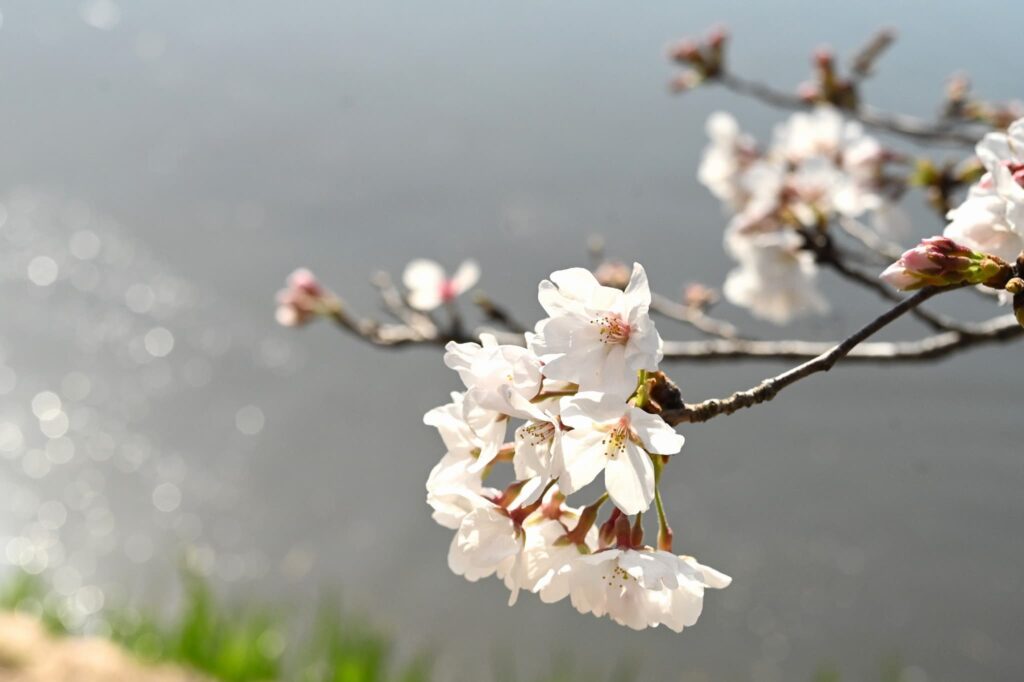
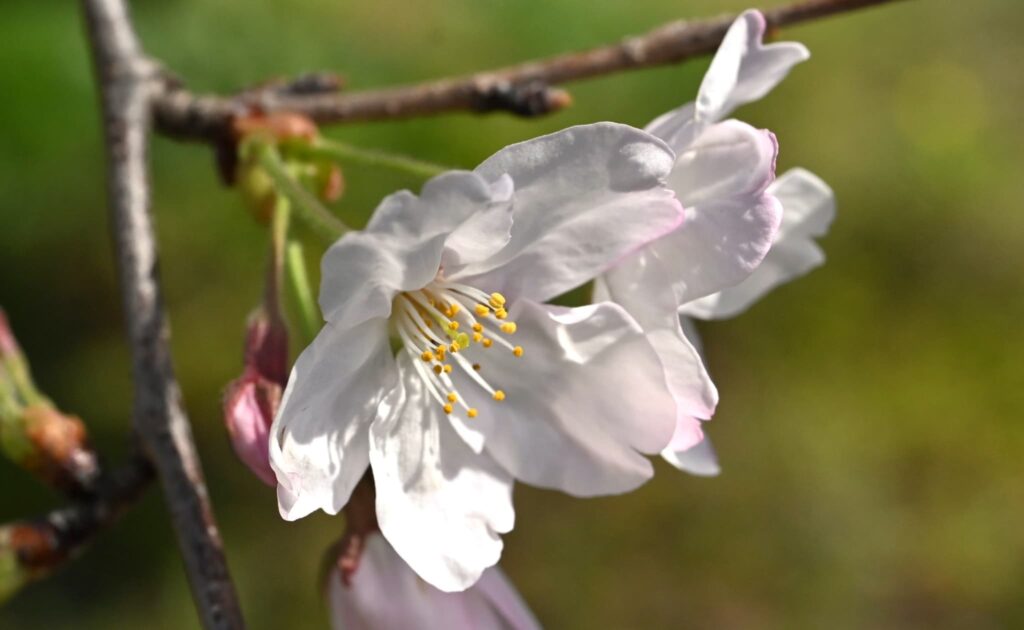
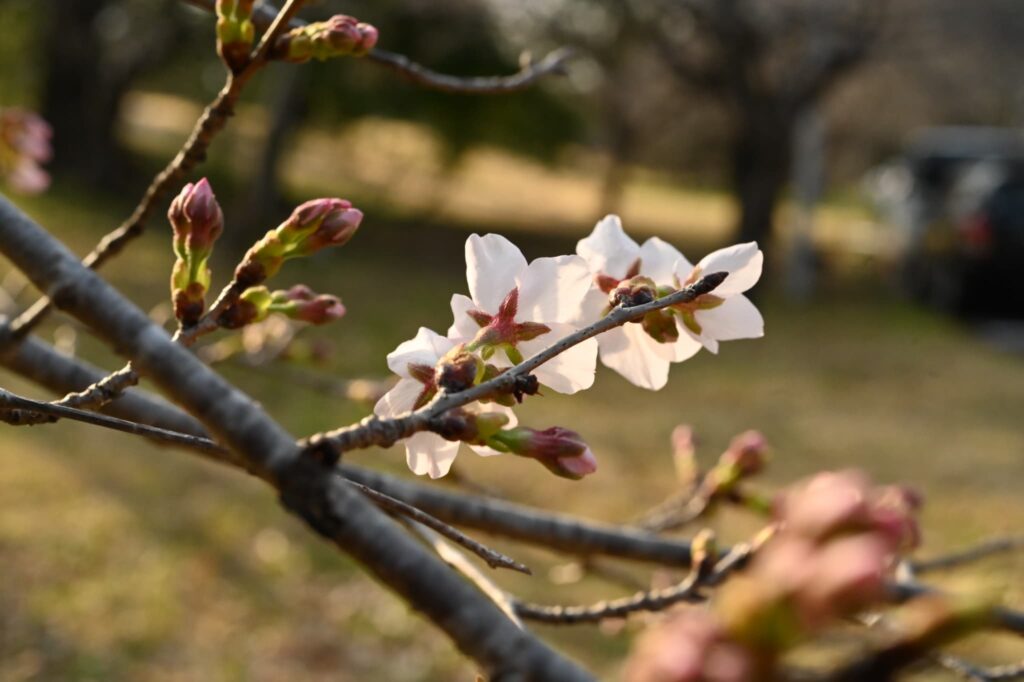
Yoshino Cherry blooms from March to April. The flowers are commonly imagined as pink, but in reality they are only faintly pink at first opening — gradually fading to near-white as they mature. Each flower is approximately 4 cm in diameter, with five petals each bearing a small notch at the tip. The flower center holds 30–35 stamens alongside a pistil of similar length. The flower stalk is 2–3 cm long; the sepals have finely toothed margins, and fine hairs are present on the flower stalk, calyx, and the base of the pistil.
Yoshino Cherry is sensitive to drought and salt spray, and does not flower as cleanly in warmer climates — which is why it is more prevalent in eastern Japan.
Fruit
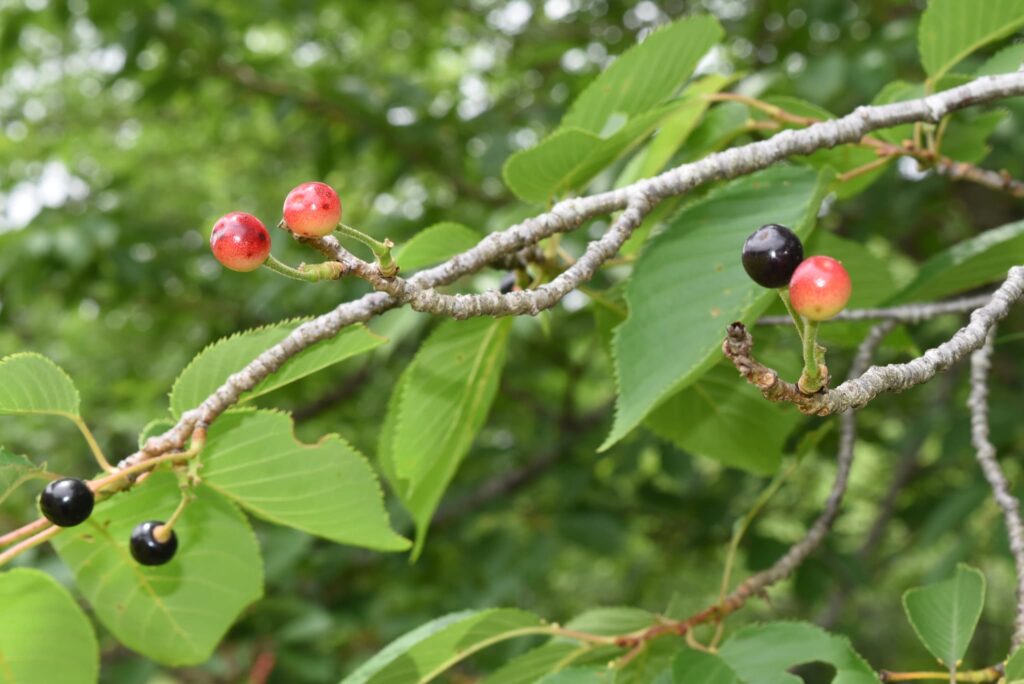
The small cherries (sakuranbo) that develop on Yoshino Cherry trees are spherical and ripen from red to dark purple-black between May and June. Because Yoshino Cherry is propagated clonally and planted primarily for ornament, fruit set is often sparse, although trees can produce small cherries after successful pollination. However, because Yoshino Cherry is planted so widely throughout Japan, seeing the fruit is not uncommon. Seeds will germinate if sown, but the resulting seedlings will not be true Yoshino Cherry, and the fruit is not suitable for eating.
Foliage & Autumn Color
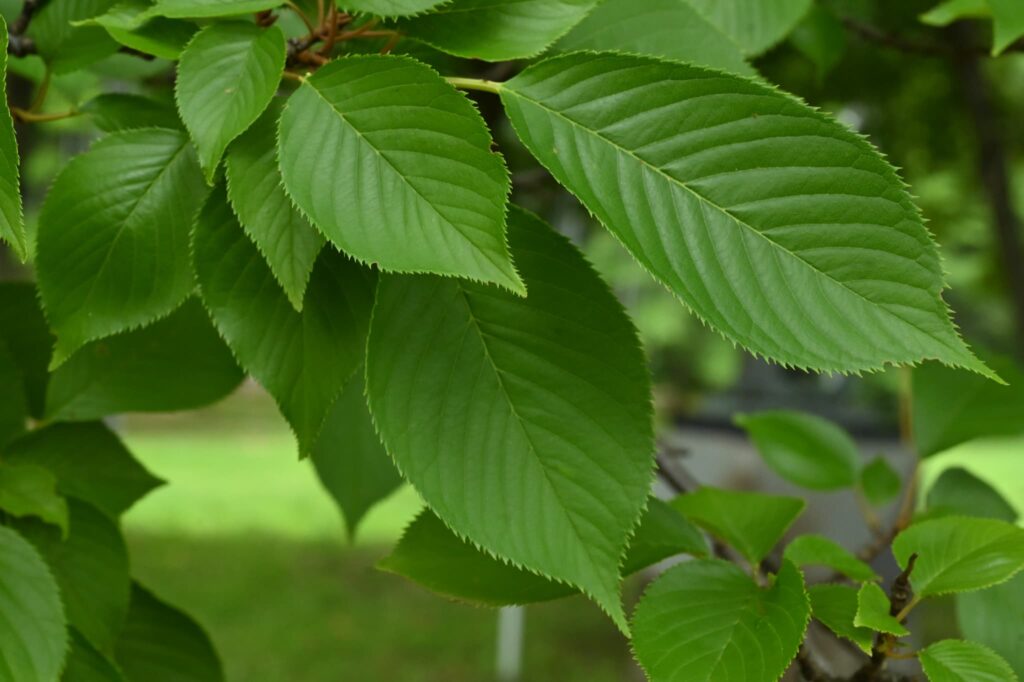
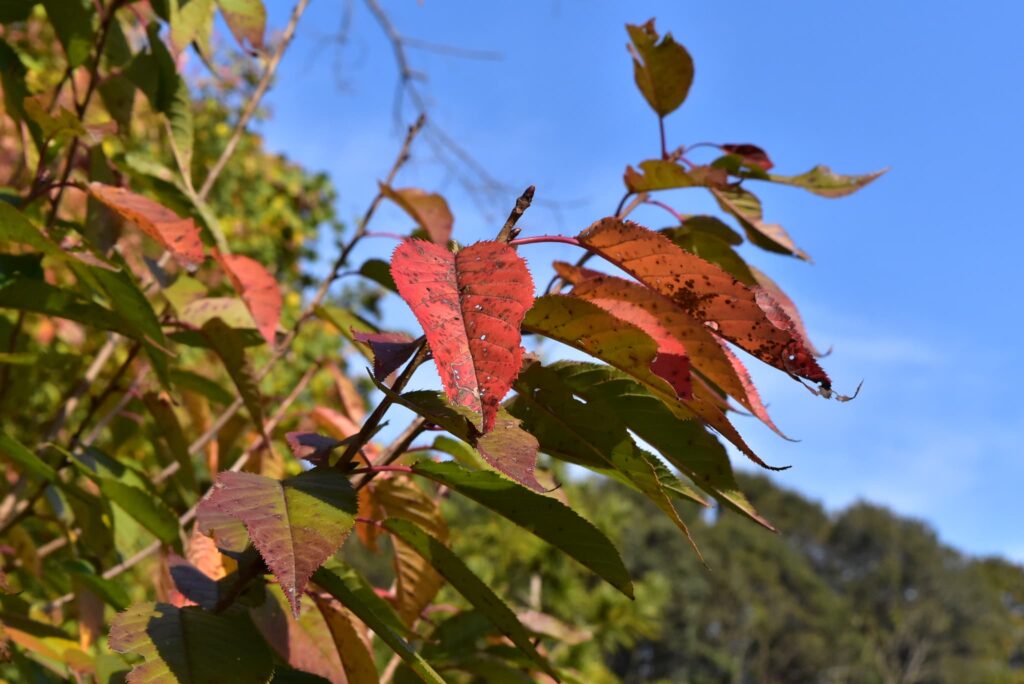
The leaves are elliptical, 8–12 cm long, with a pointed tip and serrated margins, arranged alternately along the branches. Fine hairs on the leaf stalk and along the veins on the underside distinguish it from Yamazakura. Near the top of the leaf stalk or at the base of the leaf blade, a pair of small nectar glands — common to the cherry genus — can be found.
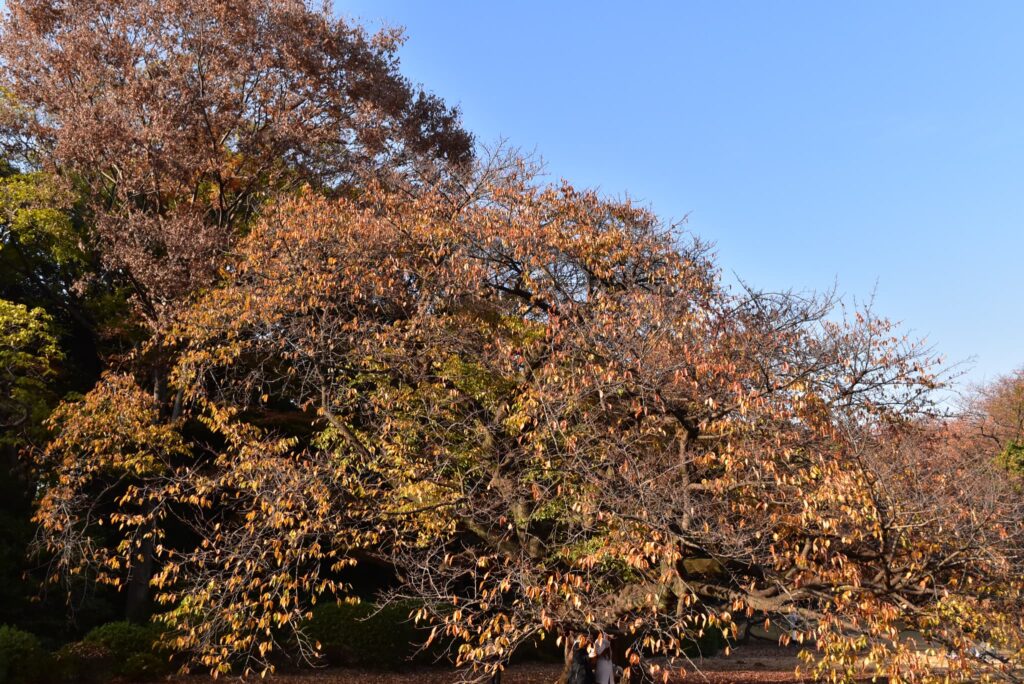
In favorable growing conditions, the autumn foliage can be attractive. However, in urban environments the display is often disappointing; leaves may begin to drop as early as September or October. The color is primarily yellow rather than red — leaves that turn red are often diseased rather than healthy.
Trunk & Bark
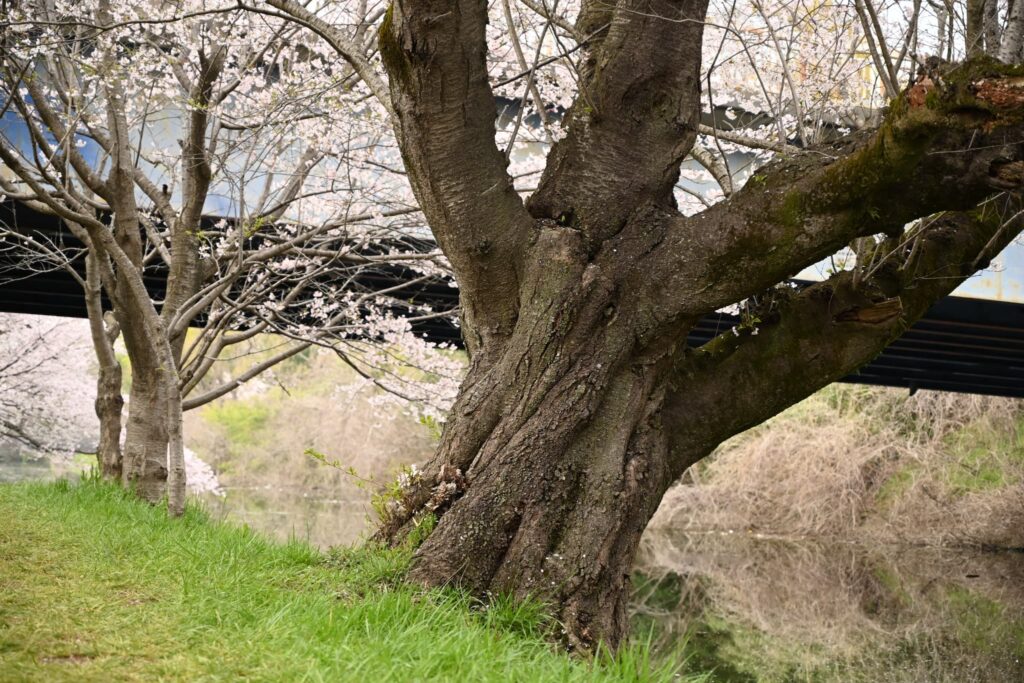
The trunk of Yoshino Cherry is characteristically short and stout, giving rise to large, widely spreading branches that form a broad, rounded crown. As the tree matures, the outermost branchlets take on a gently weeping habit, adding a graceful softness to the overall silhouette. In winter, when the leaves have fallen, the tree’s elegant branching structure and attractive bark provide quiet visual interest throughout the cold season.
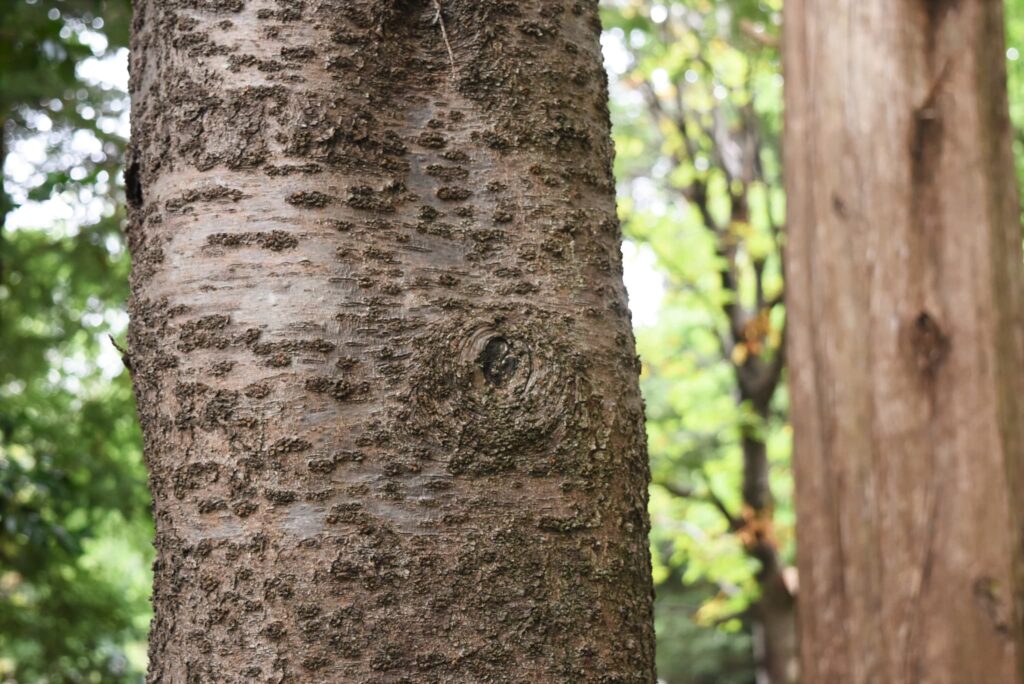
The bark is smooth and dark reddish-brown, marked by distinctive horizontal lenticels — lens-shaped pores that allow gas exchange through the bark surface. This pattern of raised horizontal lines is a characteristic shared across the cherry genus (Prunus) and is one of the most reliable ways to identify a cherry tree even when it is not in flower.
Origin & Name
The origin of Yoshino Cherry traces to the late Edo to early Meiji period, when nursery gardeners in Somei Village in Edo (in the area around present-day JR Komagome Station and Somei Cemetery) began selling the tree under the name Yoshino-zakura — borrowing the prestige of Yoshinoyama in Nara Prefecture, famous for its wild Yamazakura cherry blossoms. To avoid ongoing confusion between the two, naturalist Fujino Yorimichi, who conducted a cherry tree survey at Ueno Park in 1885–1886, renamed the cultivar Somei Yoshino — a name formally published in 1900.
A Clonal Species
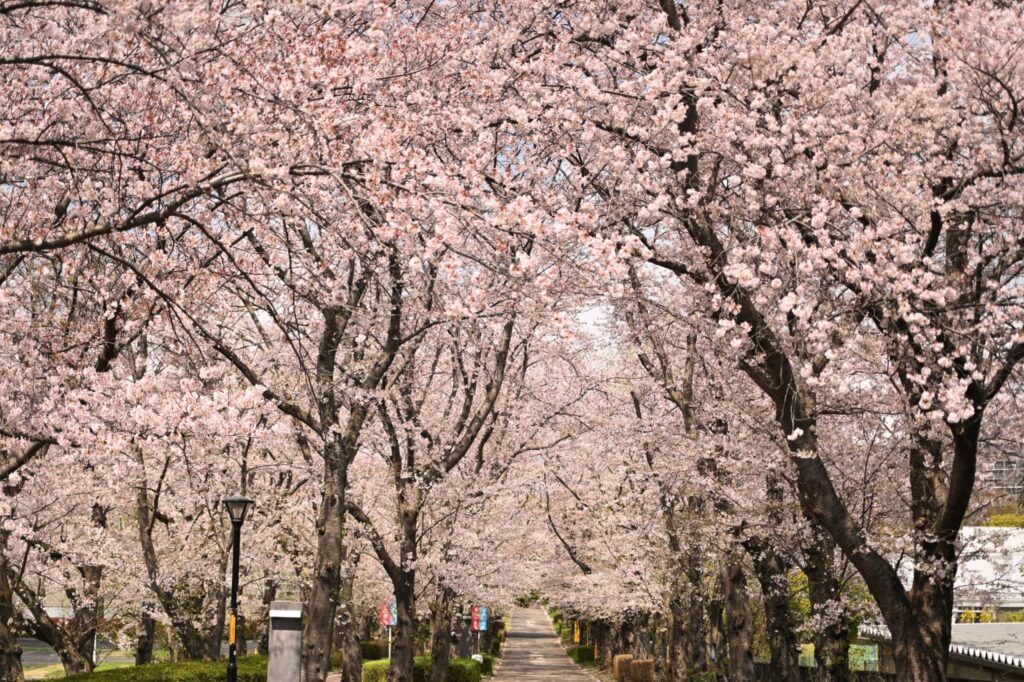
Every Yoshino Cherry tree in Japan is a clone — propagated by grafting from a single original tree, sharing identical genetic material. Because all individuals carry the same genes, they respond identically to temperature: after a sustained period of daily average temperatures below 5°C (chilling requirement), once temperatures consistently exceed 10°C, the trees bloom simultaneously across wide areas. This synchronized response is precisely what creates Japan’s famous cherry blossom front (sakura zensen), which advances northward across the country each spring.
Origin of the Cultivar
The parentage of Yoshino Cherry was first proposed by Ernest Henry Wilson, a British plant hunter who visited Japan in the early Taisho era. He identified it as a hybrid between Oshima Cherry (Prunus speciosa) and Edo Higan Cherry (Prunus pendula f. ascendens). Although several attempts have been made to recreate the original hybrid artificially,none has successfully reproduced Yoshino Cherry, and the exact circumstances of its original development remain unknown. However, genetic analysis supports the hybrid origin, and the large flower size is attributed primarily to the Oshima Cherry parentage.
Growing Guide
Light & Soil
Yoshino Cherry prefers full sun and fertile soil.
Cold Hardiness
It tolerates cold reasonably well, but the northern limit for reliable cultivation is around the Sapporo area.
Lifespan
Yoshino Cherry has a relatively short lifespan for a tree — 50 to 60 years, with a maximum of around 100 years. Its peak flowering period is typically between 30 and 40 years of age.
Pests & Disease
Yoshino Cherry is susceptible to a number of pests and diseases, including witches’ broom disease and silkworm moths, and various slug moth species. This makes it less appealing for private garden planting.
Pruning
The Japanese saying “sakura kiru baka, ume kiranu baka” — “a fool cuts cherry trees, a fool who doesn’t cut plum trees” — captures the tree’s extreme sensitivity to pruning. Cuts provide entry points for rot-causing fungi, which can cause dieback, while excessive pruning weakens overall vigor and reduces flowering. Pruning should be done during the dormant season, limited to the minimum necessary, cutting branches back to their base. Cut surfaces should be treated immediately with grafting wax or lime-sulfur compound to prevent decay.
Natural Form
Yoshino Cherry never grows with a truly upright trunk. As it matures, it naturally develops a broad, inverted umbrella shape — and this natural form is what is meant to be admired. It is therefore not well-suited to confined spaces.
Cultivars & Similar Species
Cultivar
Shidare Somei Yoshino — Estimated to be a hybrid between Oshima Cherry and Weeping Cherry (Prunus pendula). While not technically a Yoshino Cherry cultivar, it produces very similar flowers on gracefully weeping branches.
Similar Cherry Species
The following species share characteristics with Yoshino Cherry — notched petal tips and flowers blooming in small clusters on short stalks:
| Species | Key Difference |
|---|---|
| Edo Higan (Prunus pendula f. ascendens) | One of the parent species; extremely long-lived |
| Oshima Cherry (Prunus speciosa) | Other parent species; larger flowers |
| Kanhi-zakura (Prunus campanulata) | Deep pink; blooms earliest of all |
| Takane-zakura (Prunus nipponica) | Alpine species |
| Yamazakura (Prunus jamasakura) | Classic wild cherry; leaves emerge with flowers |
| Oyama-zakura (Prunus sargentii) | Larger flowers; striking red autumn color |
| Choji-zakura (Prunus apetala) | Small-flowered; clove-shaped buds |
| Mame-zakura (Prunus incisa) | Compact species; often used in bonsai |
| Kasumi-zakura (Prunus verecunda) | Hazy, misty appearance |
| Izu Yoshino | Regional variant; similar to Yoshino Cherry |
Frequently Asked Questions
Q: Are all Yoshino Cherry trees in Japan the same tree?
Genetically, yes. Every Yoshino Cherry is a clone propagated by grafting from a single original tree. This identical genetic makeup is what causes them to bloom simultaneously, creating Japan’s cherry blossom front.
Q: Why do Yoshino Cherry blossoms turn white after opening?
The flowers are only faintly pink at first opening and gradually bleach to near-white as they age. The impression of pink is strongest in the early stages of bloom and when many flowers are viewed together against a blue sky.
Q: Can you eat the cherries from a Yoshino Cherry tree?
The small cherries that develop are not suitable for eating — they are too small and not flavorful. Yoshino Cherry is an ornamental cultivar, not a fruiting cherry.
Q: Why is Yoshino Cherry less common in western Japan?
It is sensitive to heat, drought, and salt spray, and does not flower as cleanly in the warmer, more humid climate of western and southern Japan. It performs best in the cooler conditions of eastern Japan.
Q: How long does a Yoshino Cherry tree live?
Typically 50–60 years, with a maximum of around 100 years — relatively short for a tree. Most trees seen today were planted during Japan’s postwar reconstruction era and are now approaching the end of their natural lifespan.
Q: Why do Yoshino Cherry trees bloom all at once?
Because nearly all Yoshino Cherry trees are genetically identical clones, they respond to seasonal temperatures in almost exactly the same way. After receiving enough winter chilling, they flower almost simultaneously when spring temperatures rise.
Q: Why is Yoshino Cherry called Somei Yoshino?
It was first propagated by nursery growers in Somei Village (present-day Tokyo). To distinguish it from the wild cherries of Mount Yoshino in Nara, the cultivar was officially named Somei Yoshino in 1900.
Conclusion
No tree captures the Japanese sense of mono no aware — the bittersweet beauty of impermanence — quite like Yoshino Cherry. Its blossoms last barely a week, fading from pale pink to white before falling in a brief, breathtaking shower. Yet this very fleetingness is what makes hanami (flower viewing) such an anticipated and deeply felt tradition. A clonal species born in an Edo-era nursery garden, Yoshino Cherry has come to embody spring itself for millions of people across Japan and around the world. Whether admired in city parks, riverside avenues, or historic castle grounds, Yoshino Cherry remains the defining symbol of spring in Japan and one of the world’s most celebrated flowering trees.