Sawara Cypress (Chamaecyparis pisifera): Characteristics, History & Care Guide
Sawara cypress is one of Japan’s most famous trees. This guide includes identification features, bark, flowers, cones, and photographs taken in Japan.
What Is Sawara Cypress?
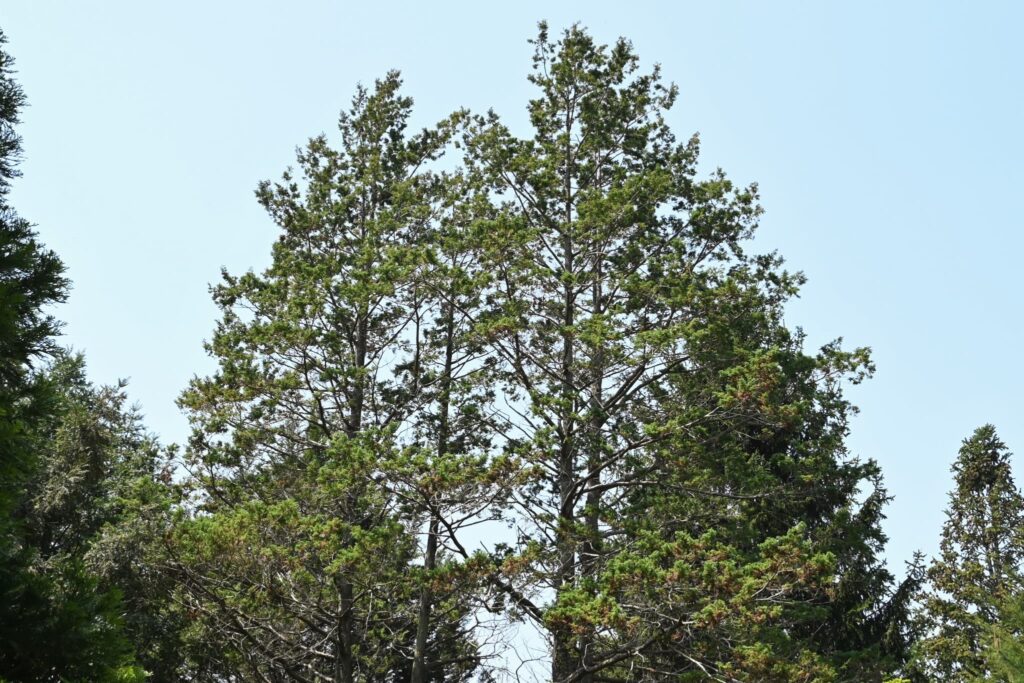
Sawara Cypress is an evergreen coniferous tree endemic to Japan, closely resembling Hinoki Cypress and sometimes referred to simply as Hiba. It is distributed across Honshu south of Mount Hayachine in Iwate Prefecture, as well as Shikoku and northern Kyushu, with particularly dense populations in northern Kanto and the Chubu region. The name Sawara is thought to derive from the Japanese word sawaraka (“refreshing” or “uncluttered”), describing the tree’s open, airy branching structure. In Japanese, it is written using the characters 椹 or 花柏 — not to be confused with the unrelated character used for the sawara fish (Spanish mackerel).
Overview
| Item | Description |
| Scientific Name | Chamaecyparis pisifera |
| Common Name | Sawara Cypress |
| Japanese Name | Sawara (サワラ) |
| Family | Cupressaceae |
| Native Range | Japan (endemic) |
| Plant Type | Evergreen Coniferous Tree |
| Height | 30–50 m (100–165 ft) |
| Flowering Season | April |
| Cone Type | Woody Cone |
| USDA Zones | 4–8 |
| Sun Exposure | Full Sun to Partial Shade |
Characteristics
Foliage
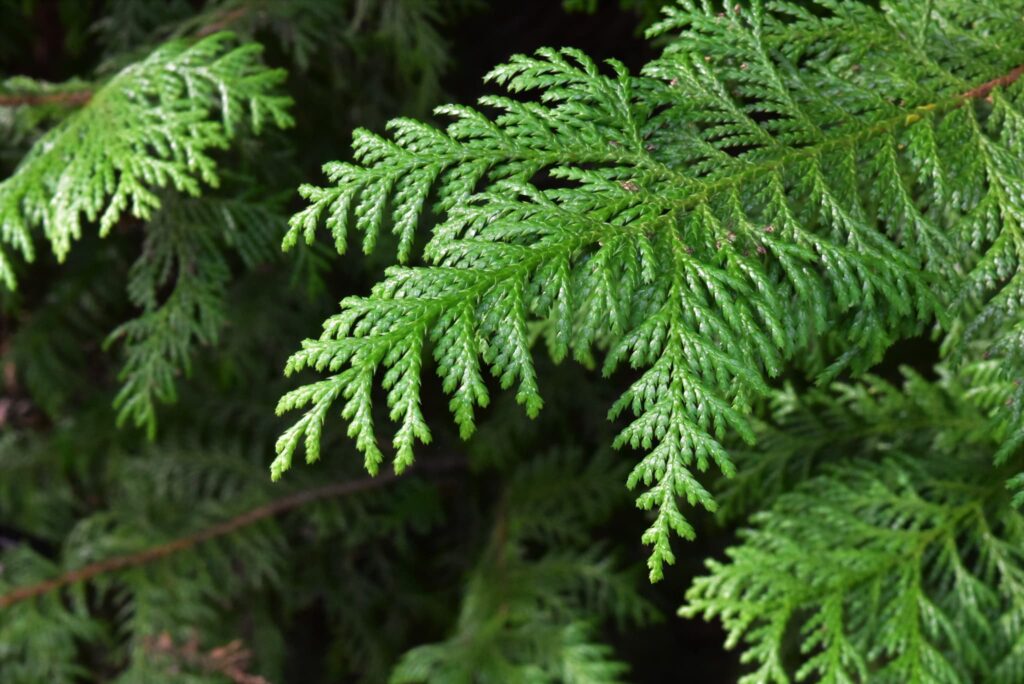
Like the scale-like leaves of Hinoki and Asunaro, Sawara Cypress foliage has traditionally been used as a decorative garnish (kaishiki) placed beneath fresh fish and matsutake mushrooms. The leaves contain pisiferic acid, a natural compound that has been studied for its antioxidant properties.
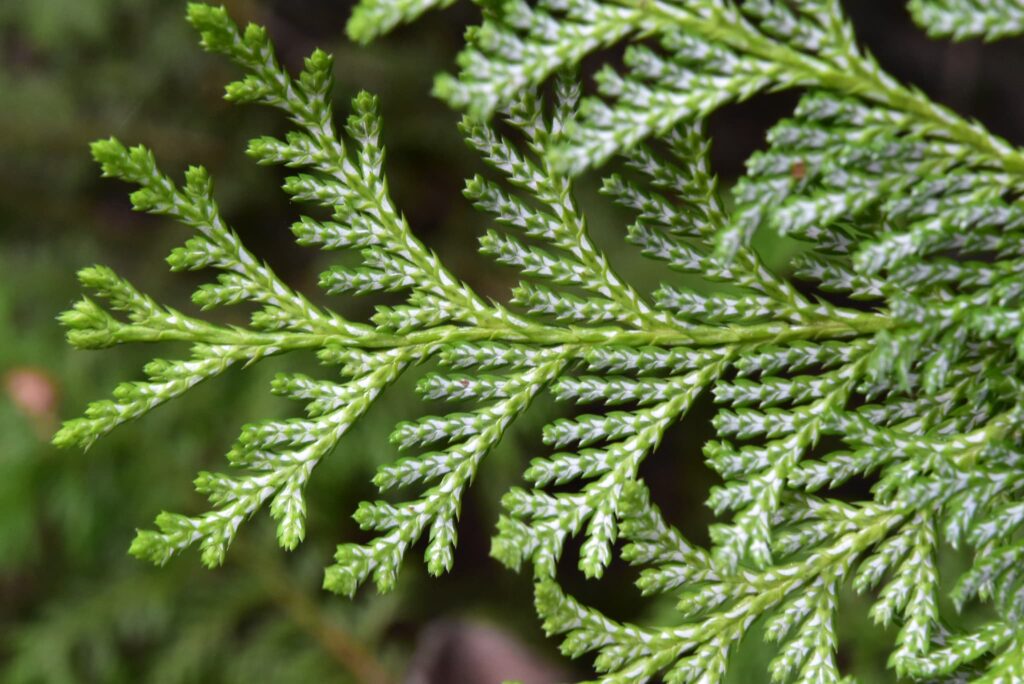
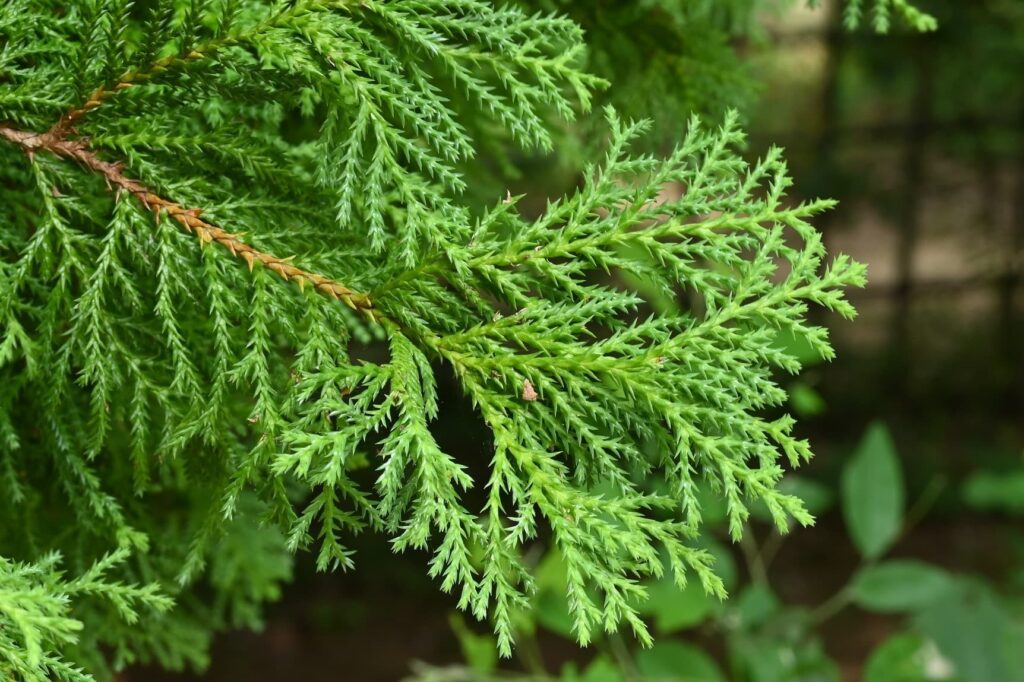
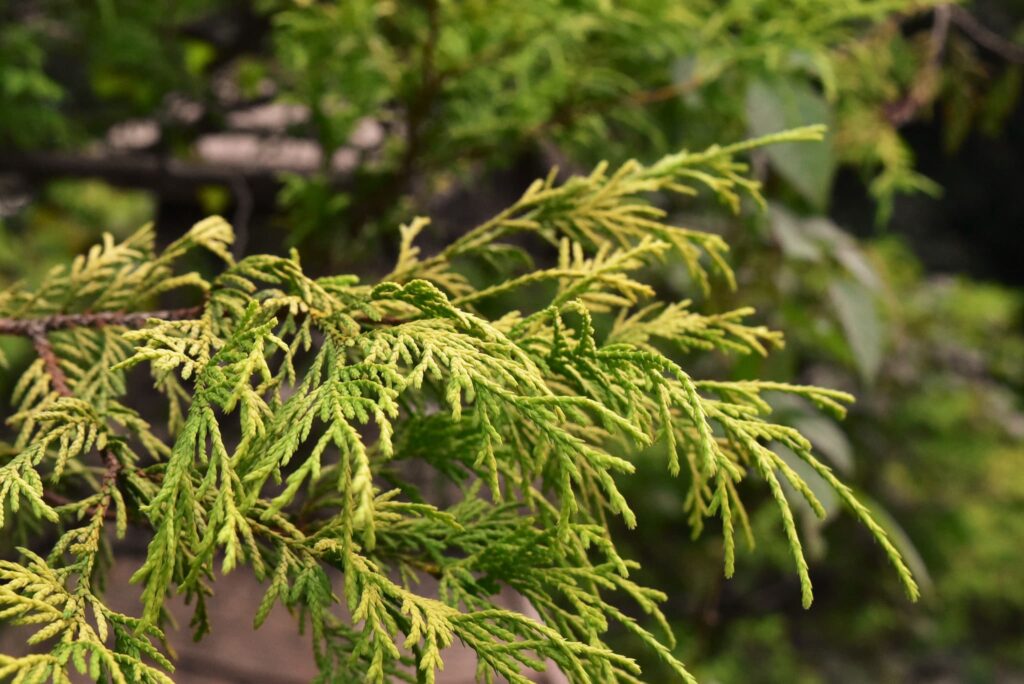
Each leaf segment is about 3 mm long and arranged in cross-shaped clusters. The foliage is paler than Hinoki’s, with a slightly yellowish tint. Sawara’s leaf tips are sharply pointed and noticeably prickly to the touch — in contrast to Hinoki, whose rounded leaf tips feel soft and smooth.
Flowers & Cones
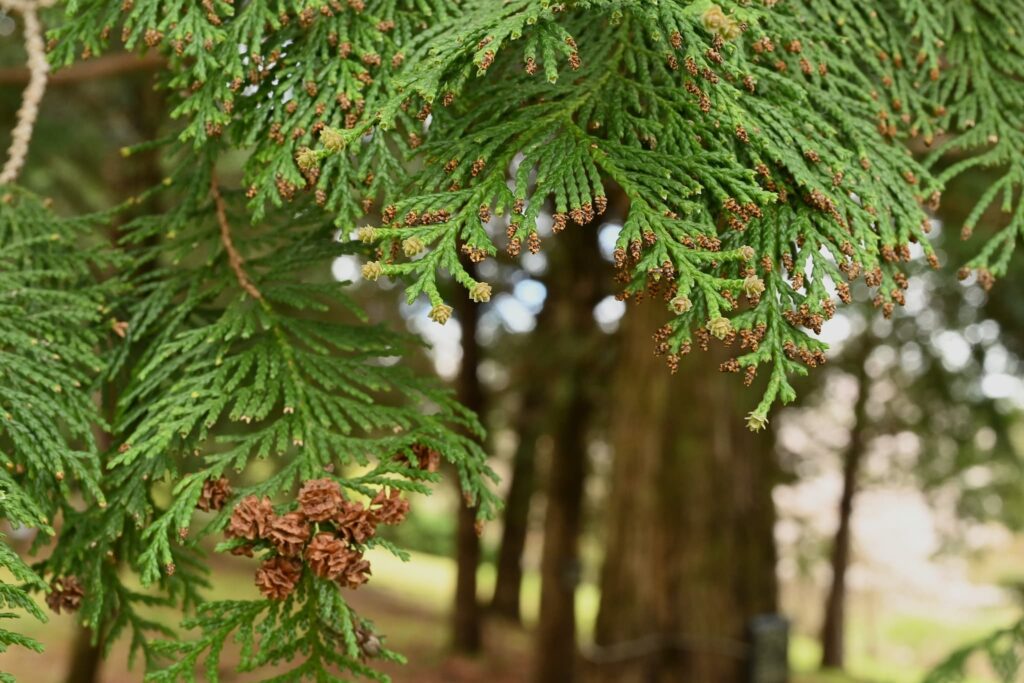
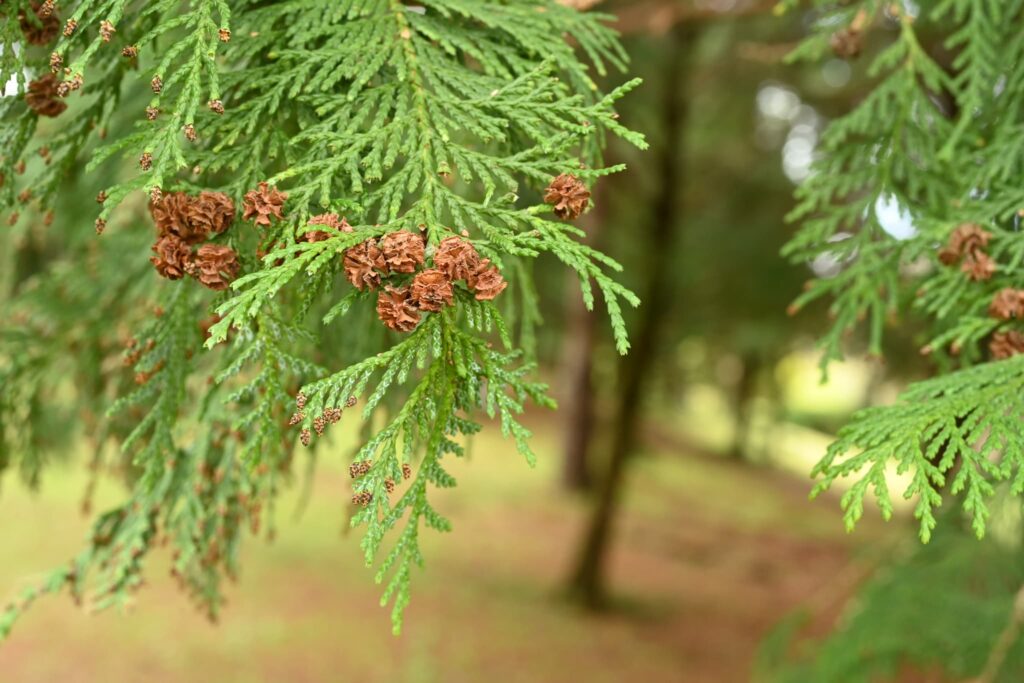
Sawara Cypress flowers in April, producing small, understated blooms at the branch tips. The tree is monoecious, bearing both male and female flowers. Male flowers are oval and purplish-brown; female flowers are pale green and irregularly spherical. Both are small and inconspicuous, with little ornamental value.
The cones that follow are 6–7 mm in diameter, smaller than those of Hinoki Cypress (8–15 mm), and ripen to a yellowish-brown color in autumn around October. As they dry and mature, Sawara cones develop a distinctive cup-shaped, bumpy texture — another point of contrast with Hinoki’s smoother, rounder cones. Like Hinoki, the seeds are winged and are released from both ends of the cone as it splits open.
Form & Bark
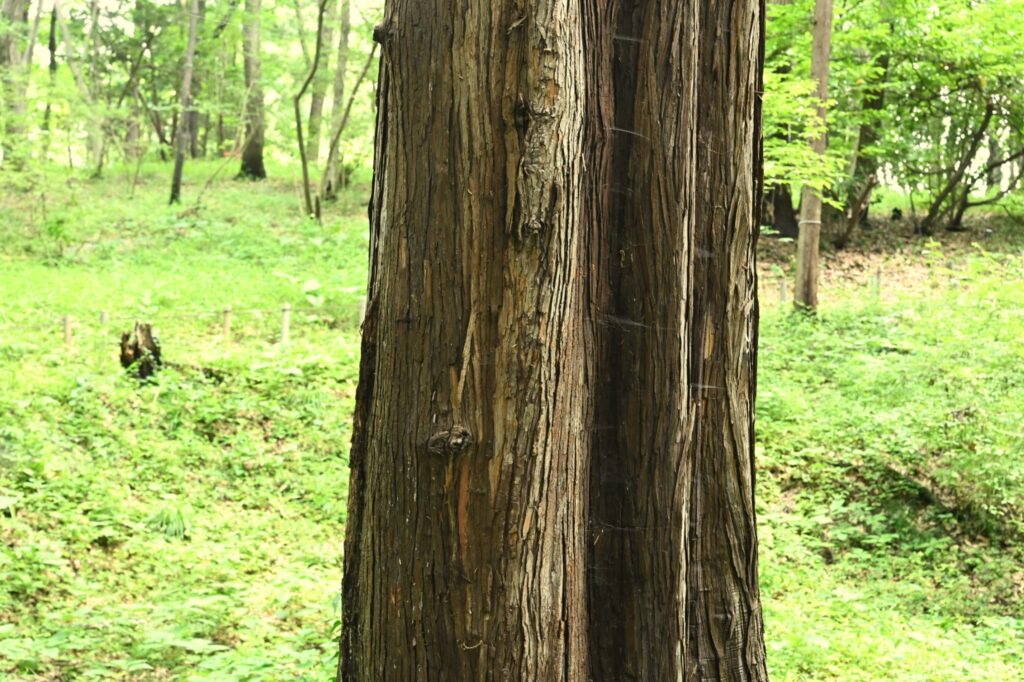
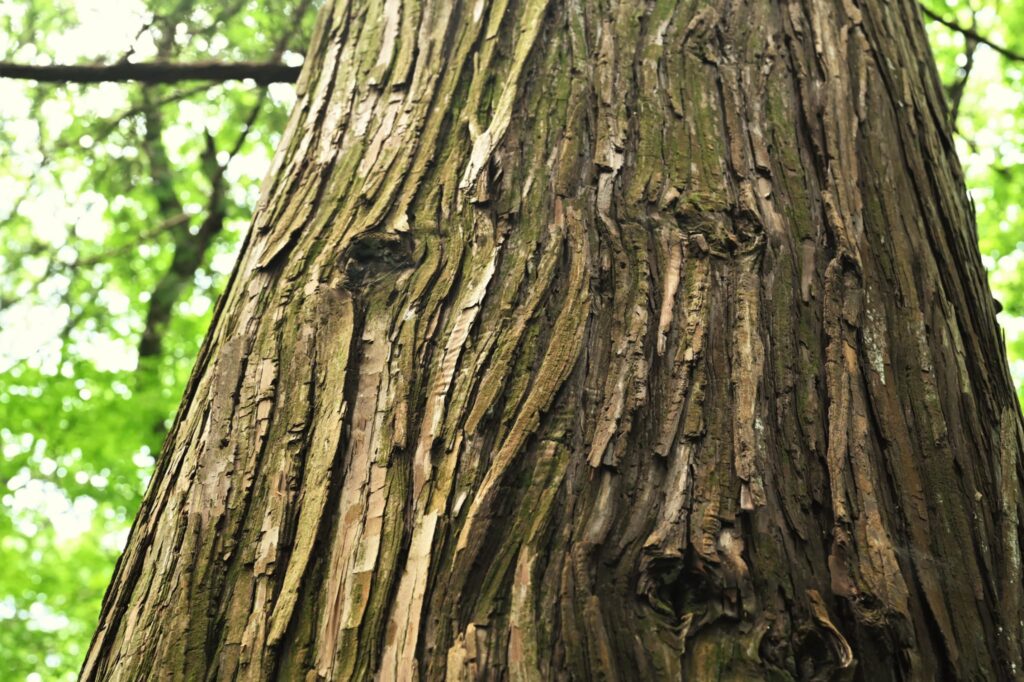
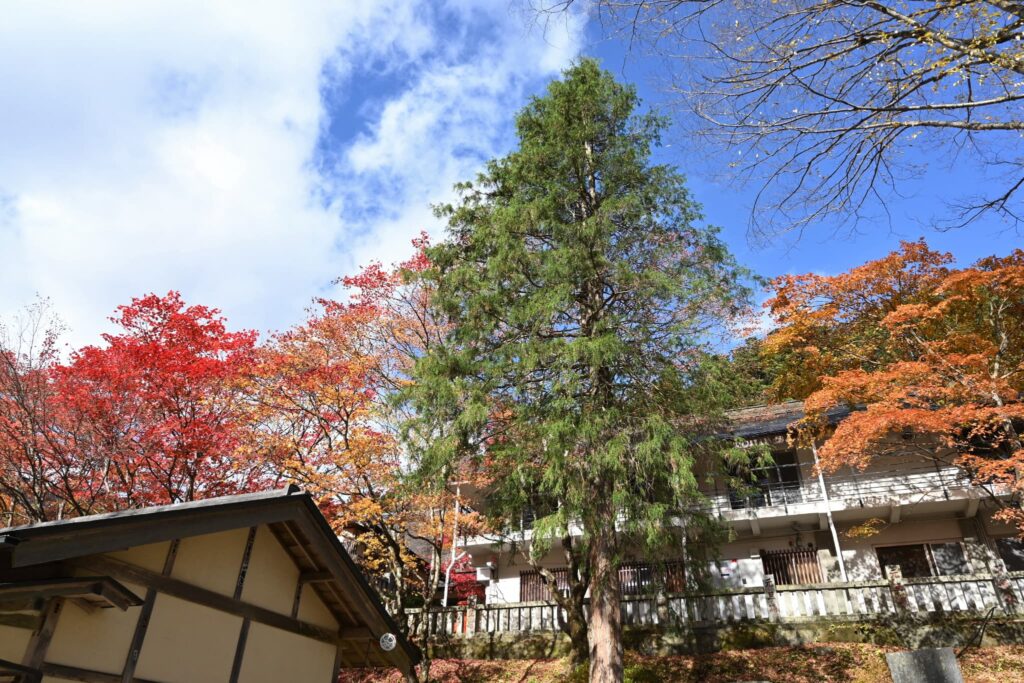
Sawara’s branches are slender, spreading horizontally with slightly upturned tips, giving the overall tree a graceful conical silhouette. The bark is reddish-brown to grayish-brown, similar in appearance to Hinoki Cypress and Japanese Cedar. With age, it develops vertical fissures and peels in thin strips — though these strips are narrower and less durable than Hinoki’s, making Sawara bark unsuitable for traditional roof thatching (hiwada-buki).
Timber & Practical Uses
Sawara Cypress wood is exceptionally soft and lightweight — among the lightest of all Japanese conifer timbers. This makes it unsuitable for structural use such as support pillars, but its high resin content gives it excellent water resistance.
These properties make it ideal for crafting wooden buckets and bathtubs. Because it lacks the strong fragrance of Hinoki, it is also widely used for food-related containers such as sushi oke (sushi rice tubs) and traditional rice storage bins. Along with Hinoki Cypress, Kurobe, Asunaro, and Japanese Umbrella Pine, Sawara Cypress was designated one of the “Five Precious Trees of Kiso” — protected under the Owari Domain during the Edo period.
Growing Guide
Habitat & Growth
While Hinoki Cypress naturally grows in harsh, dry environments such as old lava fields and exposed ridgelines, Sawara Cypress favors moist habitats like streamsides and ravines, and grows noticeably faster than its relative.
The trunk grows straight and can reach impressive sizes — 30–50 m in height and 1–2.8 m in diameter — making it a true giant among Japanese conifers. Due to its scale, it has historically been valued more for timber than as an ornamental garden tree.
Soil & Moisture
Sawara Cypress prefers moderately moist, fertile soil, though cultivated nursery stock tends to adapt well to a range of soil conditions. Pest and disease problems are rare.
Climate Tolerance
Sawara is somewhat more cold-hardy than Hinoki Cypress and can be grown at relatively high elevations and in colder regions such as Hokkaido.
Sun & Drought Tolerance
The species is moderately drought-sensitive and tends to perform better in partial shade rather than intense, direct sunlight.
Hedging & Pruning
Sawara has good regenerative growth and dense foliage — though somewhat less dense than Hinoki — making it usable for hedging. However, pruning must be done carefully to preserve enough foliage; over-pruning can cause dieback, which often means hedges are allowed to grow larger over the years rather than being kept compact. It’s best suited to large spaces such as school grounds or factory grounds where size is not a constraint.
Wind Resistance
Due to its shallow root system and dense foliage, Sawara Cypress is somewhat vulnerable to wind damage. Staking young trees during the early establishment period is recommended.
How to Tell Sawara Cypress Apart from Hinoki Cypress
| Feature | Hinoki Cypress | Sawara Cypress |
|---|---|---|
| Leaf tip | Rounded, soft to touch | Pointed, prickly to touch |
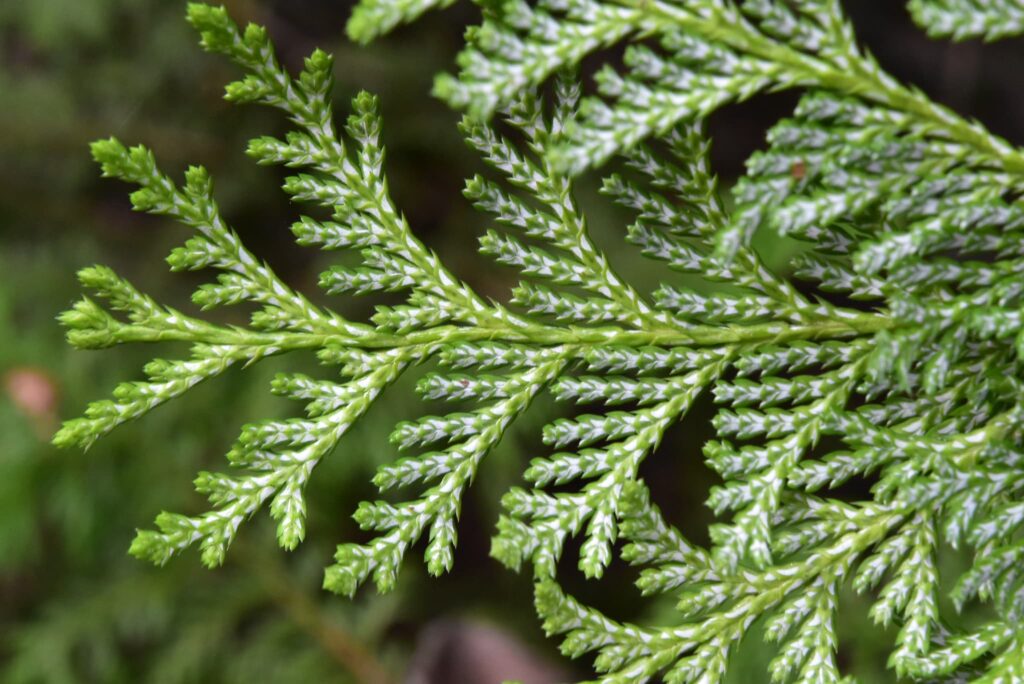
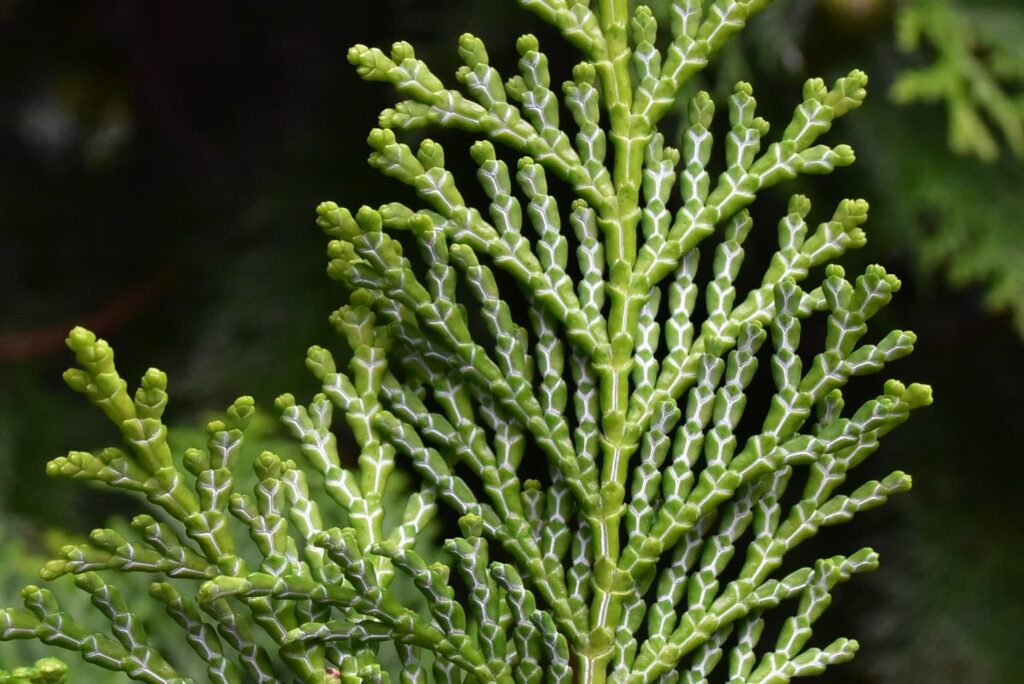
| Underside stomatal marking | “Y” shape | “X” or “H” shape |
| Foliage density | Dense — blocks view through branches | Looser — visible gaps between branches |
| Cone shape | Smooth, nearly round | Cup-shaped, bumpy when dry |
| Cone size | 8–15 mm | 6–7 mm |
The most reliable method is examining the underside of the leaves: Hinoki shows a white “Y”-shaped marking, while Sawara shows a white “X” or “H” shape — both visible clearly even to non-experts.
Two other species are sometimes confused with Sawara Cypress: Taiwan Red Cypress (Chamaecyparis formosensis) and Lawson Cypress (Chamaecyparis lawsoniana), native to Taiwan and North America respectively — though both are far less commonly planted in Japan.
Cultivars
Sawara Cypress has produced numerous ornamental cultivars with subtly different foliage colors and textures, which are far more commonly planted in gardens than the wild species itself.
| Cultivar | Feature |
|---|---|
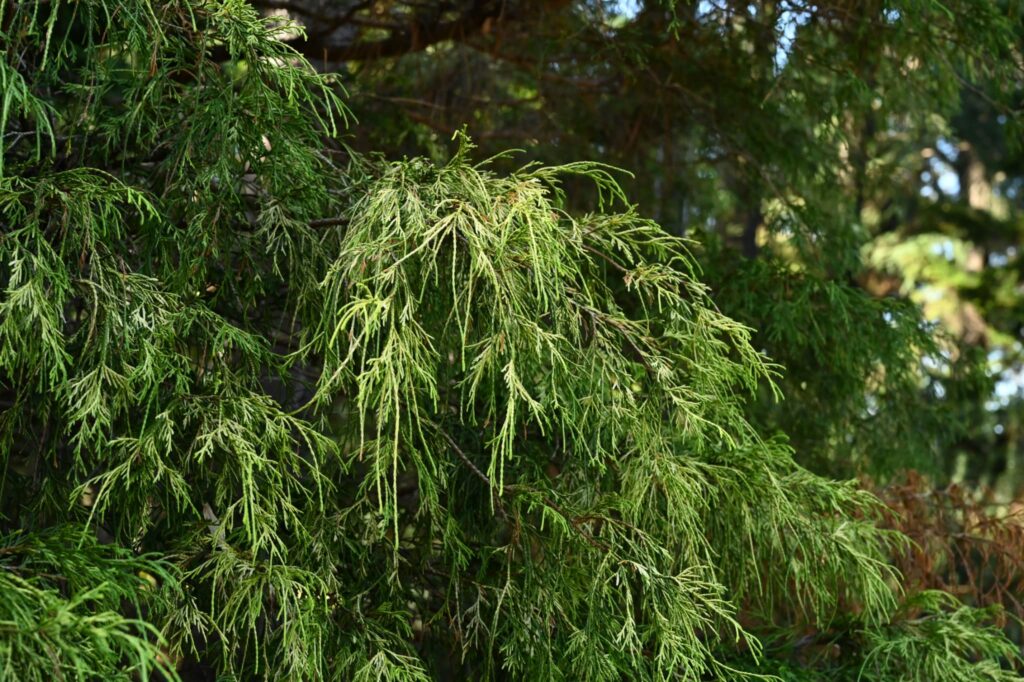
| Hiyoku Hiba (Filifera) | Thread-like, cascading foliage |
| Ougon Hiyoku Hiba (Filifera Aurea) | Golden-yellow thread-like foliage |
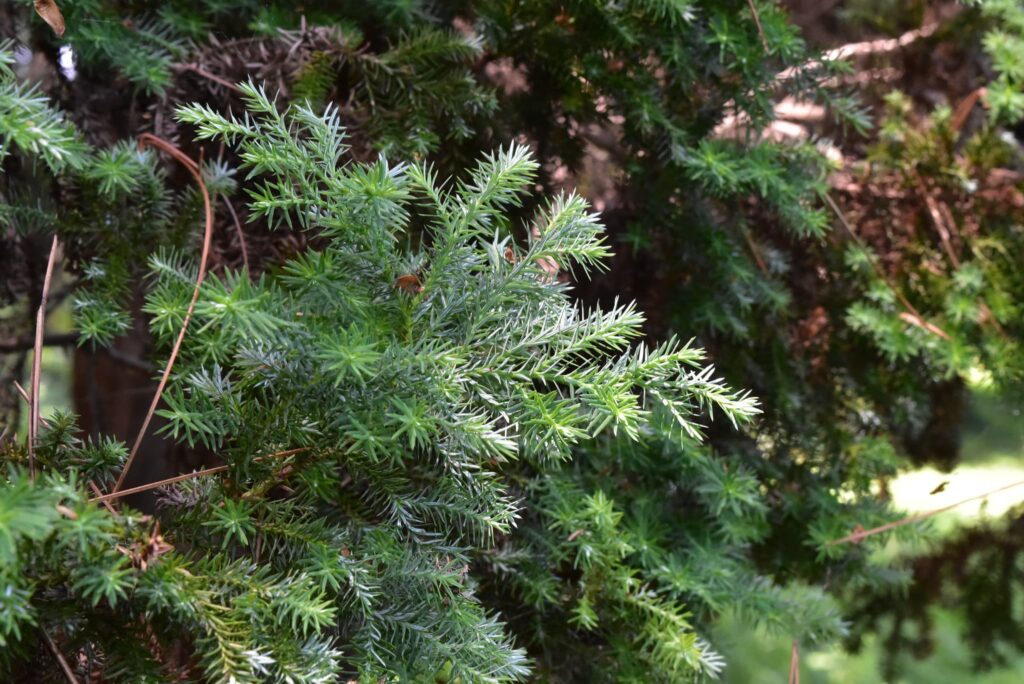
| Himuro Sugi (Satsuma Hiba) | Soft, feathery, cedar-like foliage |
| Chirimen Himuro | Crinkled, textured foliage |
| Hime Himuro | Dwarf form of Himuro Sugi |
| Atsukawa Sawara | Thick-leaved variety |
| Tsukumo Hiba | Dense, compact growth habit |
| Shinobu Hiba | Soft, fern-like foliage texture |
| Ougon Shinobu (Nikko Hiba) | Golden-yellow, fern-like foliage |
| Fuiri Shinobu | Variegated, fern-like foliage |
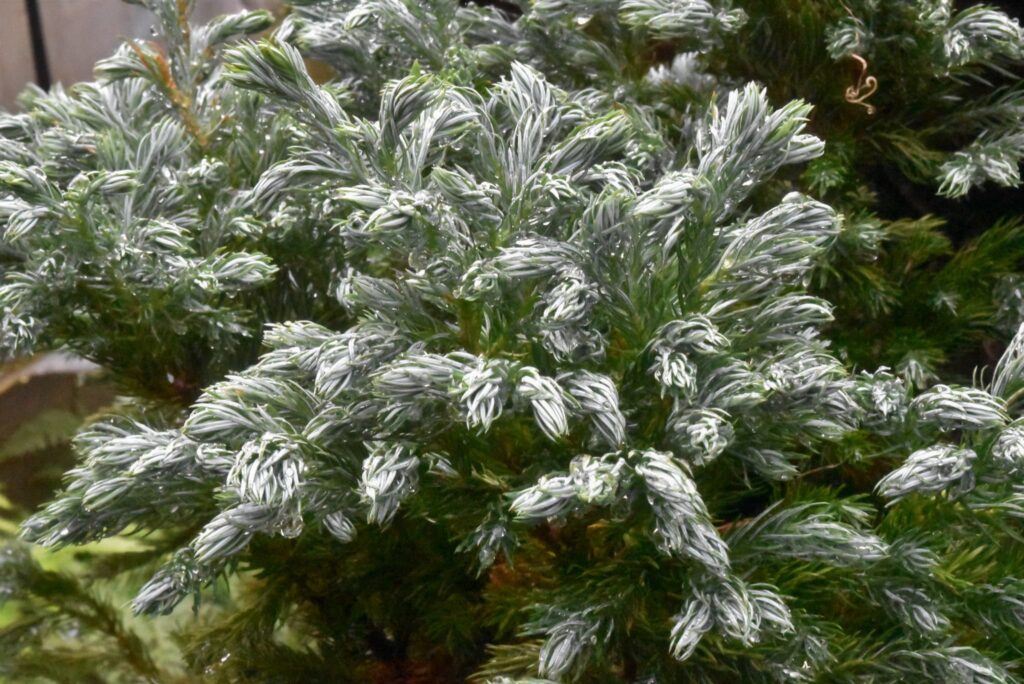
| Boulevard | Silvery-blue foliage; one of the most popular landscaping cultivars worldwide |
Frequently Asked Questions
Q: What is the easiest way to tell Sawara Cypress apart from Hinoki Cypress?
Touch the leaf tips — Sawara’s are pointed and slightly prickly, while Hinoki’s are rounded and soft. For certainty, check the underside of the leaves: Sawara shows a white “X” or “H” pattern, Hinoki shows a “Y.”
Q: Is Sawara Cypress good for hedging?
Yes, though care must be taken not to over-prune, as removing too much foliage can cause dieback. It’s best suited to large properties where the hedge can be allowed to grow over time.
Q: Why is Sawara Cypress used for sushi tubs and rice containers?
Unlike Hinoki, Sawara wood has very little fragrance of its own, making it ideal for food storage and serving vessels where a neutral scent is desired. It’s also naturally water-resistant due to its high resin content.
Q: Is ‘Boulevard’ a type of Sawara Cypress?
Yes — Boulevard Cypress is one of the most popular ornamental cultivars of Chamaecyparis pisifera, prized for its soft, silvery-blue foliage in landscaping worldwide.
Q: Is Sawara Cypress cold-hardy?
Yes, it is slightly more cold-tolerant than Hinoki Cypress and can be grown in colder regions, including parts of Hokkaido and at higher elevations.
Q: Is Sawara Cypress wood rot-resistant?
Yes. Sawara wood is naturally resistant to moisture and decay, making it suitable for bathtubs, buckets, and other items frequently exposed to water.
Q: How fast does Sawara Cypress grow?
Sawara Cypress generally grows faster than Hinoki Cypress, especially in moist, fertile soils.
Conclusion
Though often overshadowed by its more famous relative, Hinoki Cypress, Sawara Cypress holds its own distinct place in Japanese forestry, craftsmanship, and garden design. Its lightweight, water-resistant timber has made it a practical choice for everything from bathtubs to sushi rice tubs, while its many ornamental cultivars — from the golden threads of Ougon Hiyoku Hiba to the silvery elegance of Boulevard — have made it a beloved garden tree across the world. Whether admired for its towering natural form or its delicate cultivated varieties, Sawara Cypress reflects the same quiet refinement suggested by its name.Although often overlooked outside Japan, Sawara Cypress is one of the country’s most valuable native conifers. Its graceful form, practical timber, and remarkable diversity of ornamental cultivars continue to make it an important tree in both Japanese forestry and gardens around the world.