Hinoki Cypress (Chamaecyparis obtusa): Identification, Care and Uses
Hinoki Cypress is one of Japan’s most celebrated trees, prized for its fragrant, durable timber and its long association with Shinto shrines and Buddhist temples. This guide covers its identification features, growing habits, cultural significance, and care, based on observations of the plant as grown in Japan.
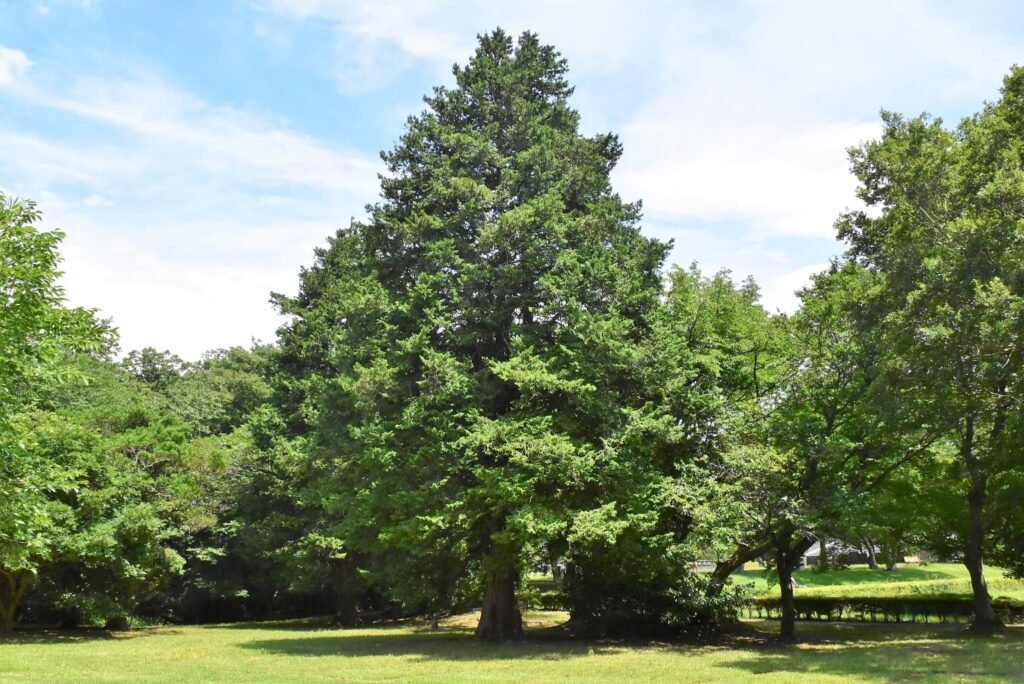
What Is the Hinoki Cypress?
Hinoki Cypress is an evergreen coniferous tree in the family Cupressaceae, native to a wide range across Japan — from Akai-dake in Fukushima Prefecture (Iwaki City) southward through Honshu, Shikoku, and Kyushu, including Yakushima. While natural Hinoki forests are now limited to a few regions such as Kiso, Ura-Kiso, Koyasan, and western Kochi Prefecture, the species has a long history of cultivation for timber and ranks second only to Japanese Cedar (Cryptomeria japonica) in total planted area, remaining one of the most commonly seen trees in Japan today.
Overview
| Item | Description |
|---|---|
| Scientific Name | Chamaecyparis obtusa |
| Common Name | Hinoki Cypress |
| Japanese Name | Hinoki (ヒノキ) |
| Family | Cupressaceae |
| Native Range | Japan |
| Plant Type | Evergreen Coniferous Tree |
| Height | 30–50 m (100–165 ft) |
| Trunk | Reddish-brown bark, peeling in thin vertical strips; diameter can exceed 2 m in old specimens |
| Flowering Season | Late March–April |
| Fruit Type | Cone (spherical, 1–2 cm) |
| USDA Zones | 5–8 |
| Sun Exposure | Full Sun to Partial Shade |
Characteristics
| Item | Description |
|---|---|
| Foliage | Scale-like leaves, 1–3 mm, blunt-tipped, densely overlapping |
| Flowers | Monoecious; small yellow-green/reddish-purple female flowers, purplish-brown male flowers |
| Fruits | Spherical woody cones, 1–2 cm, ripening reddish-brown |
| Bark | Reddish-brown, peels in wide vertical strips |
| Growth Habit | Slow-growing; horizontal branching forming an elongated, egg-shaped crown if unpruned |
Foliage
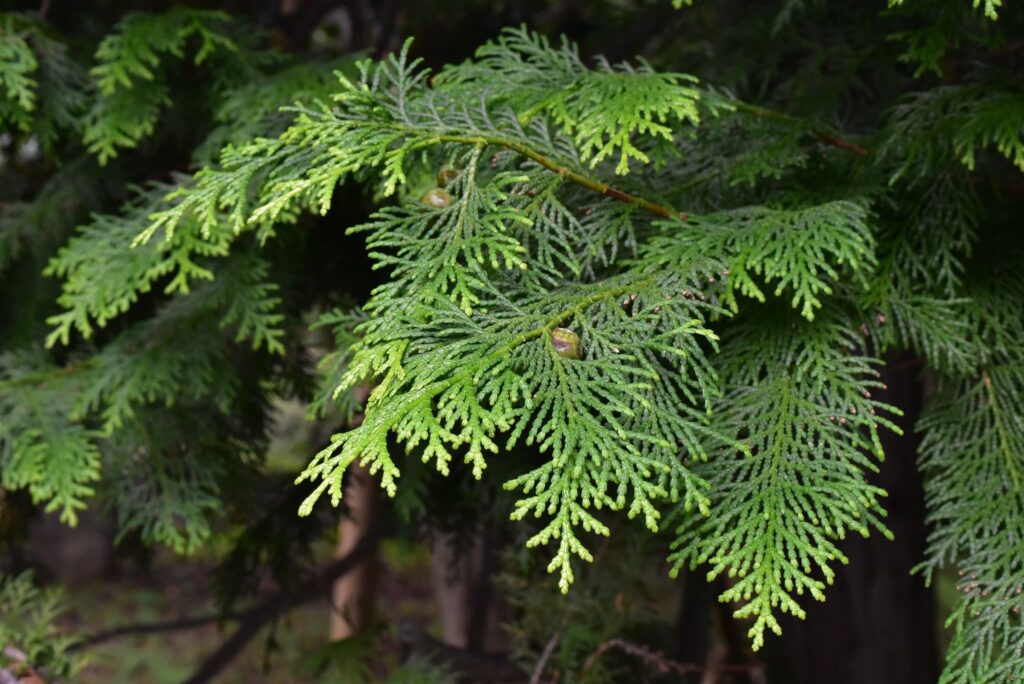
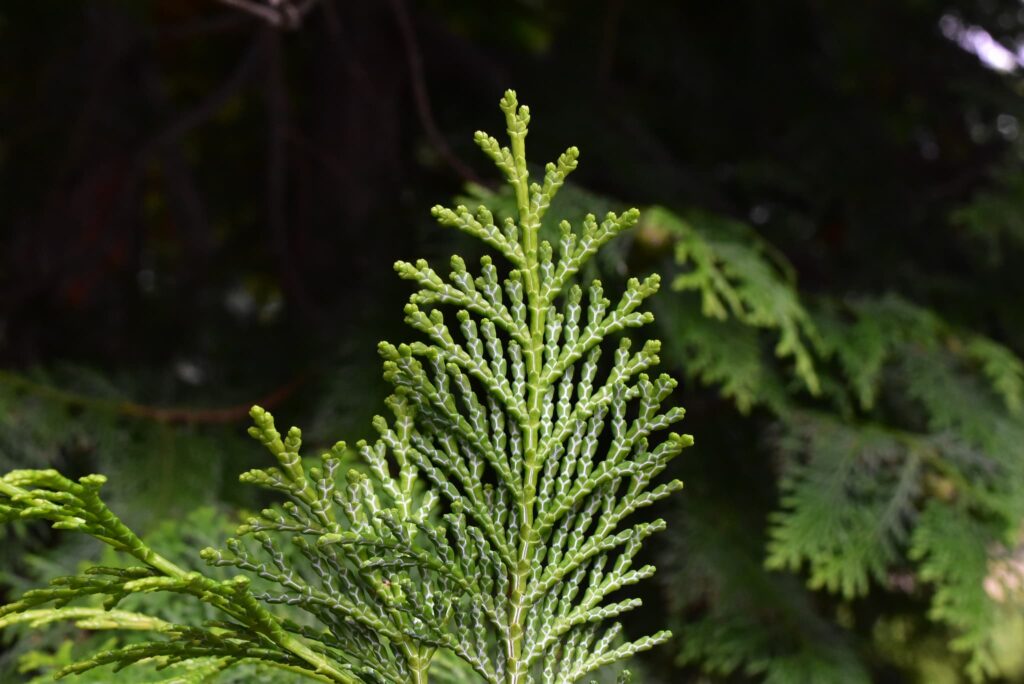
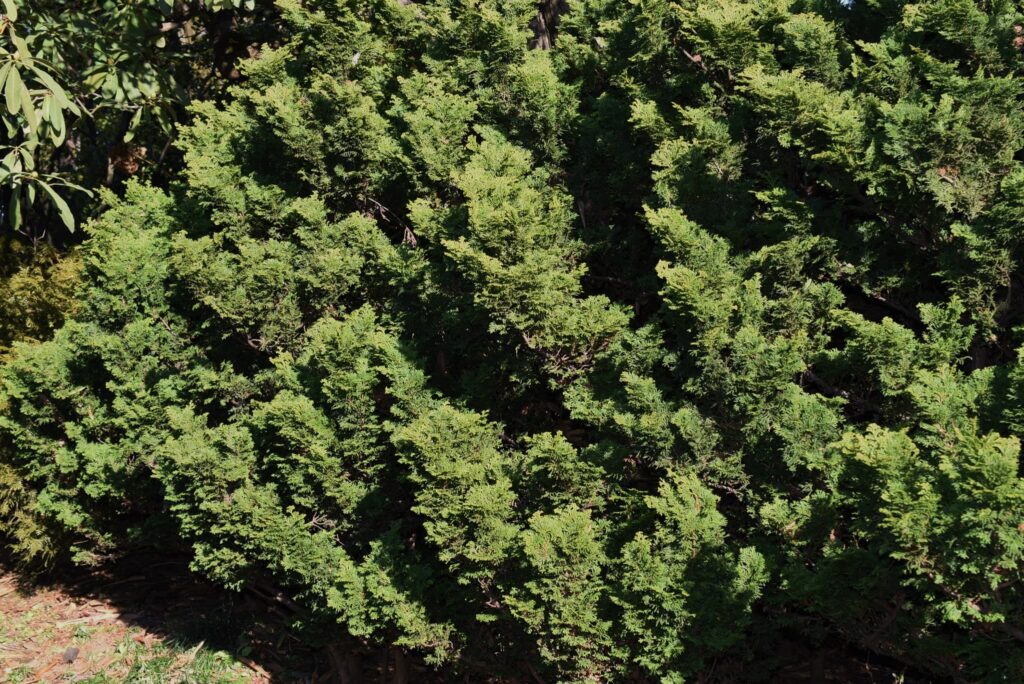
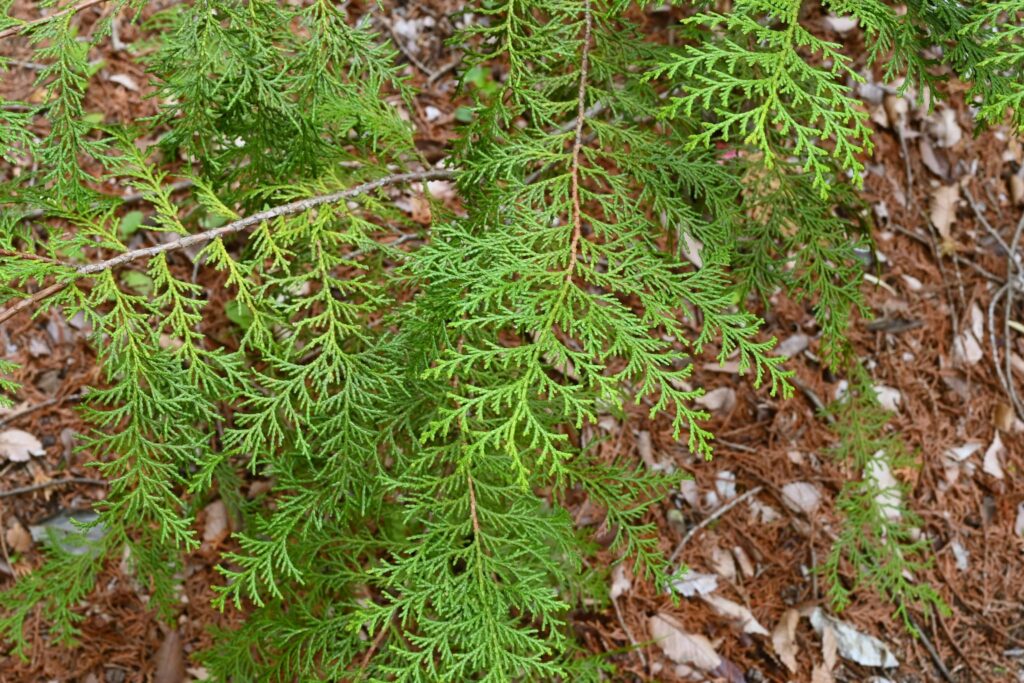
The leaves are small, scale-like, and 1–3 mm long, overlapping to form dense sprays. They closely resemble those of Sawara Cypress (Chamaecyparis pisifera), a close relative in the same family, but Hinoki’s leaf tips are blunt rather than pointed, and its foliage is noticeably denser. Another distinguishing feature: the white stomatal markings on the underside of the leaves form an “X” shape in Sawara Cypress, compared to a “Y” shape in Hinoki.
Hinoki leaves contain natural oils with antibacterial and preservative properties. These leaves have traditionally been used as a decorative garnish (kaishiki) beneath fresh fish and matsutake mushrooms — a presentation still commonly seen in Japanese supermarkets today.
Flowers
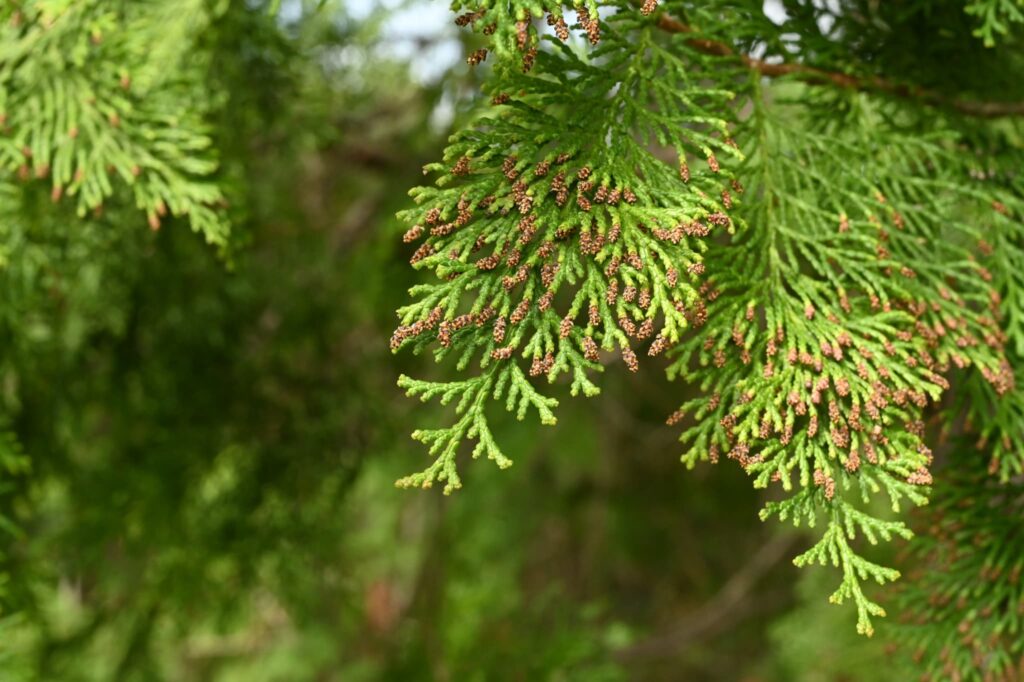
Hinoki Cypress flowers from late March through April. It is monoecious, with both male and female flowers appearing on the same tree. Female flowers are spherical, 3–5 mm in diameter, and pale yellow-green to reddish-purple in color, featuring a distinctive cross-shaped scale pattern absent in male flowers — though their relative scarcity makes them easy to overlook. Male flowers are oval, 2–3 mm in diameter, purplish-brown, and bloom in large numbers at the branch tips. Like Japanese Cedar pollen, Hinoki pollen is a well-known cause of seasonal allergies in Japan.
Fruits
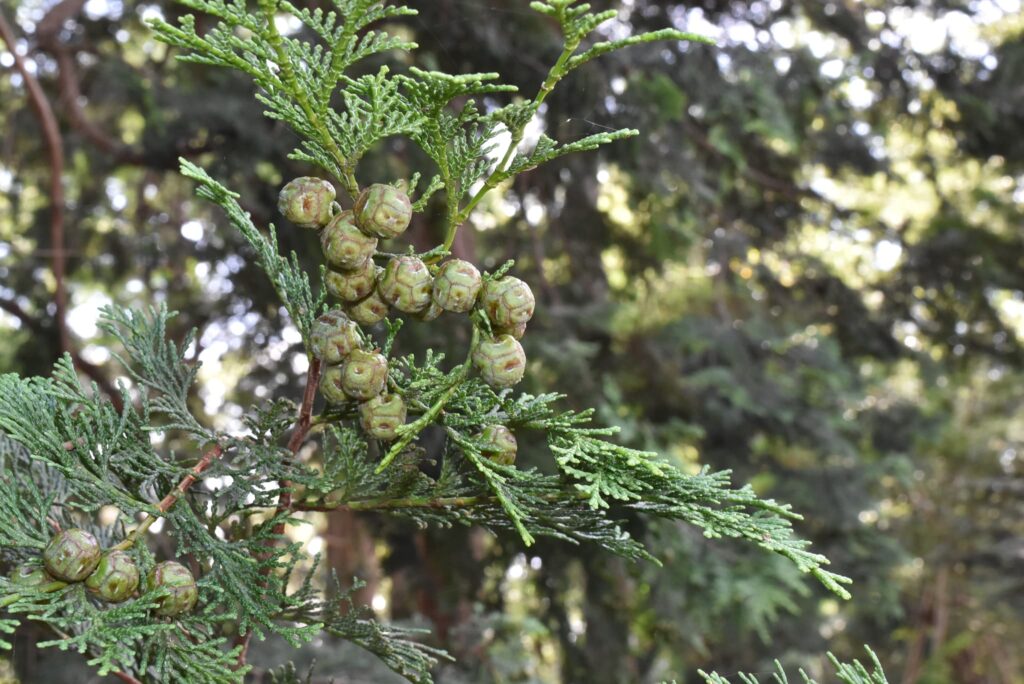
The cones that follow flowering are spherical, 1–2 cm in diameter, covered in woody scales. They ripen to reddish-brown around October to November, at which point the scales open to release winged seeds. The seeds, roughly 3 mm in diameter, are not edible to humans but are a favored food source for Oriental Turtle Doves, which are common even in residential areas.
Bark & Timber
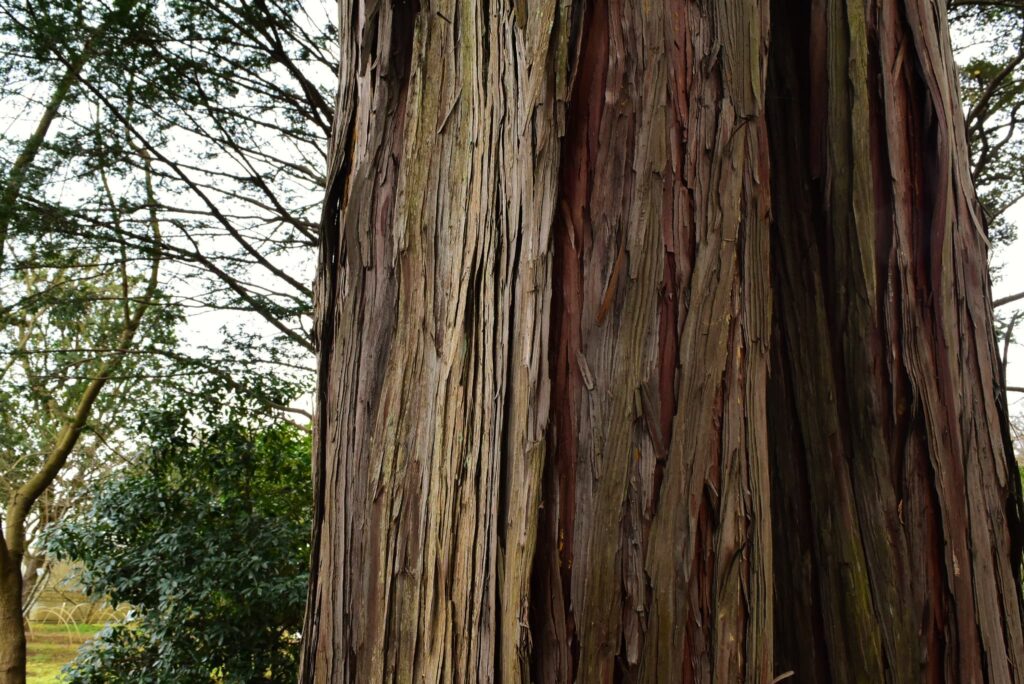
The bark is reddish-brown and peels away in thin vertical strips as the tree ages — wider strips than those of Cedar or Sawara Cypress. This bark has traditionally been used for hiwada-buki (traditional cypress bark roofing) and as material for fire-starting cords (hinawa).
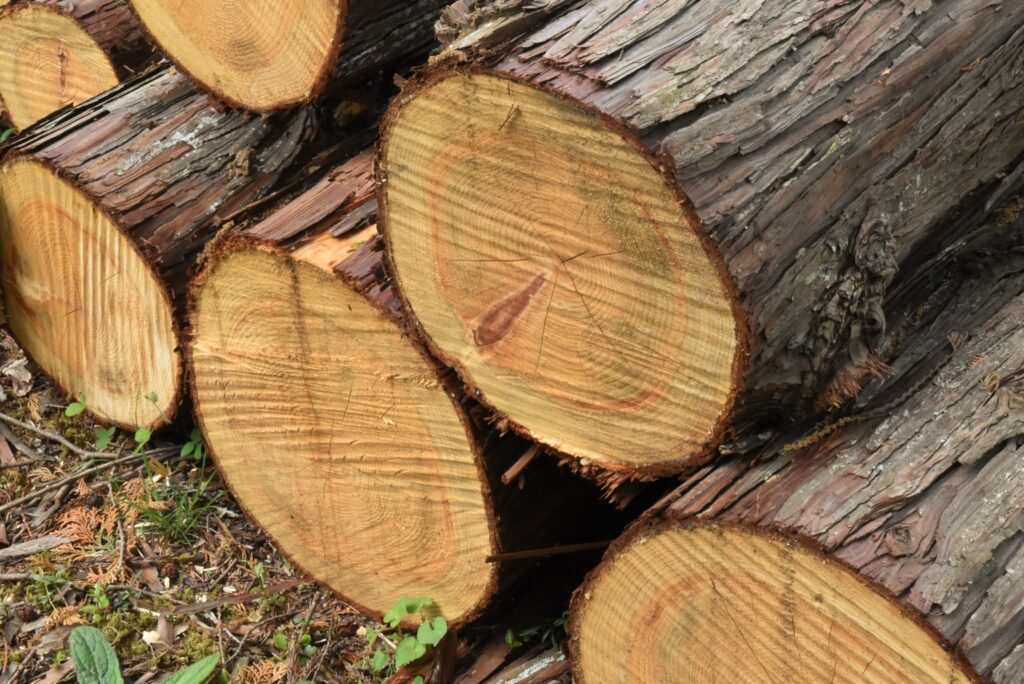
Hinoki timber is prized as premier construction material for its beautiful grain, pleasant fragrance, and exceptional durability and water resistance — properties that can last over 1,000 years. Because Hinoki grows more slowly than Cedar, its grain is finer and its finish more refined, commanding a premium price.
Size & Growth
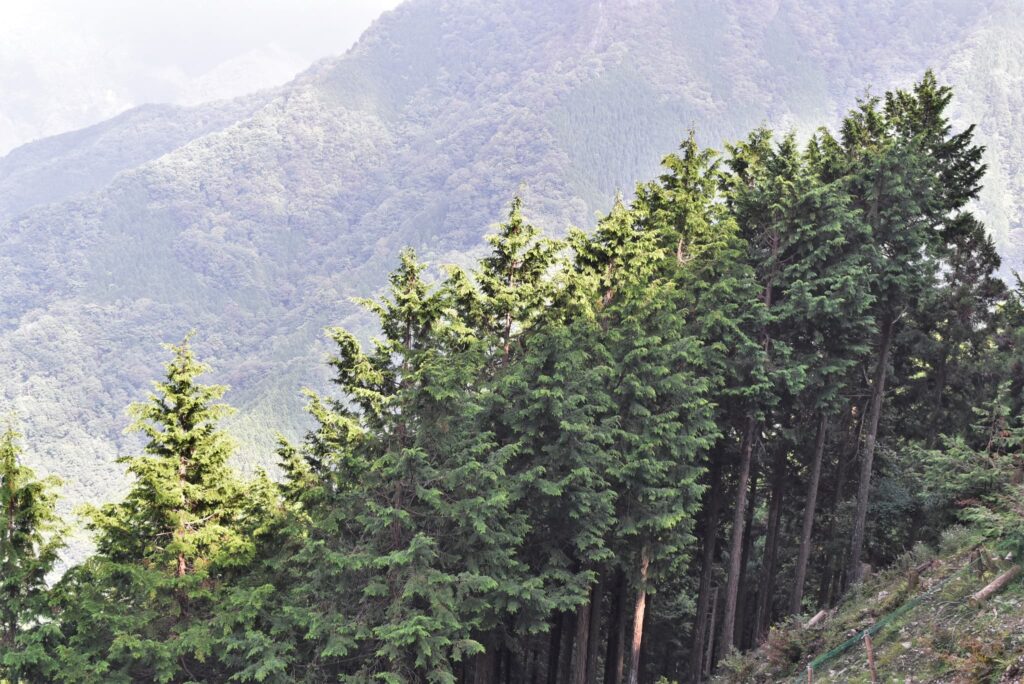
Hinoki Cypress can live for over 2,000 years, with the largest specimens reaching heights of 50 m and trunk diameters exceeding 2 m. It is a slow-growing tree compared to Japanese Cedar — a trait that also produces its finer, denser grain. Left unpruned, branches spread horizontally, producing an elongated, egg-shaped overall form.
Uses & Cultural Significance
Name Origin
Hinoki’s name is most commonly traced to “hi no ki” (火の木, “fire tree”) — a reference to its resin-rich wood, which was historically used to start fires through friction. Remarkably, there are traditional accounts of Hinoki trees generating enough friction during storms to ignite dry material.
Other proposed origins include “hi no ki” (日の木, “sun tree” or “supreme tree”), reflecting its status as a top-tier wood; “hi no ki” (霊の木, “sacred tree”), referencing its use in shrine construction; and “hime-ha-no-ki” (姫葉之木, “tree of small leaves”). According to the Nihon Shoki, the deity Susanoo-no-Mikoto is said to have created Hinoki from the hair of his own chest. In Japanese, the tree is written as 檜, 桧, or 扁柏.
Notable Forests
During the Edo period, the Tokugawa Shogunate strictly protected Hinoki — along with Sawara Cypress, Kurobe, Asunaro, and Japanese Umbrella Pine — as one of the “Five Precious Trees of Kiso” (Kisogo Boku). The Kiso Hinoki forest preserved at Akazawa Natural Recreation Forest in Nagano Prefecture is one of three areas, alongside Aomori Hiba and Akita Cedar, recognized as one of Japan’s Three Great Natural Forests. Notable Hinoki plantations include those in Owase, Yoshino, and Tenryu.
Historical & Traditional Uses
Hinoki has been used in some of Japan’s most important historical structures, including Ise Grand Shrine, the Main Hall and Five-Story Pagoda of Horyu-ji Temple, Todai-ji Temple, and Toshodai-ji Temple. Beyond construction, it has traditionally been used to craft Buddhist statues, bathtubs, wooden buckets, draining racks, cutting boards, traditional sedge-style hats (hinoki-gasa), ceremonial fans (hi-ogi), and bentwood containers historically used by fishermen.
Hinoki vs. Taiwan Hinoki Cypress
The compound hinokitiol — well known for its skin-brightening and anti-inflammatory properties, often used in skincare and treatments for atopic dermatitis — is not found in Japanese Hinoki, but rather in Taiwan Hinoki Cypress (Chamaecyparis obtusa var. formosana). Native to mountainous regions at elevations of 2,000–3,000 m, Taiwan Hinoki grows larger than its Japanese counterpart and has a noticeably stronger fragrance. As large-diameter Japanese Hinoki has become increasingly rare, Taiwan Hinoki is now used in landmark structures such as the torii gates at Meiji Jingu Shrine.
A Note on “Hiba”
The term Hiba (桧葉) is sometimes used loosely to refer to trees with Hinoki-like foliage, but the term is used differently depending on region and context. Depending on region and speaker, it may refer to Hinoki itself, its cultivars, or related species such as Asunaro (Thujopsis dolabrata), Hinoki-Asunaro, or Kurobe (Thuja standishii). Broadly speaking, Hinoki is found in the cool temperate zones along Japan’s Pacific coast, while Asunaro and Kurobe inhabit cooler, snowier regions, and Hinoki-Asunaro grows in even colder climates. Historically, all of these were simply grouped together under the name “Hinoki.”
Growing Guide
| Item | Description |
|---|---|
| Light & Soil | Full sun to partial shade; tolerates nutrient-poor, dry soils and shaded conditions |
| Wind & Snow Tolerance | Shallow roots; can topple in strong winds — staking recommended for young trees |
| Cold Hardiness | Hardy in USDA zones 5–8; tolerates both heat and cold well |
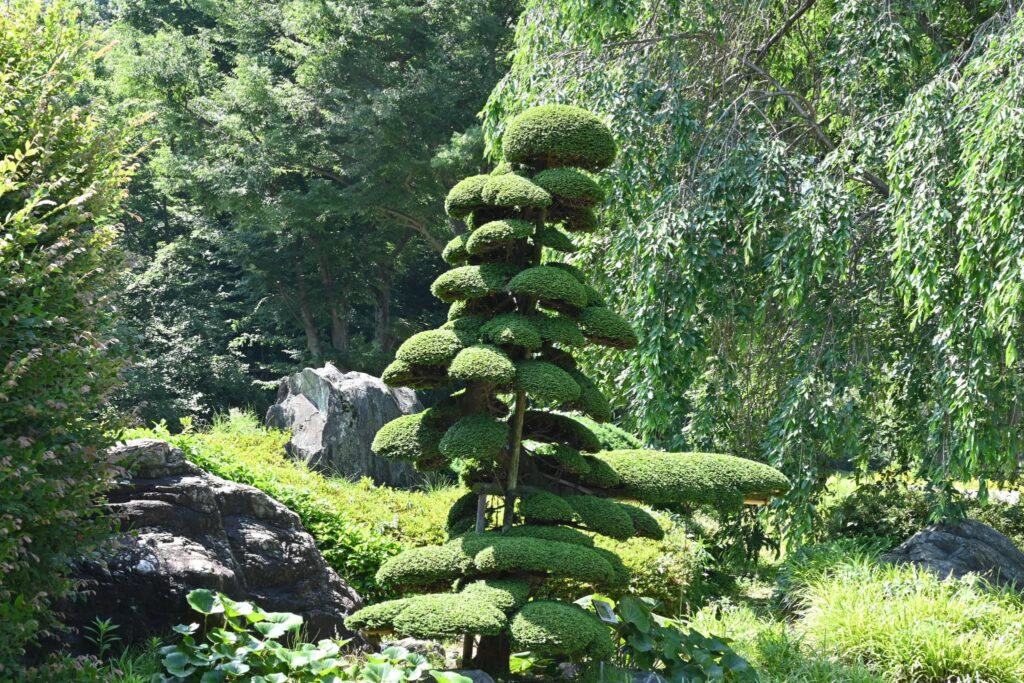
| Pruning | Tolerates pruning but does not respond well to heavy cutting back |
| Suitability for Home Gardens | Better suited to large spaces; slower-growing cultivars recommended for typical gardens |
| Pests | Resistant to pests, disease, and air pollution |
Light & Soil
In the wild, Hinoki often grows alone in harsh environments such as lava fields and rocky mountainsides. While moderately moist soil is ideal, the species is fundamentally hardy and can tolerate nutrient-poor, dry soils as well as shaded conditions. The finest timber-quality Hinoki tends to come from trees that grew slowly on shaded, steep slopes.
Wind & Snow Tolerance
Hinoki has relatively shallow roots and can topple in strong winds. Staking is recommended, particularly for young trees.
Cold Hardiness
Hinoki is resistant to pests, disease, and air pollution, and tolerates both heat and cold well. It can be successfully cultivated at elevations up to 2,200 m, and is hardy in USDA zones 5–8.
Pruning
The tree tolerates pruning but does not respond well to heavy cutting back — once it grows large, reducing its size again is difficult. Regular, attentive maintenance is recommended.
Suitability for Home Gardens
Hinoki is well-suited for filling large spaces affordably, but for typical residential gardens, slower-growing cultivars — such as Chabohiba (Kamakura Hiba), Peacock Hiba, and Kanaami Hiba — are more commonly chosen.
Pests
Hinoki is notably resistant to pests, disease, and air pollution, making it a low-maintenance choice once established.
Cultivars
| Cultivar | Feature |
|---|---|
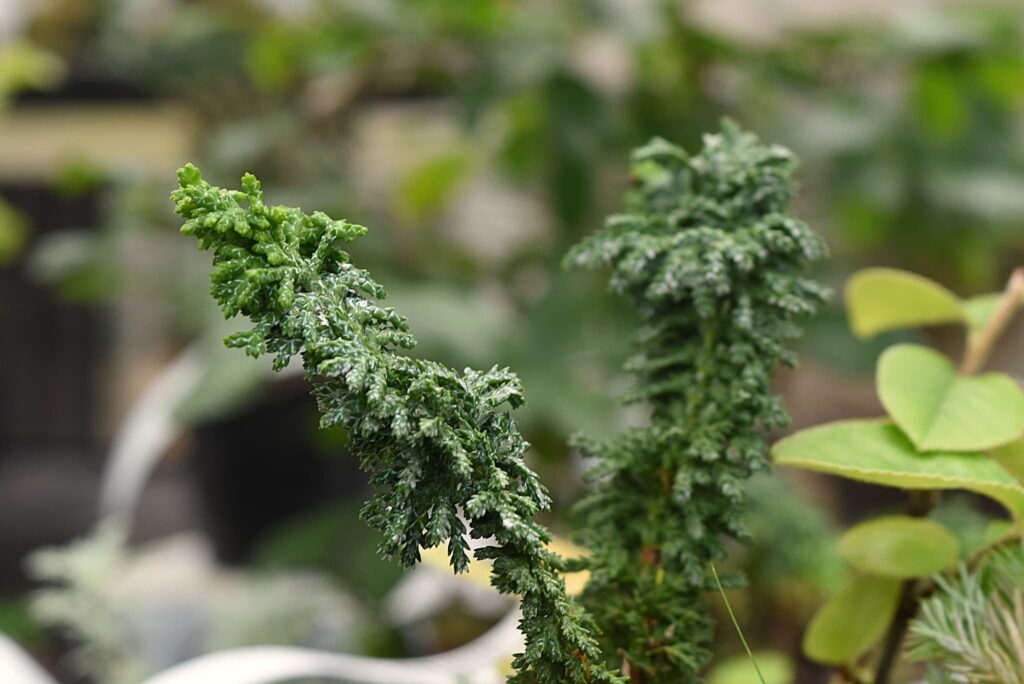
| Hinoki ‘Nana’ | Dwarf form; does not grow large |
| Yatsubusa Hinoki | Compact, densely branched cultivar |
| Sekka Hinoki (Crested Hinoki) | Fan-shaped, fasciated branch growth |
| Chabohiba (thread-leaf form) | Thread-like, cascading foliage |
| Nangoh-hi | A unique cultivar traditionally propagated near Nangoh Valley in Aso District, Kumamoto Prefecture. While Hinoki is typically propagated from seed, Nangoh-hi is the only Japanese Hinoki variety propagated by cuttings, reliably inheriting the vigorous traits of its parent tree — strong disease resistance, sustained growth even at advanced age, and notably tough, resilient timber. |
Similar Species
- Sawara Cypress (Chamaecyparis pisifera)
- Asunaro (Thujopsis dolabrata)
- Kurobe (Thuja standishii)
- Lawson Cypress (Chamaecyparis lawsoniana)
Frequently Asked Questions
Is Hinoki Cypress the same as the wood used in Japanese hot spring baths?
Yes. The fragrant wood used for traditional hinoki-buro (cypress bathtubs) at Japanese hot springs and ryokan inns comes from this tree. Its natural oils give it antibacterial properties and a distinctive, calming scent.
What is the difference between Hinoki and Taiwan Hinoki Cypress?
They are closely related, but only Taiwan Hinoki Cypress (Chamaecyparis obtusa var. formosana) contains hinokitiol, the compound prized in skincare for its antibacterial and skin-brightening properties. Taiwan Hinoki also grows larger and has a stronger fragrance than Japanese Hinoki.
How can I tell Hinoki Cypress apart from Sawara Cypress?
Hinoki leaves have blunt, rounded tips and a denser growth habit, with a white “Y”-shaped marking on the underside. Sawara Cypress leaves are more pointed and sparser, with an “X”-shaped marking instead.
Why does Hinoki Cypress cause allergies?
Like Japanese Cedar, Hinoki produces large amounts of airborne pollen in spring (late March through April), which is one of the leading causes of seasonal allergic rhinitis in Japan.
Can Hinoki Cypress be grown outside of Japan?
Yes. It is hardy in USDA zones 5–8 and is increasingly popular in gardens throughout North America, Europe, and other temperate regions for its elegant form and fragrant foliage.
Is Hinoki Cypress slow-growing?
Yes, especially compared to Japanese Cedar. This slower growth produces a finer, denser grain, which is part of why Hinoki timber is so highly valued.
How long does Hinoki Cypress live?
Hinoki Cypress can live for more than 1,000 years, and some exceptional specimens are believed to be over 2,000 years old.
Why is Hinoki wood so expensive?
Hinoki grows slowly and produces exceptionally durable, fine-grained timber. Large old-growth trees have also become increasingly scarce, which contributes to its high value.
Conclusion
Few trees are as deeply woven into Japanese culture, architecture, and daily life as Hinoki Cypress. From the ancient halls of Ise Grand Shrine and Horyu-ji Temple to the relaxing cypress bathtubs found in hot spring resorts today, Hinoki’s combination of natural beauty, durability, and fragrance has made it one of Japan’s most treasured trees for over a thousand years. Whether valued for its historic temples, premium timber, aromatic wood, or elegant appearance, Hinoki Cypress stands as one of Japan’s most important and enduring trees.