Japanese Umbrella Pine (Sciadopitys verticillata): Characteristics, Symbolism & Care Guide
Japanese Umbrella Pine (Sciadopitys verticillata) is one of Japan’s most distinctive evergreen conifers, prized for its unusual umbrella-like foliage, naturally symmetrical form, attractive reddish-brown bark, and exceptional longevity. It is the only living species in the genus Sciadopitys and the sole species of the family Sciadopityaceae.
Native to Japan, with a disjunct occurrence also reported from Jeju Island in South Korea, Japanese Umbrella Pine has a long history of use in Japanese gardens, temples, timber production, and traditional culture. This guide covers identification features, foliage, reproductive structures, bark, timber, cultural significance, cultivars, and cultivation.
What Is Japanese Umbrella Pine?
Japanese Umbrella Pine is an evergreen conifer in the family Sciadopityaceae. It is the only living species in the genus Sciadopitys and is considered an evolutionary relict because closely related fossil plants were much more widespread in the past.
The species is native primarily to central and southern Japan, where it occurs in mountainous areas from southern Tohoku through Honshu, Shikoku, and Kyushu. It is also known from Jeju Island in South Korea.
In Japan, it is known as Koyamaki (コウヤマキ, 高野槇) and is also called Honmaki (ホンマキ). The English name “Japanese Umbrella Pine” refers to the unusual arrangement of its long, thick foliage, which radiates from short shoots in a distinctive whorl.
Although it is called a pine in English, it is not a true pine and does not belong to the genus Pinus. Its closest living relatives are represented by its own isolated lineage, the family Sciadopityaceae.
Overview
| Item | Description |
|---|---|
| Scientific Name | Sciadopitys verticillata |
| Common Name | Japanese Umbrella Pine |
| Other English Names | Japanese Umbrella-pine, Parasol Pine |
| Japanese Name | Koyamaki (コウヤマキ), Honmaki (ホンマキ) |
| Family | Sciadopityaceae |
| Genus | Sciadopitys |
| Native Range | Japan; also reported from Jeju Island, South Korea |
| Plant Type | Evergreen Coniferous Tree |
| Height | Commonly 20–30 m; exceptionally up to around 40 m |
| Trunk | Reddish-brown, fibrous bark that becomes vertically fissured and exfoliating with age |
| Foliage | Thick, linear, glossy green, 6–13 cm long, arranged in whorls |
| Reproductive Structures | Male pollen cones and female seed cones on the same tree |
| Pollination | Spring |
| Seed Cone | Ovoid to broadly cylindrical, about 4.5–10 cm long |
| USDA Zones | Approximately 5–8 |
| Sun Exposure | Full sun to partial shade |
| Growth Rate | Slow |
| Conservation Status | Near Threatened (IUCN) |
Characteristics
| Feature | Description |
|---|---|
| Foliage | Thick, glossy green, linear foliage arranged in distinctive whorls |
| Male Cones | Small pollen cones produced in dense terminal clusters |
| Female Cones | Large, solitary seed cones that mature about 18–20 months after pollination |
| Bark | Reddish-brown and fibrous, becoming vertically fissured and peeling with age |
| Habit | Evergreen tree with a broad pyramidal to conical crown |
| Growth | Slow, but capable of eventually reaching a very large size |
| Longevity | Long-lived, with specimens capable of surviving for centuries |
Foliage
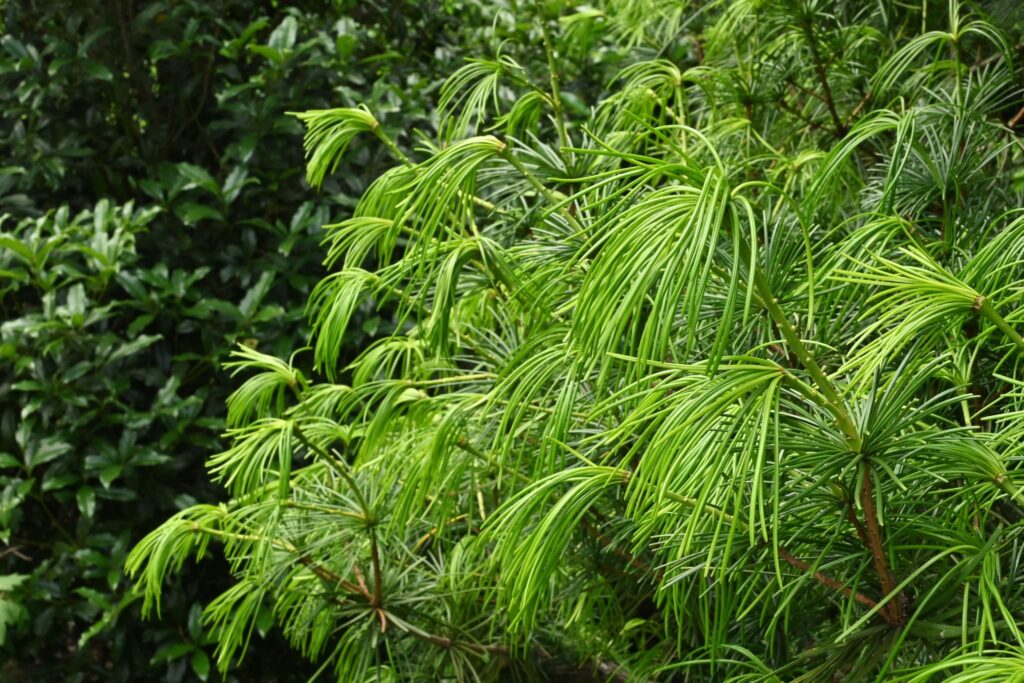
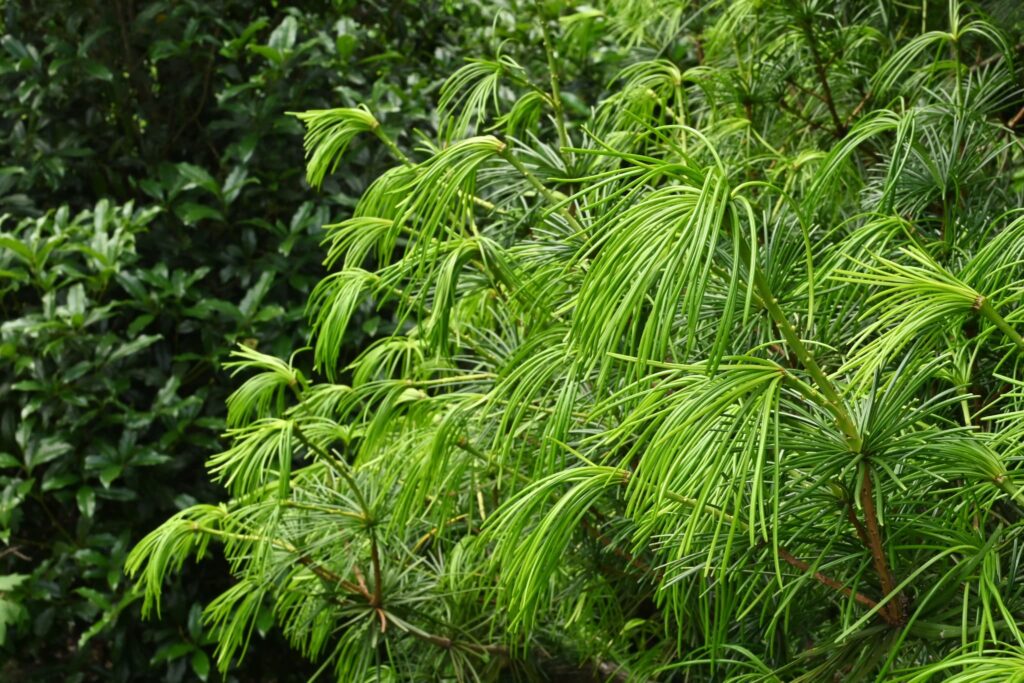
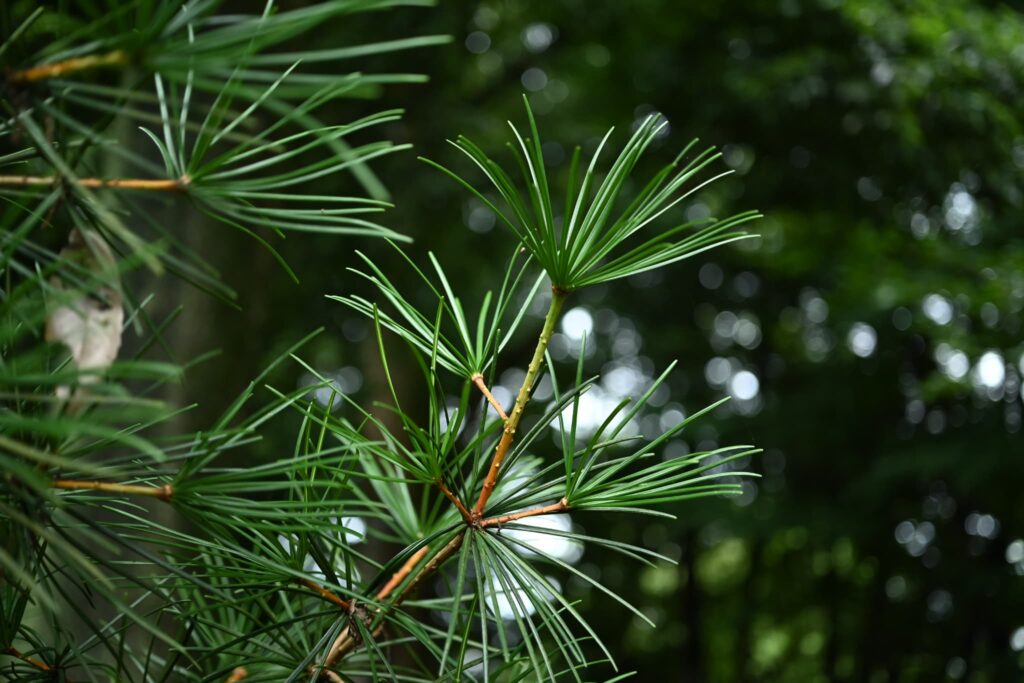
The foliage of Japanese Umbrella Pine is its most immediately recognizable feature.
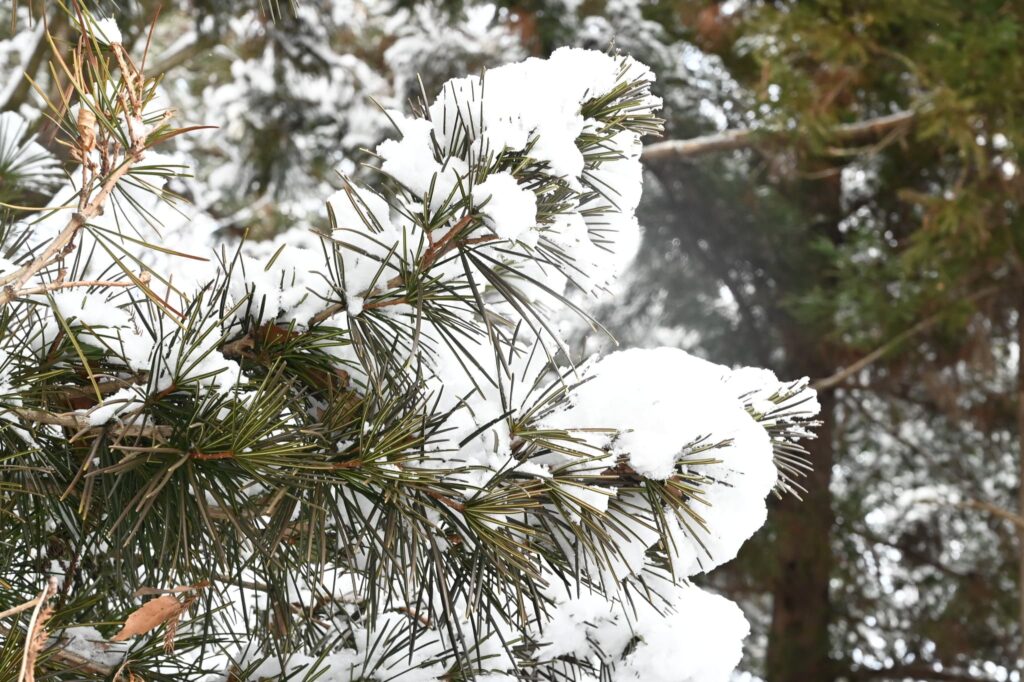
The photosynthetic leaves are thick, linear, glossy green, and generally about 6–13 cm long and 2–3 mm wide. They are arranged in dense whorls around short shoots, creating the appearance of the ribs of an umbrella.
The leaves are relatively soft and flexible compared with the rigid, sharply pointed needles of many conifers. A shallow groove runs along the center of each leaf, and pale stomatal bands are visible on the underside.
Botanically, the structures commonly called “needles” are highly modified shoots called cladodes, a remarkable feature that contributes to the unusual morphology of the species.
The foliage remains on the tree for several years before being shed.
Flowers
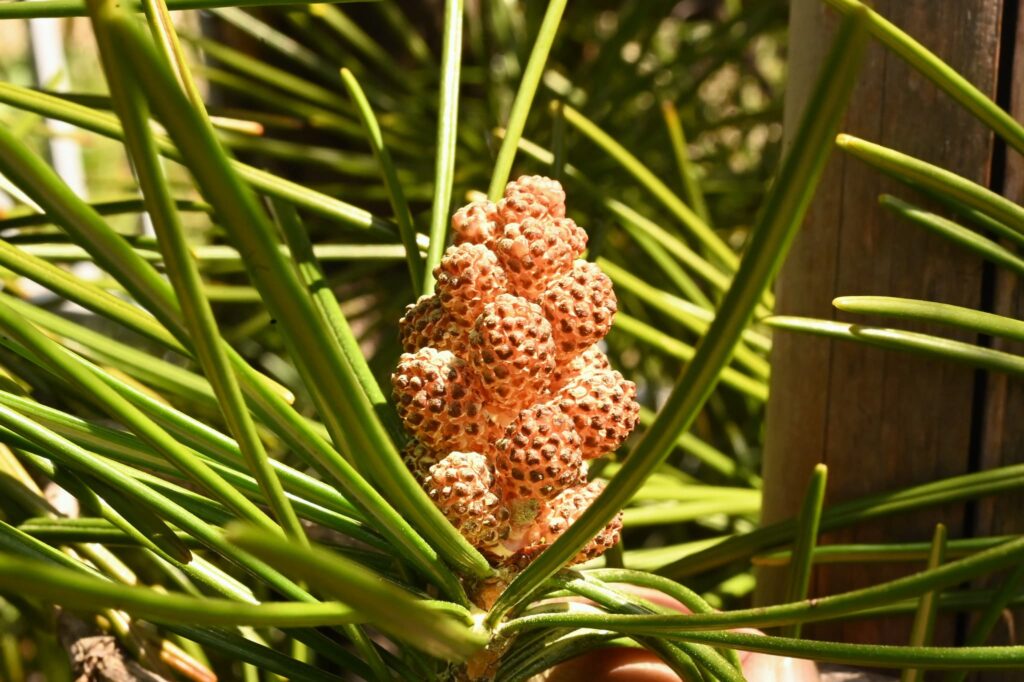
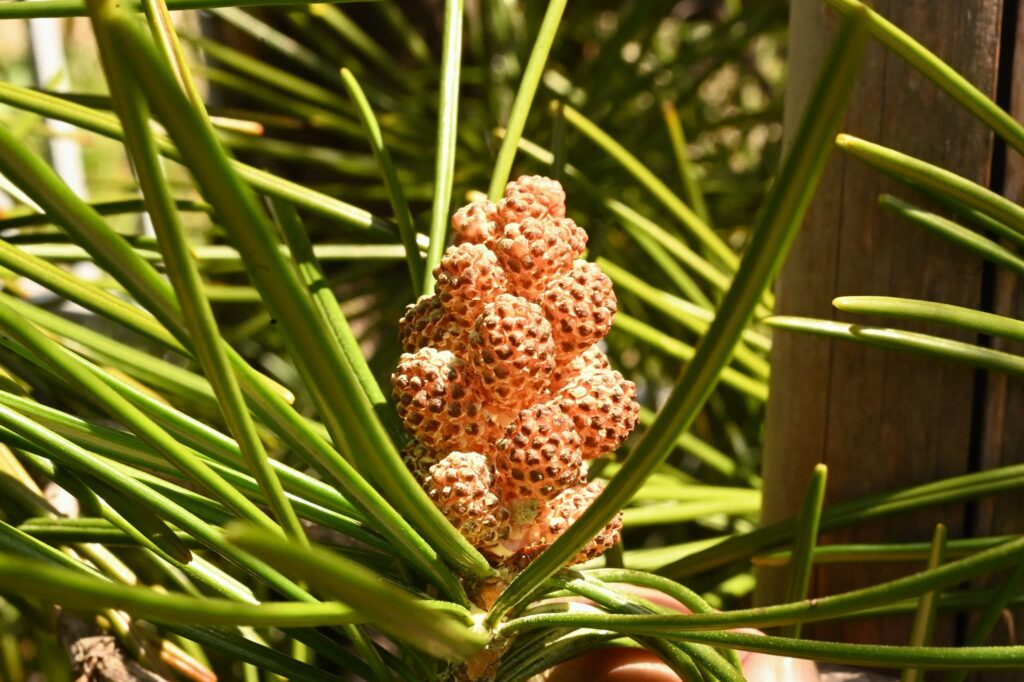
Japanese Umbrella Pine is monoecious, meaning that a single tree produces both male and female reproductive structures.
The male structures are small pollen cones produced in dense clusters near the ends of shoots. The female structures develop into the much larger seed cones.
Because both structures are relatively inconspicuous compared with those of flowering plants, Japanese Umbrella Pine is not normally grown for a showy floral display.
Pollination takes place in spring, while the seed cones require considerably longer to mature.
Cones
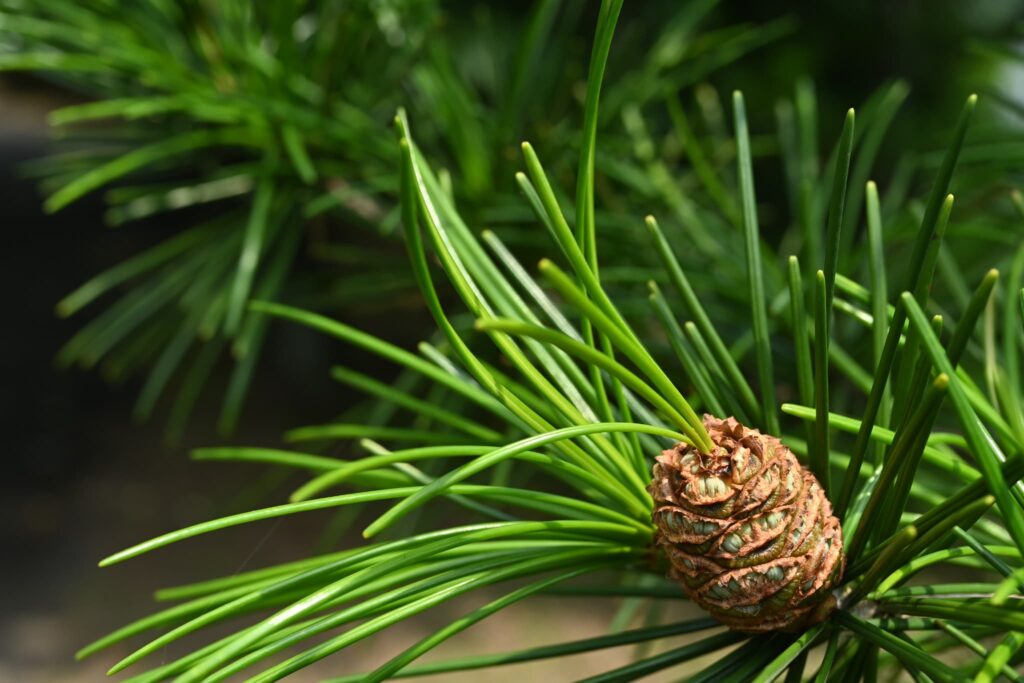
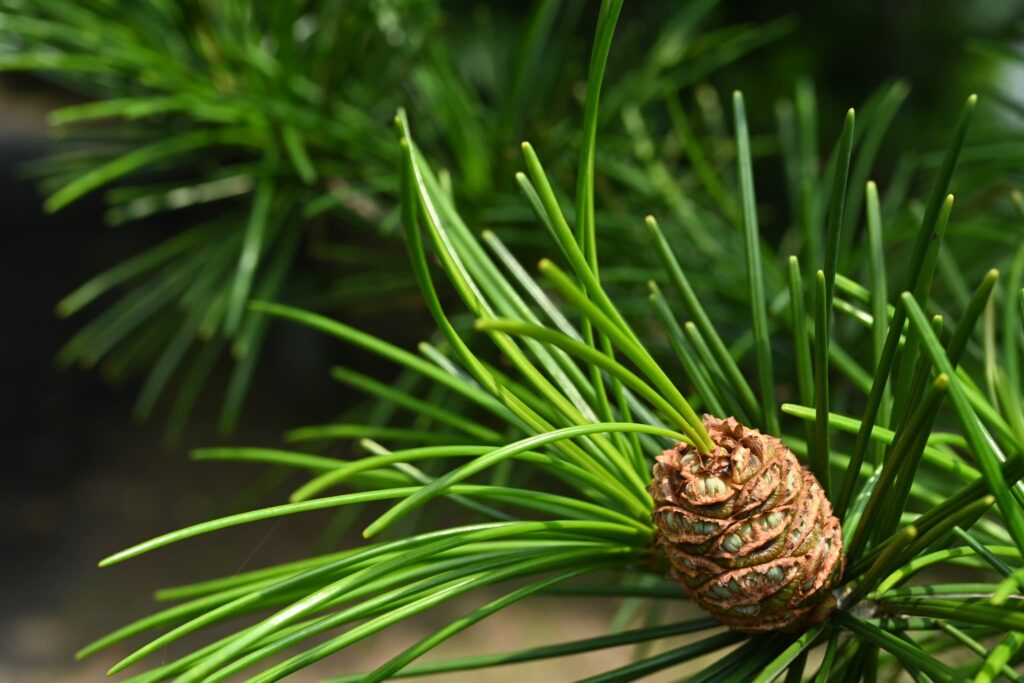
The female seed cones are one of the most conspicuous reproductive features of Japanese Umbrella Pine.
They are ovoid to broadly cylindrical and generally about 4.5–10 cm long and 3.5–6.5 cm wide. Young cones are green and gradually become reddish-brown to dark brown as they mature.
Unlike many conifers whose cones mature within a single growing season, Japanese Umbrella Pine requires approximately 18–20 months after pollination for its seed cones to mature.
The seeds are flattened and winged, allowing them to be dispersed by wind.
Bark & Timber
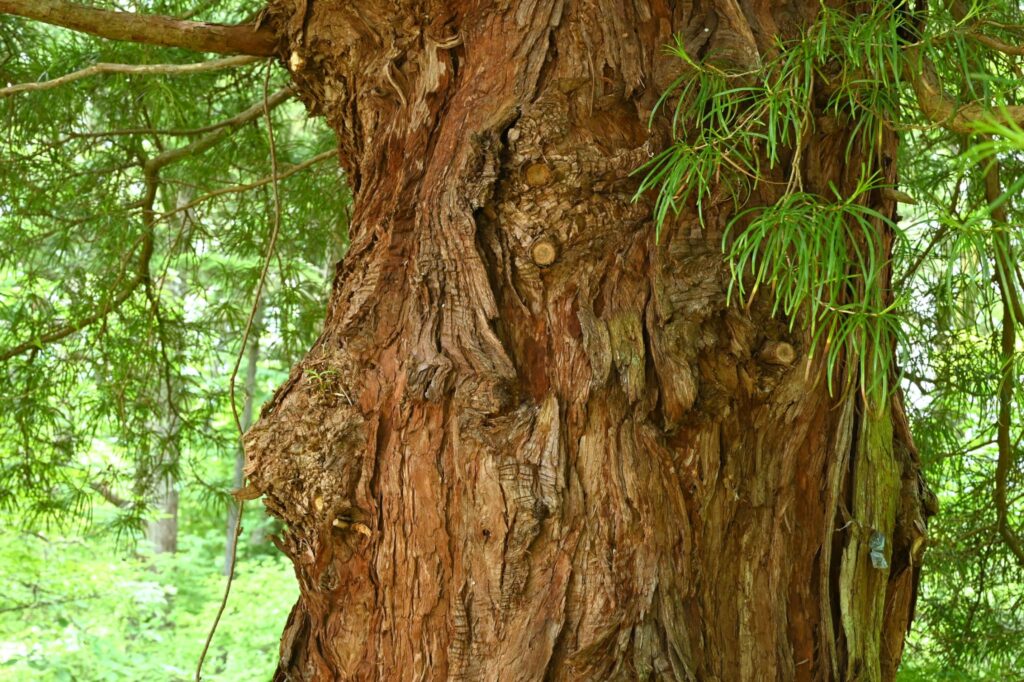
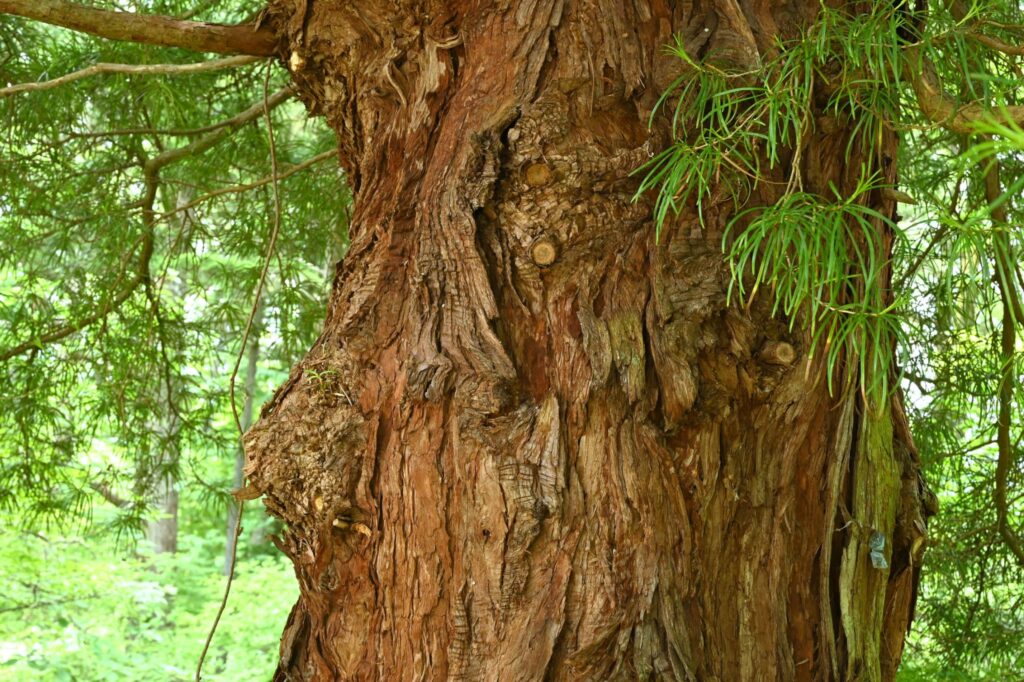
The bark of Japanese Umbrella Pine is reddish-brown and fibrous. As trees mature, the outer bark develops vertical fissures and may peel away in long, narrow strips.
The bark has an important traditional use known as maihada or makihada (槙肌). Its fibrous structure and resistance to water made it useful as packing material for sealing gaps in boats, wells, tubs, and other water-related structures.
Japanese Umbrella Pine wood is pale yellowish-brown, fine-textured, workable, and notably resistant to moisture. It has traditionally been used for:
- Bathtubs
- Water tubs and buckets
- Household utensils
- Boats and boat components
- Building and civil-engineering applications
- Coffins
- Traditional wooden products
Its resistance to water is one of the most important characteristics of the wood. Today, high-quality Koyamaki timber is relatively scarce, and it is not a major mass-market timber.
Size & Growth
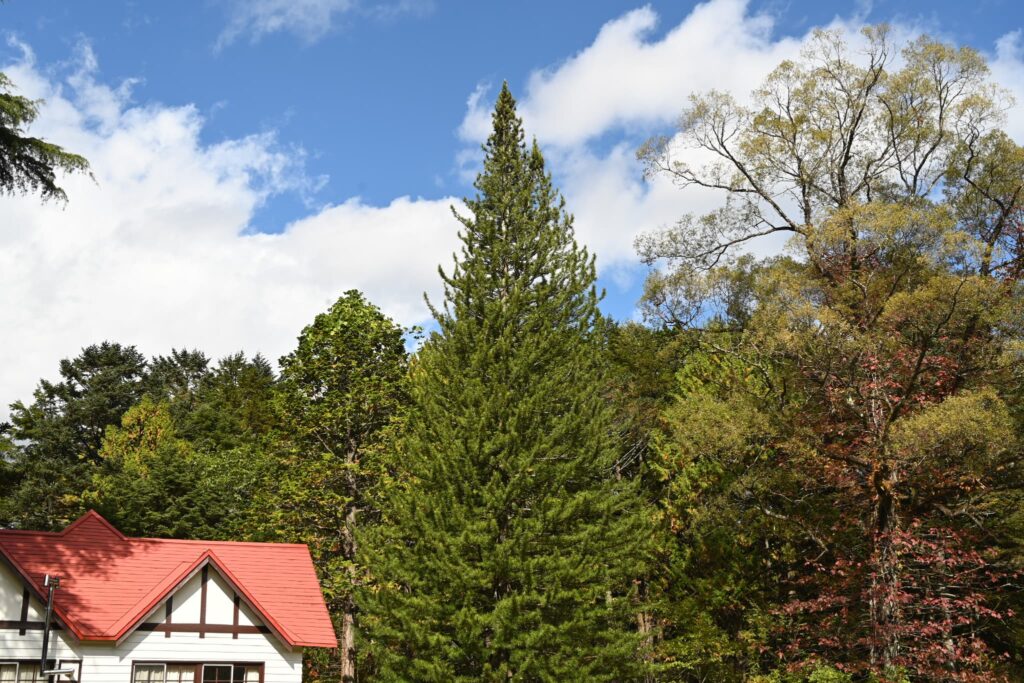
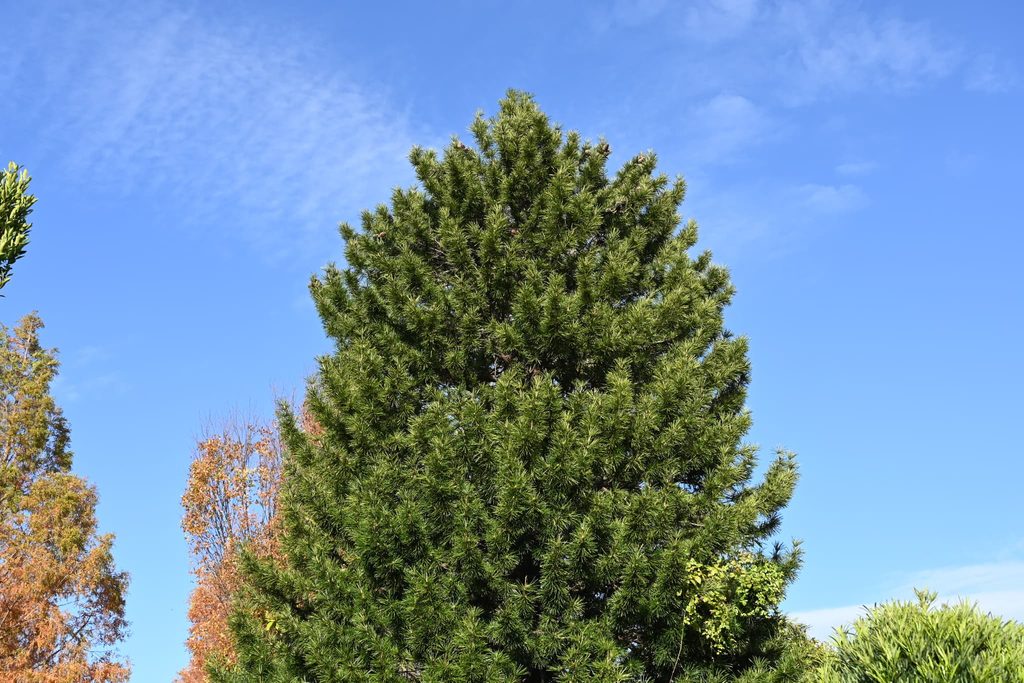
Japanese Umbrella Pine is a slow-growing tree, particularly when young. In favorable conditions, however, it eventually becomes a substantial tree, commonly reaching 20–30 m and exceptionally approaching 40 m.
The crown is naturally pyramidal to conical, although mature trees can develop a broader crown and large lateral branches.
Because the tree grows slowly and can ultimately become very large, it should not be selected for a small planting bed simply because a young nursery specimen appears compact.
A mature tree can become an imposing specimen with a highly distinctive silhouette.
Uses & Cultural Significance
Japanese Umbrella Pine has a particularly rich history in Japanese culture.
Kiso Five Precious Trees
During the Edo period, Koyamaki was included among the Kiso Five Precious Trees (Kiso Goshoboku), a group of economically valuable trees whose logging was strictly regulated in the Kiso region.
The five species are:
- Hinoki Cypress (Chamaecyparis obtusa)
- Sawara Cypress (Chamaecyparis pisifera)
- Asunaro (Thujopsis dolabrata)
- Koyamaki (Sciadopitys verticillata)
- Nezuko (Thuja standishii)
The inclusion of Koyamaki reflects the high value placed on its durable, water-resistant timber.
Koya Six Trees
Koyamaki also has a special place in the forests of Mount Koya in Wakayama Prefecture.
The Koya Six Trees (Koya Rokuboku) were designated as important trees for temple construction and maintenance. The six are Japanese Cedar, Hinoki Cypress, Koyamaki, Japanese Red Pine, Momi Fir, and Tsuga.
At Koyasan, Koyamaki has traditionally been treated as a sacred tree and its branches have been used as offerings.
Buddhist Traditions
Koyamaki has long been associated with Buddhist temples and funerary traditions.
Its water-resistant wood was historically used for coffins, particularly in ancient Japan. At the same time, branches of the tree have traditionally been offered at Buddhist altars, particularly in areas associated with Koyasan.
These apparently contrasting associations reflect the long history of the tree in Japanese religious culture rather than a simple “auspicious” or “inauspicious” symbolism.
Japanese Mythology
Koyamaki also appears in early Japanese tradition. In the Nihon Shoki, Susanoo-no-Mikoto is said to have created trees from parts of his body, including Koyamaki.
This makes the species notable not only as a horticultural tree but also as a species appearing in Japan’s early literary and mythological tradition.
Imperial Association
Japanese Umbrella Pine has a modern imperial association as well. Koyamaki is the personal emblem (o-shirushi) of Prince Hisahito of Japan. The Imperial Household Agency continues to identify Koyamaki as his emblem.
One of Japan’s Great Garden Trees
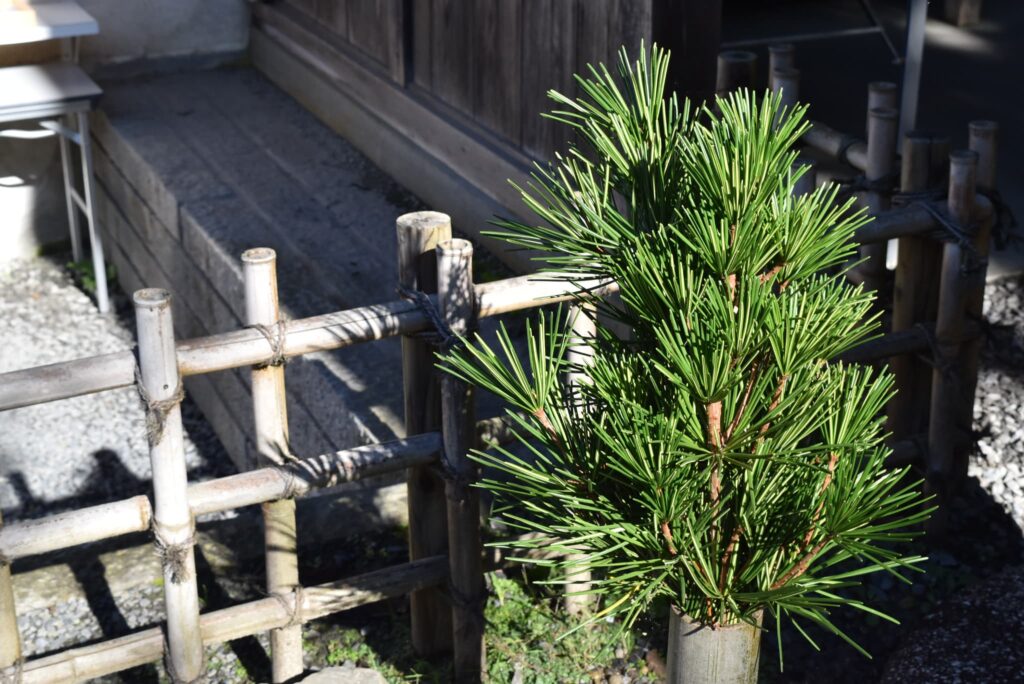
Koyamaki has long been regarded as one of Japan’s outstanding garden trees because of its distinctive form, evergreen foliage, longevity, and ability to become an impressive specimen.
Rather than relying on flowers or autumn color, its ornamental value comes primarily from its architectural form and unusual foliage.
Growing Guide
| Item | Description |
|---|---|
| Soil & Site | Moist, fertile, well-drained soil; adaptable to different soil textures |
| Soil pH | Slightly acidic to neutral soils are suitable |
| Sun Exposure | Full sun to partial shade |
| Water | Regular moisture is beneficial, especially during establishment |
| Cold Hardiness | Approximately USDA Zones 5–8 |
| Wind | Generally tolerant once established, but shelter is beneficial for young trees |
| Snow | Generally tolerant, although heavy wet snow can damage weak or multiple leaders |
| Pruning | Minimal; preserve the natural form |
| Transplanting | Establishment can be slow |
| Growth Rate | Slow |
| Maintenance | Low once established |
| Pests | Generally few serious pest problems |
Light & Soil
Japanese Umbrella Pine is adaptable to a range of soil textures provided that drainage is adequate.
In cultivation, it performs best in fertile, moist but well-drained soil. It tolerates both full sun and partial shade, although a bright position is generally preferable for maintaining strong, balanced growth.
Young plants can tolerate considerable shade, but heavily shaded specimens may develop weaker or more elongated growth.
The claim that the tree specifically dislikes afternoon western exposure is too strong to use as a general rule. In hot climates, however, protection from intense afternoon heat can reduce stress, especially when soil moisture is limited.
Watering
Although established trees can tolerate periods of relatively dry weather, Japanese Umbrella Pine performs best with consistent moisture.
Young trees should be watered regularly during dry periods until their root systems are well established.
Avoid permanently waterlogged soil. Good drainage is important because excessive moisture around the roots can cause root problems even though the species is well known for the water resistance of its wood.
Wind & Snow Tolerance
Japanese Umbrella Pine is generally hardy in temperate climates and can withstand winter conditions well once established.
However, the species can suffer structural damage when heavy wet snow accumulates on weak, multiple, or poorly structured leaders. Maintaining a strong central leader when the tree is young can reduce this risk.
Shelter from severe drying winds is particularly useful for young trees.
Cold Hardiness
Japanese Umbrella Pine is commonly rated around USDA Zones 5–8. North Carolina State Extension lists it from Zone 5a through 8a.
This means it can be grown successfully in regions with substantially colder winters than much of Japan. Nevertheless, hardiness varies with local exposure, soil conditions, plant age, and provenance.
Winter browning of foliage can occur in cold or exposed locations and does not necessarily indicate that the tree has died.
Pruning
Japanese Umbrella Pine requires little routine pruning.
Its naturally symmetrical form is one of its main ornamental qualities, so repeated shearing or aggressive reduction should be avoided.
Pruning is best limited to:
- Removing dead or damaged branches
- Correcting poorly positioned branches
- Maintaining a strong central leader when young
- Removing branches that interfere with structures or paths
Do not prune the tree simply to force it into a formal shape. Its natural architecture is much more attractive.
Suitability for Home Gardens
Japanese Umbrella Pine can make an outstanding specimen tree in a home garden, provided sufficient space is available for its eventual size.
Its slow growth makes it easier to manage during the early years, but it should not be regarded as a permanently small tree.
It is particularly suitable for:
- Japanese gardens
- Large residential gardens
- Temple and shrine landscapes
- Parks and arboreta
- Specimen plantings
- Woodland-style gardens
For a small urban garden, a dwarf cultivar may be more appropriate than the species.
Propagation
Japanese Umbrella Pine can be propagated from seed or cuttings.
Seed propagation is relatively slow, while rooting cuttings can be difficult. This contributes to the relatively high price of nursery-grown specimens compared with faster-growing conifers.
For ordinary landscape planting, purchasing a healthy nursery-grown tree is generally more practical than attempting propagation at home.
Pests & Diseases
Japanese Umbrella Pine is generally regarded as a low-maintenance tree with relatively few serious pest problems.
The original description of “black spot (kokuhanbyō)” as a characteristic disease is too vague and should not be retained without identifying the pathogen and symptoms. Yellowing foliage should likewise not automatically be attributed to nutrient deficiency.
Poor drainage, drought, transplant stress, winter injury, and other environmental problems can all cause foliage discoloration.
Cultivars
Several named cultivars and selections of Japanese Umbrella Pine are available internationally.
| Cultivar | Characteristics |
|---|---|
| ‘Mireille’ | Dwarf, dense, conical form with creamy-orange new growth |
| ‘Mitsch Select’ | Compact, upright form with short, dark green foliage |
| ‘Monolith’ | Narrowly conical to columnar form with dark green foliage |
| ‘Megaschirm’ | Faster-growing selection with unusually long foliage |
| ‘Perlenglanz’ | Dwarf, upright form with pearly-white new growth |
| ‘Shidare Koyamaki’ | Pendulous or weeping form |
| Variegated selections | Foliage marked with white or cream coloration |
Cultivar availability varies considerably by country. In Japan, the species itself remains much more commonly encountered than many of the named selections available from specialist conifer nurseries overseas.
Similar Species
Japanese Umbrella Pine is sometimes confused with Podocarpus macrophyllus (Inumaki) and Podocarpus nagi (Rakanmaki) because all three are evergreen conifers commonly planted in Japanese gardens.
However, they are not closely related. Podocarpus belongs to the family Podocarpaceae, whereas Japanese Umbrella Pine belongs to the separate family Sciadopityaceae.
| Feature | Japanese Umbrella Pine | Inumaki | Rakanmaki |
|---|---|---|---|
| Scientific Name | Sciadopitys verticillata | Podocarpus macrophyllus | Podocarpus nagi |
| Family | Sciadopityaceae | Podocarpaceae | Podocarpaceae |
| Foliage | Thick, long, whorled | Long, narrow, individually arranged | Broad, flattened leaves |
| Habit | Pyramidal to broad conical | Dense, often irregular | Broad, dense |
| Pruning | Minimal | Tolerates heavy pruning | Tolerates pruning |
| Common Landscape Use | Specimen tree | Hedge, screen, specimen | Hedge, screen, specimen |
The unusual whorled foliage of Japanese Umbrella Pine is the easiest feature by which to distinguish it from the two Podocarpus species.
Frequently Asked Questions
Is Japanese Umbrella Pine native to Japan?
Yes. Sciadopitys verticillata is native to Japan and is also reported from Jeju Island in South Korea. In Japan it occurs mainly in central and southern regions, extending into the Tohoku region.
Why is it called Japanese Umbrella Pine?
The name refers to the arrangement of its thick foliage. The leaves radiate from the short shoots in a whorl resembling the ribs of an umbrella.
Is Japanese Umbrella Pine a true pine?
No. Despite its English common name, it is not a member of the genus Pinus. It is the sole living species of the family Sciadopityaceae.
How fast does Japanese Umbrella Pine grow?
It is generally slow-growing, particularly when young. Growth varies considerably with climate and cultivation conditions, so a fixed annual growth rate such as 15–30 cm should not be treated as universal.
Can Japanese Umbrella Pine be grown in a container?
Young trees can be grown in large containers, but this is a temporary solution. Because the species eventually becomes a large tree, long-term container culture requires an appropriately large container and careful management.
Is Japanese Umbrella Pine suitable for small gardens?
The species itself is not ideal for a genuinely small garden if sufficient room for its mature size is unavailable. Its slow growth can make it appear suitable when young, but it can eventually become a large tree.
Dwarf cultivars are better choices where space is restricted.
How long does Japanese Umbrella Pine live?
It is a long-lived tree capable of surviving for centuries under favorable conditions. The species’ longevity, ancient evolutionary lineage, and distinctive morphology contribute to its reputation as a living relic of an ancient flora.
Does Japanese Umbrella Pine tolerate drought?
Established trees have some drought tolerance, but they perform best with adequate moisture. Young trees are considerably more vulnerable to drought stress.
Why are the needles turning brown?
Possible causes include drought, transplant stress, winter injury, excessive exposure, root problems, and natural aging of older foliage. Browning alone is not sufficient to diagnose a particular problem.
Is Japanese Umbrella Pine rare?
The species is not rare in cultivation, but its natural distribution is restricted and its conservation status is Near Threatened (NT) according to the IUCN assessment cited by Kew.
Historical changes in land use and the restriction of its natural distribution have contributed to its conservation significance.
Is Japanese Umbrella Pine a living fossil?
It is often described as a “living fossil” because the family Sciadopityaceae has a very ancient fossil history and the modern genus represents a highly isolated surviving lineage.
However, “living fossil” is an informal descriptive term, not a formal taxonomic category. It is better to explain the species as an evolutionary relict than to imply that it has remained biologically unchanged since prehistoric times.
Why is Japanese Umbrella Pine so expensive?
The species grows slowly and can be relatively difficult and time-consuming to propagate. Large specimens also take many years to produce.
As a result, nursery-grown Japanese Umbrella Pines can be substantially more expensive than faster-growing landscape conifers.
Can Japanese Umbrella Pine grow in cold climates?
Yes. It is generally rated around USDA Zones 5–8 and is cultivated successfully in regions with cold winters.
Young plants may need protection from severe winter exposure, and heavy wet snow can damage poorly structured branches.
Is Japanese Umbrella Pine suitable for bonsai?
It can be grown as bonsai, but it is relatively uncommon compared with Japanese Black Pine (Pinus thunbergii) and Japanese Red Pine (Pinus densiflora).
Its slow growth and distinctive foliage make it interesting to specialist growers, although its growth habit is less suited to some conventional bonsai styles.
Conclusion
Japanese Umbrella Pine (Sciadopitys verticillata) is one of Japan’s most distinctive evergreen conifers. Its thick, glossy foliage arranged in umbrella-like whorls, naturally symmetrical form, reddish-brown bark, and exceptional longevity make it immediately recognizable.
It is also botanically remarkable. The species is the sole living member of both its genus and family, while fossil relatives show that this lineage was once much more widespread. For this reason, Japanese Umbrella Pine is often described as a living fossil or evolutionary relict.
Its importance extends beyond botany. Koyamaki has been valued for centuries for its durable, water-resistant timber, included among the Kiso Five Precious Trees, protected as one of the Koya Six Trees, and used in Buddhist and funerary traditions. In modern Japan, it is also known as the personal emblem of Prince Hisahito.
As a garden tree, its greatest strengths are its distinctive architecture, evergreen foliage, longevity, and relatively low maintenance requirements. Its slow growth should not be mistaken for small ultimate size, however. Given sufficient space and a well-drained, reasonably moist site, Japanese Umbrella Pine can develop into a magnificent specimen tree that combines botanical rarity, cultural history, and exceptional ornamental character.